The Oswald Files: What America's Intelligence Agencies Kept From JFK Investigators
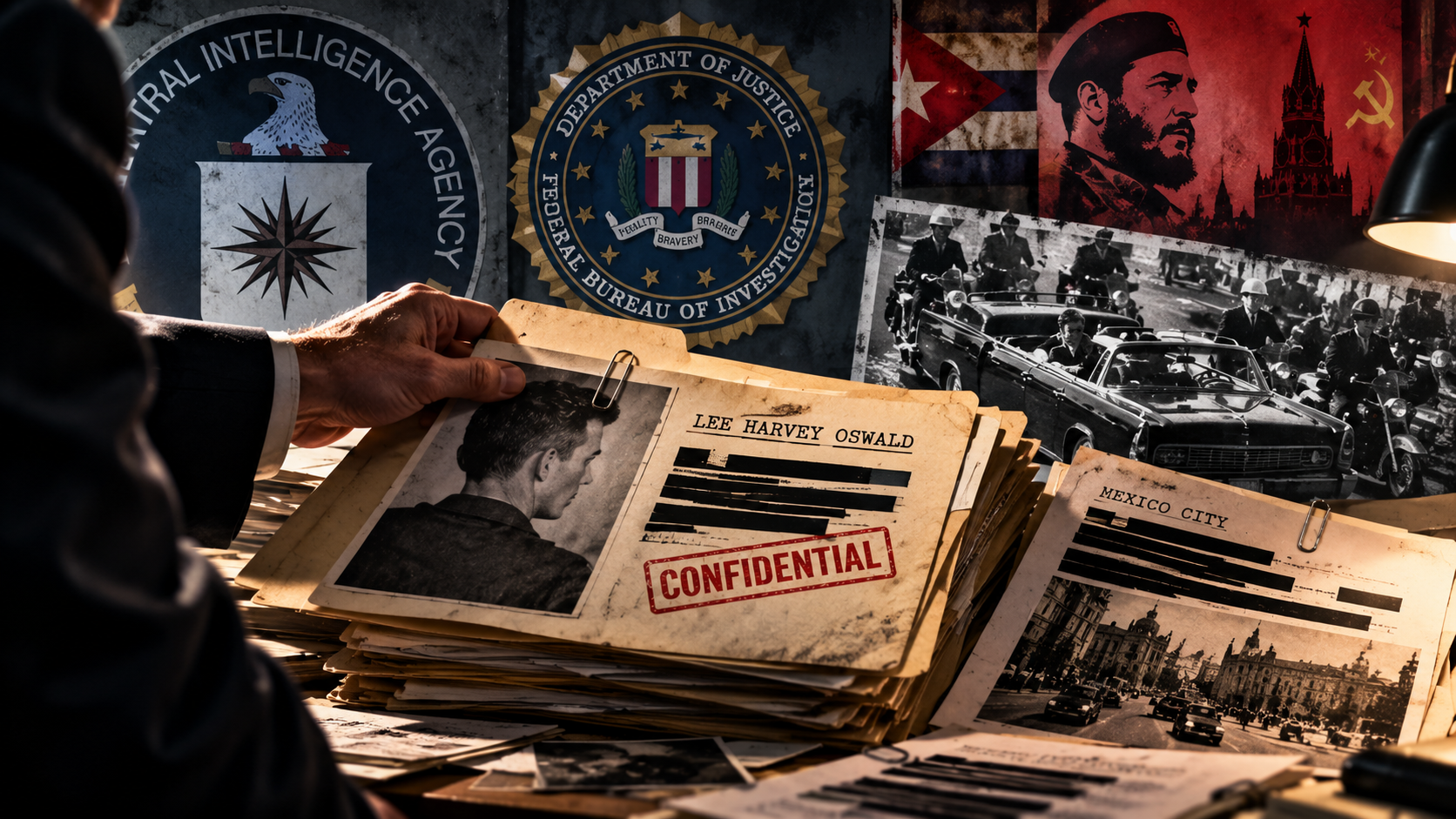
Why the FBI Destroyed Oswald's Note — and What the CIA Kept Quiet
The Record Shows Destroyed Evidence, Withheld Intelligence And Investigative Failures — But Not Proof That The Agencies Planned Kennedy's Murder.
On 22 November 1963, President John F. Kennedy was murdered in Dallas. Within hours, the authorities had a suspect whose history seemed tailor-made to frighten Washington: Lee Harvey Oswald, a former Marine who had defected to the Soviet Union, returned to America and made contact with Soviet and Cuban representatives. The Federal Bureau of Investigation knew his name. The Central Intelligence Agency held a file on him. Yet the official inquiry that followed did not receive all the information the government already possessed.
Some of that failure was bureaucratic. Some information was considered too sensitive to share. And some acts, including the destruction of a note left by Oswald at an FBI office, were deliberate. Decades of investigations have established serious concealment and incomplete cooperation. They have not established that either agency directed the assassination. Understanding why both propositions can be true is the key to the case.
The Cold War Made Oswald An Extraordinary Intelligence Subject
Oswald was not an anonymous Dallas warehouse worker in the eyes of American intelligence. He had been a Marine radar operator. In 1959 he travelled to the Soviet Union and presented himself at the American embassy in Moscow intending to renounce his citizenship. Diplomatic reporting said he had offered the Soviets information obtained in his military service. Whether, and precisely what, he actually provided remained a separate question.
At the height of the Cold War, an American serviceman crossing to the Soviet side was a natural object of security interest. Intelligence agencies needed to know whether secrets had been exposed, whether the defector might be used for propaganda and whether he had relationships with foreign officials. None of that implied that Oswald was employed by the CIA. It explained why agencies would collect information about him without necessarily recruiting him.
Oswald returned to the United States in 1962 with his Soviet-born wife, Marina, and their child. FBI personnel interviewed him after his return. They also sought information about his activities and associations. Later accounts sometimes transform these interviews into proof of a clandestine relationship, but an interview can be an act of surveillance or routine security inquiry. The 1979 House Select Committee on Assassinations, which reviewed claims that Oswald had been an FBI informant, found no credible evidence that he was one.
The distinction is essential. An intelligence file proves official interest, not official control. At the same time, the existence of those records placed a serious obligation on investigators after the assassination. If officials held relevant facts about the suspect's contacts, conduct or foreign ties, the presidential inquiry needed a complete and candid account of them.
Why The CIA Opened A File — And Why Its Timing Mattered
The CIA's individual file on Oswald, commonly called a 201 file, has long attracted attention. The designation refers to a dossier used by the agency's clandestine service for a person of interest. It is not a certificate of employment, a covert-agent number or an admission that the subject was under CIA direction.
Congress found an uncomfortable chronology. Reports about Oswald's Soviet defection reached the agency in 1959, but the 201 file was not opened until December 1960. Investigators asked why an apparent offer by a former radar operator to provide information to the Soviets had not prompted quicker formal filing. CIA personnel acknowledged that the early reporting was sufficiently significant to have justified such a file.
These details illustrate a recurring danger in the Kennedy record. A bureaucratic anomaly can be real without supporting the strongest claim made about it. A delayed file and restricted access deserved examination, especially after the assassination. Neither established that Oswald was an intelligence asset. The more consequential question was what the CIA knew, when it knew it and how it conveyed that knowledge to other parts of the government.
Mexico City: The Warning That Did Not Travel Properly
In late September and early October 1963, Oswald visited Mexico City. His efforts to obtain travel documents brought him into contact with the Cuban consulate and the Soviet diplomatic establishment. Both were places of intense American intelligence interest. The CIA's Mexico City station used sensitive surveillance sources, and reports concerning a person identifying himself as Oswald reached headquarters before the assassination.
A cable dated 9 October referred to someone using Oswald's name in connection with the Soviet embassy. Subsequent correspondence between the CIA and FBI formed part of the pre-assassination intelligence trail. Yet the information provided to other agencies was incomplete or misleading in important respects. Congressional investigators later examined whether the surveillance had really identified Oswald and what headquarters had been told.
One unusual photograph complicated matters. An individual photographed in connection with surveillance did not look like Oswald. In 1963, a cable and subsequent communications helped create confusion about whether the man in the image was the person who had made the diplomatic contacts. That discrepancy fuelled theories of an Oswald impersonator, a possibility investigators considered without establishing that an impostor had actually made the consular visit.
There was also a dispute over recordings. One FBI communication gave the impression that agents had listened to a recording of the relevant voice. The later congressional inquiry reported that the Dallas FBI office had not in fact received such a recording, but information describing the conversation. Those are materially different things. A photograph or an audio recording can potentially test an identity; an intelligence summary is an intermediary account, dependent on whoever prepared it.
The CIA's problem was not simply that it had imperfect surveillance. Intelligence often is imperfect. It was that the chain of collection, analysis and dissemination did not provide the most reliable possible account to those responsible for assessing Oswald or investigating the murder. The House committee criticised the agency's pre-assassination handling of the Mexico City evidence and the protection of sensitive methods when the Warren Commission later sought explanations.
Why would an agency be reluctant to expose how it monitored foreign embassies? In 1963, disclosing a source or technique could damage ongoing collection against the Soviet Union or Cuba. That concern was genuine. It was also a poor substitute for finding a secure way to give a presidential investigation the underlying facts. Protecting sources and withholding material context are not always the same thing.
The FBI Note That Was Destroyed
The starkest confirmed case of evidence destruction concerns Dallas FBI agent James Hosty. Before Kennedy's death, Hosty had interviewed Marina Oswald. Lee Harvey Oswald subsequently visited the Dallas FBI office and left a note for him. Its full wording is lost because the note was destroyed after the assassination.
The National Archives' description of Hosty's papers records that the note was threatening and that he destroyed it two days after Kennedy was killed. Investigations into the incident also exposed disagreements among FBI witnesses over its exact content and who had ordered the destruction. A Senate intelligence investigation in the 1970s reported that it could not settle those disputes on the conflicting evidence available.
The timing was devastating. On the day Oswald himself was shot by Jack Ruby, the FBI held a written communication from the man accused of killing the president. Whatever the note said, it was plainly relevant to understanding Oswald's relationship with the bureau, his conduct before the assassination and the choices agents made after it. Destroying it denied investigators the chance to examine the original text and test later memories against a physical document.
The note's destruction was deliberate; its significance is less certain. Some explanations centred on Oswald's anger about the FBI's contact with his wife. That would make the note evidence of a tense relationship rather than an advance confession or warning of the assassination. Other allegations suggested more threatening language. Once the paper was destroyed, competing recollections could not be resolved by inspecting it.
The FBI did not tell the Warren Commission about the episode. When the incident became public years later, it naturally intensified suspicion. The responsible conclusion is not that the note necessarily contained proof of a plot. It is that officials eliminated potentially important evidence and then denied the original investigators the knowledge needed to assess its importance. That alone was a serious institutional breach.
The Name Missing From Oswald's Address Book Report
A second FBI episode was smaller but revealing. Oswald's address book contained Hosty's name and contact details. A report supplied to the Warren Commission, purporting to describe the notebook's contents, did not initially include the entry. It looked like an effort to minimise the bureau's connection to Oswald at precisely the moment officials faced questions about what they had known.
The House committee reviewed the matter and did not find evidence of a sinister plan to erase a secret FBI relationship. Its assessment was narrower: the omission might have been inadvertent, or Dallas agents might have wished to spare Hosty personal embarrassment. A retained copy of the relevant report helped investigators reconstruct what happened. The committee regarded the omission as regrettable but relatively minor in the overall investigation.
This distinction is useful because it shows what a disciplined inquiry can do. Not every omission should be elevated to a conspiracy clue of equal weight. Some omissions are enormous because they destroy evidence or deprive investigators of operational context. Others reveal imperfect paperwork, self-protection or confused reporting. The challenge is to assess the consequences, not merely count the gaps.
There was still a reputational problem for the bureau. It had investigated Oswald, had approached his wife, and had then failed to tell the presidential commission everything about those contacts. Officials investigating an alleged lone assassin were entitled to ask whether the FBI wanted to avoid the appearance of having missed warning signs. The answer may differ from incident to incident, and the available documents do not justify assigning one motive to every employee.
Hoover's Bureau And The Incentive To Protect Its Reputation
FBI director J. Edgar Hoover was one of the most powerful officials in Washington. His bureau enjoyed a reputation for discipline and investigative expertise, and Hoover guarded its independence fiercely. Kennedy's death presented a professional catastrophe as well as a national tragedy: a man previously known to federal investigators had been accused of murdering the president.
The bureau's conduct after the assassination reflected a strong determination to establish Oswald's responsibility. The congressional review concluded that its investigation into whether Oswald fired the shots was thorough and professional. But the same committee found that the FBI failed to investigate conspiracy possibilities adequately and had not cooperated fully with the Warren Commission. These findings must be read together. Thoroughly proving one man's actions is not identical to exhaustively testing whether he had collaborators.
An internal FBI inspection also examined failures in the bureau's handling of Oswald before 22 November. It recommended disciplinary measures against personnel at several levels. Hoover implemented most of the recommended action. Congressional investigators later reported testimony that this disciplinary process had been kept secret so the Warren Commission would not learn the extent of the bureau's internal criticisms.
That is a particularly telling form of concealment. It did not require officials to know a conspiracy existed. It required them to know that their own organisation could be criticised. Congress also concluded that the FBI's pre-assassination security investigation of Oswald had been adequate, and it considered some disciplinary actions excessive. Nonetheless, secretly punishing employees while withholding the broader internal reckoning made independent scrutiny harder.
There was a structural conflict. The FBI was asked to supply central evidence about an assassination while simultaneously defending its own previous conduct. An outside commission needed candour from the agency, but the institution had incentives to frame events in the least damaging light. That does not demonstrate criminal participation. It explains why apparently peripheral records about agent contacts, internal reviews and omitted reports can matter so much.
The CIA's Secret War Against Castro
The CIA held another category of information that did not concern Oswald's personal file at all. During the early 1960s, the United States ran covert operations against Fidel Castro's government, including plans developed with organised-crime figures to assassinate the Cuban leader. These activities were extraordinarily sensitive, even by Cold War standards. Their disclosure would have exposed operational partners and forced Washington to confront its own involvement in schemes of political murder.
The Warren Commission did not receive the full picture of CIA assassination plotting against Castro. The House committee later interviewed former commissioners and staff, who regarded these plots as among the most consequential omissions. J. Lee Rankin, the Warren Commission's general counsel, was especially angered when he learned of the CIA's use of underworld figures. Investigators believed that knowledge of those operations would have widened the original inquiry into potential motives and contacts.
The implication should be stated carefully. Kennedy's assassination occurred against a background of covert American hostility towards Cuba, Cuban exile militancy and concern about possible retaliation. That setting made hidden intelligence operations relevant to any attempt to rule out a conspiracy. But it did not prove that Castro retaliated, that organised crime arranged the killing or that the CIA ordered it. The problem was investigative: the commission could not fully test possibilities it did not know existed.
This is also where the CIA's secrecy had a logic separate from the assassination itself. Revealing plots against Castro risked legal and diplomatic consequences, the exposure of sources and lasting damage to the agency's reputation. Those motivations could lead officials to conceal unrelated wrongdoing or embarrassment. They could also obscure information that historians and investigators legitimately needed. The same withheld fact can matter to a murder inquiry without proving involvement in the murder.
George Joannides And The Anti-Castro Student Group
The story did not end with the Warren Commission. Decades later, researchers and congressional witnesses focused on CIA officer George Joannides and the Revolutionary Student Directorate, commonly known as the DRE, an anti-Castro Cuban exile organisation. Oswald encountered DRE members in New Orleans during the summer of 1963. The encounters became public and helped associate Oswald with Cuba in the months before Kennedy's death.
Joannides was a CIA officer involved in handling the student group. That relationship is important because the agency secretly supported the organisation while its members publicly confronted Oswald. It created an intelligence context around one strand of Oswald's public political activity that investigators were not fully told about at the time. In 2025 congressional testimony, former congressional investigator Dan Hardway described records linking Joannides to the DRE and argued that the CIA had systematically withheld this relationship from assassination inquiries.
A further complication emerged from the 1970s congressional inquiry. Joannides later served as a CIA liaison to the House Select Committee on Assassinations. The committee was examining, among other matters, Oswald's contacts with anti-Castro activists. The agency did not fully disclose to the committee that its liaison had an earlier operational connection to the very group under scrutiny. Such a conflict made it harder for investigators to know which records to request and which witnesses or officers might have relevant first-hand knowledge.
What does the connection prove about Oswald? It establishes that people who interacted with him belonged to an organisation with covert CIA support, not that Oswald was recruited by the CIA. It does not prove that Joannides ordered the assassination or knew that it was planned. There are plausible questions about propaganda, intelligence collection and how the agency handled information about Oswald. Those questions remain distinct from proof of operational control over him.
The Joannides matter has survived successive disclosure rounds because it strikes at a fundamental issue: an investigation can be compromised by an undisclosed conflict even if the underlying crime was not arranged by the institution withholding the information. The need for transparency is independent of any final verdict about conspiracy.
Why The Warren Commission Could Not Simply Demand Every File
The Warren Commission was created quickly after Kennedy's death and faced enormous pressure to explain events that had unsettled the country and the world. Its members depended heavily on federal agencies for field investigations, technical findings, interviews and intelligence. They had legal authority and prominent members, but they were not a permanent counterintelligence organisation able to inspect every CIA and FBI compartment on their own.
Information held by secret agencies is not stored in one neat folder labelled with a suspect's name. Files may be distributed across operational units, overseas stations, technical surveillance programmes and administrative records. A request for everything about Oswald may not automatically capture a covert relationship with a third-party group whose members met him. A request for evidence about Mexico City may draw summaries without the full operational trail that produced them.
The House committee later criticised a failure of initiative on both sides. Agencies argued that they had answered specific questions put to them; commission staff assumed relevant information would be volunteered. That expectation was dangerous when the subject involved sensitive operations and agency self-interest. An investigator cannot ask a precise question about an operation whose existence is concealed.
The commission nevertheless did important work on the physical evidence. It examined the rifle, the cartridges, the wounds, Oswald's movements and eyewitness accounts. The 1979 House committee concluded that the commission had investigated Oswald's personal responsibility in good faith and with considerable competence. Its shortcoming was greater when testing possible collaboration, particularly because relevant information had not been made available.
This is why the familiar choice between an honest commission and a government cover-up is too crude. The commission could act honestly and still produce an incomplete account. Individual officials could withhold information for institutional reasons without participating in murder. And later investigators could rightly criticise both without establishing an alternative shooter or organiser.
Could Fear Of Soviet Involvement Have Shaped The Investigation?
The Cold War multiplied the possible consequences of a mistaken conclusion. Oswald's Soviet defection, his efforts to contact Soviet officials and his interest in travel to Cuba meant that allegations of foreign direction were inevitable. The United States had only recently emerged from the Cuban Missile Crisis. Senior officials knew that unverified rumours connecting Moscow or Havana to the president's murder could become an international emergency.
President Lyndon Johnson had a powerful reason to want a reliable answer quickly and to prevent unfounded speculation from escalating. The pressure for public reassurance was real. Yet caution against blaming a foreign government was not itself proof that officials suppressed a known foreign conspiracy. Policymakers can simultaneously want truth, stability and speed, even when those goals conflict.
Protecting classified sources, shielding officials and reducing geopolitical panic were therefore possible incentives for incomplete disclosure. Their importance varied with the record under examination. The FBI's destroyed note is not explained by surveillance technology. CIA protection of a Mexico City technical source is not identical to an effort to conceal an internal disciplinary review. One universal motive is unlikely to explain every omission.
What Congress Found In 1979
The House Select Committee on Assassinations delivered findings that were both critical and limiting. It concluded that the FBI had investigated Oswald's responsibility thoroughly but had inadequately pursued a possible conspiracy. It said the CIA was deficient in gathering and sharing intelligence before and after the assassination. It also faulted the Warren Commission for accepting an incomplete flow of information and stating its conclusions too definitively.
At the same time, the committee found that Oswald fired the shots that struck Kennedy and that available evidence did not establish CIA, FBI or Secret Service participation in the assassination. Its separate conclusion that Kennedy was probably killed as the result of a conspiracy depended heavily on acoustic evidence. A subsequent National Research Council review challenged that acoustic interpretation, severely weakening the scientific foundation of the committee's second-gunman finding.
The result was neither a complete vindication of the official 1964 account nor an official finding that intelligence agents murdered Kennedy. Congress identified a genuine failure to pursue conspiracy leads, but an inadequate investigation does not automatically answer what a better investigation would have discovered. Some opportunities, including questioning Oswald at trial and examining his destroyed note, were permanently lost.
Another point is often overlooked. When congressional investigators studied allegations that Oswald was an FBI informant, they did not find credible evidence to support the claim. Similarly, they found that the mere existence of a CIA 201 file did not indicate a clandestine relationship. These were important negative findings produced by investigators who were otherwise highly critical of agency secrecy.
The Long Struggle To Open The Records
Public doubts remained because so much relevant material was inaccessible for years. The Freedom of Information Act brought releases, but investigators often received pages with redactions and gaps. The 1992 JFK Records Act responded to those concerns by creating a comprehensive collection and an independent review board empowered to challenge agency efforts to withhold assassination-related material.
The Assassination Records Review Board operated through the 1990s, pressed agencies to locate records and issued its final report in 1998. Millions of pages eventually entered the National Archives collection. Subsequent releases in 2017, 2022, 2023 and beyond provided further details about intelligence operations, surveillance and earlier investigative decisions. Declassification itself does not convert every old memorandum into a verified account of events; it gives researchers the opportunity to compare documents against one another.
A particularly large release began in March 2025 following a presidential directive. The National Archives described the release of materials previously withheld on classification grounds and continued posting digitised records. Additional FBI files identified during records-inventory work were also transferred during 2025. The archive noted that some material still faced different legal restrictions, including grand jury protections, so statements that every conceivable JFK document had become public would be inaccurate.
Access also creates a different challenge: scale. An enormous archive can contain duplicate memoranda, unverified tips, statements later corrected and intelligence reports that merely relay rumours. Historians must establish who wrote a document, why, what its author actually knew and whether independent records confirm its central claims. A stamp marked secret may explain restricted circulation; it does not guarantee that the contents were true.
The Four Different Kinds Of Secrecy
The Oswald investigation becomes clearer when omissions are separated by type. First comes operational secrecy: protecting surveillance sources, foreign contacts and covert programmes such as the CIA's Cuba-related activities. This may be defensible in principle, but a presidential inquiry still needs mechanisms for receiving the essential information securely.
Second comes institutional self-protection. The FBI had an incentive to minimise visible mistakes in its handling of a known security subject. Concealed disciplinary action and incomplete disclosure of agent contacts fit this concern more closely than a theory of sophisticated international orchestration. Such actions can be deliberate and improper without demonstrating guilt in the underlying assassination.
Third comes evidentiary destruction. Hosty's note was physically eliminated. That is categorically different from classifying a file that might eventually be opened. No later transparency policy can restore the wording of a document deliberately discarded. The uncertainty becomes permanent and lends later witnesses more importance than their recollections can safely bear.
Fourth comes investigative fragmentation. Relevant information may exist but never reach the person able to understand its significance. A Mexico City report, a Dallas interview, a Cuban exile group's CIA relationship and a Secret Service threat assessment might be held by different teams under different classification rules. Even without a conscious decision to hide them, the separation can cripple a comprehensive inquiry.
These categories overlap, but they should not be confused. To say the agencies withheld information is a supported general statement. To say every withheld item was part of a single intentional plot is a much stronger proposition requiring evidence of coordination, purpose and connection to the crime itself.
What Evidence Would Establish A Real Assassination Cover-Up?
A serious case alleging that intelligence officials concealed direct participation in Kennedy's murder would need more than suspicious filing practices. It would require credible evidence connecting identified people to planning, financing, directing, facilitating or knowingly protecting the attackers. That might take the form of authenticated operational instructions, reliably corroborated testimony, contemporaneous communications or independently supported financial and logistical records.
A weaker but still consequential finding would be that an official knowingly suppressed evidence of an identifiable accomplice. That would not automatically prove the official helped plan the murder, but it could establish obstruction of an investigation. Again, the standard is higher than demonstrating that an agency protected an embarrassing programme or made misleading statements about its sources.
The strongest alternative explanation for much of the documentary record is a mixture of source protection, bureaucratic compartmentalisation, institutional defensiveness and incomplete investigation. Critics respond that the persistence and selectivity of some omissions, particularly around Cuba and Joannides, leave questions that should not be dismissed as mere administration. Both claims can be examined without treating their evidentiary strength as equal in every instance.
One unresolved problem is counterfactual. What might the Warren Commission have discovered had it been told about the Castro assassination plots, the full context of anti-Castro groups and all the FBI's interactions with Oswald? Later investigators believed its work would have expanded. Nobody can reconstruct with certainty the evidence that an earlier, more complete inquiry would have uncovered, especially once witnesses died and records disappeared.
What We Can Say About Oswald And The Agencies Today
The intelligence trail begins with a man who attracted official interest because of his defection and later political contacts. It continues through incomplete surveillance reporting, poorly managed interagency communications and a presidential investigation that relied on institutions with reasons to protect their own records. It includes deliberately destroyed evidence and CIA relationships that were not made transparent to successive inquiries. Those are not inventions of conspiracy literature; they are documented problems.
Yet the underlying criminal question remains separate. The major official inquiries connected Oswald to the rifle and the shots fired from the Texas School Book Depository. They did not establish that he worked for the CIA or FBI, or that either organisation planned Kennedy's death. Decades of disclosure have enlarged the account of American intelligence activity around him without producing a settled alternative reconstruction of the assassination.
The lasting significance of the withheld files is therefore twofold. They expose how secrecy and agency self-protection weakened public confidence in one of the most important investigations in American history. They also show why trustworthy conclusions require carefully distinguishing proof of concealment from proof of the crime concealed. The first is documented in multiple forms. The second, as an allegation of CIA or FBI responsibility for Kennedy's murder, remains unproven.
Sources
US House Select Committee on Assassinations — Findings on CIA, FBI and the Warren Commission — Congressional findings on intelligence sharing, incomplete cooperation and investigative performance.
National Archives — Papers of James P. Hosty Jr. — The FBI agent's contacts with the Oswald family and the destroyed note.
National Archives — JFK Assassination Records, 2025 Documents Release — Declassification, transferred FBI records and current release context.
