

The Real Stories Behind 10 Of Horror’s Most Famous Films Are More Disturbing Than The Movies Suggest
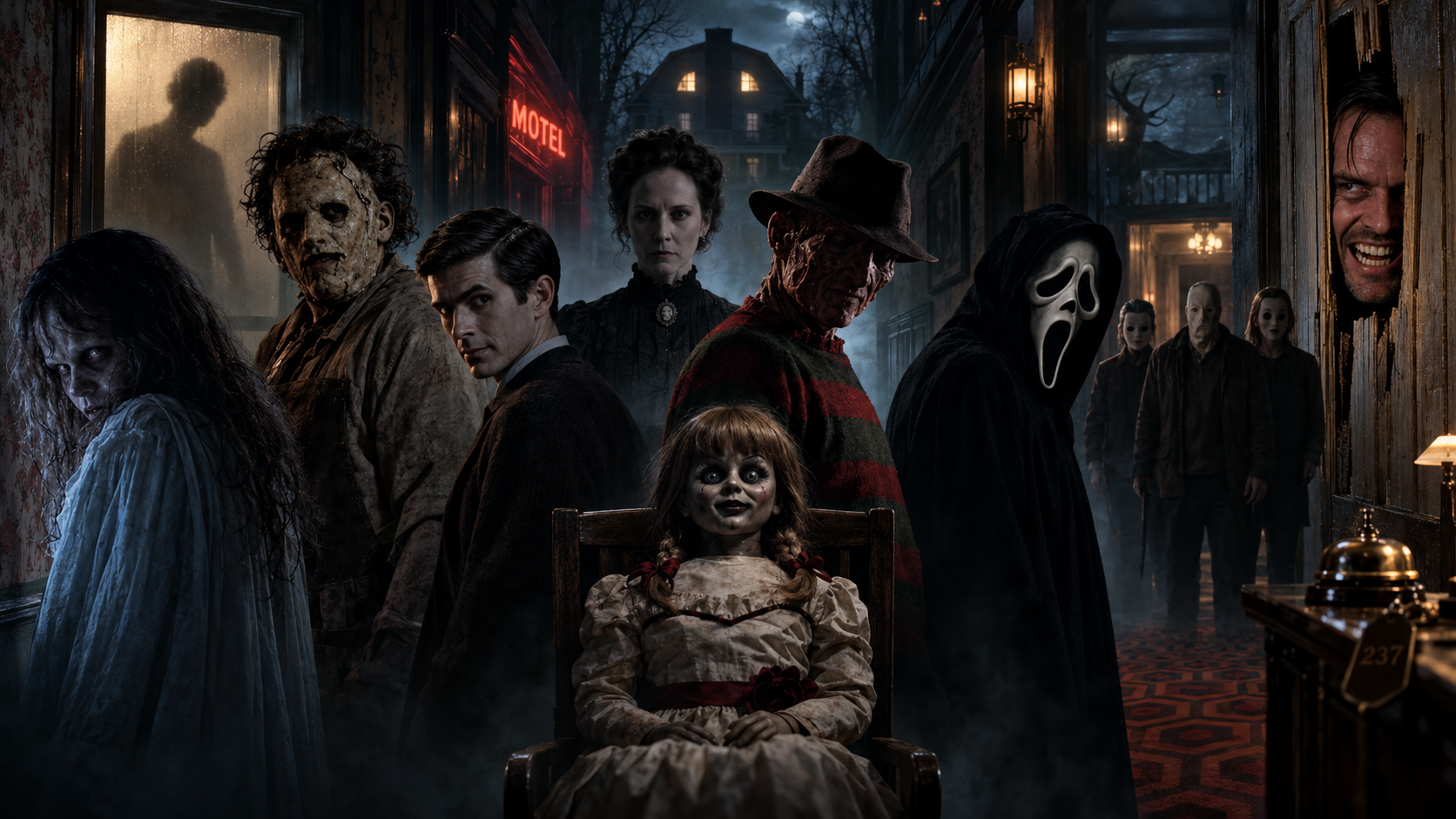
How Real Crimes And Unexplained Events Became 10 Of Horror’s Biggest Films
The Words That Make A Horror Film Follow You Home
A fictional monster can be left behind when the credits roll. A monster with an apparent connection to real life is harder to dismiss. Add “based on a true story” and an ordinary bedroom becomes suspicious, a noise downstairs becomes personal, and the comforting distance between the screen and your own home begins to shrink.
But that phrase can conceal enormous differences. A documented murder, a person’s account of a haunting and a filmmaker’s frightening childhood memory are different kinds of evidence. Hollywood can turn each into the same promise: something like this happened, somewhere, to someone who probably thought they were safe.
The ten films below have real connections of very different strengths. Some borrow from criminal cases; others transform disputed experiences or personal inspiration into fiction. Understanding those connections makes them fascinating for a second reason: you can see exactly how a detail from ordinary life becomes something capable of frightening millions.
The Exorcist: The Child Behind The Story Was A Boy
Before Regan MacNeil became one of cinema’s most recognizable possessed children, a teenage boy underwent a series of Catholic exorcism rituals in 1949. The case, associated with Maryland and St. Louis, became an inspiration for William Peter Blatty’s novel and William Friedkin’s 1973 adaptation. Saint Louis University documents the involvement of Jesuits connected to the institution.
That is the firm connection: a real boy and real religious interventions. It does not establish that a supernatural possession occurred. Accounts of the case include extraordinary claims, but an account written by someone who believed they witnessed possession remains evidence of their observations and interpretation, rather than independent confirmation of a demon.
The movie turns that uncertainty into a terrifying physical confrontation. Regan’s bedroom becomes a place where parental love, medical investigation and religious faith are all tested. Viewers are shown events within a fictional world; they do not have to reconstruct an incomplete historical record or decide how much confidence to place in somebody else’s recollection.
What makes the real origin unsettling is the child at its center. Strip away the film’s famous effects and there is still a young person surrounded by adults trying to understand disturbing behavior through the explanations available to them. The emotional force of The Exorcist comes partly from that helplessness: the fear that someone you love is suffering, while every familiar source of reassurance seems inadequate.
The Texas Chain Saw Massacre: Leatherface’s Inspiration Lived In Wisconsin
The title sounds like a crime already entered into the record. The opening presentation encourages that impression, and the film’s rough textures make it feel almost discovered rather than staged. Yet Tobe Hooper’s 1974 nightmare does not reconstruct a documented Texas massacre involving Leatherface and his family. Its central story is fiction, with elements inspired by Ed Gein.
Gein lived in Wisconsin, where investigators searching his property in 1957 uncovered human remains and objects fashioned from them. His crimes and grave-robbing supplied a horrifying point of reference for the use of human skin and remains in horror imagery. The geographical distinction matters: a real criminal case in one state became material for an invented nightmare in another.
The transformation is enormous. Hooper builds an entire environment around the fear that people can become objects: bodies reduced to material, domestic rooms turned into threatening spaces, and a family home stripped of everything comforting that the word “home” should imply. The terror comes as much from that corrupted familiarity as from the weapon named in the title.
Knowing the difference does not make Leatherface harmless. It changes what you are watching. The film takes fragments of genuine human cruelty and constructs a world in which those fragments seem to explain everything. Its apparent authenticity is part of its artistry, but treating its plot as a literal historical account gives the fiction credit for events that never happened.
Psycho: The Horror Was The Man Nobody Suspected
Ed Gein also helped inspire the literary starting point for Alfred Hitchcock’s Psycho. Robert Bloch’s 1959 novel emerged from the disturbing possibility that a person capable of monstrous acts could live within an ordinary community without being recognized for what he was. Hitchcock’s 1960 adaptation then gave that idea its unforgettable cinematic shape through Norman Bates and the isolated motel.
Norman is a fictional character, rather than a faithful portrait of Gein. The motel, the narrative built around its visitors and the particular secrets of the Bates household belong to the story. The connection is best understood as a creative response to a case, with a real discovery helping a novelist imagine what might remain hidden behind an apparently unremarkable life.
That is a different kind of fear from Leatherface. Psycho makes room for awkwardness, politeness and sympathy before it reveals danger. You are invited to form an impression of somebody, then forced to confront how little that impression actually tells you. The unsettling question is how confidently we mistake a brief encounter for knowledge of a person.
The same concern appears in a different social setting in the polished identity of Patrick Bateman. The characters are very different, but both stories exploit the gap between presentation and concealed violence. Psycho endures because its most effective disguise is recognizable human behavior: a conversation, an apology, an apparently ordinary person standing behind a desk.
The Amityville Horror: Six Murders Came Before The Haunting Claims
The documented horror at Amityville began on November 13, 1974, when Ronald DeFeo Jr. killed his parents and four siblings in their Long Island home. He was subsequently convicted of six murders. Those deaths are the essential historical foundation of the story, and they must remain distinct from the supernatural claims later attached to the property.
George and Kathy Lutz later moved into the house with their children, leaving after 28 days and describing frightening experiences. Their account became the basis for Jay Anson’s 1977 book and the 1979 film. The alleged haunting has long been disputed; the existence of the house, the family’s stay and the earlier murders does not authenticate the paranormal explanation.
The power of the premise is easy to understand. A family tries to begin a new life in a place already marked by violence. Every sound has a possible history, every room carries knowledge that cannot be put back, and a home purchased for the future becomes dominated by what happened before its new occupants arrived.
The problem comes when those layers merge. A viewer may remember that the murders were real, then unconsciously extend that certainty to the haunting. The victims become supporting characters in the legend of a dangerous building. Looking carefully at Amityville restores the distinction: six people were killed by a person, while the subsequent story of supernatural activity belongs to a contested account.
The Conjuring: A Real Family, A Real Farmhouse And A Disputed Villain
James Wan’s The Conjuring, released in 2013, draws on the Perron family’s accounts of experiences in a Rhode Island farmhouse and the involvement of paranormal investigators Ed and Lorraine Warren. Roger and Carolyn Perron raised five daughters there, and the family’s connection to the property extended across roughly a decade. The people and the house existed; the haunting is a claim about their experiences. The Perron story and adaptation.
The most sensitive historical element is Bathsheba Sherman, whose name became attached to the film’s malevolent presence. She was a real nineteenth-century woman, but the sinister characterization should not be mistaken for an established biography. Stories identifying her as a witch or attributing supernatural violence to her lack the evidential basis that the movie’s confident presentation can appear to supply.
That matters because cinema can give an accusation a face. Once an audience has seen a terrifying character perform an act, the image is easy to remember and the qualification is easy to forget. A person who cannot answer back becomes fixed in public imagination as the villain a screenplay needed.
There is an uncomfortable connection here with the accusations behind historical werewolf trials: stories about hidden supernatural evil can become more durable than the evidence supporting them. The Conjuring succeeds as a carefully constructed supernatural thriller. Its effectiveness should make viewers more attentive to the distinction between dramatic certainty and historical knowledge, especially when an actual person’s name is used.
Annabelle: The Real Doll Looks Nothing Like The Movie Monster
The real object behind Annabelle is a Raggedy Ann doll. It does not resemble the elaborate, sinister-looking doll that became the franchise’s visual signature. In the Warrens’ account, a nursing student received it in 1970, after which she and her roommate allegedly noticed it changing position and encountered other disturbing phenomena. Those details come from the paranormal investigators’ narrative.
The 2014 film invents a substantial backstory around that object. Its central couple and the attack involving a satanic cult are fictional elements, rather than a reconstruction of the nursing student’s experience. The screen version provides a dramatic origin for the danger, turning a collection of allegations about a doll into a story with characters, escalation and visible consequences.
Oddly, the real doll’s ordinary appearance may be the more disturbing idea. A clearly sinister prop announces how an audience should feel. A familiar toy leaves a larger gap between appearance and supposed threat, asking the imagination to supply what cannot be seen. That gap is where a great deal of effective horror operates.
But possession is not established by the existence of the object. Nor does a story gain independent corroboration merely because it appears in several books, films or retellings drawing on the same account. Annabelle offers a particularly clear example of how a tangible item can anchor an intangible claim: the doll can be photographed, while the explanation attached to it remains unproven.
A Nightmare On Elm Street: Real Deaths Helped Inspire An Impossible Killer
Freddy Krueger belongs to fantasy, but the starting point for A Nightmare on Elm Street was connected to accounts of people dying during sleep. Wes Craven drew inspiration from stories involving Southeast Asian refugees and frightening nighttime experiences. The leap from those accounts to an attacker who enters dreams was a work of imagination, rather than a proposed explanation for the deaths.
That distinction is essential. Death during sleep does not show that a nightmare killed somebody, and the history should not be flattened into a claim that frightened people were pursued by something supernatural. What Craven identified was a terrifying dramatic possibility: a person might become afraid of the very thing they eventually have to do.
The 1984 film turns that problem into a trap with no ordinary exit. You can leave a house, avoid a road or lock a door, but you cannot permanently remove sleep from your life. Its young characters face danger in a private world where other people cannot simply accompany them and verify everything they experience.
That makes the film resonate with familiar nighttime fears, including the unnerving experiences explored in why sleep paralysis can feel like an intruder in the room. Sleep paralysis should not be confused with the deaths associated with Craven’s inspiration. The connection is thematic: horror becomes especially powerful when the boundary between safety, awareness and vulnerability no longer feels reliable.
Scream: A Real Killer Helped Put Fear Into The Opening Phone Call
Before Ghostface began asking questions about scary movies, screenwriter Kevin Williamson became frightened while watching a documentary about Danny Rolling. Rolling’s murders of five students in Gainesville, Florida, in August 1990 formed the real criminal background to that inspiration. The resulting film, released in 1996, tells a fictional story rather than dramatizing those victims’ lives.
Williamson’s account of developing Scream includes feeling vulnerable while alone in a house, noticing an open window and speaking with a friend about horror films. Those experiences helped shape a screenplay in which familiar entertainment and immediate personal danger collide. A story watched from a position of safety becomes the thing that makes safety feel uncertain.
That is why the opening works beyond its famous references. A telephone should connect you to somebody elsewhere; the film turns it into evidence that somebody may already be close. Conversation becomes a way to establish control, and knowledge that ought to be harmless becomes part of a threat. The audience understands the danger before it knows how far the intruder can reach.
The distinction between inspiration and adaptation also protects the real victims from being absorbed into a fictional brand. Ghostface’s identity, motives and theatrical methods should not be projected backward onto Rolling’s crimes. Scream transformed a writer’s response to actual violence into a film about people who know horror conventions, then discover that knowing the conventions does not make fear disappear.
The Strangers: The Knock At The Door Came From Childhood
Bryan Bertino’s The Strangers, released in 2008, makes a simple interruption feel unbearable: somebody knocks at an isolated home and asks for a person who does not live there. Bertino traced part of that premise to a childhood incident. Strangers had approached houses in his neighborhood, and he later understood that unoccupied homes were being targeted for burglary.
He also identified the Manson murders, through his reading of Helter Skelter, as an influence. These are separate sources of inspiration, rather than pieces of one crime that the film faithfully reconstructs. Claims that its plot directly recreates a particular unsolved case should be treated cautiously unless supported by the filmmaker’s account or production evidence.
The childhood detail is powerful because nothing about it initially requires an extraordinary explanation. People make mistakes, visit the wrong address and ask for unfamiliar names. Bertino takes that small ambiguity and makes it difficult to close: was the visitor confused, checking who was inside, or trying to make the occupants open the door?
The film’s terror lies in how little reassurance its victims can extract from the situation. There is no useful relationship to understand and no obvious grievance to resolve. Its real-life connection gives that fear a recognizable starting point, but the prolonged attack is a constructed nightmare. An unsettling memory provided the opening; fiction supplied everything that followed through it.
The Shining: Stephen King’s Hotel Stay Became A Family’s Nightmare
The Shining has a real-world origin that its author described directly. In September 1974, Stephen King and his wife, Tabitha, stayed at the Stanley Hotel in Estes Park, Colorado, as it was preparing to close for winter. King recalled the empty corridors and a nightmare involving his young son being pursued by a fire hose. By the end of that night, he had the foundations of the novel in mind.
That is a compelling creative history without requiring a real Jack Torrance or a documented series of events matching the Overlook’s story. King’s novel appeared in 1977, followed by Stanley Kubrick’s adaptation in 1980. A hotel stay and a dream supplied inspiration; the family’s ordeal and the supernatural narrative were fiction.
The setting does much of the psychological work. A hotel is designed to accommodate people temporarily, with staff, guests and routines creating the impression that help is available. Empty it out, remove those routines and make departure difficult, and the same spaces begin to feel enormous, indifferent and capable of concealing anything.
The deeper fear is domestic. The family has brought its relationships into isolation, where there are fewer interruptions and fewer witnesses. The horror grows from the possibility that the person who should provide protection may become a source of danger. King’s account of waking frightened for his child gives that imaginative starting point an emotional weight that no invented claim of a “real Overlook massacre” could improve.
The Real Story Can Be Smaller Than The Legend — And Still Terrifying
Across these films, reality enters through very different doors. Psycho and The Texas Chain Saw Massacre draw from aspects of a criminal case. The Exorcist grows from an actual religious intervention. Annabelle and The Conjuring dramatize supernatural claims, while The Shining has a clearly described origin in a writer’s experience and imagination.
Those distinctions make the stories richer. They allow us to recognize the people behind them, understand the filmmakers’ decisions and resist the temptation to treat every memorable scene as recovered history. They also reveal how much craft is involved in turning a fragment into a nightmare: the mask, the room, the phone call and the doll each give fear something concrete to attach itself to.
The process has older precedents in the real history behind vampire beliefs, where frightening experiences acquired explanations that could outlive the circumstances that produced them. Cinema adds performances, music and images strong enough to become the version we remember. Once that happens, separating the original event from the retelling requires a conscious effort.
The next time a horror film promises a true story, ask what precisely is true. Was there a murder, a witness account, a building, an object or simply an experience that frightened its creator? Sometimes the answer dismantles the legend. Sometimes it leaves something more difficult to dismiss: real people suffered, someone remembered being afraid, and a filmmaker found a way to bring that fear into your room.
Read Next
The Terrifying Real History Behind Vampires
Discover how disease, decomposition and fear of the dead created a monster that has survived for centuries.
The Terrifying True History Behind The Werewolves
From ancient transformation myths to brutal European trials, explore the real beliefs behind the werewolf legend.
Sleep Paralysis: Why You Wake Up Unable To Move
The science behind terrifying nighttime paralysis, shadowy figures and the feeling that something else is inside the room.
The Lighthouse Summary
Two isolated men descend into paranoia, obsession and a violent struggle over who gets to control reality.
Mulholland Drive Summary
A Hollywood mystery fractures into something darker as fantasy, guilt and reality become impossible to separate.
