New Evidence Points To Possible Hidden Chambers Beyond Tutankhamun’s Tomb
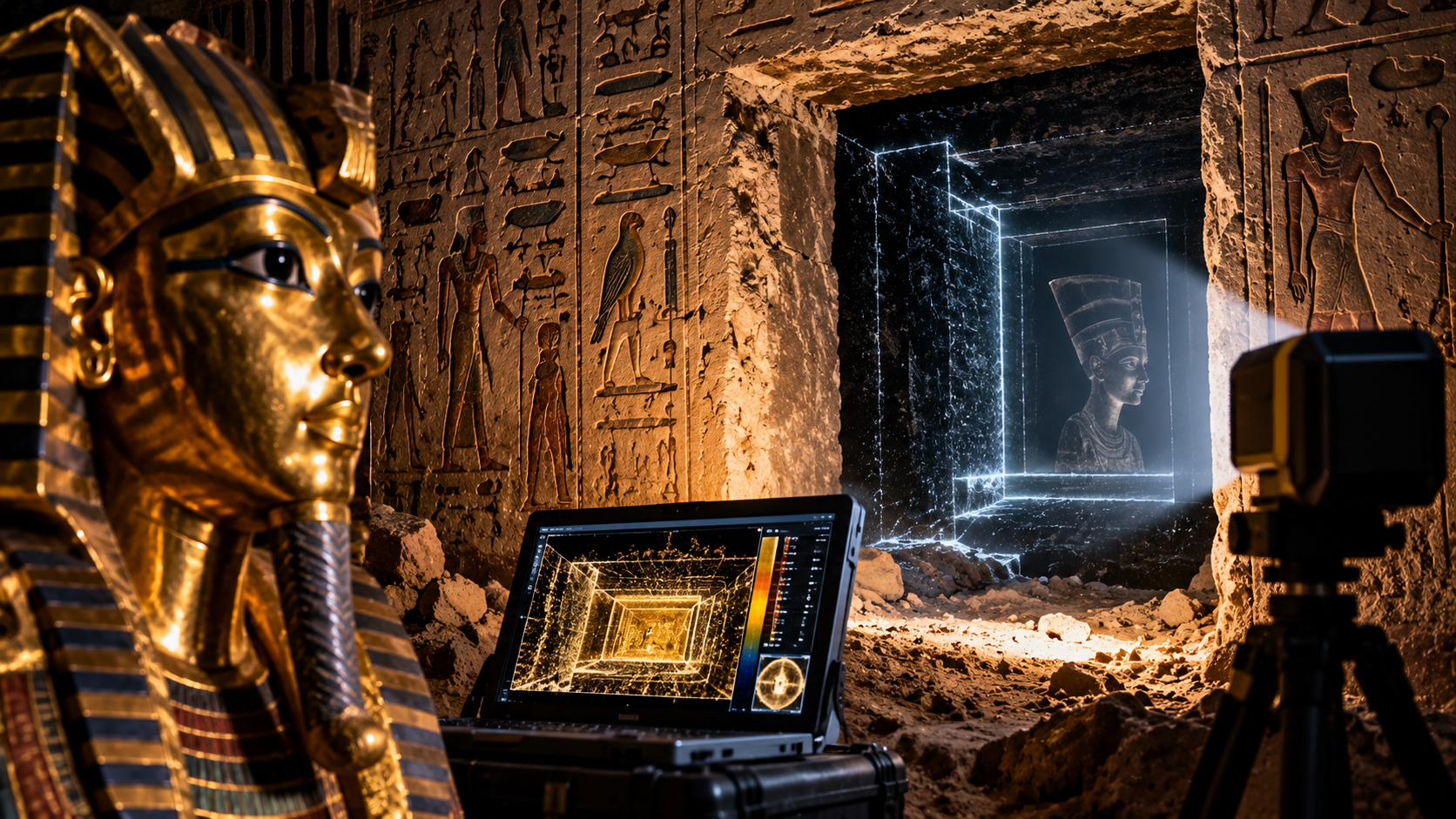
Tutankhamun Mystery Deepens As New Evidence Points Beyond His Tomb Walls
Scientists May Have Found Clues To Secret Chambers Beside The World’s Most Famous Pharaoh
More than a century after the discovery of Tutankhamun's tomb electrified the world, new geological evidence has revived the possibility that unexplored chambers could exist beyond the famous burial complex in Egypt's Valley of the Kings.
A three-year study led by former Egyptian antiquities minister Mamdouh Eldamaty has identified geological features that researchers say could be consistent with hidden passageways or chambers near the tomb. Eldamaty has reportedly applied for permission to drill a small opening through which miniature cameras could investigate the area directly.
The findings do not prove that another tomb exists.
But they have breathed new life into one of modern Egyptology's most tantalising debates.
Could Something Be Hidden Beyond Tutankhamun?
Tutankhamun's tomb, known as KV62, was discovered by Howard Carter in 1922.
Its extraordinary collection of funerary objects transformed the young pharaoh into one of the most recognisable figures from the ancient world.
Yet the tomb itself has always been unusual.
Compared with the elaborate burial places of several other pharaohs, Tutankhamun's is relatively small.
That has contributed to speculation that the complex may originally have been designed for someone else or that the rooms discovered by Carter represent only part of a larger structure.
Archaeologist Nicholas Reeves has previously argued that architectural features within the tomb could indicate blocked doorways and additional chambers.
His theory attracted enormous attention because of the identity he suggested might lie beyond them: Queen Nefertiti.
Why Nefertiti Enters The Story
Nefertiti was the wife of Pharaoh Akhenaten and one of the most famous royal women of ancient Egypt.
Her painted limestone bust has become an international symbol of ancient Egyptian art.
But her burial place remains unknown.
Reeves proposed that Tutankhamun's burial complex might originally have incorporated a royal tomb built for a woman, with parts later adapted after the young king's unexpected death.
That possibility is debated.
Researchers have not established that Nefertiti is buried beside Tutankhamun, and the existence of undiscovered chambers has itself remained uncertain.
The new geological results therefore do not confirm Reeves's theory.
They simply add another layer of evidence to the question of whether unexplored spaces exist.
What The New Survey Found
According to reporting on the research, Eldamaty's team spent three years examining the geology surrounding Tutankhamun's tomb.
The survey identified features interpreted as possible passageways and chambers extending beyond the known structure.
Geophysical and geological techniques can identify differences in density, structure or material that suggest empty spaces.
But interpreting underground data is notoriously difficult.
Natural cracks, geological boundaries and variations in rock can sometimes resemble artificial structures.
That is why the next stage could be so important.
A camera placed through a carefully drilled opening could provide direct visual evidence.
Previous Searches Produced Conflicting Results
The possibility of hidden chambers around Tutankhamun's tomb is not new.
Earlier radar investigations produced disputed findings.
Some surveys appeared to detect features consistent with voids or structures behind walls.
Other investigations failed to reproduce those results convincingly.
That history explains why Egyptologists are cautious.
Extraordinary archaeological claims require evidence strong enough to distinguish a genuine built space from geological noise or instrumental artefacts.
The new work adds information, but it does not erase the uncertainty created by previous contradictory surveys.
Why Tutankhamun’s Tomb Is So Unusual
Tutankhamun became king as a child during one of the most turbulent periods in ancient Egyptian history.
His reign followed the religious revolution associated with Akhenaten, who promoted worship centred on the Aten and disrupted long-established religious institutions.
Tutankhamun's rule saw a restoration of older traditions.
He died young, probably in his late teens.
Because his death appears to have been unexpected, archaeologists have long considered whether his burial preparations were completed under unusual time pressure.
That context makes the architecture of KV62 particularly interesting.
If an existing royal burial complex had been repurposed, it could help explain some of the tomb's unusual features.
But that remains a hypothesis rather than established fact.
What Would A Hidden Chamber Mean?
The importance would depend entirely on what was found.
An empty architectural extension would still improve understanding of the tomb's construction.
A sealed room containing artefacts could transform knowledge of Tutankhamun's burial.
And an intact royal burial would rank among the most significant archaeological discoveries in modern Egyptian history.
That possibility explains the intense interest surrounding Nefertiti.
Her final resting place has never been conclusively identified.
Finding her burial would potentially provide new information about the royal family, funerary practices and political transition of the late Eighteenth Dynasty.
Yet attaching Nefertiti's name too firmly to the current evidence would be premature.
First, researchers need to establish whether the chambers exist at all.
The Challenge Of Investigating A Priceless Tomb
Any physical investigation of Tutankhamun's tomb carries obvious risks.
The site is one of the most important archaeological monuments in the world.
Drilling through ancient material simply to test an uncertain hypothesis requires careful conservation planning and official approval.
That is why a very small opening combined with miniature imaging technology has been proposed.
The aim would be to minimise intervention while obtaining direct evidence about what lies beyond the known walls.
If permission is granted, a camera could potentially settle questions that remote surveys have struggled to answer.
A Century-Old Discovery Still Produces Mysteries
Howard Carter's excavation produced one of archaeology's defining moments.
Yet Tutankhamun continues to generate new scientific questions more than 100 years later.
Modern researchers can bring technologies Carter never possessed: high-resolution imaging, geophysical surveys, advanced material analysis and miniature robotic instruments.
Those methods can reveal aspects of ancient sites without dismantling them.
In this case, however, technology has created a mystery rather than resolved one.
The geological data suggests that something unusual may lie beyond the familiar tomb.
Whether that something is natural rock, an architectural feature, an empty passage or a previously untouched burial chamber remains unknown.
And until researchers can look beyond the wall directly, the most extraordinary possibility will remain exactly that — a possibility.
