What If The Library Of Alexandria Had Survived? What Knowledge Was Really Lost?
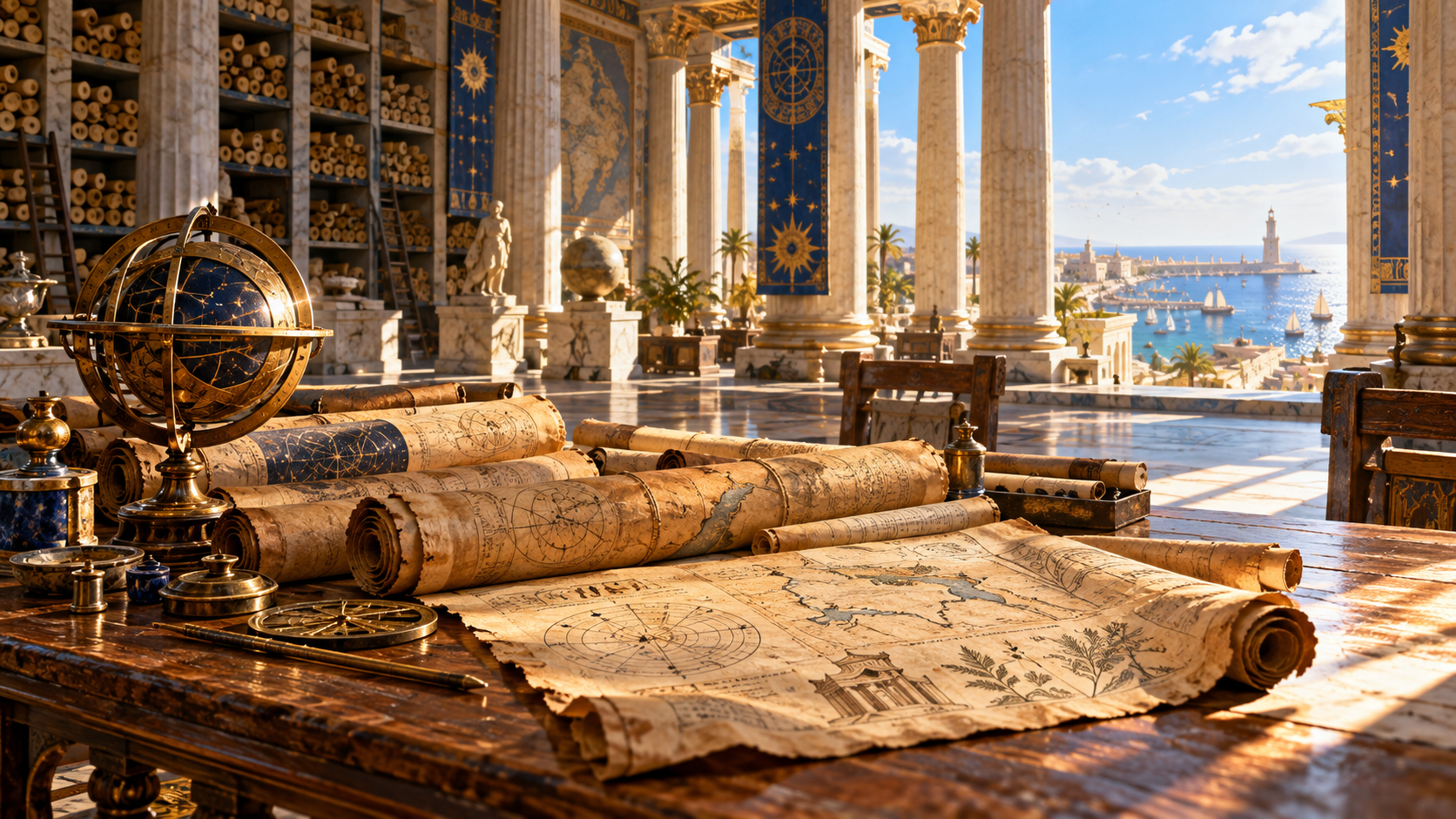
What Alexandria’s Lost Library Could Really Have Changed
Saving Alexandria’s Scrolls Would Have Required Much More Than Preventing A Fire.
The imagined scene is irresistible: shelves of ancient knowledge, a sudden blaze and discoveries disappearing before humanity can use them. From that picture follows an even larger question. If the Library of Alexandria had survived, would civilisation have advanced centuries earlier?
The defensible answer is more interesting than a guaranteed technological shortcut. A durable Alexandrian scholarly institution might have preserved more literature, evidence and technical writing. It might also have supported new work. But historians cannot reconstruct a complete inventory of its losses, and the familiar story of one fire destroying all ancient knowledge does not match the surviving evidence.
Before changing history, we need to establish which history we are changing. A building surviving, a collection surviving and a community of scholars continuing to work are three different counterfactuals. Only the last two offer a serious basis for imagining a different intellectual world.
What Was The Library Of Alexandria?
The library developed under Egypt’s Ptolemaic rulers in the third century BCE. It belonged to a wider Alexandrian culture of scholarship associated with the Mouseion, an institution whose name referred to the Muses. It should not be imagined as a modern public lending library with clearly documented visitor numbers and opening hours.
The Open University’s teaching on Alexandria emphasises the gaps between the famous image and the evidence. Even details about founding, scale and acquisition are disputed. Ancient descriptions sometimes served political, literary or religious purposes, and later writers repeated stories long after the events they described.
Reports of enormous scroll totals therefore need care. A scroll was not equivalent to a modern complete book: a long work could occupy several rolls, and collections could include multiple copies. A striking number does not tell us how many unique works an institution possessed.
Alexandria’s importance does not depend on accepting its largest reported inventory. A centre that gathered texts, supported scholars and enabled comparison could have extraordinary intellectual value without literally containing everything written in the ancient world.
The Fire Story Contains Several Different Histories
Julius Caesar’s Alexandrian campaign in 48 BCE involved a fire in the harbour area. Ancient writers differ over its consequences for books and collections. The relationship between damaged material and the main library cannot be reduced confidently to the destruction of one universally agreed inventory.
Later episodes of conflict and institutional disruption also belong to Alexandria’s history. The destruction of the Serapeum in 391 CE is often drawn into the library story, but the temple complex and the earlier royal library should not simply be treated as one unchanged institution. The nature of surviving collections at particular dates remains disputed.
The story blaming the Arab conquest centuries later for burning the whole ancient library is a much later tradition, not secure contemporary documentation of that event. Treating competing accounts as interchangeable versions of one fire obscures the chronological problems.
The University of Chicago-hosted survey of ancient accounts demonstrates how differently the sources describe fires, buildings and books. Taken together, they support caution about the popular single-catastrophe narrative. They do not give historians a complete final-day catalogue of what vanished.
A Library Can Die Without Burning
A manuscript collection requires work. Texts must be located, acquired, stored, checked, copied and understood. Materials deteriorate; readers’ interests change; funding disappears. A building can remain standing while its collection becomes less accessible and its scholarly activity declines.
The key point for our counterfactual is therefore institutional continuity. Preventing a particular fire would not automatically provide centuries of scribes, patrons, teachers or readers. It would not guarantee that later rulers valued the same works or maintained the same scholarly priorities.
Imagine a collection whose physical holdings escape disaster but whose copying budget ends. The immediate victory is real. Over a longer period, however, ageing manuscripts and a shrinking community of readers could still lead to substantial loss. Survival needs repeated acts of preservation.
This is why “the library survived” is too vague to predict an outcome. We need to specify what remains active, who supports it and whether copies circulate. The strongest alternate history begins with those practical conditions rather than an untouched room of scrolls.
What Knowledge Was Really Lost?
There is no surviving complete Alexandrian inventory that allows us to name every lost work, much less identify all its contents. We know that a great deal of ancient literature has disappeared, but disappearance does not establish that a unique copy burned at Alexandria.
The evidence for loss comes in different forms: references to works no longer extant, quotations preserved by other writers, summaries, fragments and gaps within surviving collections. Each tells us something, but none automatically establishes the final location or cause of a work’s disappearance.
The Oxyrhynchus papyri offer a useful corrective. Material recovered from Egyptian rubbish deposits has supplied fragments of literature alongside documents of ordinary life. Oxford’s account of the collection describes how these finds restore access to authors and works that did not survive through the main manuscript tradition.
That is a different picture from one library holding civilisation’s only memory. Ancient texts circulated, were discarded, reused and copied in many places. Sometimes an accidental survivor in a provincial rubbish heap tells us something a prestigious collection did not preserve for the future.
The Loss Of Context Matters As Much As Lost Discoveries
We tend to imagine missing scientific breakthroughs because their value is easy to dramatise. Yet a fuller ancient record might change history most immediately through context: competing interpretations, local accounts, letters, administrative practices and works by writers known today only through others.
Consider what a lost commentary could provide. It might preserve a quotation from another lost work, explain an unfamiliar term or record a disagreement that later summaries conceal. Its importance would not depend on containing a secret invention. It could change how we understand evidence we already possess.
This is an inference about the value of a richer archive, not a claim that Alexandria definitely held particular missing documents. The distinction matters. A hypothetical benefit should not quietly become a factual assertion about the contents of an undocumented shelf.
The greatest loss may sometimes be the ability to ask a question at all. If only one side of a dispute survives, later readers can mistake survival for consensus. More texts would give historians more opportunities to test that impression.
Ancient Science Was Impressive—and Some Of It Survived
Alexandria is associated with significant mathematical and scientific work. Eratosthenes, who directed the library, is particularly famous for his calculation of the Earth’s circumference. The surviving accounts allow historians to discuss his method while recognising uncertainty about some details and units.
Euclid’s Elements offers another corrective to the idea of a complete intellectual blackout. The work survived through a long history of transmission and became extraordinarily influential. Alexandria’s eventual institutional losses did not erase everything associated with the city or its scholarly traditions.
The Archimedes Palimpsest makes the process more tangible. A later manuscript preserved mathematical texts beneath overwritten religious writing, and modern imaging helped recover material that was difficult to read. Its survival depended on a complicated manuscript history, not continuous safekeeping in Alexandria.
Knowledge can persist incompletely, change format and acquire new readers far from its original setting. That history is less tidy than the contrast between a golden age and a single destructive fire. It also provides a better foundation for imagining how additional preservation might have mattered.
Counterfactual One: More Texts Reach Later Readers
Here the assumption is modest: an Alexandrian institution continues copying a substantial collection and distributes copies beyond the city. Under those conditions, it is plausible that more ancient works would reach later scholarly communities. The benefit comes from maintaining and multiplying access.
The likely gains are easiest to describe in literature and historical evidence. More complete plays, poems, geographical accounts and technical discussions could enlarge the record. We should resist inventing a list of recovered masterpieces, because the scenario does not tell us which texts were actually present.
Even familiar works might survive in additional versions. Comparing manuscripts can help identify copying errors, variations and editorial choices. More witnesses to a text could improve understanding without producing an entirely new discipline or device.
This is the least extravagant version of Alexandria’s survival, yet it could transform what we know about antiquity. A richer evidence base would affect scholarship in ways that extend far beyond the library’s own walls.
Counterfactual Two: A Scholarly Community Remains Active
The stronger scenario assumes more than preservation. The institution continues attracting scholars, supporting teaching and encouraging the comparison and criticism of ideas. It also adapts across political changes instead of surviving merely as a ceremonial possession.
Such continuity could reduce the effort later thinkers spend recovering lost arguments. A researcher who can consult predecessors’ observations may test, correct or extend them. A translator with access to several manuscripts may make different choices from one working from a single damaged copy.
But an institution can preserve errors as well as insights. Prestige may protect established authorities from criticism. A large collection only supports progress when people can examine it, disagree about it and connect its contents with observation and practical problems.
The consequence is conditional: sustained, critical scholarship could change intellectual development. It does not follow that every surviving institution would do so, or that one centre would determine the direction of every other society’s learning.
Counterfactual Three: An Early Industrial Revolution
This is where the popular argument makes its largest leap. Hero of Alexandria described ingenious mechanical devices, including the steam-driven aeolipile. The existence of an ancient steam device is often treated as evidence that industrial machinery was almost within reach.
But a device demonstrating a principle is different from a practical system that performs useful work economically and reliably. Widespread industrialisation requires materials, manufacturing skill, energy supplies, maintenance, demand and institutions capable of sustaining investment. A surviving technical description alone does not provide all of them.
We can illustrate the distinction without assigning ancient societies a fixed technological destiny. A design might inspire experimentation yet remain difficult to manufacture at useful scale. A workable machine might still be too expensive for the problem it solves. Adoption requires more than theoretical possibility.
There is no defensible calculation showing that Alexandria’s survival would put humanity a specified number of centuries ahead. Such figures turn a chain of contingent events into an imaginary timetable. They can be enjoyable fiction, but they should be labelled as fiction.
The Best Survival Strategy Would Be More Than One Alexandria
Suppose the institution preserved its collection perfectly but kept all unique material in one place. It would remain vulnerable to a later disaster, loss of support or restricted access. Concentration creates intellectual convenience while concentrating risk.
Now change the scenario so that copies circulate among different centres. A loss in one location need not become a total loss. Readers elsewhere can preserve, translate and challenge the material, creating further opportunities for survival and development.
This is an analytical conclusion from the preservation problem, rather than a claim that ancient librarians operated a modern backup policy. The mechanism is nevertheless clear: several accessible copies are less dependent on the fate of one institution than a unique copy.
It also changes the emotional centre of the story. The person copying a difficult text, the patron paying for that work and the reader finding a reason to keep it become as consequential as the ruler associated with a magnificent building.
What Alexandria’s Survival Could Really Have Changed
The most credible alternate world contains a fuller ancient record and a different pattern of intellectual continuity. Some later scholars might have had more evidence, fewer missing arguments and additional starting points. Specific technological consequences remain much harder to establish.
That answer does not diminish the loss. Literature, language and historical memory do not need to accelerate machinery to matter. A recovered voice can change our understanding of a society, reveal a neglected experience or overturn an apparently settled interpretation.
The question therefore becomes larger than whether somebody could have stopped a blaze. Could successive generations have kept the texts readable, the collection accessible and the scholarly work alive? Saving Alexandria would have required a long commitment to knowledge—and the willingness to let that knowledge travel.
