

The Terrifying Real History Behind Vampires
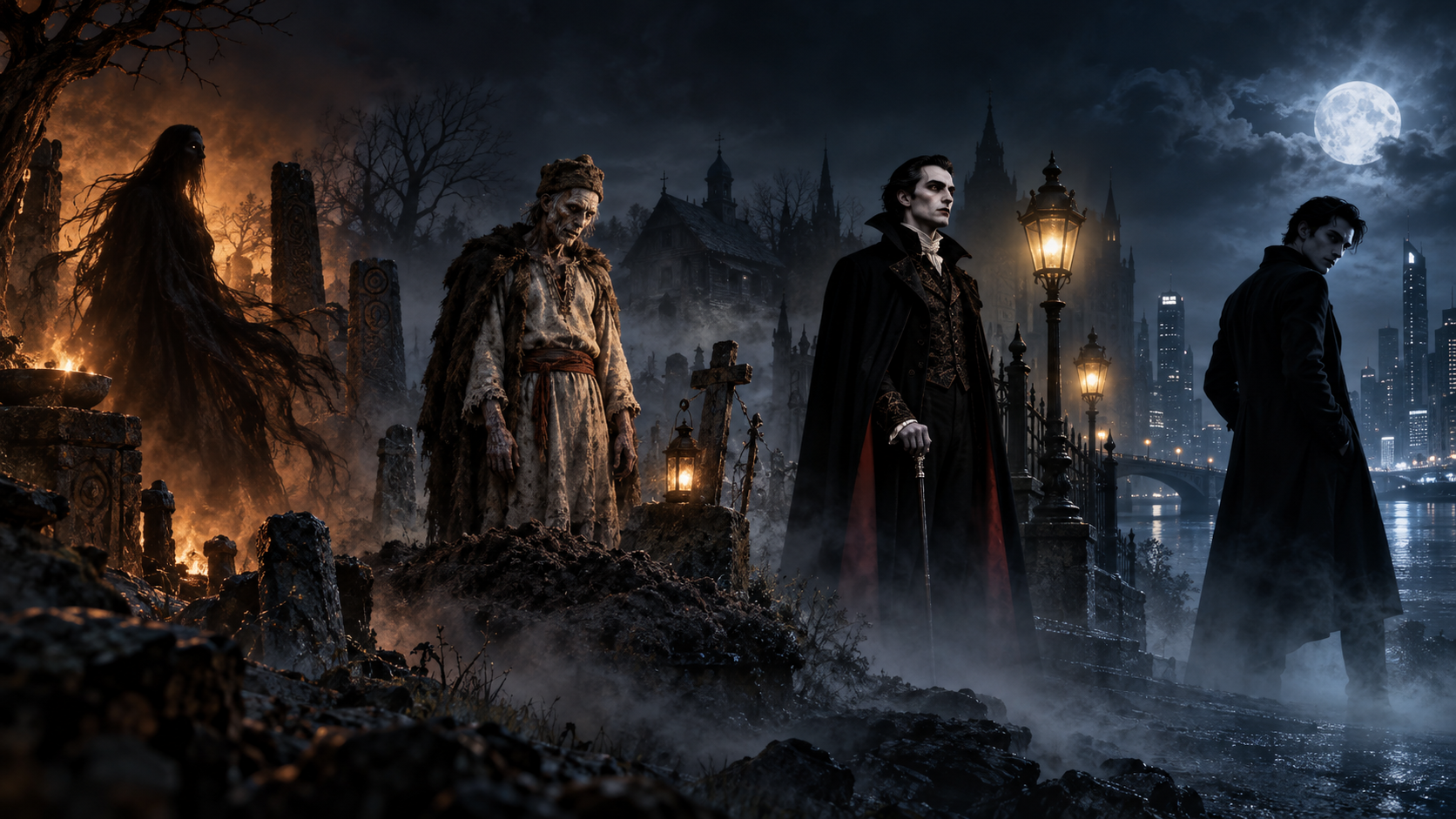
Before Dracula, Villagers Feared Their Dead Were Killing Again
Why People Once Believed The Dead Could Return
Vampires did not begin as elegant aristocrats in black capes, glittering teenagers or Hollywood monsters with perfect teeth. Long before Bram Stoker wrote Dracula, the vampire was something much more frightening because it was much closer to home: a dead neighbour, a relative, a child, a spouse or a stranger believed to have returned from the grave.
For centuries, people across parts of Europe genuinely believed that some dead people could rise again, drain life from the living and carry sickness through a household or village. When deaths came quickly, when a corpse looked disturbingly intact, or when grief left a family searching for an explanation, the dead could become suspects.
The vampire myth was not created in one moment by one culture. It developed from older fears about restless spirits, dangerous corpses, blood, burial and disease. But the recognisable European vampire emerged most strongly through Slavic and Balkan folklore before exploding into Western Europe during the eighteenth century. From there, writers, theatre, cinema and television reshaped it into one of the world’s most durable monsters.
Did People Actually Believe In Vampires?
Yes. The belief was not merely a campfire story or a private superstition for many communities. It could influence funerals, burial practices, local authority decisions and the treatment of a person’s body after death.
In traditional vampire belief, a suspected vampire was often someone who had died in an unusual, sudden or socially troubling way. Suicide, violence, a disputed death, religious exclusion, perceived wrongdoing or a failure to follow burial customs could all make a person seem dangerous after death. In some regions, the risk was also associated with outsiders, strangers, people thought to have lived badly, or individuals who had died without proper rites.
The fear was painfully practical. If several people in one family became ill or died, villagers might conclude that the first person buried had returned to prey on them. The vampire was not simply a symbol of evil. It was an explanation for a disaster that otherwise seemed impossible to understand.
This matters because death was far more visible in earlier communities. Most people died at home. Bodies were washed, watched and buried by relatives. Epidemics, tuberculosis, childbirth complications, malnutrition and infections could kill several people in a household over a short period. Without modern medical knowledge, those patterns demanded an explanation.
A vampire was often the explanation.
The Ancient Fears Behind The Myth
There is no single ancient “first vampire”. However, many cultures told stories about supernatural beings connected with blood, death or the dangerous return of the dead.
Ancient Mesopotamian traditions included malevolent spirits blamed for illness and danger. Greek and Roman stories contained blood-drinking or child-threatening beings. Jewish folklore developed figures such as Lilith in later traditions, while South and East Asian folklore includes a vast range of hungry ghosts, spirits and corpse-associated entities.
These creatures were not identical to the later European vampire. It is misleading to treat every ancient demon as Dracula’s direct ancestor. But they show that human beings have long connected death with an unnerving possibility: that something which should be gone might still have power over the living.
The later vampire combined several ancient fears into one body. It crossed the boundary between life and death. It entered homes. It targeted the vulnerable. It caused illness without leaving a clear human attacker. And, most disturbing of all, it could be someone the community had known.
Where The Word “Vampire” Came From
The English word “vampire” entered wider European use in the eighteenth century. The Oxford English Dictionary’s earliest evidence for the English noun dates to 1741, after reports of alleged vampirism in Eastern Europe had begun circulating through European newspapers and learned journals. Oxford English Dictionary
Its earlier linguistic roots are usually connected to Slavic forms including upir or vampir, although the precise etymology remains debated. One of the earliest written references to a related term appears in Old Russian in 1047. University Of Virginia
That uncertainty is important. The vampire did not arrive with a clean origin story. It emerged from oral traditions that changed between languages, regions and generations. A Serbian vampir, a Romanian strigoi, a Bulgarian vapir, a Greek vrykolakas and other regional figures shared traits, but they were not all the same creature.
What united them was the terror of the returning dead.
The Vampire Was Originally A Neighbour, Not A Count
Modern popular culture has made vampires seductive, powerful and often glamorous. Traditional folklore was usually much harsher.
The old vampire was frequently bloated rather than beautiful. It might be ruddy-faced, blood-filled and swollen beneath its burial clothes. It could knock at doors, haunt a family home, sit on a sleeping person’s chest, attack livestock or cause relatives to weaken and die.
The association with blood was present, but blood-drinking was not always the central feature. In some stories, a vampire strangled victims, brought nightmares, spread plague, consumed food or simply drained life force. The consistent element was not a pair of fangs. It was a corpse that had failed to stay dead.
This is why the vampire became so deeply connected to family fear. The dead person was sometimes believed to return first to the people they had loved, lived with or depended on. The home, rather than a distant castle, was the place under threat.
Why Corpses Looked Like Evidence
Many alleged vampire cases can now be understood through normal decomposition. But to people with no modern forensic framework, decomposition could look like proof that a body was active after death.
As the body breaks down, gases can make it swell. Skin can recede, making nails and hair appear longer. Dark fluids can emerge from the mouth or nose, creating the impression that a corpse has fed on blood. A body buried in cold conditions or particular soil may decompose more slowly than expected.
To a frightened observer, these changes could look horrifyingly alive.
A corpse that seemed unusually fresh, plump or bloodied might be interpreted as a vampire. A body that had changed after burial could appear to have grown hair or nails. Strange sounds from a grave, caused by shifting soil or gases, could be interpreted as movement.
The mistake was understandable within the knowledge available at the time. The people who opened graves were not necessarily foolish. They were trying to interpret frightening physical evidence during outbreaks of illness and grief.
Serbia And The Vampire Cases That Shocked Europe
The word “vampire” became a European sensation after reports from Serbian communities under Habsburg administration in the early eighteenth century.
One of the most famous cases involved Petar Blagojević, who died in the village of Kisiljevo in 1725. Villagers later reported a run of deaths and claimed that Blagojević had appeared to people in dreams or at night, demanding food and attacking them. His body was exhumed, and observers said it appeared unusually preserved, with blood around the mouth.
An even more influential case involved Arnold Paole, a former soldier associated with the Serbian village of Medveđa. According to later reports, Paole had claimed during his life that he had once been attacked by a vampire and had tried to protect himself using folk remedies. After his death around 1725, villagers reportedly blamed him for a series of illnesses and deaths.
The story did not remain local. Austrian authorities became involved. In 1731 and 1732, officials and military medical personnel investigated reports from the area. Johann Flückinger’s report, commonly known as Visum et Repertum, described exhumed bodies that villagers and investigators considered suspicious. The case circulated across Europe and helped turn a local folk belief into an international intellectual controversy. Arnold Paole Case Overview
The reports were not proof that vampires existed. They were proof that the belief was taken seriously enough to be documented by officials, discussed by doctors and debated by educated Europeans.
The Age Of Enlightenment Had A Vampire Panic
It is tempting to imagine that the Enlightenment made vampire belief disappear overnight. In reality, the eighteenth century saw a remarkable collision between folk fear and emerging rational inquiry.
European newspapers and pamphlets carried accounts from Serbia and neighbouring regions. Clerics, physicians and philosophers debated whether the reports were fraud, superstition, misunderstanding or evidence of something extraordinary. The alleged vampire was no longer just a figure from village folklore. It had become a topic for governments, universities and print culture.
The French scholar and Benedictine monk Augustin Calmet published influential works examining reports of apparitions, revenants and vampires. Some readers viewed such investigations as evidence of credulity. Others believed the documents raised genuine questions.
Eventually, sceptical officials increasingly argued that supposed vampire signs were natural processes of burial and decay. In the Habsburg lands, reforms sought to curb disruptive exhumations and folk practices. But a rational explanation did not instantly remove the emotional power of the belief.
Science could explain a body. It could not immediately erase grief, fear or the suspicion that a run of deaths had a hidden cause.
Vampire Belief Was Also A Way Of Explaining Disease
The vampire myth became especially powerful where disease arrived without a visible explanation.
Tuberculosis, once commonly called consumption, offers a stark example. The illness could move through families over months or years, causing weight loss, weakness, coughing and death. To relatives watching one loved one fade after another, it could appear as though the first dead family member was somehow taking life from those still alive.
That idea reached nineteenth-century New England. The best-known American case involved Mercy Lena Brown of Exeter, Rhode Island. Her mother and sister had died of tuberculosis, and her brother Edwin was seriously ill. When Mercy died in 1892, villagers exhumed her body. Believing her to be a vampire, they removed and burned her heart, then gave ashes mixed with water to Edwin in the hope of stopping the illness. He died soon afterwards. Rhode Island Historical Society
The case is chilling, but it should be read with care. It was not an ancient ritual carried out by people who did not care about Mercy. It was an act of desperation by a community facing a disease it could not cure.
Vampire belief offered a brutal form of control. If the dead were responsible, the living could do something: open the grave, drive in a stake, remove the heart, burn the remains or scatter ashes.
How People Tried To Stop Vampires
The methods used against suspected vampires differed between places, but they were often physical and direct.
A suspected vampire might be buried face-down so it could not find its way out. Stones, sickles or iron objects could be placed in graves. The body might be pinned down, decapitated, staked, burned or reburied. In some traditions, garlic, religious symbols, holy water, seeds and knots were used to keep a vampire away.
These practices were not random. They reflected local beliefs about what could restrain, confuse or destroy a dangerous dead person. A sharp object might pin the body to the earth. Fire might purify it. A severed head might prevent it from acting. Seeds could force a compulsive creature to count until daylight.
Archaeologists have found burials in parts of Europe containing unusual measures that are sometimes described as anti-vampire practices. But caution is essential. An unusual burial does not automatically prove a vampire ritual. Objects can have multiple meanings, and archaeology often reveals uncertainty rather than a simple answer.
Still, the graves show something striking: fear of the dead could leave marks in the ground centuries later.
Dracula Did Not Create Vampires — But He Changed Them Forever
The vampire that dominates modern culture owes an enormous debt to nineteenth-century fiction.
John Polidori’s 1819 story The Vampyre helped popularise the image of the vampire as an aristocratic, seductive and socially dangerous man. Sheridan Le Fanu’s Carmilla, published in 1872, gave readers a powerful female vampire whose intimacy and menace still influence the genre.
Then came Bram Stoker’s Dracula in 1897.
Stoker gathered strands from folklore, Gothic fiction, Victorian anxiety, new technology, sexuality, disease and foreignness. Count Dracula was not a direct recreation of a Serbian village revenant. He was a literary transformation: an ancient, wealthy, calculating predator who could move between primitive terror and modern London.
The novel fixed many of the images now treated as permanent vampire rules: the Transylvanian castle, the vampire hunter, the threatened woman, the blood transfusion, the bat, the crucifix and the desperate race against darkness. Some details came from earlier folklore and fiction; others were strengthened or transformed by Stoker’s imagination.
The link between Dracula and Vlad the Impaler is often overstated. Stoker used the name “Dracula” and some historical material, but there is no firm evidence that he built his vampire directly on the Wallachian ruler. The connection has become part of the legend surrounding the novel rather than a settled fact.
How Hollywood Made The Vampire Immortal
Cinema made the vampire universal.
F. W. Murnau’s Nosferatu in 1922 presented a nightmare version of the creature: bald, clawed, rat-like and associated with plague. Bela Lugosi’s 1931 performance as Dracula gave audiences the elegant, hypnotic aristocrat. Later films pushed the vampire in different directions — tragic, romantic, comic, erotic, monstrous and heroic.
The modern vampire can be a villain, a lover, an outsider, a metaphor for addiction, a symbol of disease, a fantasy of eternal youth or an embodiment of predatory power. It can be terrifying or sympathetic. It can live in a medieval castle, a school corridor, a dystopian city or a suburban home.
That flexibility is one reason the myth survives. The vampire changes with the anxieties of each generation.
Victorian readers saw fears about sexuality, invasion, illness and urban modernity. Twentieth-century audiences saw alienation, repression and epidemic. Modern stories often explore consent, identity, trauma, loneliness, class and the fantasy of escaping death itself.
Why Vampires Still Fascinate Us
The vampire is not just a monster with fangs. It is a story about the boundary humans most want to understand and cannot control: the boundary between life and death.
It represents the terror that the past might not stay buried. It reflects the fear that a loved one can become unrecognisable through illness, death or grief. It turns infection into a creature, desire into danger and immortality into a curse.
The first people who feared vampires were not imagining a glamorous fantasy. They were trying to survive uncertainty. They watched families become sick, saw bodies behave in strange ways after burial and searched for a cause when medicine could offer none.
That is why the vampire has lasted so long. Its appearance has changed beyond recognition, but its central question remains as powerful as ever: what if death is not the end — and what if the dead come back hungry?
