

What If Britain Helped The Confederacy Win The American Civil War?
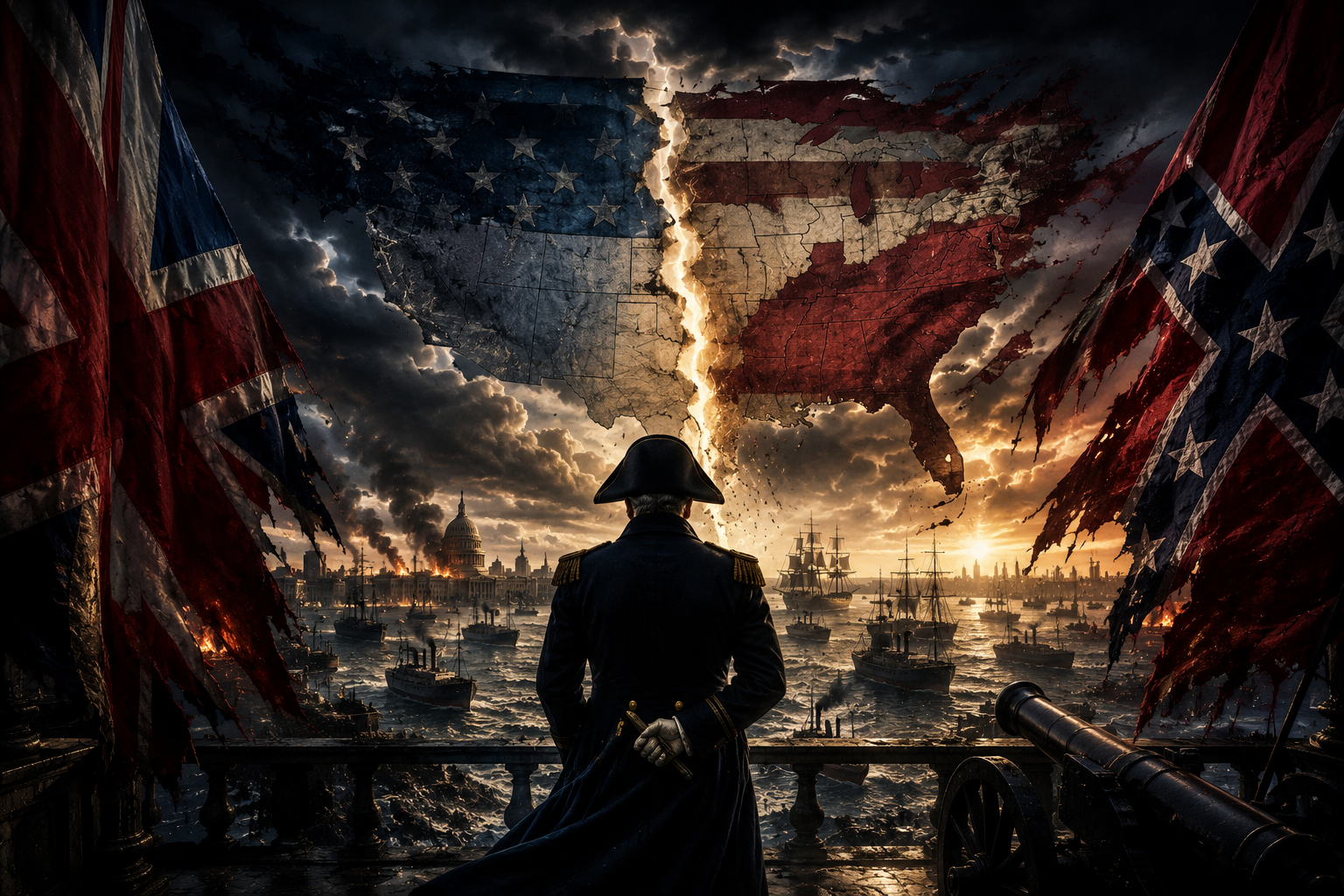
What If Britain Helped The Confederacy Win The American Civil War?
The Civil War Timeline Where Britain Breaks America In Two
The War That Almost Changed EverythingThe American Civil War was not sealed inside America. It was fought in Virginia, Tennessee, Georgia and Mississippi, but its pressure points ran through Liverpool, Manchester, Montreal, Paris, St Petersburg and London. It was a domestic war with global consequences, because the United States was already too large, too resource-rich and too strategically placed to collapse quietly.
The most plausible point of divergence is not a wild battlefield miracle. It is the Trent Affair of late 1861, when the U.S. Navy seized two Confederate envoys from a British mail steamer and brought Britain and the Union close to war. In real history, Washington climbed down and released the envoys. The crisis faded. But it did not have to. Official diplomatic history records the seizure of James Mason and John Slidell from the British vessel Trent as one of the most dangerous early-war confrontations between Washington and London.
In this alternate timeline, Abraham Lincoln’s government delays, domestic pressure hardens, and London concludes that the Union has deliberately violated British neutrality and maritime rights. Britain does not intervene because it loves the Confederacy. It intervenes because it believes the United States has challenged the Royal Navy, threatened imperial prestige, endangered Canadian security and destabilised the cotton economy that still feeds part of Britain’s industrial machine.
That distinction matters. The realistic British intervention is not ideological romance for the South. It is a cold imperial calculation. London does not need the Confederacy to be admirable. It only needs the Union to look dangerous, overextended and vulnerable.
Britain’s Dilemma
Britain’s real dilemma in 1861 was brutal. On one side stood anti-slavery sentiment, the moral memory of abolition, and the political danger of being seen to support a slaveholding republic. On the other stood textile distress, maritime honour, fear for Canada, aristocratic sympathy for the South, and a strategic temptation: a divided North America would be easier for Britain to manage than a single expanding United States.
The Confederacy’s original bet on “King Cotton” failed in real history because Britain found alternatives, public anti-slavery feeling mattered, and the South never produced enough consecutive military success to make recognition feel safe. Official U.S. diplomatic history notes that European governments were restrained not only by anti-slavery sentiment but by battlefield uncertainty and other crises in Europe. The Confederacy could not prove it was durable enough to justify the risk.
The alternate version needs to change that calculation. Britain does not enter simply because mills want cotton. That is too simplistic. It enters because the Trent Affair converts economic pain into a legal and imperial dispute. The cotton famine supplies pressure. Maritime insult supplies principle. Canada supplies vulnerability. Confederate survival supplies opportunity.
London believes the risk is worth taking because intervention does not have to mean conquering the North. It only has to mean breaking the blockade, recognising Confederate independence, protecting British shipping and forcing Washington into a two-front strategic crisis. Britain has the world’s dominant navy. The Union has a growing army but a fragile coastline, a young blockade, and no appetite for war with the greatest maritime empire on Earth.
The Moment London Intervenes
The divergence begins in December 1861. Washington refuses immediate surrender of Mason and Slidell, or offers a legalistic reply that London reads as insult rather than compromise. British ministers, already mobilising troops toward Canada in the real crisis, move further. The Royal Navy is ordered to protect British commerce and prepare to challenge the Union blockade.
Recognition follows in stages. London first declares that the Union blockade must be effective under international law or it will not be respected. Then British naval squadrons escort merchant shipping toward Southern ports. France, under Napoleon III, does not lead, but it follows enough to matter. Paris sees a chance to weaken the United States, protect its Mexican ambitions and act beside Britain without bearing the full strategic burden.
This does not instantly destroy the Union. It changes the risk equation. The North now faces the Confederacy on land, Britain at sea, potential raids from Canada, financial alarm, and the prospect that European recognition will turn the South from rebellion into statehood. Insurance costs rise. Northern merchants panic. War Democrats gain strength. Lincoln’s room for manoeuvre narrows.
The key military effect is not British soldiers marching through Ohio. It is naval and economic. The blockade weakens. Confederate ports breathe. Arms, credit and manufactured goods flow in more reliably. Cotton flows out under protection. The South remains poorer and less industrial than the North, but it no longer has to win a total war. It only has to avoid defeat until Northern politics breaks.
Confederate Victory
The Confederacy survives by changing the definition of victory. It does not need to capture Washington. It does not need to occupy New York. It needs recognition, foreign credit, a functioning export route and enough battlefield success to make reunification look too expensive.
By 1862, British pressure at sea forces the Union to divert resources from offensive operations. The Peninsular Campaign becomes even more cautious. Confederate commanders are supplied more consistently. The Union Navy can no longer tighten the blockade with the same confidence. Britain does not destroy the Union fleet outright, but the mere possibility of escalation changes every movement.
Lincoln still tries to transform the war morally through emancipation. In real history, the Emancipation Proclamation changed the character of the conflict and helped make open European support for the Confederacy far harder. It did not end slavery everywhere immediately, but it made every Union advance an advance of freedom and enabled Black enlistment on a large scale.
In this timeline, emancipation still matters, but it comes into a different diplomatic environment. Britain has already crossed the threshold. London presents intervention as maritime enforcement and negotiated settlement, not as moral endorsement of slavery. That argument is ugly, strained and politically costly, but it gives British ministers a way to claim they are ending war rather than defending bondage.
By 1863, Northern politics is exhausted. The Union has not collapsed, but it has failed to restore the republic. British and French recognition has made Confederate independence a diplomatic fact. The peace settlement freezes the continent into two American states: the United States in the North and West, and the Confederate States across the lower South, with contested borders settled by exhausted negotiation rather than moral victory.
The Divided American Continent
The United States survives, but it is not the United States that later dominates the twentieth century. It keeps New England, the Mid-Atlantic, the Great Lakes, much of the Midwest and the Pacific trajectory. It remains industrial, literate, inventive and ambitious. But it loses the South’s population, ports, cotton, lower Mississippi strategy and much of the psychological confidence that came from continental consolidation.
The Confederate States of America also survives, but not as a romantic agrarian paradise. It is born dependent. It owes its survival partly to Britain. It relies on cotton exports, foreign credit, Gulf ports, slave property and political decentralisation. Its independence creates a permanent security dilemma because neither American republic can trust the other.
The United States becomes more militarised earlier. The Confederacy becomes more paranoid earlier. Canada becomes more important immediately. Instead of being a quiet northern neighbour beside a rising American giant, British North America becomes the central imperial buffer between two hostile American systems.
That changes Canadian development. Confederation likely accelerates and militarises. Ottawa emerges less as a compromise between colonies and more as a strategic project: a northern federation built to prevent absorption by either American republic. Railways receive even greater imperial urgency. Western Canada is settled not only as economic expansion but as geopolitical insurance.
Slavery’s Uncertain Future
The hardest question is slavery. A Confederate victory almost certainly extends slavery beyond 1865. That is the dark centre of this timeline. The Confederacy was built around the protection of slavery, and its constitution and political economy made that clear. A victorious Confederate state would not voluntarily abolish slavery immediately after winning the war that secured it.
But slavery surviving longer does not mean slavery surviving forever. That is where simplistic alternate history fails. The pressures against it would accumulate from several directions: British moral pressure, industrial modernisation, enslaved resistance, diplomatic isolation, fear of revolt, changing military technology, and the economic problem of tying capital to human ownership in a world moving toward wage labour, railways, mechanisation and finance.
Britain would face a contradiction. It helped create or protect a slaveholding state while ruling an empire that had already abolished slavery. That contradiction becomes diplomatically toxic. British governments would likely pressure Richmond over time, not from pure morality alone, but because association with slavery damages Britain’s global legitimacy and creates domestic political backlash.
The most plausible outcome is not instant emancipation, but managed decay. Slavery survives into the 1870s or 1880s, perhaps longer in harsher regions, before being converted through compensated emancipation, forced apprenticeship, debt peonage, racial codes and coercive labour systems. The formal institution dies later than in real history. Its social logic survives brutally.
The unexpected consequence is that America’s racial trauma becomes internationalised. Instead of Reconstruction, there is a Confederate emancipation crisis under foreign pressure. Instead of one republic fighting over citizenship, there are two American states weaponising race, migration and labour against each other for generations.
The British Century Extended
A divided America extends the British century. Not because Britain becomes stronger in absolute terms forever, but because its most dangerous future rival is delayed, divided and strategically distracted. In real history, the United States eventually combined population, industry, continental resources, financial depth and oceanic security into an unmatched power platform. In this timeline, that machine is split in two.
Britain regains influence in North America without formally reconquering it. It becomes the offshore balancer of the continent. Canada remains tied more tightly to London. The Confederacy depends on British recognition, markets and financial channels. The United States resents Britain, but must trade with the British world and cannot easily challenge the Royal Navy while facing a hostile southern border.
This produces a different global economy. New York still grows, but London’s financial dominance lasts longer. The pound remains central for longer. British shipping, insurance and capital markets face less American competition. Southern cotton continues to flow through Atlantic networks where British merchants retain leverage.
Yet the victory contains poison. Britain has bought time by associating itself with a morally compromised Southern regime. It has delayed America, but also deepened anti-British nationalism in the North. It has preserved influence, but at the cost of ensuring that North America remains unstable. The empire wins the nineteenth century more comfortably and inherits a more dangerous twentieth.
A World Without An American Superpower
The central consequence is not that America disappears. It is that America arrives late, fractured and smaller in strategic imagination. The Northern United States still industrialises. It may even industrialise more intensely because it doubles down on manufacturing, tariffs, railways and technological development after losing the South. But it lacks the same unified continental market and the same demographic gravity.
The Confederacy industrialises more slowly. Its elite remains tied to land, export agriculture and racial hierarchy. Some cities grow: New Orleans, Richmond, Atlanta, Charleston, Galveston and Mobile become more important. But the system’s political incentives reward plantation wealth, state sovereignty and low-tax decentralisation rather than mass education, integrated infrastructure and broad industrial citizenship.
Mexico changes dramatically. In real history, the United States emerged from the Civil War able to pressure France out of Mexico and later dominate the hemisphere. In this timeline, a divided America gives Napoleon III’s Mexican adventure more oxygen. France may sustain influence longer, or Mexico may become the arena where Britain, France, the Confederacy and the Northern United States compete indirectly.
The Monroe Doctrine weakens. Latin America faces less U.S. dominance in the short term but more European meddling. That may look like freedom at first. It is not necessarily freedom. It may mean more debt diplomacy, more naval coercion, more foreign-backed regimes and a slower emergence of a coherent American hemispheric order.
The unexpected consequence is that a divided America does not simply reduce imperialism. It redistributes imperialism. The United States becomes less dominant, but Britain, France and later Germany find more room to manoeuvre.
The Twentieth Century Rewritten
Germany still rises. The causes of German unification are rooted mainly in Prussian power, Austrian weakness, French miscalculation and the logic of European balance. A divided America does not stop Bismarck. It may even help him, because Britain remains more confident, France remains distracted by imperial ambitions, and the absence of a rising American counterweight leaves Europe more self-contained.
France faces a more complicated century. Napoleon III benefits briefly from American division, especially in Mexico, but this does not guarantee French strength. France still fears Prussia. It still faces demographic and industrial competition. If the Franco-Prussian War still happens, Germany still has a strong chance of victory. The difference is what follows.
Russia also changes. Without a powerful united United States emerging as a future Pacific and industrial force, Russia faces less American pressure in the nineteenth century but more British pressure across Eurasia. The Great Game intensifies. Alaska may not be sold to Washington in the same way, or may be sold to Britain, Canada, or retained longer by Russia. That one change alone alters Pacific geography.
World War I probably still happens, but differently. The structural causes remain: German power, alliance systems, imperial rivalry, nationalism, arms races and the instability of Austria-Hungary and the Balkans. But without a unified American superpower entering decisively, the war is longer, more uncertain and more dependent on empire.
Britain and France cannot assume American industrial rescue. The Northern United States might sell arms and food, but its politics are more cautious and anti-British feeling remains strong. The Confederacy may lean toward Britain because of old diplomatic ties, but it has limited industrial capacity. A divided America means Europe has fewer external shock absorbers.
Does World War II Still Happen?
A Second World War is possible, but its form changes. If Germany loses the First World War less decisively, the post-war settlement may be less punitive or simply more chaotic. If Germany wins a negotiated settlement, the twentieth century becomes darker in a different way: a German-dominated Europe, a weakened France, and a British Empire forced into permanent strategic competition with the continent.
If Germany loses without major American intervention, Britain and France are more exhausted. The Russian Revolution may still happen because its causes are internal as well as military: autocracy, land hunger, industrial unrest, war strain and political collapse. But the post-war balance is less stable. There is no overwhelming American creditor-superpower standing behind a liberal order.
World War II may still emerge from German revisionism, Soviet ambition, Japanese expansion and imperial exhaustion. But the timing, alliances and outcome are altered. Britain cannot rely on a giant friendly United States. The Northern United States may remain suspicious of Britain. The Confederacy may be authoritarian, racially hierarchical and commercially tied to European powers. Neither American state has the scale to become the arsenal of democracy alone.
Japan’s rise becomes more dangerous. In real history, American Pacific power eventually became decisive. In this timeline, Pacific deterrence is weaker and more fragmented. A Northern United States with California and Pacific ports still matters, but it may not possess the same naval reach, fiscal base or strategic confidence. Britain must defend Asian possessions with less certainty of American support.
The result is a twentieth century with more regional wars, more negotiated settlements, and fewer clean endings. The absence of one overwhelming American superpower does not make the world peaceful. It makes the balance of power more crowded.
The Cold War Without One America
The Cold War as we know it probably does not happen. There may still be a struggle between communism, empire, nationalism and capitalism, but it is not the same bipolar contest between Washington and Moscow. No single American republic has the same capacity to organise the capitalist world, fund European reconstruction, guarantee sea lanes, build NATO and contain the Soviet Union at global scale.
NATO may not exist, or it exists as a looser British-led Atlantic defence arrangement. Canada becomes far more central. The Northern United States might participate reluctantly, especially if Soviet power threatens Europe and the North Atlantic. The Confederacy might join an anti-communist bloc for ideological and commercial reasons, but its domestic racial order makes it an uncomfortable partner.
The Soviet Union faces a different West. It may find more opportunities in Europe, the Middle East and Asia because the capitalist camp is less unified. But it also faces Britain, Germany, Japan, Canada, the Northern United States and perhaps the Confederacy as separate balancing forces rather than one American-led system. That fragmentation creates openings and limits at the same time.
China rises differently too. Without the same U.S.-led Pacific order, China’s twentieth century is less constrained by American architecture but still shaped by internal collapse, Japanese invasion, civil war and communist revolution. A weaker American presence could allow Japan to dominate East Asia longer, or allow Britain and Russia to interfere more deeply. China may still rise in the late twentieth and twenty-first centuries, but into a multipolar world rather than a U.S.-designed global economy.
The unexpected consequence is that China’s rise may feel less like a challenge to American hegemony and more like the return of a civilisational state into a world that never had a single hegemon after Britain.
The New Balance Of Power
By the late twentieth century, the planet is more multipolar, less standardised and less Americanised. English still dominates because Britain, Canada and the American republics remain powerful, but American culture does not conquer the world in the same way. Hollywood may exist, but it is smaller or more northern. Southern culture exports differently, perhaps through music, religion, military mythology and racial politics.
Technology develops, but unevenly. The Northern United States remains a major innovation centre, especially in manufacturing, electrical systems, finance, universities and computing. But the absence of a unified U.S. defence-industrial base changes the scale of twentieth-century research. The Manhattan Project may not happen in the same form. Space exploration may become a contest between Germany, Russia, Britain, Japan and the Northern United States rather than a U.S.-Soviet duel.
The internet may emerge later or under a different architecture. Silicon Valley might still rise if California remains in the Northern United States, but federal funding, military procurement and unified national markets matter. A smaller United States means less capital concentration. More technologies are developed through imperial, European or private-commercial networks.
Economically, the world is less integrated around American demand. The dollar may not become the unquestioned reserve currency. Sterling lasts longer, but eventually competes with German, northern American, Canadian and possibly multinational financial blocs. Oil markets are more imperial and more fragmented. The Middle East becomes even more contested because no single post-1945 American security umbrella dominates it.
This is the deeper lesson: the biggest consequences of Confederate victory are not flags, borders or battlefield statues. They are balance sheets, shipping lanes, reserve currencies, research budgets, alliance structures, migration flows and industrial standards.
The World Today
The world created by British intervention is recognisable but profoundly altered. There are likely still two American republics. The Northern United States is wealthy, industrial, technologically advanced and democratic, though more suspicious, more protectionist and more militarised than in real history. It sees itself as the legitimate heir of the old Union and treats the Confederate state as a historical wound that never healed.
The Confederate States still exists, but probably not as the slave republic of 1861. Formal slavery has ended, likely under pressure, crisis and international isolation. Yet its successor systems leave deep scars: racial caste, regional inequality, weak central institutions, agricultural dependency and delayed industrial reform. By the late twentieth century, it may have modernised unevenly, with Atlanta, Texas ports and Gulf energy driving growth while poorer interior regions lag badly.
Canada is stronger and more strategically serious. It is not merely America’s polite neighbour. It is the northern anchor of the British-descended Atlantic world, a resource power, a military buffer and a diplomatic bridge between Britain and the divided American continent. Its population may be larger, its west more developed earlier, and its national identity more explicitly built around survival.
Britain is different too. It kept influence longer, but the cost was strategic overextension. The empire may have declined more slowly, but not avoided decline entirely. Industrial competition, colonial nationalism, financial strain and world wars still bite. Britain’s great achievement in this timeline is not permanent dominance. It is delaying American replacement.
Winners And Losers
The biggest winner is the British Empire in the short and medium term. It prevents the emergence of a united American colossus, strengthens Canada, preserves maritime influence and extends London’s financial centrality. France gains room in Mexico and the Americas, though probably not enough to reverse its European vulnerabilities. Germany benefits from a world with no overwhelming American counterweight. Russia faces a more complicated but less U.S.-dominated century.
The Confederacy wins independence but inherits a trap. Its victory preserves the very system that makes long-term modernisation harder. It gains sovereignty at the cost of dependency, moral isolation and internal rigidity. The South survives, but survival is not the same as flourishing.
The Northern United States loses the most obvious prize: continental destiny. Yet it may become more coherent, more industrial and more culturally unified without the South. It becomes a major power, but not the major power. Its tragedy is that it remains strong enough to matter, but not strong enough to shape the world alone.
The greatest losers are enslaved people and their descendants. In this timeline, emancipation is delayed, compromised and likely replaced by new systems of coercion. The moral cost of Confederate victory cannot be dissolved into geopolitical cleverness. A divided America may produce a more balanced world order, but that balance is bought partly through prolonged human bondage and delayed citizenship.
Final Verdict
So would Confederate victory have created a better world or a worse one? The answer is uncomfortable because it depends on the measure used. A divided America might have prevented the overwhelming dominance of one superpower. It might have extended British restraint in some places and reduced American intervention in others. It might have produced a more multipolar world earlier.
But multipolar worlds are not automatically kinder. They often mean more bargaining, more spheres of influence, more imperial interference, more small-state vulnerability and more wars without decisive endings. The absence of American dominance does not remove power politics. It removes one version of order and replaces it with a harsher, older logic.
The strangest consequence is that Confederate victory may have strengthened Britain, prolonged empire, complicated Germany’s rise, changed Mexico’s fate, weakened the Monroe Doctrine, delayed American technological scale, reshaped the world wars, prevented NATO as we know it, and produced a twenty-first century where China rises into a crowded field rather than against a single American-led system.
Yet the price is severe. Slavery lasts longer. North America remains divided. Democracy develops under permanent strategic suspicion. The modern world becomes less American, but not necessarily more free.
The American Civil War decided more than the future of one nation. It may have decided the shape of the modern world.
