

What If Russia Took Ukraine in 10 Days? The Fast Victory That Could Have Broken Europe
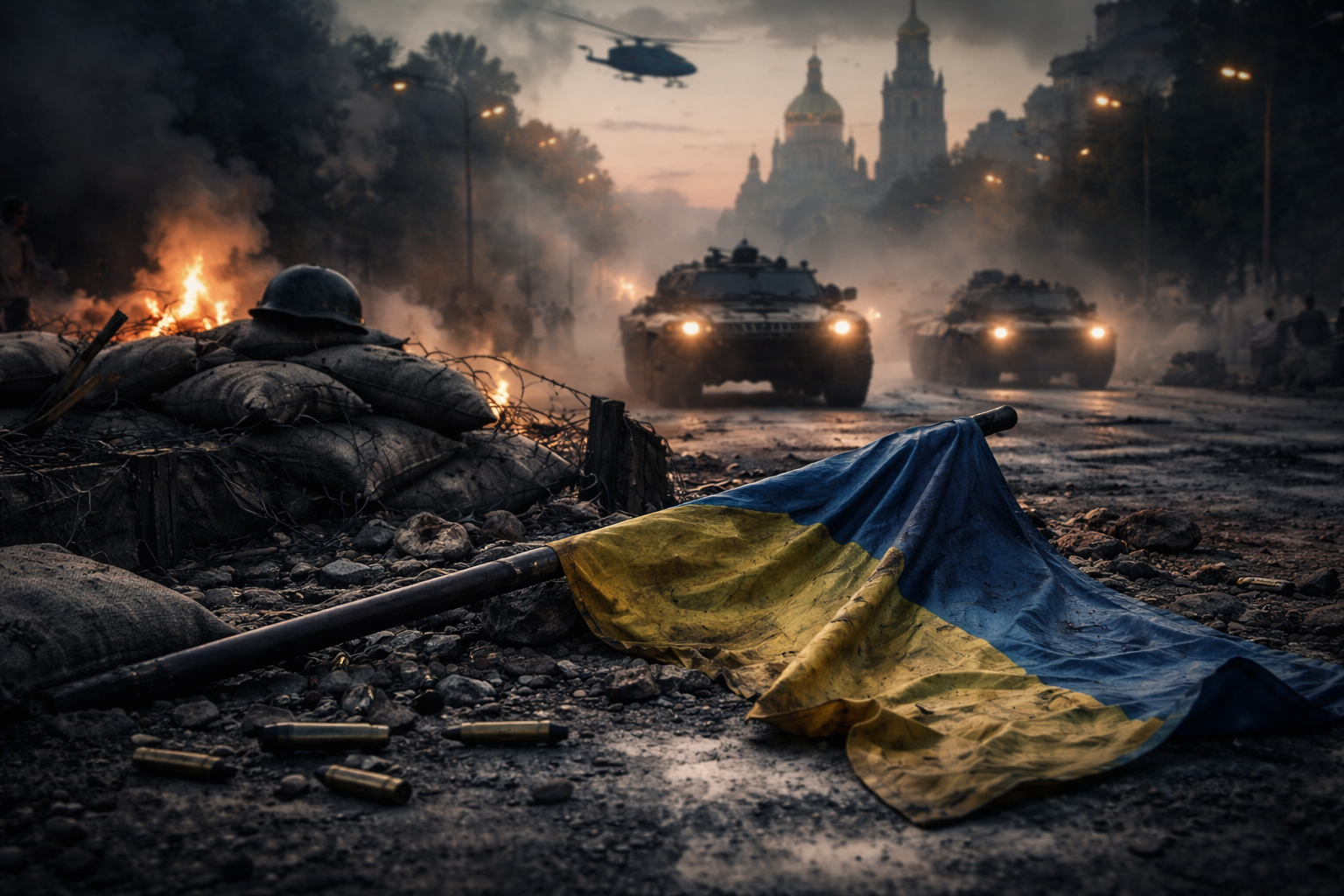
What If Russia Captured Kyiv in 10 Days? How a Rapid Ukraine War Would Reshape the World
The War That Ended in Days—and Haunted Europe for Decades
A swift Russian victory in Ukraine would not have ended the war. It would have changed what the war was.
This counterfactual narrows to the decisive window from 24 February to mid-March 2022, when Russia’s opening plan leaned on speed: seize Kyiv, fracture command, force a political capitulation, then “stabilize” the country before outside support fully mobilizes.
The central tension lies in the fact that while regime change is a political act, its success hinges on logistics, legitimacy, and the ability of the defeated state to continue coordinating violence.
A quick fall of Kyiv would have created a new problem set: occupation capacity, insurgency incentives, sanctions lock-in, and the question of whether the West treats the result as temporary or terminal.
The piece maps the mechanisms that would have mattered most and the branching paths those mechanisms tend to produce once “speed” replaces “control.”
The story turns on how a short, violent opening sprint reshapes the long war of administration.
Key Points
This WHAT-IF asks: if Russia captured Kyiv fast in late Feb/early Mar 2022, how would power, legitimacy, and capacity shift next?
Decisive starting point: the Kyiv axis from Belarus and Russia’s attempt at rapid decapitation and paralysis in the first days of the invasion.
Major branching point number 1: whether a quick seizure produces a functioning puppet government or a hollow shell that can’t command obedience.
Major branching point number 2: whether Ukrainian command-and-control survives outside Kyiv and can coordinate sustained resistance.
Biggest constraint shaping outcomes: Russia’s ability to police a large, hostile population while under escalating sanctions and international isolation.
Hinge decision/shock: a successful air-bridge-style seizure that enables rapid reinforcement into the capital, compressing Ukraine’s mobilization timeline.
What changes most is that the battlefield becomes less about maneuver and more about occupation, sabotage, coercion, and competing claims of legal authority.
Clearest legacy signal: the hardening of European security and sanctions architecture into default policy rather than emergency reaction.
Background
By early 2022, Russia held leverage and momentum narratives: massed forces, coercive diplomacy, and a belief that Ukraine’s political center could be shocked into collapse. Ukraine, for its part, had spent years hardening its military and civic resilience but still faced the classic vulnerability of capitals: decapitation risk and informational panic.
The major actors each needed something different. Russia needed a fast political outcome that looked “legal” enough to freeze Western choices. Ukraine needed continuity of command, a credible national voice, and time—time for mobilization, time for air defenses and logistics to adapt, and time for partners to decide that aid was not futile.
Systems were already in motion: sanctions playbooks, NATO reassurance measures, European energy exposure, and an information environment where images of resistance could mobilize resources faster than treaties. A short war would have collided with these systems, not bypassed them.
The next move depends on whether speed can substitute for legitimacy.
The Point of Divergence
Point of Divergence: Russia’s opening operation succeeds in establishing a reliable air-and-ground corridor into Kyiv in the first 72 hours, enabling rapid reinforcement and a credible encirclement, while Ukrainian senior leadership is forced to disperse and loses secure national-level coordination for a critical week.
This is plausible in context because Russia’s initial theory of victory already prioritized rapid seizure and political paralysis; small changes in execution, timing, and local outcomes can compound quickly in the first days of an invasion.
Enabling conditions are institutional and geographic: a short drive from Belarus to the capital, pre-planned axes, reliance on shock, and the assumption that Ukraine’s state would buckle under pressure if the center could be seized.
From there, the story becomes less about taking Kyiv and more about what taking Kyiv actually buys.
The Branches
Trajectory 1: “Decapitation Works” and a Managed Capitulation
On the ground, Kyiv falls fast, and the appearance of order is created through a televised transfer of authority, emergency decrees, and rapid arrests of symbolic figures. Markets freeze, banks ration, and daily life becomes checkpoint-driven.
The mechanism is administrative capture: control the ministries, broadcast a new chain of command, and force local officials to choose between collaboration and removal. The constraint is legitimacy: an imposed government may issue orders, but it cannot conjure consent, and coercion is manpower-hungry.
Capacity shifts toward Russia in the capital and major hubs, while Ukraine’s capacity migrates outward into regional command nodes and diaspora networks that can fund and coordinate resistance. Carry-over is grimly predictable: “Security” becomes the governing ideology, and repression becomes the currency that holds the system together.
Mandatory hinge: the moment Ukrainian national coordination fails to produce a unified counter-message for days, letting the occupier define what “normal” is before the outside world can lock in a shared narrative. Alternatives are limited because real-time communications and secure movement become contested.
Signposts: a rapid attempt to reopen schools, utilities, and pensions under new authority; a fast push for staged referendums or legal instruments to claim permanence.
Trajectory 2: Kyiv Falls, the State Survives, and Insurgency Becomes the Main War
On the ground, the capital is captured, but Ukrainian command relocates, maintains communications, and frames Kyiv as occupied rather than lost. Violence disperses: ambushes, sabotage, targeted strikes, and clandestine policing battles.
The mechanism is resistance entrepreneurship: local cells exploit terrain, social networks, and the occupier’s need to move supplies on predictable routes. The constraint is intelligence: insurgency depends on secrecy and trust, while occupation depends on informants and fear.
Capacity shifts to whoever can gather information fastest. Russia may hold roads by day but loses freedom of movement by night; Ukraine gains strategic endurance even while losing conventional ground. Carry-over is a long war of attrition that makes “victory” look like a set of policing statistics rather than captured cities.
Mandatory hinge: whether Russian forces can prevent a sustained cross-border supply and training pipeline for resistance. Alternatives are limited because even a “quiet” occupation must feed itself, and feeding an army advertises its arteries.
Signposts: expanding partisan attacks outside Kyiv; rapid growth in collaborator security units and filtration-style control measures.
Trajectory 3: A Fast Partition and a Frozen Settlement
On the ground, Russia prioritizes holding a belt of territory linking key corridors, trading maximal goals for defensible ones. Kyiv is taken or neutralized, but the war’s center of gravity shifts to negotiating lines rather than chasing total control.
The mechanism is diplomatic freezing: create facts on the ground fast enough that external actors begin to treat them as stable borders. The constraint is sanctions durability: if the West treats the outcome as reversible, it keeps tightening; if it treats it as fixed, it begins bargaining.
Capacity shifts into institutions: whoever controls customs points, rail junctions, and legal documentation controls economic life. Carry-over is a political ecology where corruption and coercion become the practical glue that holds the settlement.
Mandatory hinge: whether European states unify around long-term isolation or fracture into “stability first” camps. Alternatives are limited because energy, inflation, and domestic politics do not wait for moral clarity.
Signposts: early ceasefire talks that focus on recognition language; creation of new administrative borders and currency/payment controls.
Trajectory 4: Rapid Shock Triggers Faster Western Rearmament and a Hard Containment Line
On the ground, the military fights contracts, but the strategic fight expands: massive rearmament, forward basing, and long-term military support to whatever Ukrainian authority remains viable.
The mechanism is alliance acceleration: the speed of the Russian win becomes the proof that “buffer assumptions” are dead, pushing budgets and deployments that would otherwise take years. The constraint is escalation management: how far can support go without widening the war?
Capacity shifts toward NATO states in procurement, stockpiles, and training pipelines; Russia gains territory but loses access to capital and technology at scale. Carry-over is a new normal where Europe treats security spending as infrastructure, not politics.
Mandatory hinge: whether Russia conducts overt intimidation beyond Ukraine (airspace incidents, cyber campaigns, coercive energy moves) that collapses any hope of de-escalation. Alternatives are limited because ambiguity in deterrence is an invitation to further tests.
Signposts: rapid multi-year defense spending commitments; permanent basing decisions framed as irreversible.
Trajectory 5: Overreach After a Quick Win and a Second Crisis in the Occupied Zone
On the ground, Russia wins quickly and then stretches thin: garrisons, policing, and supply protection degrade, and a second wave of violence erupts that looks less like war and more like state failure inside occupied areas.
The mechanism is overstretch: coercion substitutes for governance until coercion becomes a generator of resistance. The constraint is manpower quality: occupation needs disciplined, locally informed policing capacity, not just battalions that can take ground.
Capacity shifts to non-state and semi-state actors: militias, security contractors, criminal networks, and local strongmen who trade stability for autonomy. Carry-over is fragmentation, making the occupation harder to negotiate because there is no single actor fully in control.
Mandatory hinge: whether Moscow tries to rule through local proxies or direct administration. Alternatives are limited because direct rule consumes personnel, while proxy rule consumes legitimacy.
Signposts: growing autonomy of local armed groups; inconsistent enforcement, rising corruption, and internal security purges.
Consequences
Immediate outcomes would include a faster humanitarian displacement wave, a sharper financial shock in Ukraine, and a quicker move by Russia to present the situation as settled law rather than battlefield contingency.
Second-order effects are where the world changes. A quick victory locks sanctions into a structural feature of the global economy, not a temporary punishment. It also forces European security institutions to harden faster, because the comforting belief that big wars bog down on their own would be disproved.
Ukraine’s capacity would not vanish; it would mutate. The state’s most valuable asset would become continuity of authority, even in exile or in relocation, because continuity is what turns resistance from anger into strategy.
The next chapter is decided by whether occupation can be made cheap.
What Most People Miss
Speed is not the same as control. Capturing a capital is a military achievement; running a country is a logistics and legitimacy project.
The overlooked factor is administrative bandwidth: the ability to staff checkpoints, process detainees, pay pensions, control documents, and keep utilities running while also fighting an insurgency. Those tasks are boring, visible, and endlessly consumptive.
If Russia “wins fast,” it inherits the hardest part sooner, before it has adapted its forces and institutions for occupation. That mismatch tends to create either repression spirals or negotiated freezes.
The real question is how long an imposed normal can survive first contact with daily life.
What Endured
Geography stayed brutal: distance, river lines, and urban density still punish overconfident planning.
National identity stayed decisive: a population that does not consent turns every administrative act into a contest.
Sanctions logic stayed sticky: once major economic measures are in place, unwinding them requires political capital that few leaders spend lightly.
Alliance politics stayed self-interested: partners help more when they believe help changes outcomes, and they ration help when outcomes look fixed.
Information warfare stayed fast: images and narratives still move resources, volunteers, and money across borders at modern speed.
These constants would cap how “complete” a quick victory could ever be.
Uncertainties and Fragile Assumptions
Ukrainian continuity: if national command is disrupted longer than a week, resistance fragments; if it stabilizes quickly, occupation costs explode.
Local official behavior: a small shift in whether mayors, police, and utility managers comply with or resist changes the occupation’s feasibility.
Sanctions unity: slight differences in European cohesion can swing the long-run balance between containment and negotiated normalization.
Russian internal politics: a fast win can either consolidate authority or create elite competition over spoils and blame.
Insurgency supply lines: if cross-border support becomes reliable, insurgency becomes strategic; if it is choked, resistance becomes episodic.
Escalation thresholds: misreads about what the West will tolerate can turn a “quick win” into a broader confrontation.
The World That Follows
A quick invasion would likely produce a slower peace. The battlefield might quiet sooner, but the conflict would move into institutions: passports, property registers, tribunals, sanctions regimes, intelligence wars, and the quiet mathematics of who can fund and staff coercion longer.
Borders would become less a line on a map and more a system of permissions: who may travel, who may work, who may receive benefits, who may own land. That system is the real legacy of fast conquest, because it is how power reproduces itself without firing shots.
In this world, the defining artifact is administrative habit: the paperwork of occupation on one side and the paperwork of resistance and recognition on the other.
Subscribe on Spotify, or explore more articles for more compelling insight.
