

What If the Cuban Missile Crisis Had Triggered Nuclear War?
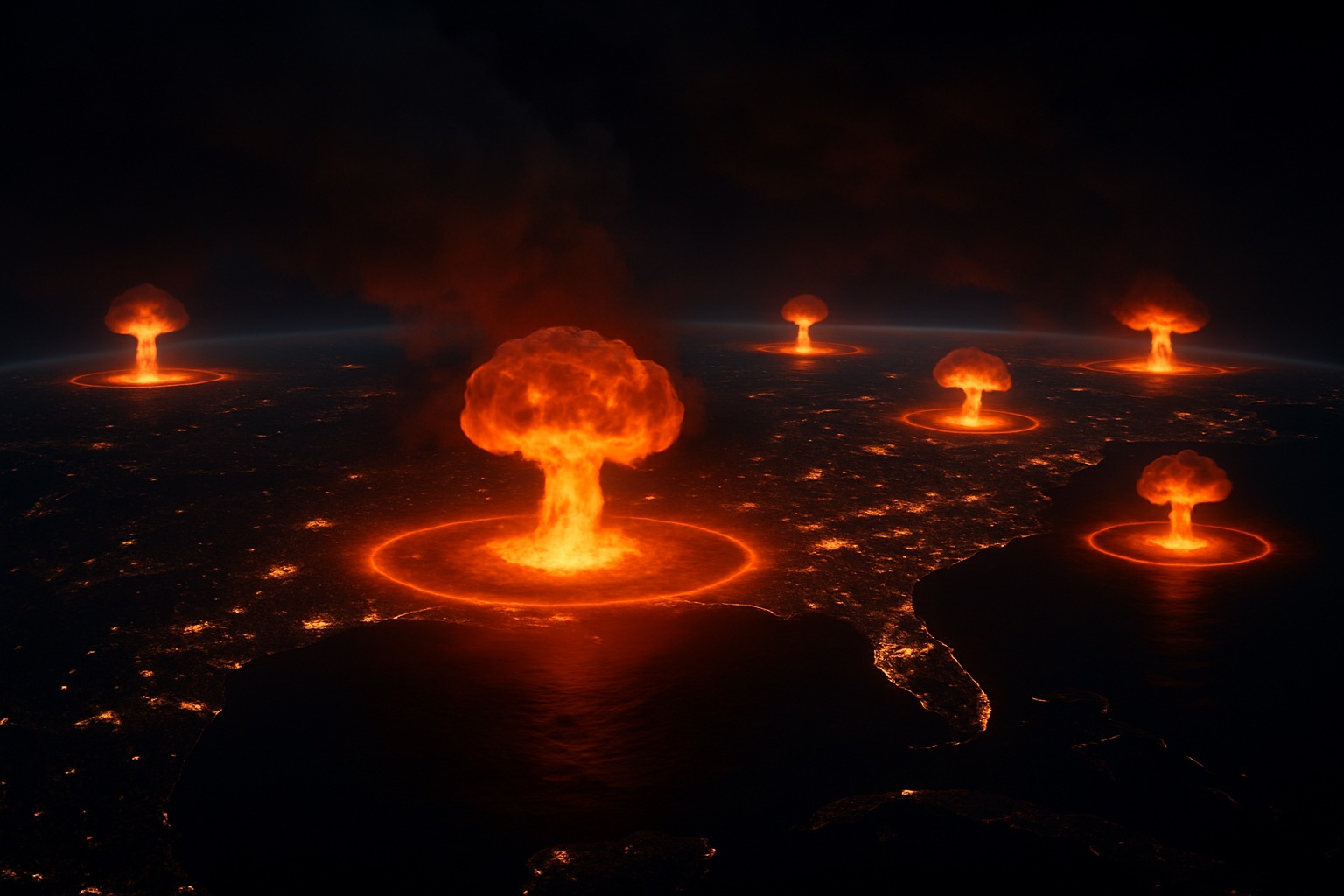
In October 1962, the world held its breath for thirteen days. Soviet nuclear missiles in Cuba, U.S. missiles in Turkey, warplanes on constant alert, submarines hunted in the dark. It was the moment when the Cold War came closest to open nuclear conflict.
In reality, a fragile compromise pulled both sides back from the edge. But it could have gone differently. A misread radar return, a shot-down aircraft, a submarine commander under pressure: any of these might have tipped the crisis into nuclear war.
This article explores a grounded “what if.” It sets out what actually happened in 1962, then traces a plausible path from the real crisis to a full-scale nuclear exchange, using what is known about arsenals, doctrine, and later scientific work on nuclear war and nuclear winter. It then asks what such a war might have meant for Europe, the Americas, and global politics—and why this near-miss still matters in an era of renewed nuclear tension.
By the end, the reader will have three things: a clear view of the real Cuban Missile Crisis, a carefully signposted counterfactual of how nuclear war might have started and escalated, and a sense of how that alternate 1962 would echo into today’s debates.
Key Points
The Cuban Missile Crisis brought the United States and Soviet Union to the brink of nuclear war in October 1962, with forces at unprecedented alert levels.
Both sides fielded thousands of nuclear weapons, but with imbalances in delivery systems that shaped how a war might have unfolded.
A nuclear war scenario rooted in real plans and near-misses begins with clashes over Cuba, then escalates to tactical nuclear use, theater strikes in Europe, and finally intercontinental exchanges.
Scientific studies suggest tens of millions could die in the first hours of a large U.S.–Soviet exchange, followed by global famine driven by nuclear winter effects.
This counterfactual is speculative but grounded in known arsenals, doctrines, and close calls such as the B-59 submarine incident.
Revisiting this “road not taken” highlights how much depended on human judgment in 1962—and how fragile nuclear stability remains amid today’s deteriorating arms control landscape.
Background
The Cuban Missile Crisis unfolded between 16 and 28 October 1962, after U.S. U-2 reconnaissance flights revealed Soviet medium- and intermediate-range ballistic missile sites under construction in Cuba. These missiles, once operational, could deliver nuclear warheads to much of the continental United States within minutes.
They did not appear in a vacuum. The United States had already deployed nuclear-armed Jupiter missiles in Turkey and Italy, as well as Thor missiles in the United Kingdom, placing Soviet cities within striking range. At sea, U.S. ballistic missile submarines carried Polaris missiles, while Strategic Air Command (SAC) fielded hundreds of bombers and intercontinental ballistic missiles (ICBMs). The Soviet Union, by contrast, had far fewer reliable ICBMs and relied heavily on medium- and intermediate-range missiles and bomber forces.
By October 1962, the United States possessed on the order of tens of thousands of nuclear weapons; the Soviet Union had several thousand. Many were not immediately deployable, but the sheer stockpiles underscore how destructive a war could have been. In Europe alone, both sides had stationed hundreds of tactical nuclear weapons. In Cuba, the Soviets secretly deployed a large number of nuclear warheads, including short-range tactical weapons intended for use against any invasion force or targets like the U.S. base at Guantánamo Bay.
Once the missile sites in Cuba were discovered, President John F. Kennedy convened an Executive Committee (ExComm) to consider options: do nothing, rely on diplomacy, carry out air strikes, or invade Cuba. The administration chose a naval “quarantine” to stop further Soviet shipments, backed by preparations for air strikes and invasion if diplomacy failed.
Tension peaked on “Black Saturday,” 27 October, when a U-2 was shot down over Cuba and a separate U-2 strayed into Soviet airspace over the Arctic. U.S. nuclear forces were raised to DEFCON 2, the highest alert level SAC has ever reached, one step below general war. Bomber crews sat in cockpits; missiles and aircraft were ready to launch in minutes.
At the same time, a Soviet submarine, B-59, hunted by U.S. destroyers near the quarantine line, came close to launching a nuclear torpedo. Cut off from Moscow, overheated, and under repeated practice depth-charge signals, the captain believed war might have already begun and wanted to fire. Only the refusal of a senior officer, Vasili Arkhipov, to consent prevented the launch.
In reality, back-channel diplomacy prevailed. The Soviet Union agreed to withdraw its missiles from Cuba in exchange for a public U.S. pledge not to invade the island and a secret promise to remove U.S. Jupiter missiles from Turkey and Italy. The crisis ended without a shot fired between U.S. and Soviet forces.
But the same facts—the arsenals, the alert levels, the near-misses—also provide the raw material for a plausible alternate history.
Analysis
How Nuclear War Could Have Started
Any counterfactual must begin with the real decision points. During the crisis, Kennedy privately estimated the chance of nuclear war at somewhere between a coin toss and one-in-three. That subjective judgment reflected how narrow the margin for error was.
A plausible path to war might start on Black Saturday and diverge in three steps:
Escalation over Cuba. In this scenario, the shootdown of the U-2 over Cuba prompts the United States to carry out limited air strikes on the surface-to-air missile (SAM) site responsible, as some military advisers urged at the time. The strikes destroy several SAM batteries and inadvertently kill Soviet personnel.
Tactical nuclear use in Cuba. On the ground, Soviet commanders in Cuba had access to tactical nuclear weapons and, in some cases, predelegated authority for their use if an invasion appeared underway. In this counterfactual, they interpret the air strikes and continued U.S. preparations as the opening phase of an invasion. When U.S. Marines and airborne troops begin moving toward embarkation, one or more Soviet tactical nuclear missiles are fired at Guantánamo Bay and at U.S. naval forces supporting the quarantine.
From theater war to global exchange. Once U.S. forces are hit with nuclear weapons, the pressure to respond in kind becomes overwhelming. Under Cold War doctrine, a nuclear attack on U.S. forces—even “limited” and “tactical”—would almost certainly be met with nuclear retaliation. In this scenario, the United States strikes Cuban missile sites and key Soviet bases in the western USSR with medium-range and strategic nuclear weapons. Soviet leadership, seeing nuclear detonations on its territory as well as in Cuba, concludes that a wider disarming attack is underway and orders a full retaliatory strike against U.S. bases, cities, and allied targets in Europe.
This chain is speculative but consistent with actual deployment plans, standing doctrines, and the fragmented communications of October 1962. It also fits with what is known about the political pressure on leaders to “not back down” once nuclear use begins.
Early Hours: Firestorms Over the Atlantic World
Modern simulations of a large U.S.–Russia nuclear exchange estimate more than 90 million people dead and injured within hours, with hundreds of detonations on cities and military targets. In 1962, arsenals were smaller and delivery systems less accurate, but the concentration of targets in Europe and North America was already vast.
In this alternate Cuban Missile Crisis nuclear war, the first day might look like this:
U.S. nuclear weapons obliterate Soviet missile sites in Cuba, along with much of the island’s military infrastructure and major ports like Havana. Cuban casualties reach into the millions.
Soviet forces respond with nuclear strikes on U.S. bases in Florida, the southeastern United States, and possibly Washington, D.C., using missiles from Cuba and long-range bombers. Some warheads fail; others miss; enough reach their targets to destroy major cities and bases.
In Europe, NATO and Warsaw Pact forces exchange tactical and theater nuclear weapons along the central front, from West Germany through Czechoslovakia and Poland. Cities like Berlin, Hamburg, Warsaw, and Prague suffer direct strikes or fires from nearby detonations.
Secondary strikes hit allied bases in the United Kingdom, Italy, Turkey, and elsewhere, reflecting the logic that launched the Cuban deployment in the first place: forward nuclear sites seen as unacceptable threats.
Direct deaths in the first day could plausibly reach tens of millions across North America, Europe, and the Soviet Union, even if many weapons fail or are intercepted. Cold War-era planning suggested that a major U.S.–Soviet exchange could kill a significant fraction of each country’s population in the short term, with many more injured and exposed to radiation.
The Long Shadow: Nuclear Winter and Global Famine
In 1962, neither side fully understood the climate consequences of burning cities. Later research on nuclear winter indicates that smoke and soot from hundreds of large urban firestorms could rise into the upper atmosphere, blocking sunlight and dramatically cooling the planet for years.
Recent modeling of a full-scale U.S.–Russia nuclear war using modern arsenals suggests that more than five billion people could die from famine induced by crop failures, on top of hundreds of millions killed directly by blasts and radiation. The 1962 scenario would likely involve fewer and less powerful warheads but still enough to ignite many major cities in the Northern Hemisphere.
In this counterfactual, after the first weeks of fire and fallout:
Temperatures in key agricultural regions of North America, Europe, and Asia fall sharply. Growing seasons shorten. Frosts become more frequent.
Global food production collapses as staple crops fail; fisheries and livestock are disrupted by climate shifts and radioactive contamination.
Even countries far from the conflict—across Africa, Latin America, and parts of Asia—face severe food shortages, economic breakdown, and political instability, despite avoiding direct nuclear strikes.
The exact numbers are unknowable, but extrapolating from modern studies suggests that the majority of humanity could face starvation or related causes of death in the decade following a large-scale 1960s nuclear war.
Politics After the Unthinkable
What kind of political order emerges after such a catastrophe is the most speculative element of any scenario. Still, some broad patterns follow from the likely damage.
In this alternate timeline, the United States and Soviet Union both survive as shattered states, with devastated capitals, crippled economies, and enormous military and civilian losses. The ideological contest that defined the early Cold War is effectively over, replaced by the struggle to maintain basic governance and feed survivors.
Western Europe, heavily targeted as a theater of war, loses many of its major cities. The early European integration project stalls; cooperation gives way to local survival politics. Postwar authority might shift toward less damaged regions or new coalitions of states focused on reconstruction and food distribution.
In the global South, some countries emerge physically intact yet economically stranded. Their leaders face a grim choice between quasi-autarky, trying to sustain local populations with dwindling global trade, and entering unequal relationships with whichever nuclear-damaged powers remain capable of shipping food or fuel.
International institutions evolve around relief and basic stabilization rather than development or human rights. A new “never again” movement grows, but its influence is constrained by the sheer effort of rebuilding.
The postwar world is not a simple dystopia of ruins, nor a straightforward path to global government. It is fragmented, traumatized, authoritarian in many places, and obsessed with food, health, and basic security.
Fact, Interpretation, and Imagination
The details of this alternate 1962 are speculative. They rest on three pillars:
Established facts: the arsenals, doctrines, deployment patterns, and near-misses of the real Cuban Missile Crisis are well documented.
Mainstream interpretations: many scholars see the crisis as a close-run contest shaped by misperceptions, bureaucratic pressures, and individual choices—Kennedy’s caution, Khrushchev’s risk-taking, Arkhipov’s dissent.
Informed imagination: modern simulations of nuclear war and nuclear winter, combined with knowledge of 1960s technology and politics, provide a structured way to picture what might have followed if a few key decisions had gone the other way.
This counterfactual is not a prediction of what “would” have happened in every case, but one plausible path through a thicket of dangerous possibilities.
Why This Matters
Revisiting a Cuban Missile Crisis nuclear war scenario is not an exercise in historical voyeurism. It serves three purposes in today’s context.
First, it underscores how dependent nuclear peace has been on human judgment under pressure. The crisis was resolved not just by grand strategy but by individuals choosing not to escalate, from high-level leaders to submarine officers in cramped, overheated compartments.
Second, it highlights how systemic risks—miscommunication, technical error, ambiguous signals—interact with political decisions. The U-2 incidents, the B-59 episode, and the unilateral moves by some military commanders all show how quickly events can slip beyond central control.
Third, it casts a harsh light on today’s nuclear landscape. Arms control treaties have eroded, more states possess nuclear weapons, and new technologies shorten decision times. Many analysts argue that global nuclear risk is again rising toward Cold War levels, even without a direct repeat of 1962.
Looking at the road not taken in 1962 can sharpen debates about deterrence, disarmament, and the design of institutions meant to prevent catastrophe.
Real-World Impact
The shadow of the Cuban Missile Crisis already shapes everyday life in subtle ways. In the real timeline, the crisis led to a direct communication hotline between Washington and Moscow and helped spur the Partial Test Ban Treaty, which banned atmospheric nuclear tests. Those decisions reduced some risks and environmental damage for subsequent generations.
In schools around the world, the story of 1962 is taught as a textbook case of brinkmanship and restraint. That narrative influences how young people think about war, diplomacy, and leadership under pressure. It also shapes how citizens respond to later crises, from nuclear standoffs in Asia to tensions in Eastern Europe.
Local communities near nuclear bases, missile fields, or strategic ports still live with the infrastructure built for a war that never came. Their economies, landscapes, and politics bear traces of decisions made in the early 1960s.
In contemporary policy circles, references to “another Cuban Missile Crisis” serve as shorthand for situations where great powers confront each other in confined theaters—over islands, territories, or missile deployments. How leaders remember and reinterpret 1962 can influence decisions about whether to escalate, compromise, or redesign security arrangements.
If the crisis had ended in nuclear war, many of these everyday legacies would vanish. In their place would be a very different set of “normalities”: rationing systems, migration flows from ruined regions, and political cultures hardened by mass death.
Conclusion
The real Cuban Missile Crisis has often been described as proof that nuclear deterrence works—that rational leaders, staring into the abyss, will always pull back. The counterfactual explored here suggests a more fragile lesson: the world in 1962 survived not because catastrophe was impossible, but because a handful of contingent choices and narrow escapes happened to line up in humanity’s favor.
Comparing the actual crisis with a plausible nuclear war scenario highlights both continuity and change. The basic dynamics of misperception, alliance pressure, and military momentum remain familiar. So do the political incentives to appear strong and avoid domestic humiliation. What has changed is the number of nuclear-armed states, the speed and complexity of weapons systems, and the erosion of some of the guardrails built in the wake of 1962.
Using a historical lens on the Cuban Missile Crisis nuclear war scenario can clarify today’s debates in three ways. It reminds policymakers that nuclear weapons are not abstract bargaining chips but devices whose use would radically reorder global society. It underlines the importance of communication channels, crisis-management doctrines, and arms control agreements that slow decision-making and reduce ambiguity. And it warns against complacency: the fact that nuclear war did not happen in 1962 is not a guarantee for the future.
The next chapters in the nuclear age will be written by leaders, publics, and institutions that did not live through the original crisis. Whether they choose caution, disarmament, renewed arms races, or something in between will determine whether the Cuban Missile Crisis remains a near-miss—or becomes, in some future conflict, a grim template for what might yet unfold.
These reflections are interpretive and speculative, offering a modern lens on historical ideas rather than asserting definitive claims
