What if the Franz Ferdinand assassination never happened?
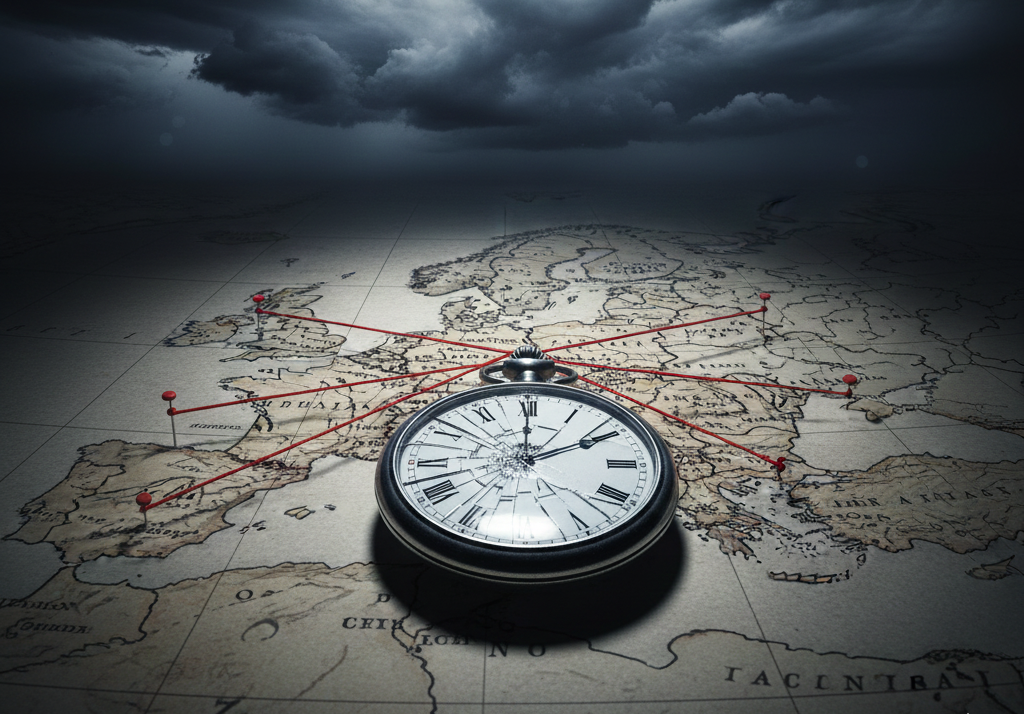
In this alternate timeline, the shots in Sarajevo miss their moment. Archduke Franz Ferdinand survives, the headlines fade, and Europe steps back from the edge in the summer of 1914.
That sounds like a simple fix. One life saved, one war avoided. But the tension in Europe was not a single wire. It was a dense knot of alliances, fear, pride, and military plans built around speed. The question is not whether peace was possible. It is whether peace could last once the system began to creak.
This piece explores how events might have unfolded if Franz Ferdinand was never assassinated, what pressures would still have pushed Europe toward conflict, and what a delayed or reshaped World War I could have changed in politics, economics, culture, and security.
The story turns on whether the crisis of 1914 needed Sarajevo, or whether Europe was already set up to explode from a different spark.
Key Points
Without the Franz Ferdinand assassination, the July 1914 crisis likely does not happen in the same way, removing the immediate trigger for a general European war.
Austria-Hungary’s internal problems still remain, and Franz Ferdinand’s rise could have intensified conflict inside the empire even if it reduced the urge for an external war.
Germany, Russia, and France would still be locked in a high-stakes security competition, with mobilization plans that rewarded speed and punished patience.
A major war might be delayed rather than prevented, possibly starting later in the Balkans or through a different great-power confrontation.
Delaying the war even a few years could change who leads, who hesitates, and which technologies dominate, altering the scale and character of any later conflict.
If a continent-wide war is avoided entirely, the 20th century’s political extremes, revolutions, and border settlements could look radically different, but instability would not vanish.
Background
The real 1914 timeline is familiar: Franz Ferdinand’s killing in Sarajevo set off a chain reaction. Austria-Hungary confronted Serbia. Great powers backed their partners. Mobilizations escalated into declarations of war.
If the Franz Ferdinand assassination does not occur, the fuse is not lit in the same place at the same time. But many of the underlying ingredients remain: nationalism in the Balkans, a fragile multi-ethnic Austria-Hungary, a German leadership anxious about encirclement, a Russian leadership determined not to lose influence in Slavic regions, and a France that feared permanent strategic weakness.
On top of that sat the machinery of early 20th-century war planning. Mobilization schedules were treated like physics. Rail timetables became strategy. Leaders believed that waiting could be fatal, because an enemy might mobilize first and gain an irreversible advantage.
So the alternate history is not a fairy tale of calm. It is a question of timing, personalities, and whether reforms or restraint can outpace the system’s drift toward confrontation.
Analysis
Political and Geopolitical Dimensions
A surviving Franz Ferdinand changes Vienna first. He was not a blank slate. He carried strong views about the empire’s future and reportedly feared a war with Serbia could be disastrous. In a world where he lives, Austria-Hungary still faces the same structural dilemma: how to govern rising nationalist demands without breaking apart.
If he eventually becomes emperor, he may push internal reforms meant to stabilise the empire by changing how different national groups are represented. That could reduce some revolutionary pressure. It could also enrage entrenched elites, especially those who benefit from the existing balance of power. The empire’s biggest threat might shift from external humiliation to internal paralysis.
Meanwhile, Serbia and pan-Slav movements do not disappear. The Balkans remain the most volatile region in Europe, a place where local violence can pull in patrons with larger ambitions. The alliances still exist, and the fear that a rival bloc is gaining ground still shapes decision-making.
So the likely geopolitical outcome is not “no crisis.” It is “a different crisis.” Austria-Hungary might still clash with Serbia later, but with different leadership in Vienna and possibly different calculations in Berlin and St. Petersburg.
Economic and Market Impact
Avoiding a 1914 war would be an economic reprieve in the short term. Trade and finance could continue, and governments would not immediately pivot to mass mobilisation, rationing, and wartime borrowing.
But pre-war Europe was not an economic paradise. Industrial competition was intense, labor unrest was common, and governments were under pressure to fund arms races while also responding to social demands at home. A delayed war could mean larger militaries, larger stockpiles, and more expensive commitments that strain budgets even without fighting.
If a major war breaks out later, the economic damage could be worse in some ways because states might enter it with bigger expectations, bigger promises to their populations, and more tightly coupled financial systems. A war starting in, say, the late 1910s could also intersect with different technologies and production capacity, changing how quickly societies can sustain mass conflict.
The biggest economic wild card is political. If a continent-wide war is avoided entirely, the revolutionary shocks associated with wartime collapse may not arrive in the same form. That could mean fewer sudden regime changes. It could also mean older empires limp on, postponing reform and storing up future economic crisis.
Social and Cultural Fallout
If 1914 passes without catastrophe, Europe’s mood might shift from fatalism to relief. But relief can be dangerous. Leaders may interpret “we got through it” as proof the system works, even as the pressures keep rising.
A delayed or avoided war could also reshape cultural identity. In the real timeline, World War I became a trauma that rewired politics, art, class structures, and trust in institutions. Without that rupture, older social hierarchies might persist longer. Women’s roles in the workforce might change more slowly. The moral authority of monarchies might erode more gradually instead of collapsing in a few years.
But nationalism would remain potent. Many movements were not created by the war; they were intensified by it. Without the war, some would cool. Others might fester, especially if empires keep denying self-determination while promising it will come “later.”
In other words, the social question becomes less about sudden trauma and more about prolonged tension: a longer, slower struggle over identity, rights, and borders.
Technological and Security Implications
War is an accelerator. Without a 1914 great-power war, certain technologies might develop more slowly, at least in military form. But the arms race would still drive innovation, and militaries would still plan for mass conflict.
If a later war occurs, it could be more mechanised from the start. The balance between infantry, artillery, aircraft, and armoured vehicles might look different. The early months could be deadlier, not because people became more brutal, but because states learned, prepared, and industrialised in advance.
Security dynamics would also be shaped by doctrine. Pre-1914 military thinking often assumed offense was decisive and speed was salvation. A delayed war might not fix that. It could even harden it, as generals argue that the only reason peace survived was that rivals were deterred by readiness.
What Most Coverage Misses
The popular version of this what-if is moral and personal: “One assassination caused a world war.” It is emotionally satisfying, and it highlights how fragile history can be. But it risks missing the deeper danger: systems that punish hesitation.
Even without Sarajevo, leaders were operating inside a structure that turned local shocks into existential tests. Alliances carried pride and credibility. Mobilization plans reduced flexibility. Domestic politics rewarded toughness. A crisis anywhere could be framed as the moment to prove resolve.
That matters because it suggests the real lesson is not simply “remove the spark.” It is “change the room full of gas.” In this alternate world, Sarajevo is not the match. But the air can still be combustible.
Why This Matters
The most affected regions in this alternate history are Central and Eastern Europe, the Balkans, and any colonial territories tied to European empires. In the short term, the absence of a 1914 war means fewer immediate deaths, less devastation, and no rapid collapse of multiple imperial systems.
In the long term, the stakes widen. If war is delayed, it may arrive with different leaders, different alliances, and different technology. If war is avoided entirely, the 20th century’s defining political upheavals could be muted or rerouted, but not magically resolved. Empires might survive longer, and the struggle for national self-rule might become a slower, messier process.
What to watch next in this hypothetical timeline is not a single date, but recurring fault lines: another Balkan crisis, a military incident between rival blocs, or a domestic collapse inside an empire that triggers intervention “to restore order.” The key signal would be whether great powers build mechanisms to slow crises down, or whether they keep treating speed as virtue.
Real-World Impact
A factory owner in northern Italy sees orders rise as rail and steel contracts expand, but worries that every “defense modernization” bill looks like a down payment on a war everyone claims they do not want.
A Serbian schoolteacher in Belgrade feels a brief easing of fear when 1914 passes quietly, yet still lives under pressure as nationalist groups push louder demands and the state tightens control to avoid provoking its neighbors.
A civil servant in Vienna spends years watching reform plans stall. Each delay fuels cynicism. The fear is not invasion tomorrow, but slow collapse at home.
A shipbroker in London enjoys calmer markets in the short run, then notices insurance rates creeping upward with every new European scare, as if finance itself is bracing for a conflict that keeps failing to arrive.
Conclusion
If Franz Ferdinand was never assassinated, Europe likely avoids the immediate plunge into World War I in 1914. That is the cleanest consequence, and it is enormous.
But the deeper question is whether leaders would use the extra time to defuse rivalries and reform brittle empires, or whether they would simply tighten alliances, expand armies, and wait for the next crisis with even sharper knives.
The fork in the road is between adaptation and escalation: compromise that feels humiliating versus readiness that feels safe. The direction becomes clearer when decision-makers start building “off-ramps” for crises, or when they keep designing plans that assume war must be fast, total, and unavoidable.
