Why the Cold War Lasted So Long: Fear, Power, and a Peace That Could Not Thaw
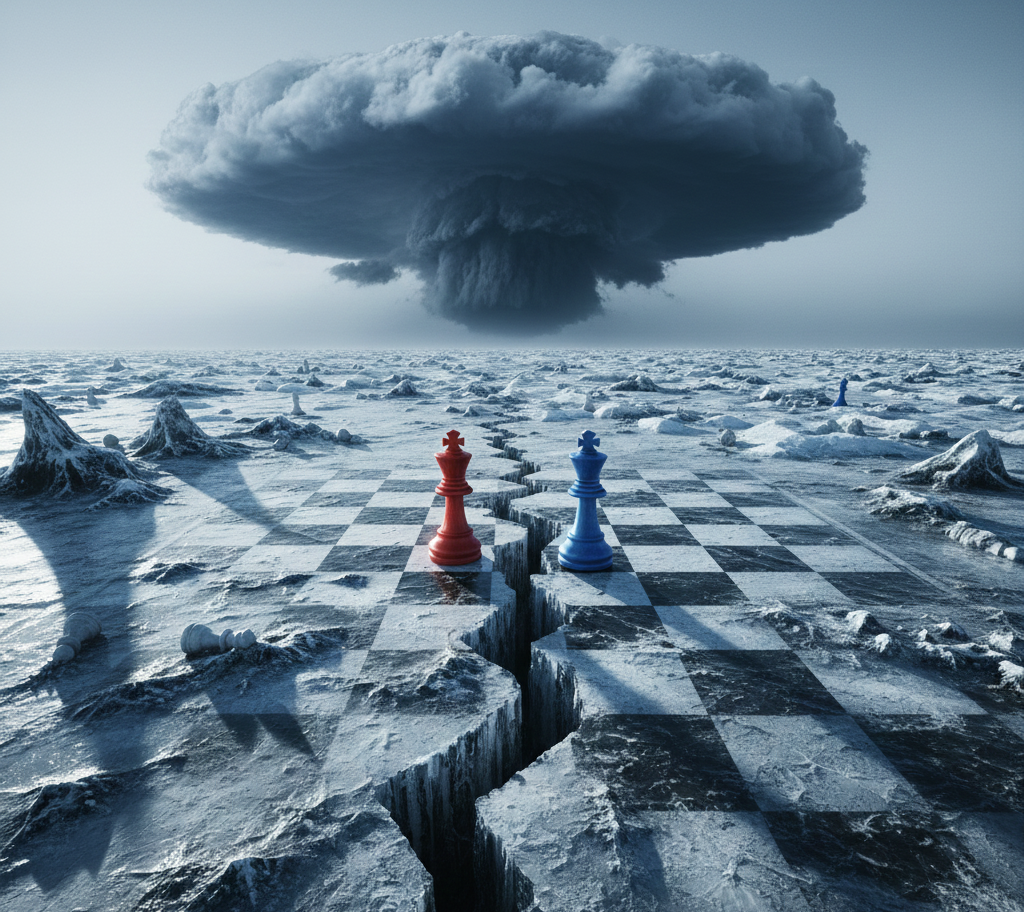
The Cold War lasted so long because neither side could afford to “win” in the normal sense. The United States and the Soviet Union built a world where a direct clash risked nuclear catastrophe, yet backing down risked collapse, humiliation, or strategic defeat.
That created a strange kind of stalemate. It was not calm. It was not safe. But it was stable enough to endure for decades, because the alternatives looked worse.
This piece explains the mechanics of that endurance. It breaks down the incentives that kept the conflict frozen, the pressure points that made it flare in proxy wars, and the slow internal strains that eventually snapped the Soviet system.
The story turns on whether a rivalry can be managed indefinitely when both sides fear defeat more than they desire peace.
Key Points
The Cold War endured because nuclear weapons made full-scale war too risky, while ideology and security fears made compromise feel dangerous.
Both blocs built alliances, bases, and doctrines that locked them into competition and made retreat look like weakness.
Proxy wars let each side fight for influence without triggering direct superpower combat, prolonging conflict instead of resolving it.
Intelligence failures and mutual suspicion kept worst-case thinking alive, even during periods of negotiation and arms control.
Domestic politics on both sides rewarded toughness and punished leaders who appeared to concede, narrowing room for settlement.
The Cold War ended less through a single “victory” than through Soviet economic strain, political legitimacy loss, and reform that spiraled beyond control.
Background
The Cold War was a long struggle for global influence between two rival systems: a US-led capitalist democratic bloc and a Soviet-led communist one-party bloc. It took shape after World War II as Europe and parts of Asia were reorganized, empires unraveled, and new states emerged.
It was “cold” because the superpowers avoided direct, sustained warfare against each other. But it was still a global conflict. It played out through military buildups, alliance systems, espionage, propaganda, economic pressure, and a series of crises that repeatedly brought the world close to disaster.
Several early features made it durable. Europe was divided, Germany was split, and security fears were intense on both sides. The US built a strategy of containment to limit Soviet expansion. The Soviet leadership sought buffers and control in its near abroad, shaped by its experience of repeated invasion from the West. The two sides also treated the conflict as moral and historical, not just strategic. That made “live and let live” harder to sell at home.
By the late 1940s and early 1950s, the conflict had hardened into institutions and routines: NATO and other alliances, large standing militaries, permanent intelligence bureaucracies, and an arms race that became a central feature of state power. The Cold War then ran through distinct phases of tension and easing, but the underlying structure stayed in place until the Soviet Union collapsed in 1991.
Analysis
Political and Geopolitical Dimensions
The Cold War lasted because it became a system, not a single dispute. Each side organized its security around the assumption that the other side was not simply a competitor but a threat to its existence.
For the United States and its allies, the fear was that Soviet power would roll outward: first through pressure on weakened European states, then through the takeover of key regions, and finally through the erosion of global confidence in liberal democracy. Even when Soviet moves were cautious or defensive, they were often interpreted through that lens.
For the Soviet Union, the fear ran the other direction. Soviet leaders believed that capitalist powers would exploit any Soviet weakness, surround them militarily, and eventually force regime change or fragment the state. Their answer was control: control of borderlands, control of satellites, and control of the narrative that their system was historically inevitable.
Those fears created a trap. If one side built missiles, the other saw proof of aggression and built more. If one side formed alliances, the other saw encirclement. Even détente, the periods of reduced tension, rarely erased the assumption of rivalry. It simply managed it.
And crucially, the Cold War involved many countries that were not superpowers but mattered immensely. Germany, Turkey, Iran, Korea, Vietnam, Cuba, Afghanistan, and dozens more became arenas where local politics and global rivalry fused. That multiplication of fronts made a clean settlement difficult. Even if Washington and Moscow wanted to cool tensions, events in one hotspot could reignite the whole system.
Economic and Market Impact
A long rivalry needs funding, and the Cold War turned competition into an economic structure. Defense spending became a permanent feature of budgets, not an emergency measure. Entire industries, research pipelines, and political coalitions formed around it.
For the United States, the burden was heavy but manageable within a large, adaptive economy. Defense spending also drove innovation and industrial output, even as it crowded out other priorities and intensified fiscal debates.
For the Soviet Union, the strain was more corrosive over time. A command economy can mobilize resources quickly, but it struggles with efficiency, consumer satisfaction, and technological diffusion. Sustaining military parity while also providing rising living standards proved brutally hard. The Soviet system could keep up for long stretches, but the cost accumulated: stagnation, shortages, cynicism, and a widening gap between official promises and lived reality.
The economic dimension also became global. Aid, trade access, and energy politics were used as tools. Countries were pulled into blocs not only by ideology but by loans, security guarantees, and access to markets. That turned the Cold War into an everyday reality for governments and households far from Washington or Moscow.
Social and Cultural Fallout
The Cold War lasted because it lived inside people’s identities. It was taught in schools, embedded in news coverage, and reinforced by constant storytelling about the other side’s menace. In many countries, fear of communism or fear of capitalism was not abstract. It was linked to real memories of war, occupation, repression, or poverty.
This cultural machinery made compromise politically dangerous. Leaders who explored accommodation risked being portrayed as naïve at best, traitorous at worst. Hardliners gained leverage because uncertainty was easy to weaponize. You could not easily prove the other side’s intentions were benign, but you could always imagine a worst case.
It also created habits of secrecy and suspicion. Espionage was not a side plot; it was central. The more each side spied, the more it assumed it had to. The more it assumed it had to, the more it invested in systems that needed an enemy to justify their scale.
Technological and Security Implications
Nuclear weapons were the core reason the Cold War could not resolve through direct war. They created a ceiling on escalation. That ceiling prevented a final showdown, but it did not produce trust. It produced management.
Deterrence worked by making the cost of attack unthinkable. Yet deterrence also encouraged constant readiness, rapid decision timelines, and hair-trigger fears of surprise attack. The result was a world where crises were terrifying, but also where both sides often stepped back at the edge because they understood the abyss.
Technology extended the rivalry into every domain: missiles, submarines, satellites, codebreaking, early warning systems, and eventually computing networks. Each new capability promised advantage, and each advantage threatened instability. That fed an arms race not only in weapons but in information.
Arms control helped. It did not end the Cold War, but it reduced certain risks and created channels of communication. Even so, arms control was usually about limiting the most dangerous excesses, not reconciling the underlying conflict.
What Most Coverage Misses
The Cold War lasted so long partly because it offered both sides a kind of clarity. It simplified the world into a map of allies, adversaries, and swing states. That clarity was politically useful. It justified budgets, disciplined internal dissent, and turned complex local conflicts into moral dramas with a “right side” and a “wrong side.”
It also lasted because it produced routines that substituted for resolution. Crisis management, back-channel diplomacy, summitry, and proxy competition became normal. In a paradoxical way, the conflict became governable. Leaders learned how to threaten without firing, how to posture without committing, and how to settle for partial deals that lowered risk without dissolving rivalry.
In other words, the Cold War did not just persist despite its dangers. It persisted because it became a stable operating system for international politics, until the Soviet state could no longer pay the costs of running it.
Why This Matters
The Cold War shaped borders, alliances, and nuclear strategy that still influence the modern world. Regions most affected were Europe, East Asia, the Middle East, and parts of Africa and Latin America where proxy struggles turned into long, brutal wars.
In the short term, the Cold War’s endurance meant decades of military spending, recurring crises, and periodic waves of fear. In the long term, it hardened institutions and expectations: permanent alliances, intelligence services with vast reach, and the assumption that great powers compete for spheres of influence.
There is no single upcoming “Cold War deadline” to watch. But there are concrete markers that keep changing how people understand it: the steady release of archival material over time, new historical research, and political debates that revive Cold War language to frame today’s conflicts. When leaders invoke that era, the key question to watch is whether they are using it to explain reality, or to simplify it for mobilisation.
Real-World Impact
A public school teacher in Kansas spends years running duck-and-cover drills. It becomes routine. Children absorb the idea that catastrophe can arrive in minutes, and adults learn to treat existential risk as normal background noise.
A young engineer in East Germany grows up with limited travel, restricted media, and constant pressure to conform. The state offers stability and jobs, but also demands loyalty and surveillance, shaping what ambition looks like.
A family in West Berlin lives with a divided city as daily fact. Politics is not theory. It is checkpoints, air corridors, and the knowledge that a misunderstanding between distant capitals could trap them overnight.
A diplomat in India navigates a world where accepting aid or weapons can pull the country toward one bloc’s priorities. “Non-alignment” becomes an active strategy, not a slogan, because every decision risks entanglement.
Conclusion
The Cold War lasted so long because it was a conflict neither side could safely finish. Nuclear weapons made total war suicidal. Ideology made coexistence feel like surrender. And global competition offered too many places for the rivalry to keep renewing itself.
In the end, the decisive fork was not a battlefield victory but a sustainability test. One system could absorb the costs of indefinite competition better than the other. When Soviet reforms tried to loosen the grip, they also loosened the state’s control over its own future.
The clearest sign of where any long rivalry is heading is not the loudest speeches. It is whether institutions can keep funding the contest, whether publics still believe the story that justifies it, and whether leaders can manage crises without needing a “final” win.
