What If Ukraine Was Never Invaded?
How Europe Might Have Changed After 2022
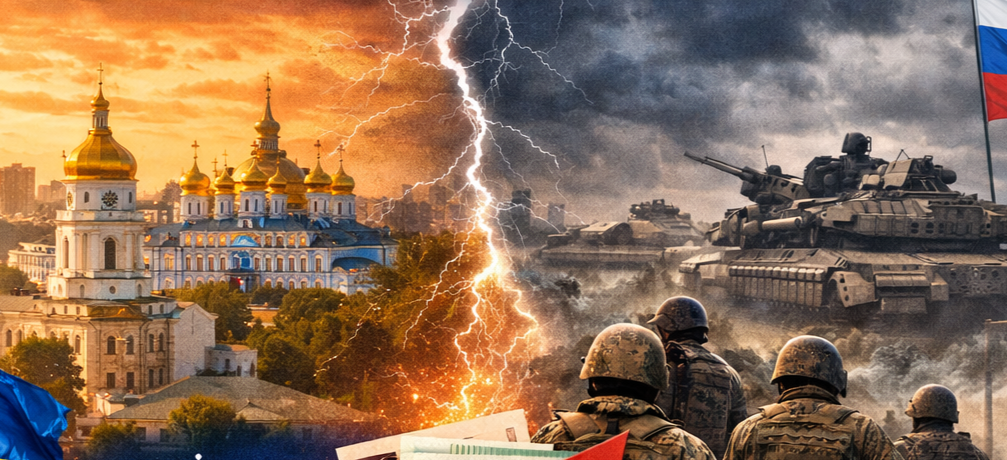
At the end of February 2022, Russian forces are in place around Ukraine. The world prepares for war. Then the order does not come.
In this scenario, the full-scale invasion of Ukraine never begins. Russia continues to use coercion, threats, and moderate pressure, but it does not escalate into a nationwide assault.
That single restraint prevents a mass battlefield shock. It also creates a different danger: a long standoff where nobody can relax, nobody can fully invest, and every capital must plan for a war that might still be one decision away.
By the end, the reader will understand how “no invasion” reshapes NATO’s urgency, Europe’s energy choices, Russia’s leverage, Ukraine’s reforms, and global inflation pressures—without pretending the world becomes stable.
There is only one point of divergence. The leaders, institutions, technology, and geography remain unchanged. Different incentives.
The story turns on whether deterrence without war produces peace—or only a quieter kind of siege.
Key Points
The divergence: Russia does not launch the February 2022 full-scale invasion, despite massed forces and a ready plan.
The first-order consequence is not calm; it is a prolonged emergency posture along a live border, with constant escalation risk.
The most significant constraint is credibility: once the invasion threat fails, Russia must either accept diminished leverage or find coercive tools short of open war.
Three plausible branches follow: a frozen standoff, a forced neutrality bargain, or a Ukraine that integrates westward without a battlefield rupture.
Much stays the same: Ukraine’s national trajectory, Russia’s security paranoia, Europe’s energy exposure, and the logic of alliance politics.
The key signal in the alternate timeline is money, not tanks: capital flight, insurance pricing, and reserve policy reveal who thinks war is truly off the table.
Baseline History
In the week before the real-world invasion, Ukraine is a sovereign state with a scarred eastern frontier. Russia has already seized Crimea years earlier and has backed separatist forces in the Donbas. Diplomacy has sputtered through ceasefires, violated truces, and exhausted formats. Trust is thin.
Russia’s leadership has concentrated military power near Ukraine’s borders. The pressure is visible: movements by rail, field hospitals, fuel and ammunition dumps, units rotated forward, and warlike messaging that frames Ukraine’s alignment with the West as a strategic threat. Ukraine, for its part, has improved its forces since 2014 but remains outmatched in mass.
Real history turned toward war because coercion had stopped delivering outcomes. Threats did not force Kyiv to yield strategic choices. Moscow’s leadership judged a rapid campaign could decapitate the state and install control at acceptable cost. It was a gamble on speed, surprise, and political collapse.
The Point of Divergence
The divergence is a decision point inside the Kremlin in the final hours before the assault.
Planners brief that the opening move depends on swift airfield capture, rapid road thrusts, and a political shock that splits the Ukrainian leadership. The same brief includes an uncomfortable fact: if the opening fails, the campaign becomes a grinding occupation problem across a huge country.
At the same moment, financial officials warn that a full-scale invasion risks immediate isolation of Russia’s banking access and the immobilisation of state wealth held abroad. They cannot guarantee the rouble, reserves, and payment rails will hold under a coordinated response.
In this scenario, the leadership chooses coercion over invasion. The forces remain in place, but the “go” order is withheld. Russia escalates pressure through recognition politics, cyber operations, and staged incidents, yet avoids the step that triggers open, nationwide war.
What changes immediately is the absence of mass bombardments and cross-border armour columns. The strategic contest remains constant. The border is still militarised. The threat is still real. Everyone still has to decide what they are willing to pay to avoid the next step.
The First Ripples
Kyiv wakes to sirens that never come. Airspace is tense but not shattered. The government keeps emergency measures ready because the absence of attack can be a feint.
Western capitals face a credibility test. They have warned for weeks. Now they must show that deterrence has weight, not just rhetoric. Sanctions that were framed as “if invasion” become harder to deploy at full force without looking arbitrary.
Moscow uses the pause as leverage. It signals that restraint is conditional and reversible. State media frames the non-attack as proof that Russia is reasonable and the West is hysterical. The message is designed for foreign audiences and for domestic legitimacy.
The First Month
The border becomes a permanent crisis zone. Units dig in. Logistics keep flowing. Families near the frontier live with packed bags and half-empty petrol tanks.
Markets respond in a muddled way. Some war premium leaks out of oil and gas pricing, but risk remains because the threat has not vanished. Insurers, shippers, and lenders price the region as unstable. That matters more than headlines. It changes who can borrow, who can export, and who can plan.
Diplomacy intensifies, but it is not warm. Ukraine seeks security guarantees and weapons deliveries. Russia seeks written limits on Ukraine’s alignment. Europe tries to prevent a war while avoiding a bargain that rewards threats.
The First Year
A non-invasion year is still a year of militarisation. Ukraine continues to rearm, train, and harden infrastructure because the next attempt could come with less warning. Conscription debates, defence budgets, and civil resilience planning become routine.
Europe’s energy policy changes, but more slowly and with more division. Without a battlefield shock, the political cost of rapid decoupling is higher. Some governments argue for long-term diversification without immediate rupture. Others push for hard separation anyway, fearing that dependency itself is the weapon.
Russia faces a different kind of risk. A failed threat can look like weakness. If it cannot convert pressure into concessions, its intimidation strategy loses potency. The state then leans harder on covert tools—sabotage, cyber disruption, and political influence—because tanks have been put back in the garage.
Analysis
Power and Strategy
Ukraine gains time, and time is power. Every month without invasion is another month of training, fortification, and institutional learning. It is also another month of diplomatic integration with European structures, even if formal membership remains distant.
Russia retains escalation dominance in the short term because it can still choose war. But coercion is not free. Keeping large forces forward drains readiness, budgets, and morale. It also locks Moscow into a posture where backing down looks like defeat.
The United States and Europe face an alliance puzzle. Without war, unity is harder to sustain. Some capitals will argue that the crisis is over. Others will insist it is merely paused. That split becomes Moscow’s best opening.
Economics, Industry, and Supply
The most important shift is not gas molecules. It is confidence.
Without invasion, Europe does not suffer the same immediate energy panic. But businesses still treat the region as risky. New factories, pipelines, and long contracts depend on the belief that borders will hold. A credible invasion threat is enough to chill investment.
Ukraine’s economy avoids mass destruction, but it does not return to normal. A country under permanent threat pays a tax in interest rates, migration, and lost capital. Even good reform laws struggle when citizens think war may still arrive.
Global inflation looks different. Food and fertiliser markets remain tight for other reasons, but a major war shock is absent. That means some prices rise less sharply, and some governments have slightly more room to breathe. It does not mean stability. It means fewer simultaneous fires.
Society, Belief, and Culture
Ukraine’s identity hardens anyway. The threat itself consolidates a national story: independence must be defended. The difference is that fewer families are displaced by war, and fewer communities are physically erased. Civic energy goes into resilience rather than reconstruction.
Russia’s domestic narrative is more complicated. Victory without battle is hard to celebrate. Leaders must claim they prevented a threat, forced respect, or exposed Western weakness. If living standards slip for unrelated reasons, the regime has less wartime unity to lean on.
Across Europe, public attention drifts sooner. That matters. Democracies fund long emergencies poorly when the images fade. A no-invasion timeline can produce complacency even as risk remains high.
Technology and Logistics of the Era
Modern warfare is fast, but modern mobilisation is also visible. Satellites, open-source tracking, and financial surveillance make surprise difficult. In real history, that visibility did not prevent war. In this scenario, it raises the perceived cost of failure.
Ukraine’s logistical advantage is geography. Defenders move along internal lines. Attackers must cross borders, hold roads, and feed columns. If the opening blow is not guaranteed, the entire premise of a quick victory collapses.
Communications, drones, and precision weapons still exist, but they do not eliminate mass. They make mistakes costly and propaganda fragile. The more the world can see, the less a state can safely bluff.
What Most Coverage Misses
Deterrence is not only missiles and speeches. It is credit.
If banks believe war is coming, they shorten maturities and raise rates. If insurers believe ports may close, they withdraw cover. If shipping firms believe a region is one missile away from chaos, they reroute. Those choices can cripple a state’s economy without a single bomb falling.
In a no-invasion timeline, the fight becomes a contest over risk pricing. Whoever convinces markets that the other side will blink gains leverage. That is why the quiet signals—reserve policy, capital controls, bond yields, and insurance exclusions—matter more than dramatic summits.
Scenario Paths: If Ukraine Was Never Invaded
1) The Border That Never Sleeps
Russia keeps forces near Ukraine and uses periodic crises to extract attention. Ukraine stays mobilised, builds layered defences, and deepens security ties with the West short of formal alliance guarantees. Europe argues endlessly over how hard to push back.
This phenomenon happens because it preserves options for Moscow while avoiding the catastrophic costs of occupation. It also suits risk-averse European politics that prefer managed tension to open war.
Breakpoint: a single incident—a downed aircraft, mass casualties from a strike blamed on the other side, or a provocation gone wrong—forces leaders to choose escalation or de-escalation in public.
Plausibility: Most likely. It requires no sudden breakthroughs, only the continuation of incentives already visible before the real invasion.
2) The Bitter Neutrality Bargain
After months of brinkmanship, Ukraine accepts a constrained neutrality formula in exchange for strong economic support and credible security commitments from several states. Russia claims it prevented NATO expansion. Ukraine claims it preserved sovereignty and bought time.
This scenario happens if European leaders decide the permanent emergency is unsustainable and if Ukraine’s public accepts a bargain that feels like risk management rather than surrender. It also requires Russia to accept that a neutral Ukraine is not a controlled Ukraine.
Breakpoint: a domestic vote or constitutional move in Ukraine becomes the hinge. If the public rejects it, the bargain collapses. If it passes narrowly, legitimacy remains fragile.
Plausibility: Plausible. The constraint is politics. The deal must survive both Ukrainian pride and Russian maximalism.
3) The Quiet Western Lock-In
Ukraine avoids war, reforms steadily, and becomes deeply integrated into European supply chains, energy grids, and defence training networks. Russia responds with sabotage, cyber disruption, and political warfare, but the window for invasion closes as Ukraine’s readiness and foreign links harden.
This occurs because time favours the defender when it is used effectively. It also happens if Western governments treat the crisis as a long campaign rather than a headline event.
Breakpoint: a shift in Western political will alters the trajectory. If military aid and economic integration slow, Ukraine’s lock-in stalls and Moscow’s leverage returns.
Plausibility: Plausible. The constraint is consistency. Democracies must fund a long strategy without the moral shock of war imagery.
Least likely outcomes are the neat ones: a stable, trusting settlement that ends the security contest, or a Russia that abandons the issue entirely. The interests and narratives are too entrenched, and the geography does not move.
Why This Matters
In the short term, a no-invasion timeline spares lives and cities from mass destruction. It also preserves a dangerous ambiguity. Europe still rearms, but it argues more. Ukraine still mobilises, but it lives in suspended time. Russia still threatens, but it cannot easily cash in the threat without paying the costs it tried to avoid.
Long-term, the global order shifts in quieter ways. Without a full-scale war, some states conclude that coercion works even without battle. Others conclude the opposite—that deterrence works if it is credible and coordinated. Energy policy, defence industry investment, and alliance architecture still evolve, but their paces and public mandates differ.
The deeper theme is a modern one: the world can be reshaped by wars that do not happen because a permanent threat can reorganise budgets, politics, and identity almost as powerfully as combat.
Real-World Impact
A dockworker in Liverpool sees fewer sudden spikes in shipping disruption, but contracts still wobble when insurers change terms overnight. Risk sentiment fluctuates over time. The pay packet becomes tied to distant decisions that never make the local news.
A farmer near Kyiv plants with a clock in mind. The fields are intact, but the future is discounted. Loans cost more. Machinery orders are delayed. The harvest is real, yet every season is shadowed by mobilisation plans and rumours of closures.
A civil servant in Delhi manages food inflation with slightly more room. There is still global turbulence, but fewer simultaneous shocks. Diplomacy becomes a balancing act: keep trade moving, avoid taking sides, and prepare for another crisis that could erupt at any time.
A small manufacturer in southern Germany faces a different energy landscape. Prices still rise and politics still argue, but the sudden rupture is softened. The firm invests cautiously, watching for signs that the border crisis is hardening into permanence.
What’s Next?
If Ukraine was never invaded, the central question would not disappear. It changes shape.
The contest becomes a long struggle over credibility, money, and endurance. Russia tries to keep the threat alive without paying the costs of war. Ukraine tries to turn time into strength without being trapped in permanent emergency. Europe tries to stay united without the galvanising force of catastrophe.
The markers that reveal which branch is winning are concrete. Watch alliance exercises near the region, not speeches. Watch whether Ukraine’s defence budget becomes structurally normal rather than reactive. Watch energy contracts and infrastructure build-outs that assume long-term separation. Watch credit spreads, insurance exclusions, and capital controls that show who thinks war is truly off the table.
