When The Sun Vanished: How Eclipses Terrified, United And Enlightened Humanity
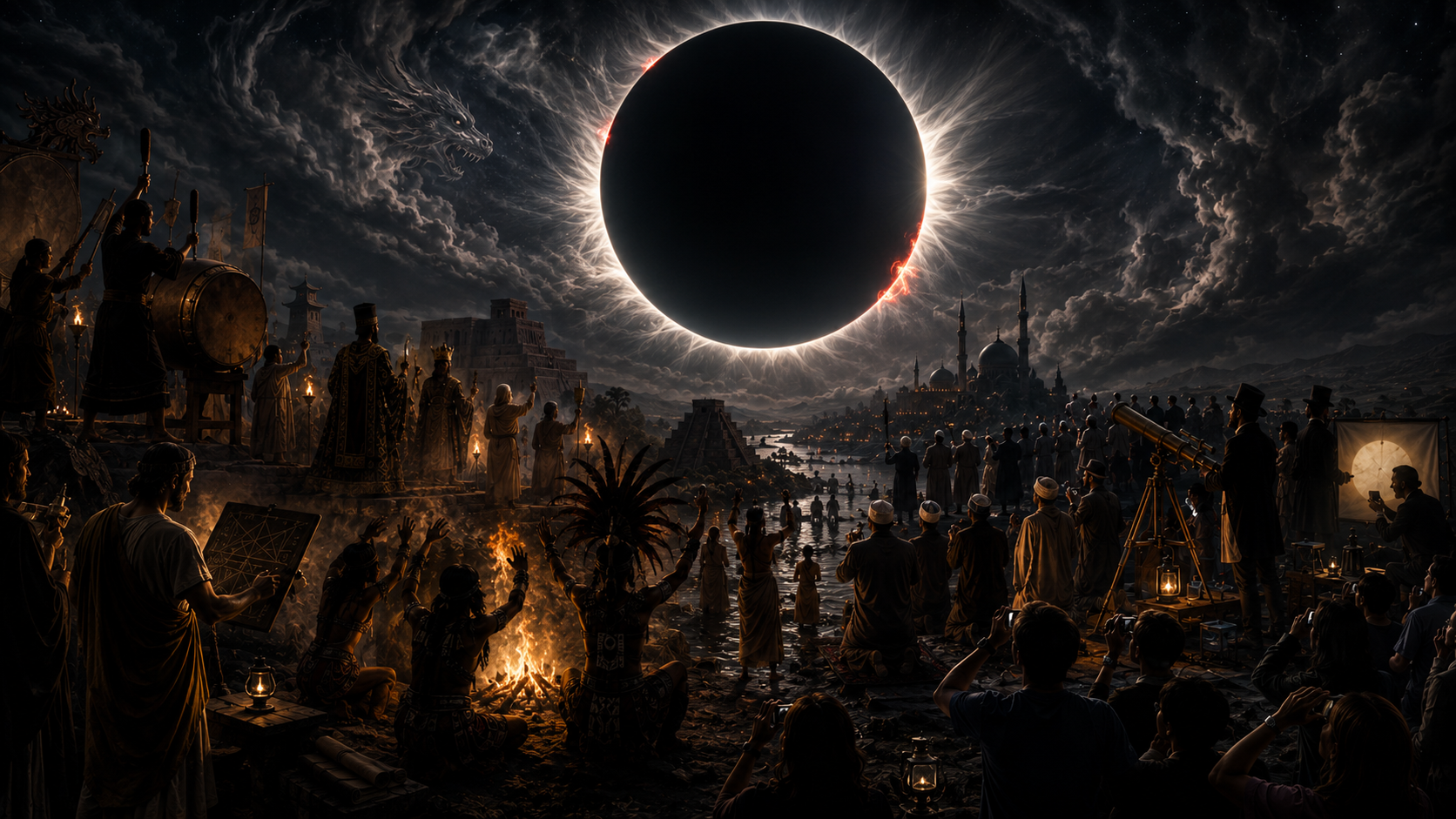
Gods, Monsters And Science: How Humans Explained Solar Eclipses
From Sun-Eating Dragons To Einstein: Humanity’s Extraordinary Eclipse Story
The Sun begins to disappear in the middle of the day. The light weakens, the temperature falls, shadows sharpen and animals behave as though night has arrived hours early. Then, along a narrow path across the Earth, the final bright sliver vanishes and an immense black disc appears in the sky, surrounded by a ghostly silver corona.
Modern observers know exactly what is happening. Yet knowledge does not make the experience ordinary, as millions witnessing the solar eclipse of 12 August 2026 are discovering across the Northern Hemisphere. A total eclipse is visible along a path crossing remote northern Russia, Greenland, Iceland, Spain and a small corner of Portugal, while much of Europe—including Britain—experiences a dramatic partial eclipse.
For most of human history, there were no orbital animations, eclipse glasses, live broadcasts or predictions accurate to the second. People saw the most dependable object in their world apparently attacked, weakened or extinguished without warning. The disappearance of the Sun could suggest that a monster had entered the heavens, a king was about to die, the gods were angry or the existing order of the universe was collapsing.
Solar eclipses therefore became far more than astronomical events. They were political emergencies, religious tests, opportunities for communal reconciliation and eventually laboratories capable of revealing the composition of the Sun and the structure of gravity itself.
The Moon’s shadow has remained the same. What has evolved is humanity’s ability to explain it—and our belief about whether people are helpless beneath the heavens or capable of understanding them.
The Most Terrifying Sight In The Ancient Sky
A total solar eclipse attacks several basic human expectations at once. Daylight is supposed to be reliable, the Sun is supposed to be untouchable and darkness is supposed to arrive gradually at the end of the day. An eclipse violates all three rules within minutes.
The physical sensations deepen the disorientation. Temperatures can fall noticeably as the Sun is covered, bright surroundings take on an unfamiliar metallic quality and the approaching lunar shadow can appear to race across the landscape. Birds may return to their roosts, insects associated with twilight can emerge and human crowds often fall silent as totality begins.
To a society whose survival depended upon sunlight, seasons and successful harvests, such a transformation demanded an explanation. The Sun was not merely an attractive object in the sky. It was heat, food, time, direction and life itself.
Ancient reactions were not simply examples of ignorant people panicking at something they did not understand. Communities interpreted eclipses through sophisticated existing systems of religion, political authority and natural observation. They often knew that eclipses recurred and might even predict when one was possible, while still regarding the event as a meaningful message from the divine world.
That combination—careful calculation alongside ritual fear—is one of the most important facts in eclipse history. Scientific prediction did not immediately erase sacred meaning. For centuries, the two existed together.
When Something Ate The Sun
One of the most widespread eclipse ideas was that a creature had bitten, swallowed or attacked the Sun. Versions of this cosmic assault appeared across societies that had little or no contact with one another.
In ancient China, eclipses were commonly described through the language of the Sun being eaten. The attacker became associated in popular tradition with a celestial dragon, and communities responded by making noise—beating drums, striking vessels and creating enough commotion to drive the creature away.
The ritual had an irresistible logic. People produced an enormous noise; the darkness receded; the Sun returned. Whatever calculations court astronomers may have possessed, the public performance could appear to have succeeded every time.
Chinese eclipse rituals eventually became more formal than a spontaneous attempt to frighten a monster. Classical texts describe drums being beaten and normal royal sacrifices being interrupted. By the Ming period, “rescuing the Sun” could form part of organised local government ritual, revealing how an ancient cosmic fear became embedded within the machinery of the state.
The devouring image appeared elsewhere in different forms. Norse mythology described the wolves Sköll and Hati pursuing the Sun and Moon through the sky, with the eventual capture of their prey connected to the destruction of the existing world at Ragnarök. In parts of Vietnam, a frog or toad was blamed, while some North American traditions spoke of a squirrel or other animal gnawing at the Sun.
These stories should not be flattened into a single universal myth. Their religious meanings, social functions and surviving evidence differ considerably. What they share is an intuitive response to the visual appearance of a partial eclipse: it really does look as though an invisible mouth is taking progressively larger bites from the solar disc.
Making noise also gave frightened observers something active to do. Instead of waiting helplessly for daylight to return, the community could assemble, confront the danger and participate in the rescue of the world.
China Turned Eclipses Into Affairs Of State
Few civilisations recorded celestial events as consistently as imperial China. Astronomy was closely connected to government because the emperor ruled through the Mandate of Heaven, and unusual events in the sky could be interpreted as evidence that the relationship between Heaven and the dynasty had been disturbed.
A solar eclipse was therefore politically dangerous. It might signal failures in government, misconduct at court or approaching trouble for the ruler. Prediction was not an abstract intellectual exercise; it allowed the state to prepare its ritual response and demonstrate that the emperor’s officials remained capable of interpreting the cosmos.
Chinese astronomers maintained records over many centuries and continually improved their mathematical methods. Eclipse calculation eventually became an important test of astronomical competence, although predicting exactly where a solar eclipse would be visible remained extremely difficult.
The famous story of the astronomers Hsi and Ho claims that they were executed after becoming drunk and failing to predict an eclipse during the reign of the legendary emperor Zhong Kang. It is frequently repeated as an example of the deadly consequences of professional failure, but the story comes from sources written long after the supposed event and cannot be treated as straightforward history.
The more important truth is institutional. China created a long-lived astronomical bureaucracy in which observation, mathematics, ritual and political legitimacy reinforced one another. An eclipse could be understood as a calculable alignment and a moral warning at the same time.
Officials might fast, modify court ceremonies, issue proclamations or participate in rituals intended to restore harmony. The event was not celebrated in the modern sense. It was managed as a disturbance in the relationship between the human and celestial orders.
Mesopotamia And The King Who Could Not Risk The Sky
Ancient Mesopotamian scholars created some of the most detailed astronomical records in the pre-modern world. Babylonian and Assyrian specialists tracked the movements of the Moon and planets, identified recurring patterns and developed increasingly effective methods of anticipating eclipses.
Their expertise did not make eclipses emotionally neutral. The heavens were filled with messages, and a solar eclipse could be read as a particularly dangerous omen for a king and his kingdom. Its meaning might depend upon the month, time, direction of the shadow and region in which it appeared.
A securely dated Assyrian record describes the solar eclipse of 15 June 763 BC. Because that eclipse was entered into an official sequence of years, modern historians have used it as a crucial chronological anchor for the ancient Near East.
The most extraordinary response to a threatening eclipse was the substitute-king ritual. If priests concluded that an omen endangered the real ruler, another man could temporarily be placed on the throne, dressed as a king and given a queen. The genuine monarch withdrew from view so that the predicted disaster would fall upon his substitute.
Once the dangerous period had passed, the substitute and his queen could be killed, carrying the hostile fate with them. The real king then returned to power, symbolically surviving the judgement of the heavens.
The ritual reveals how inseparable astronomy and politics had become. Mesopotamian scholars could possess the technical ability to anticipate an eclipse without seeing it as merely mechanical. Prediction made the ritual possible because the court knew when the danger was approaching.
There are surviving references to multiple substitute kings, although the details varied and not every eclipse required such an extreme response. The practice was built upon a brutal political principle: the stability of the realm and survival of the legitimate monarch were considered more valuable than the lives of those selected to absorb the omen.
Greece And The Search For A Physical Cause
Greek thinkers helped advance a different kind of eclipse question. Instead of asking primarily what an eclipse meant, natural philosophers increasingly asked what physical arrangement of objects caused it.
A famous account attributed to Herodotus says that Thales of Miletus predicted a solar eclipse during a battle between the Medes and Lydians. When darkness fell, the armies supposedly stopped fighting and negotiated peace. The eclipse is usually associated with 28 May 585 BC.
The story is powerful but should be treated cautiously. Historians continue to debate whether Thales could have predicted that particular eclipse with the geographical and chronological accuracy implied by later retellings. He might have identified a period in which an eclipse was possible, or the prediction may have been enhanced as the story passed down.
By the fifth century BC, Anaxagoras offered a recognisably physical explanation: the Moon could block the Sun’s light. He also understood that moonlight was reflected sunlight and that the Earth’s shadow caused lunar eclipses.
This was a profound conceptual change. An eclipse did not require the Sun to be injured, consumed or extinguished. The Sun could remain exactly where it was, shining continuously, while the apparent catastrophe was produced by the positions of three ordinary celestial bodies.
Greek geometry allowed astronomers to turn that insight into a mathematical system. Hipparchus used eclipse observations to investigate the distances and sizes of the Sun and Moon, while Ptolemy’s later astronomical model provided methods for calculating their movements.
None of this instantly destroyed astrology, religion or supernatural interpretation. Educated observers could understand the geometry and still consider an eclipse meaningful. The decisive change was that natural causation had become available: the darkness could be explained without needing a monster or an angry god to physically attack the Sun.
Eclipses In The Maya And Aztec Worlds
Maya astronomers monitored the sky with extraordinary care. Their surviving manuscripts include tables designed to track cycles in which solar and lunar eclipses could occur, most famously within the Dresden Codex.
These tables did not operate like a modern map predicting the exact route of the Moon’s shadow across the Earth. They identified recurring periods of eclipse danger, enabling ritual specialists to anticipate when an eclipse was astronomically possible.
Among Maya peoples, the language of the Sun being eaten also appeared. Eclipses could be associated with imbalance, conflict between cosmic powers, danger to rulers or disruption within the natural and social worlds. Ritual action, prayer and noise could help confront that instability.
The Mexica, widely known as the Aztecs, placed the Sun at the centre of a universe that required continual nourishment and renewal. Their cosmology described earlier worlds that had been destroyed, creating a deep sense that the current Sun was powerful but not guaranteed to survive forever.
Eclipses could therefore suggest something more frightening than a temporary interruption of daylight. They could appear to foreshadow the death of the Sun and the release of destructive celestial beings. Some accounts describe particular concern for pregnant women and unborn children, alongside defensive practices intended to protect the household and body.
Human sacrifice formed part of the broader Mexica relationship with solar power, but it is misleading to suggest that every eclipse automatically produced a single standard sacrifice ceremony. Much of the written evidence was recorded after the Spanish conquest, and it passed through the interpretations of colonial authors.
The reliable conclusion is more nuanced. Maya and Mexica societies possessed serious astronomical knowledge while understanding the heavens through religious systems in which celestial stability required attention, calculation and sometimes ritual intervention.
The Inca And The Anger Of Inti
For the Inca Empire, the Sun was intimately connected to political authority. The ruler was presented as a descendant of Inti, the Sun god, while temples, agricultural calendars and public ceremonies reinforced the relationship between sunlight, prosperity and imperial order.
A solar eclipse could be interpreted as Inti displaying anger or withdrawing his favour. That possibility threatened more than the weather. It struck at the sacred legitimacy of the ruler and the stability of the empire.
Accounts written during and after the Spanish conquest describe responses including fasting, lamentation, prayer and offerings. Diviners might attempt to identify the offence that had provoked the Sun, while the ruler could perform ceremonies intended to restore the relationship.
Colonial accounts require careful handling because European chroniclers did not observe Inca religion from a neutral position. Some were attempting to document an empire being dismantled; others filtered Andean traditions through Christian assumptions about worship and superstition.
Even so, the broader pattern is consistent with the political meaning of eclipses in China and Mesopotamia. Where rulers claimed a privileged relationship with the sky, an eclipse could become a referendum on earthly power.
Rahu, Purification And Hindu Eclipse Traditions
In Hindu mythology, eclipses became associated with Rahu, whose story is told in several forms. During the churning of the cosmic ocean, Rahu disguised himself and consumed some of the nectar of immortality. The Sun and Moon exposed him, and Vishnu severed his head—but because the nectar had already made him immortal, Rahu survived and continued pursuing the celestial bodies in revenge.
When Rahu catches the Sun, an eclipse occurs. The explanation captures the visual idea of swallowing while also explaining why the Sun always returns: Rahu’s severed form cannot hold it permanently.
Hindu eclipse observances have varied across region, period, community and family. They can include fasting, avoiding food prepared during the eclipse, reciting mantras, giving to charity and bathing before or after the event as an act of purification.
Some temples close during the eclipse and reopen after cleansing rituals. Sacred rivers may attract worshippers who regard the eclipse as an unusually powerful moment for bathing, prayer or acts intended to produce spiritual merit.
These practices have not simply vanished with modern astronomy. India has produced distinguished astronomers, operates major space missions and calculates eclipses with extreme precision, yet ritual observance continues among many people. Scientific and sacred understandings can occupy different parts of the same cultural life.
Islam Rejected A Dangerous Eclipse Myth
A pivotal episode in Islamic tradition occurred when a solar eclipse coincided with the death of Ibrahim, the young son of the Prophet Muhammad. People connected the darkness with the child’s death, but Muhammad rejected the idea that eclipses were caused by the birth or death of any person.
The Sun and Moon, he taught, were signs of God rather than celestial instruments arranged around the lives of powerful individuals. Muslims were instructed to pray when an eclipse occurred, producing the special congregational eclipse prayer known as Salat al-Kusuf.
The episode matters because it challenged a deeply attractive political and emotional explanation. A ruler or religious leader could easily have accepted the suggestion that the sky was responding personally to his loss. Instead, the coincidence was denied.
Prayer remained the appropriate response, but the eclipse was separated from human biography. It was simultaneously a natural event within creation and an occasion for humility, worship and reflection.
Astronomers working across the medieval Islamic world then improved inherited Greek, Indian and Persian mathematical traditions. Scholars compiled observational tables, refined eclipse calculations and criticised weaknesses in earlier models.
Al-Biruni used astronomical geometry and observations in his investigations of the Earth, Moon and geography. Ibn al-Haytham’s work on optics helped explain how light travelled and how solar images could be observed by projection, contributing to techniques that made eclipse study safer and more precise.
Europe Between Portent And Prediction
Medieval European chronicles frequently recorded eclipses alongside wars, royal deaths, famines and political upheaval. The events could be described as warnings from God, even when scholars understood that the Moon was passing between the Earth and Sun.
This was not necessarily seen as a contradiction. A mechanically predictable event could still have been scheduled by divine providence to communicate a warning. Knowing how an eclipse occurred did not answer why it had occurred at a particular historical moment.
Communal responses could include church services, prayer, fasting or public anxiety. Chroniclers sometimes exaggerated darkness or connected an eclipse to a disaster retrospectively, strengthening the sense that celestial changes announced earthly consequences.
The development of printing transformed eclipse culture. Predictions, pamphlets and diagrams could circulate beyond courts, monasteries and universities. Eclipses became public information events as well as religious and astrological ones.
The telescope, improved clocks and increasingly accurate lunar theories made predictions more useful. Observers could prepare instruments, travel to promising locations and compare what they saw with mathematical expectations.
Fear did not disappear overnight. Printed eclipse predictions could generate panic as easily as reassurance, particularly when astrologers attached disasters to them. Yet the balance of authority was shifting from interpreters of omens towards people who could state where the shadow would fall and when daylight would return.
Halley Made The Eclipse A Public Experiment
The total solar eclipse that crossed England on 3 May 1715 marked a turning point in Britain. Edmond Halley calculated its route, produced a map showing the expected path and invited people to report what they observed from different locations.
His predicted time for the London eclipse was accurate to within approximately four minutes. That achievement turned an event once associated with cosmic uncertainty into a demonstration of mathematical power.
Halley was not merely predicting that an eclipse would occur somewhere. He was attempting to map the Moon’s shadow across towns, counties and coastlines. Reports from the public allowed him to refine his calculations and produce an improved map for the eclipse of 1724.
The eclipse became a form of distributed science. People across the country could compare a printed prediction with the sky above them and contribute information to a larger investigation.
Public confidence in prediction grew because the result was visible. A person did not need to understand every astronomical calculation to recognise that the shadow had arrived where the map said it would.
The political implication was subtle but enormous. If the apparent death of the Sun could be forecast on paper, observed according to schedule and explained through geometry, it became harder to present it as an improvised judgement directed at a particular monarch.
When Eclipses Became Scientific Laboratories
Once astronomers could predict eclipses accurately, expeditions began travelling into the path of totality. The darkness that had once interrupted observation became the very condition scientists needed.
During totality, the Moon blocks the dazzling surface of the Sun and exposes its much fainter outer atmosphere, the corona. Before the invention of the coronagraph in the twentieth century, a total eclipse offered the only practical opportunity to study that structure in detail.
Photography transformed the work again. Johann Julius Friedrich Berkowski captured the first successful photograph of a total solar eclipse in 1851, preserving the corona for analysis rather than relying entirely upon hurried sketches and human memory.
Spectroscopy then allowed scientists to separate sunlight into its component wavelengths. During the eclipse of 1868, Pierre Janssen detected an unfamiliar spectral line associated with a previously unknown element. Norman Lockyer studied the same line and helped identify the element later named helium, after the Greek Sun god Helios.
Helium was therefore detected in the Sun before it was isolated on Earth. An event once interpreted as a monster eating the solar disc helped reveal that the Sun contained an element humanity did not yet know existed beneath its feet.
Eclipse expeditions became prestigious international operations carrying telescopes, cameras, spectroscopes and teams of assistants across oceans. Scientists confronted cloud, illness, equipment failure and the brutal fact that years of preparation could be ruined by several minutes of bad weather.
The culture surrounding eclipses was becoming celebratory, but the old emotional intensity remained. The prize was no longer the rescue of the Sun. It was a few irreplaceable minutes in which nature temporarily removed the glare concealing its secrets.
The Eclipse That Made Einstein Famous
The eclipse of 29 May 1919 produced the most famous scientific episode in eclipse history. Albert Einstein’s general theory of relativity predicted that gravity would bend light, causing stars appearing close to the Sun to look slightly displaced from their normal positions.
Ordinarily, the Sun’s brightness made those stars impossible to photograph. During a total eclipse, however, the darkened sky created an opportunity to compare their apparent positions with photographs taken when the Sun was elsewhere.
Expeditions led by British astronomers gathered observations from Príncipe, off the west coast of Africa, and Sobral in Brazil. Arthur Eddington became closely associated with the result, alongside Astronomer Royal Frank Dyson and Andrew Crommelin.
The measurements were announced as supporting Einstein’s prediction. The result turned Einstein into an international celebrity and helped replace the Newtonian image of gravity as a force acting across space with the relativistic idea that mass curves spacetime.
The 1919 analysis has since been debated, particularly over the quality and selection of photographic plates. Later observations using improved methods repeatedly confirmed gravitational light bending, and general relativity became one of the foundations of modern physics.
The historical symbolism remains extraordinary. For ancient rulers, an eclipse could threaten political legitimacy. In 1919, the same darkness helped transfer scientific authority from one conception of the universe to another.
Traditions That Continue In The Scientific Age
It is tempting to describe eclipse history as a straight road from superstition to science. That story is too simple and can become patronising towards cultures whose traditions remain alive.
Some Diné, or Navajo, people regard an eclipse as a sacred period requiring quiet, restraint and respect. Traditional practice can involve remaining indoors, avoiding looking at the eclipse and pausing normal activities rather than joining a public viewing party.
The Batammaliba people of Togo and Benin are associated with a strikingly different response. Their eclipse tradition understands the Sun and Moon as being in conflict, encouraging human beings to resolve quarrels and restore peace within their own communities.
Modern Maya communities continue to interpret eclipses through inherited cultural ideas while also participating in contemporary education and astronomy. Hindu families may observe fasting and purification rituals while following precise scientific forecasts on television or through mobile applications.
These practices are not failed attempts at physics. They address meaning, identity, conduct and relationships rather than merely the orbital cause of the event.
Respecting them also requires avoiding the claim that all Indigenous people respond in the same way. Traditions differ between nations, villages, families and individuals. Some people observe inherited restrictions closely; others attend public events; many combine cultural respect with scientific knowledge.
From Public Terror To Eclipse Tourism
The modern eclipse has become a global logistical event. Airlines adjust routes, cruise ships sail towards clear skies and enthusiasts travel thousands of miles to stand inside a path that may be only a few hundred kilometres wide.
Eclipse chasers study historical cloud data, elevation, road access and alternative viewing locations. Some spend decades accumulating minutes of totality, repeatedly crossing continents for an event that rarely lasts longer than a few minutes at any one location.
Scientists have pursued the shadow with equal determination. In 1973, researchers aboard Concorde followed a total eclipse across Africa at supersonic speed, extending their experience of totality to more than 74 minutes.
The public ritual has changed as well. Instead of beating drums to force a creature away, crowds count down to totality. Instead of hiding a king, organisers distribute certified viewing glasses. Instead of waiting for priests to interpret the omen, smartphones display the contact times for each precise location.
Festivals now combine astronomy talks, music, camping, photography and tourism. Couples arrange weddings beneath the shadow. Schools construct pinhole projectors, observatories hold public sessions and space agencies broadcast the moving darkness around the world.
Yet modern crowds often repeat one ancient behaviour: they shout, cheer or fall completely silent when totality arrives. The explanation may be different, but the emotional response remains remarkably familiar.
What Humanity Really Learned From The Vanishing Sun
The greatest change in eclipse history is not that humans stopped feeling awe. It is that prediction removed helplessness from the experience.
Babylonian scholars identified patterns. Chinese astronomers built institutions around calculation. Greek thinkers described physical causes. Islamic and medieval scholars preserved, tested and improved astronomical models. Early modern astronomers mapped the shadow, while later expeditions used its darkness to discover helium and test the nature of gravity.
At each stage, the eclipse moved further from being an unpredictable assault upon the world. Humanity learned that the Sun continued shining, the Moon followed a comprehensible orbit and the shadow could be calculated centuries into the future.
But scientific knowledge did not strip the eclipse of meaning. It created new forms of meaning: international expeditions, shared public observation, cultural remembrance, scientific discovery and the overwhelming realisation that the apparent sizes of the Sun and Moon align almost perfectly in Earth’s sky.
Modern observers can know the exact second at which totality will begin and still gasp when it happens. They can understand orbital mechanics and still feel, for several minutes, that the ordinary rules of the world have been suspended.
That may be the real continuity across eclipse history. Humans once gathered to rescue the Sun, protect a ruler, pray, fast or repair communal conflicts. Today, we gather to watch, measure, photograph and celebrate—but we are still gathering beneath the same shadow.
The Sun was never being swallowed, punished or extinguished. What eclipses revealed instead was the human mind at work: frightened by disorder, hungry for explanation, capable of transforming myth into mathematics and still unwilling to surrender its sense of wonder.
