Why Communism Usually Fails — And Why the Idea Refuses to Die
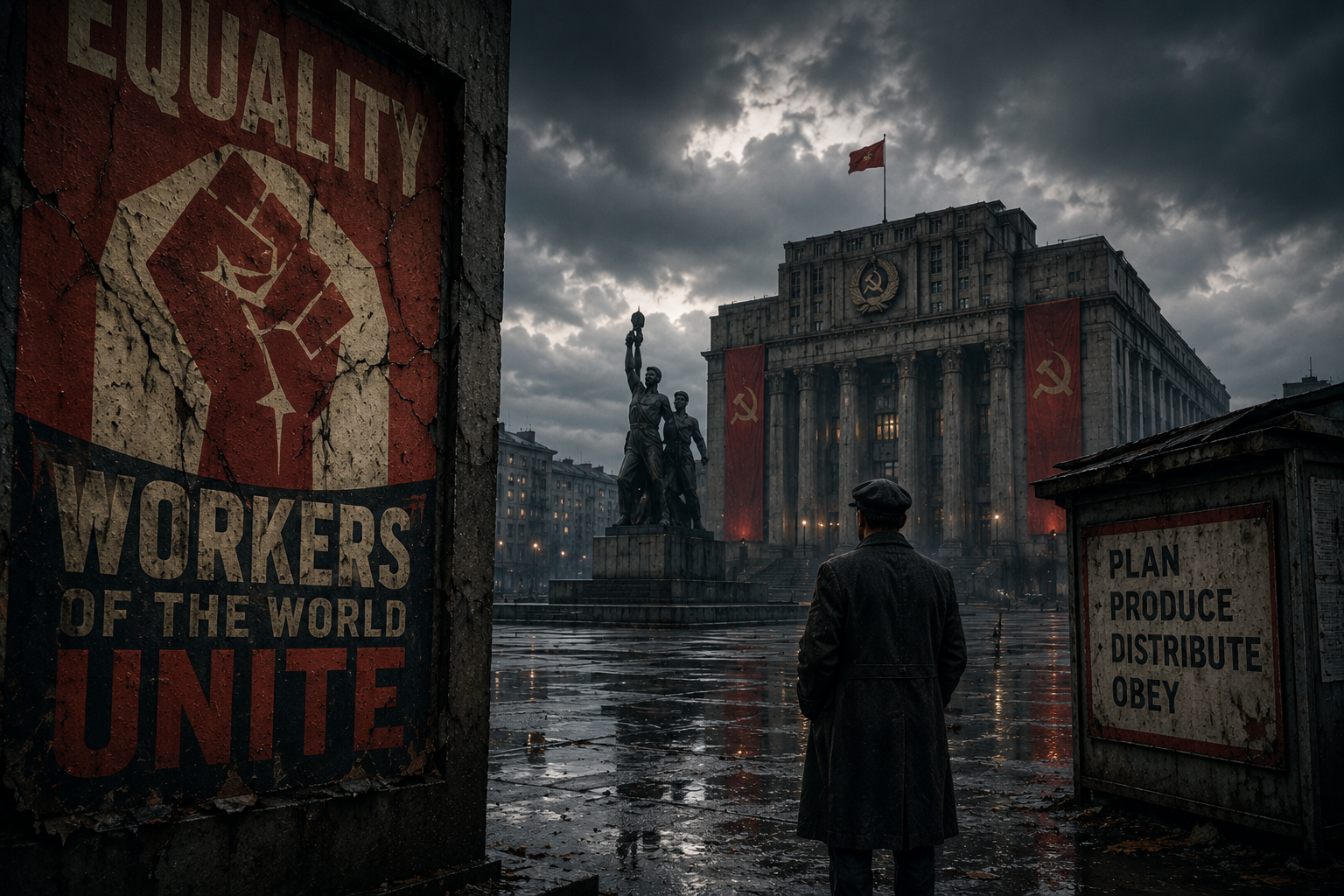
Why Communist Economies Collapse, Stagnate or Turn Capitalist
Communism Promised Equality but Repeatedly Produced Shortages and Repression
Communism begins with one of the most powerful promises in politics: that nobody should become obscenely wealthy while others remain hungry, homeless or trapped in exploitation. It imagines a society without entrenched classes, private domination or workers surrendering much of the value they create to owners who may contribute little beyond capital.
The difficulty is not understanding why this vision attracts people. The difficulty is explaining why governments that have attempted to build communist societies have so often produced shortages, coercion, stagnation, corruption and political repression instead. The central historical lesson is that abolishing markets and private ownership does not abolish power. It concentrates extraordinary economic and political power inside the state.
What Communism Is
Communism is a political and economic doctrine that seeks a classless society in which productive property is commonly owned and goods are ultimately distributed according to need. In its fully developed theoretical form, society would no longer require a coercive state because class conflict, private capital and the institutions created to protect them would have disappeared.
That final stateless society has never existed on a national scale. Governments commonly described as communist have instead been transitional party-states claiming to govern on behalf of workers while controlling industry, land, banking, trade and political life.
This creates an important distinction. Communism as an imagined end state is not identical to the Soviet Union, Maoist China, Cuba, North Korea or Cambodia under the Khmer Rouge. However, the repeated characteristics of those governments cannot simply be dismissed as irrelevant accidents. They emerged from recurring attempts to eliminate private economic power, suppress competing political centres and direct production through a ruling party.
The argument that “real communism has never been tried” therefore contains a narrow truth but avoids the larger question. The relevant issue is not whether any country reached the perfect theoretical destination. It is why efforts to travel towards it repeatedly created similar institutions, incentives and abuses.
Why the Theory Is So Attractive
Industrial capitalism created the conditions in which modern communism became politically potent. Nineteenth-century industrial workers frequently endured dangerous factories, punishing hours, insecure employment, overcrowded housing and almost no meaningful social protection. Wealth accumulated rapidly, but its distribution was profoundly unequal.
Communism offered more than economic reform. It offered a complete explanation of society. History could be understood as a struggle between classes, profit as the extraction of value from labour and political institutions as structures that protected the interests of property owners.
This framework gave exploited workers an identity, an enemy and an anticipated victory. It also gave revolutionary leaders a moral justification for drastic action. If capitalism was not merely flawed but inherently oppressive, then compromise could appear cowardly and gradual reform could look like collaboration with injustice.
Communism retains that emotional power because many of the conditions it criticises remain visible. Housing wealth divides generations, large corporations exercise substantial influence, insecure workers can feel disposable, and immense fortunes coexist with homelessness and food insecurity. Communism survives intellectually because it identifies genuine failures, even when its proposed cure has repeatedly generated worse ones.
The Knowledge Problem
One of communism’s most persistent economic weaknesses is the problem of coordination. A modern economy contains millions of products, components, preferences, skills, locations and changing circumstances. No central authority can continuously know exactly how much steel, bread, medicine, electricity, transport, housing or computing power every person and industry will require.
Markets attempt to process this dispersed information through prices. A rising price can indicate that demand has increased, supply has fallen or a resource has become more valuable elsewhere. Producers respond because potential profit rewards them for satisfying that demand, while losses signal that resources may be better used differently.
A centrally planned economy suppresses or heavily distorts this process. Officials establish production targets, administratively set prices and allocate resources according to plans assembled from reports moving through layers of bureaucracy. The official price of an item may have little connection to its scarcity, production cost or value to consumers.
The result is often simultaneous shortage and waste. Shops may lack ordinary consumer goods while warehouses hold unwanted products. A factory can meet its numerical target and still produce something unsuitable, unreliable or needlessly heavy because the target rewards quantity rather than usefulness.
Research on the former centrally planned economies identified distorted prices, missing incentives, automatically financed losses, weak property rights, absent bankruptcy mechanisms and persistent shortages among their defining structural problems.
The problem is not that government planning is always ineffective. Governments can successfully organise particular missions, including vaccination campaigns, infrastructure programmes, national defence and disaster responses. The failure occurs when a planning authority tries to substitute administrative command for nearly every decentralised decision throughout an entire economy.
The Incentive Problem
Communist systems also struggle with incentives. Under capitalism, incentives can become excessive or destructive. Executives may chase short-term profit, employers may underpay workers and corporations may impose costs on the public. Yet eliminating private profit does not eliminate self-interest.
Workers, managers and officials continue to respond to rewards and penalties. When additional effort brings little personal benefit, productivity can weaken. When failing enterprises are protected from bankruptcy, managers have less reason to reduce waste. When ministries determine resources and promotions, pleasing officials can matter more than serving consumers.
This creates a system in which people adapt rationally to irrational rules. Factory managers may understate capacity so that future targets remain achievable. Employees may conserve energy for informal work outside their official jobs. Consumers may hoard scarce goods. Officials can redirect products towards friends, political allies or black markets.
Shortages create their own opportunities for corruption. When goods cannot be obtained freely at an open price, access depends on queues, permissions, connections or bribes. Economic privilege does not disappear. It changes form.
Under capitalism, wealth can purchase influence. Under authoritarian communism, proximity to the party can determine housing, education, travel, employment and access to scarce products. The old property-owning elite may be removed, but a political-administrative elite emerges in its place.
Economic research into socialist shortages has argued that bureaucrats and enterprise managers could personally benefit from maintaining scarcity when rationed goods created opportunities for unofficial payments.
Why Economic Control Becomes Political Control
A communist revolution usually requires the state to confiscate property, nationalise industry and prevent displaced owners from restoring the previous system. That process immediately generates resistance. Farmers may reject collectivisation, business owners may hide assets, professionals may leave and political opponents may organise.
The revolutionary government then faces a choice. It can tolerate opposition and risk losing control, or suppress opposition in the name of protecting the revolution. Historically, communist governments have repeatedly chosen suppression.
Once the state controls most employment, housing, education, media and production, political dissent becomes economically dangerous. Losing favour with the ruling party can mean losing far more than an election. It can affect a person’s career, home, education and physical freedom.
The absence of independent institutions worsens every economic weakness. A free press might expose fabricated production figures. Opposition parties might challenge disastrous policies. Independent courts might restrain confiscation. Trade unions might protect workers against the state itself. When those institutions are subordinated to one party, errors can continue long after their consequences become visible.
This is why communist failure cannot be understood as an economic problem alone. Concentrated political authority prevents the system from correcting its economic mistakes. A leader’s policy can become doctrine, and criticising doctrine can become treason.
The Soviet Union: Industrial Power Without Sustainable Prosperity
The Soviet Union remains the most important historical test because it survived for more than seven decades, controlled immense territory and became a military and industrial superpower. Its record was not one of uninterrupted failure.
The Soviet state transformed a predominantly agrarian empire into an industrial power. It expanded literacy, developed heavy industry, built scientific institutions, played the decisive eastern role in defeating Nazi Germany and launched the first artificial satellite and first human into space.
These were enormous achievements. They demonstrated that central direction could mobilise resources rapidly towards a small number of national priorities. When the objective was clear, measurable and supported with overwhelming state power, the Soviet system could produce extraordinary results.
The cost was vast. Stalin’s forced collectivisation disrupted agriculture, confiscated grain and destroyed resistance among peasants. Unrealistic industrial targets were imposed while industries and services were nationalised and managers were required to fulfil centrally determined quotas.
The same system that could build steel plants and weapons struggled to provide choice, quality and responsiveness in ordinary life. Heavy industry received priority because it strengthened the state. Consumer satisfaction remained secondary.
By the 1970s and 1980s, centralisation had contributed to declining efficiency, apathy and institutional stagnation. Reforms introduced under Mikhail Gorbachev attempted to loosen the system, but partial liberalisation destabilised the existing order without creating a functioning alternative quickly enough. The Soviet Union dissolved in 1991.
Its collapse had several causes, including national divisions, military expenditure, falling institutional legitimacy, leadership failures and the destabilising effects of reform. Yet economic rigidity lay near the centre. The system could command resources, but it could not reliably discover what millions of people wanted, reward innovation or eliminate failing activity.
Maoist China and the Catastrophe of Political Certainty
China produced an even more devastating example of what happens when ideology, concentrated power and distorted information combine. Mao Zedong’s Great Leap Forward attempted to accelerate China’s transformation into an industrial communist society through collectivisation, mass mobilisation and extreme production targets.
Local officials were pressured to report success. Exaggerated harvest figures encouraged the state to procure grain that communities could not afford to surrender. Those questioning the campaign risked being treated as enemies of socialism.
The consequences included one of history’s worst famines. The precise death toll remains debated, but the disaster killed tens of millions by many scholarly estimates. Natural pressures played a part, but coercive policy, false reporting, excessive procurement and the punishment of dissent transformed hardship into catastrophe.
The Great Leap Forward reveals a fundamental danger in authoritarian planning: information travels upwards through a political hierarchy in which honesty can be punished. Leaders then make decisions using invented success figures, while local officials continue lying because admitting failure would expose them.
The Cultural Revolution later inflicted further institutional destruction. Schools and universities were disrupted, officials and intellectuals were persecuted, cultural heritage was attacked and political loyalty took precedence over professional competence.
Modern China’s economic rise did not occur because these policies finally succeeded. It began after the country moved away from strict Maoist economic organisation.
China’s Success Came Through Market Reform
Beginning in 1978, China gradually liberalised prices, opened itself to foreign trade and investment, diversified ownership and permitted private enterprise to grow. Agricultural reforms gave households stronger incentives to increase production, while special economic zones allowed experimentation with more market-oriented policies.
The political system remained dominated by the Communist Party, but the economy became increasingly hybrid. State-owned enterprises continued to play an important role, yet markets, private companies, foreign capital, entrepreneurship and global trade became central to growth.
Since the beginning of reform and opening, China has averaged exceptionally rapid long-term growth and lifted close to 800 million people above the international extreme-poverty threshold.
That achievement is sometimes presented as proof that communism works. It is more accurately evidence that a Communist Party can preside over successful development after abandoning much of orthodox communist economics.
China retained powerful state coordination, long-term planning and public investment. Those capacities supported infrastructure, manufacturing, education and targeted poverty reduction. However, the main surge in productivity was associated with opening trade, allowing private activity, strengthening incentives, diversifying ownership and permitting prices to play a larger role.
China is therefore both a communist political success and a qualification of economic communism. The ruling party survived and strengthened itself, but it did so partly by accepting mechanisms that earlier communist doctrine sought to eliminate.
Cambodia: When Revolution Became Mass Murder
The Khmer Rouge regime in Cambodia demonstrated the most extreme form of revolutionary social engineering. It attempted to erase existing class structures, empty cities, eliminate money, collectivise labour and rebuild society around agrarian communes.
Urban residents were forcibly displaced into the countryside. Families were separated, religion was suppressed and educated people were targeted. Forced labour, starvation, disease and execution killed a huge proportion of Cambodia’s population between 1975 and 1979.
Cambodia’s experience cannot be reduced to a technical failure of economic planning. It was a project of ideological purification enforced through terror. Human beings were treated as raw material from which a new society could be manufactured.
The regime’s brutality exposed the danger of believing that every attachment inherited from the previous society—family, profession, religion, property, local identity or education—must be destroyed before equality can be created. Once opponents are defined not merely as mistaken but as obstacles to historical progress, almost any cruelty can be presented as necessary.
North Korea: State Survival Is Not Social Success
North Korea remains one of the world’s most tightly controlled states. It has survived war, isolation, famine, sanctions and repeated predictions of collapse. Regime survival, however, should not be confused with a successful economic or social model.
The state concentrates political authority around the ruling family, restricts information, directs economic activity and devotes substantial resources to military capability. Markets have nevertheless developed informally because the official distribution system has repeatedly failed to meet daily needs.
North Korea illustrates the adaptability of authoritarian power. A communist state can remain intact by restricting movement, monopolising information, punishing dissent and protecting its security institutions. It does not need to deliver broad prosperity if it can prevent organised opposition.
This matters because governments do not always collapse when their economic systems fail. Some instead become more coercive, shift suffering onto the population and use external threats to justify continued control.
Cuba: Real Social Gains Alongside Chronic Economic Weakness
Cuba represents a more complex record. The revolutionary government invested heavily in literacy, education, preventative medicine and universal access to health services. Those achievements gave Cuba social indicators that often compared favourably with countries at similar income levels.
Its healthcare system developed a strong emphasis on primary care and medical training. Cuba also sent doctors abroad and built substantial expertise in public health.
These achievements should not be dismissed merely because they occurred under a communist government. Universal education, vaccination, preventative care and medical access are genuine public goods. They demonstrate that determined states can direct scarce resources towards social outcomes that markets alone may distribute unequally.
Yet Cuba has also suffered persistent shortages, weak productivity, restricted private activity, limited political freedom and dependence on external support. After Soviet assistance disappeared, the economy entered a severe crisis marked by collapsing activity, rationing and growing queues. Recovery required macroeconomic adjustment and limited liberalising measures.
The United States embargo has unquestionably imposed costs and constrained trade, finance and investment. It would therefore be inaccurate to attribute every Cuban economic weakness solely to domestic socialism. However, external pressure does not explain the full record. Central control, weak incentives, limited competition and political restrictions have also reduced adaptability.
Cuba’s experience shows that a communist government can achieve notable outcomes in selected social sectors while still producing an economy unable to provide consistent abundance, consumer choice or rising living standards.
The Genuine Successes of Communist Governments
Communist systems have sometimes been highly effective at rapid mobilisation. They have expanded basic literacy, established universal schooling, increased access to medicine, promoted women’s participation in education and employment, built heavy industry and completed large infrastructure projects.
They also challenged systems of inherited privilege. Revolutions in Russia, China and elsewhere destroyed aristocratic orders and redistributed land or status. For populations previously excluded from education or public authority, this could represent a dramatic social transformation.
Communist pressure also influenced capitalist countries. The appeal of revolutionary socialism encouraged democratic governments to improve worker protections, legalise unions, introduce public pensions, expand healthcare and build welfare states. Political elites had stronger reasons to reform capitalism when the alternative appeared revolutionary.
Some communist or socialist policy instruments therefore succeeded even where total communist systems did not. Public healthcare, universal education, social insurance, municipal ownership, strategic industrial policy and progressive taxation can reduce inequality without abolishing markets or political competition.
The strongest historical successes attributed to communism usually came from concentrated investment in a defined objective. Its greatest failures emerged when concentrated authority attempted to control an entire society indefinitely.
Why Social Democracy Usually Performs Better
Social democracy emerged as a less revolutionary response to many of the same injustices. Instead of abolishing private enterprise, it seeks to regulate markets, redistribute income and guarantee essential services through democratic government.
This model accepts that markets are powerful coordination mechanisms but rejects the idea that market outcomes are automatically fair. Private companies can innovate and compete, while taxation funds healthcare, education, infrastructure, income support and pensions.
Independent courts, opposition parties, elections, trade unions and a free press provide channels through which errors can be challenged. Governments can be removed without overthrowing the state, and economic policies can change without criminalising the losing side.
Social democracies still face bureaucracy, waste, high taxation, regulatory capture and political short-termism. They do not eliminate inequality or economic crises. Their advantage is institutional correction: neither the state nor private capital is supposed to possess unlimited power.
The countries that combine strong living standards, public services, economic innovation and political liberty generally operate mixed economies. They are not purely capitalist and certainly not communist. They blend private ownership and market pricing with regulation, redistribution and universal public provision.
Was Communism Never Properly Tried?
Defenders of communism argue that previous regimes were distorted by poverty, war, foreign intervention, isolation or authoritarian leaders. There is evidence supporting parts of that defence. Russia experienced war, revolution and civil conflict. Cuba faced a powerful hostile neighbour and a lasting embargo. Several communist movements governed countries with little industrial infrastructure.
Capitalist states have also produced imperialism, slavery, famine, dictatorship, environmental destruction and severe inequality. It would be dishonest to compare communist reality with an idealised version of capitalism.
The stronger criticism of communism does not require that comparison. It asks why communist attempts repeatedly concentrated ownership and authority in institutions that could not be effectively challenged.
A system designed to eliminate private power must transfer control somewhere. In practice, it transfers it to officials, party committees and state managers. Unless those authorities face independent courts, elections, free media and genuine economic alternatives, citizens possess few defences against error or abuse.
Introducing those protections, however, changes the system. Independent businesses recreate private capital. Competitive elections allow anti-communist parties to win. A free press exposes state failure. Independent unions may oppose the government claiming to represent workers.
Communism therefore encounters a structural contradiction. The freedoms needed to prevent authoritarianism also permit institutions that undermine the state’s monopoly over economic life.
Why Communism Usually Fails
Communism usually fails because it combines several weaknesses that reinforce one another. Central planners lack the dispersed knowledge contained in real prices and local decisions. State enterprises frequently face weak incentives to innovate, improve quality or stop wasting resources.
Shortages then increase the power of bureaucrats who control access. Political leaders suppress opposition to protect the system. Suppression blocks truthful information. False information leads to worse decisions, and worsening outcomes encourage even greater control.
The cycle is self-protecting. Every failure can be blamed on sabotage, insufficient ideological commitment, foreign enemies or corrupt local officials rather than the design of the system itself. Because admitting systemic failure threatens the ruling party’s legitimacy, reform often arrives late.
Communism is strongest at mobilisation and weakest at adaptation. It can order the construction of a dam, steel plant, railway or weapons programme. It is far less effective at coordinating millions of changing preferences, small innovations and local trade-offs over decades.
It can enforce formal equality by limiting private accumulation, but informal hierarchy returns through political access. It can guarantee employment on paper, but workers may receive low wages for unproductive jobs. It can hold prices down officially, but empty shelves reveal the actual scarcity.
What Most People Misunderstand
The greatest misunderstanding is that communism fails because everyone becomes lazy. Human behaviour is more complicated. People continued working hard in communist societies, often under extraordinarily difficult conditions. Scientists, doctors, engineers, soldiers and factory workers produced major achievements.
The problem is not an absence of effort. It is that effort is channelled through institutions that frequently reward obedience, target fulfilment and political reliability rather than usefulness, honesty and innovation.
Another misunderstanding is that every public service is communist. State-funded healthcare, council housing, public education, welfare payments and national infrastructure can operate within capitalist democracies. Collective provision is not the same as collective ownership of almost all production.
It is equally mistaken to argue that every communist failure proves that markets are always right. Markets can underprovide healthcare, exploit monopoly power, inflate housing costs, damage the environment and leave vulnerable people behind. The failure of communism does not remove the need to regulate capitalism.
The real historical divide is not simply government against markets. It is concentrated power against plural power. Successful societies generally allow multiple centres of decision-making: households, firms, councils, unions, courts, charities, regulators, elected governments and civic organisations.
What the Future Holds
A return to orthodox twentieth-century communism is unlikely across wealthy democracies. Few major political movements now advocate abolishing nearly all private ownership, collectivising agriculture or placing every industry beneath a single national plan.
However, the forces that once drove communist politics are intensifying in new forms. Housing insecurity, insecure employment, concentrated corporate ownership, automation and extreme wealth accumulation can make younger generations doubt whether existing capitalism serves them.
Artificial intelligence may deepen that pressure. If machines generate a growing share of economic output while ownership remains concentrated, societies will face increasingly difficult questions about wages, taxation and who benefits from technological productivity.
This could revive proposals once associated with socialism: stronger public ownership, wealth taxes, universal basic services, worker participation, national investment funds and public stakes in strategic technology. These policies would not necessarily produce communism. They would represent attempts to distribute the gains of capitalism more broadly.
Technology may also tempt governments to believe that central planning can finally work. Vast datasets, predictive algorithms and real-time monitoring can improve logistics and public administration. Yet no machine can remove political incentives, guarantee truthful inputs or decide objectively what every citizen should value.
Digital planning could make authoritarian control more efficient without making it wiser. A state capable of monitoring transactions, movement, communication and employment would possess powers that earlier communist governments could only imagine.
The most plausible future is therefore not a global communist revolution. It is a contest between different hybrid systems: democratic mixed economies, authoritarian state capitalism, heavily regulated capitalism and technology-driven welfare states.
China will remain central to that debate. Its leaders present state coordination, national planning and party control as sources of stability and long-term capacity. Yet its economic achievements continue to depend heavily on trade, private enterprise, competition and investment. The unresolved question is whether increasingly centralised political authority will eventually weaken the dynamism created by earlier economic liberalisation.
The Final Judgement
Communism usually fails not because equality is an absurd objective, but because it tries to achieve equality by concentrating economic control in institutions with too little information and too much power. It replaces imperfect decentralised decisions with a political hierarchy that can command production but struggles to measure value, reward experimentation or admit error.
Its historic record contains real achievements: literacy campaigns, rapid industrialisation, scientific breakthroughs, expanded healthcare, greater access to education and the destruction of some entrenched hierarchies. Those successes matter, and ignoring them produces propaganda rather than serious analysis.
The record also contains chronic shortages, coerced collectivisation, political imprisonment, famine, mass killing, stagnation and governments that survived by preventing citizens from challenging them. These were not identical events, and they cannot all be attributed to a single cause. Their recurrence nevertheless exposes a common danger.
Communism identifies a genuine moral problem: economies should serve human beings rather than reduce them to costs, consumers or sources of profit. Its fatal answer is to place overwhelming power in the hands of people claiming to act for everyone.
The future will continue borrowing from communism’s critique while rejecting most of its machinery. Societies will seek stronger safety nets, public investment and limits on concentrated wealth, but the most durable systems will preserve markets, private initiative, political competition and independent institutions.
Communism’s promise will survive wherever capitalism appears cruel, rigged or incapable of reform. Its historic failures will remain a warning that abolishing private power means little when it is replaced by a state powerful enough to control both a person’s livelihood and their right to object.
