he Raid in Guasave and the Night of Violence That Followed
Who Is El Chapo Isidro, The FBI's Most Wanted Cartel Boss Captured In Sinaloa?
For years, one of the most wanted men in the Americas was believed to be operating from a farming municipality on Mexico's Pacific coast. On the evening of Friday 20 November 2026, Mexican special forces came for him there.
Fausto Isidro Meza Flores, known as "El Chapo Isidro", was arrested in Guasave, in the northern part of the state of Sinaloa, by army and National Guard special forces working with US intelligence. He was one of the FBI's Ten Most Wanted Fugitives, with a US reward of up to $5 million on his head. Washington accuses him of leading a cartel that trafficked fentanyl, cocaine, heroin, methamphetamine and marijuana into the United States for about two decades.
He has not been tried for any of it. He is 44, he is in custody in Mexico City, and he is presumed innocent of every charge against him on both sides of the border.
What Happened in Guasave on 20 November
Mexico's defence ministry described a three-stage operation. Special forces from the army, nicknamed the "Murciélagos" (Bats), and from the National Guard, the "Lobos" (Wolves), approached the target area along different roads using what the ministry called "stealth and surprise". They threw an inner and outer cordon around the house to stop anyone escaping or reinforcements arriving.
According to the ministry, the men inside then opened fire on the troops with guns and explosives. The arrest team went into the house and detained three people: Meza Flores; a man identified only as Germán "N", alias "Serafín", whom officials call the group's second-in-command; and José "N", described as its financial operator. Mexican authorities routinely withhold the surnames of suspects who have not been convicted.
Once their identities were confirmed, the three were flown overnight to Mexico City aboard a Mexican Air Force aircraft and handed to prosecutors. Mexico's national register of detentions recorded his name, alias and arrest date early on Saturday morning.
The ministry said the operation grew out of co-operation between Mexican military intelligence and US agencies. Mexico has not said what that intelligence was or how he was located. The arrest itself was carried out entirely by Mexican forces.
Omar García Harfuch, the minister who leads President Claudia Sheinbaum's security cabinet, publicly thanked the defence ministry and both special forces units "for their courage and professionalism in the operation".
Why the Arrest Set Off a Night of Violence
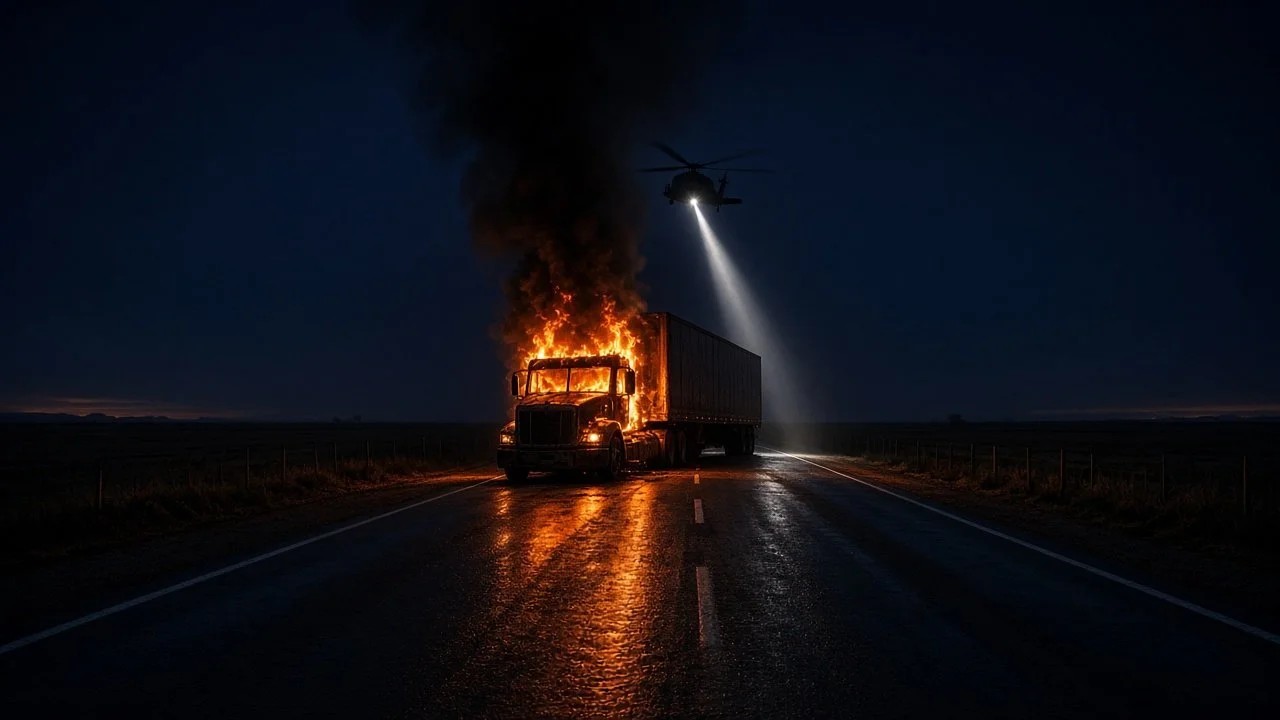
Within hours, gunmen were setting fire to lorries and blocking roads across northern and central Sinaloa.
The defence ministry reported blockades in four municipalities: Ahome, which includes the city of Los Mochis; Guamúchil; Guasave; and Navolato. By midnight, local authorities had counted at least 11 blockades, 13 places where spikes had been thrown across roads to puncture tyres and three vehicles taken from their drivers. Burning lorries closed the road from Los Mochis to the port of Topolobampo.
Sinaloa's public security department told residents to stay indoors and to avoid the main coastal highway north of the state capital, Culiacán. Videos showed helicopters firing at the ground in Guasave. A professional baseball game at the city's stadium, between the home side and Venados de Mazatlán, was suspended as spectators ran for cover. Sinaloa's interim governor, Graciela Domínguez, asked people to shelter while federal forces restored order.
As of Saturday afternoon UK time, officials had not released any figure for deaths or injuries. García Harfuch said security forces would stay deployed in Sinaloa.
The violence had a precedent. In October 2019, soldiers briefly detained Ovidio Guzmán, a son of Joaquín "El Chapo" Guzmán, in Culiacán, then released him after cartel gunmen besieged the city. He was not recaptured until January 2023. This time, the prisoner was in the air within hours, and the cartel's counterattack came too late to change the outcome.
Who Is Fausto Isidro Meza Flores?
According to his FBI wanted notice, Meza Flores was born in Mexico on 19 June 1982. He has used three nicknames: "El Chapo Isidro", "Chapo Isidro" and "Chapito Isidro".
The nickname is the main source of confusion online. He is not Joaquín Guzmán, the original El Chapo, who has been serving a life sentence in the United States since 2019. Mexican security officials say the two were rivals: Meza Flores built his own organisation and competed against Guzmán's Sinaloa Cartel.
He rose inside the Beltrán Leyva Organisation, a cartel run by brothers who had once been Guzmán's allies before a bitter split in 2008. The US Treasury describes that group as one of the most violent to operate in Mexico. After its leader, Arturo Beltrán Leyva, was killed in a Mexican military raid in December 2009, the organisation fractured. US officials say Meza Flores had established his own group by 2013.
That group goes by several names. The FBI calls it the Meza-Flores Transnational Criminal Organisation. In Mexico it is often called the Guasave Cartel, after its home base. The defence ministry, announcing his arrest, described him as head of the Beltrán Leyva Organisation itself. The US Treasury, which first sanctioned him in 2013, said in April 2025 that the organisation was "currently led by" him.
His survival owed something to discretion. Unlike Guzmán, who became a celebrity fugitive, Meza Flores kept a relatively low profile. It was widely known that he moved around Guasave; what the authorities lacked was his exact location.
What Is El Chapo Isidro Accused Of?
In the United States, he faces charges in federal court in Washington, DC. A grand jury first indicted him on 2 May 2012. A superseding indictment, which replaced the original charges with a broader case, followed on 26 November 2019.
According to the FBI, that indictment accuses him of conspiring between 2005 and 2019 to manufacture and distribute methamphetamine and to distribute cocaine, heroin and marijuana for importation into the United States, together with firearms offences.
5:01 PMTaylor Tailored
The FBI added him to its Ten Most Wanted list on 4 February 2025, the 533rd person placed on the list since it began in 1950. The then acting FBI director, Brian Driscoll, said he was "accused of spending the last 20 years flooding the U.S. with fentanyl, cocaine, heroin, and other deadly drugs". Driscoll added that the organisation was also accused of "heinous crimes ranging from kidnapping and extortion to torture and murder". None of those allegations has been tested in court.
In Mexico, the defence ministry says he is wanted on an arrest warrant for organised crime and drug offences, known in Mexican law as "crimes against health".
The scale of the trade the authorities attribute to him is suggested by one seizure. On 3 December 2024, Mexican security forces raided properties in Guasave and neighbouring Ahome and recovered more than 1,000 kilograms of fentanyl, the largest fentanyl seizure in Mexican history, equal to an estimated 20 million doses. Two leaders of criminal cells linked to the Beltrán Leyva Organisation were arrested. US officials have connected that haul to the network Meza Flores is accused of running, but no court has tested that link.
Where He Fits in Sinaloa's Cartel War
The arrest lands in the middle of a war. Since 2024, the Sinaloa Cartel has been tearing itself apart. On one side are "Los Chapitos", the sons of Joaquín Guzmán. On the other are "Los Mayos", loyal to the family of Ismael "El Mayo" Zambada, the co-founder who arrived in US custody in July 2024. Zambada was sentenced to life in prison in a New York federal court in July 2026.
The defence ministry describes Meza Flores as an ally of the Mayos faction. Mexico's security cabinet says he joined forces with the faction led by Zambada's son, Ismael Zambada Sicairos, known as "El Mayito Flaco".
That alliance helps explain why his arrest matters beyond Guasave. With the two main factions exhausting each other, a third organisation in northern Sinaloa, already allied with one side, had room to grow. Removing its alleged leader could weaken the Mayos, embolden the Chapitos or trigger a succession fight inside his own group. Any of those outcomes could mean more violence in the short term, not less.
Will El Chapo Isidro Be Extradited to the US?
Probably, eventually, but nothing has been announced. The defence ministry confirmed that Meza Flores is subject to a US extradition order for conspiring to distribute drugs. Neither government has said when or how he might be sent north.
Mexico has two routes. Formal extradition runs through a federal judge and can take months or longer, particularly if the defence files an "amparo", a Mexican constitutional appeal that can pause proceedings. The faster route is the one Mexico used twice in 2025, when it transferred 29 cartel figures to the United States in February and another 26 in August outside the normal extradition process. The February group included Rafael Caro Quintero, accused over the 1985 murder of the US drug agent Enrique "Kiki" Camarena.
Mexico attached a condition to the August transfer: none of the prisoners could face the death penalty. Any decision on Meza Flores is likely to raise the same question.
Why Mexico Moved Now
Pressure from Washington is part of the answer. President Donald Trump made cutting the flow of drugs across the southern border a central promise, and his administration has repeatedly threatened Mexico with tariffs and talked about acting against cartels directly. President Sheinbaum has welcomed closer intelligence co-operation while refusing to allow US troops to operate on Mexican soil.
The Guasave raid fits that bargain exactly: American intelligence, Mexican boots. The reaction in Washington was immediate. Sara Carter, director of the White House Office of National Drug Control Policy, called the arrest "a victory for the United States and Mexico". The Drug Enforcement Administration called it "a significant victory against one of Mexico's most violent criminal networks".
There is a domestic logic too. Sheinbaum's government has made a point of removing the figures it calls the principal generators of violence in Sinaloa, and security officials say operations in the region will continue until violence falls.
What Happens Next
Three questions will decide what this arrest means. The first is legal: whether Meza Flores is prosecuted in Mexico, extradited through the courts or transferred quickly to face the case in Washington. The second is territorial: who takes control of the routes and cells the authorities say he ran around Guasave and Los Mochis. The third is political: whether the US government treats the arrest as evidence that co-operation is working, or as a reason to demand more.
The removal of a leader rarely dismantles a criminal organisation. The capture of Joaquín Guzmán did not end the Sinaloa Cartel, and the arrival of El Mayo in US custody helped set off the current war. For the people of Guasave, who spent Friday night sheltering in supermarkets, shops and stadium corridors, the real test is whether the next few weeks are quieter than the last few hours.
Sources
FBI: Fausto Isidro Meza-Flores, Ten Most Wanted notice. Date of birth, aliases, charges, indictments and the $5 million reward.
FBI: Meza-Flores added to the Ten Most Wanted list (4 February 2025) and the Washington Field Office release. Driscoll's quotes and the 533rd listing.
US Treasury: sanctions on the Beltrán Leyva leader (9 April 2025). Cartel history and the December 2024 fentanyl seizure.
BBC News: Mexican drug lord on FBI's 10 most wanted list arrested in shoot-out (21 November 2026). The arrest, his age and US intelligence.
Associated Press: Mexico detains top cartel boss 'El Chapo Isidro' (21 November 2026). Overnight violence (headline and opening only).
Euronews: Mexico captures FBI's most-wanted cartel boss (21 November 2026). The raid, the evacuation and the baseball match.
El País México (21 November 2026). The defence ministry account, blockade counts and the 2019 precedent (Spanish).
La Jornada (20 November 2026) and La Jornada (21 November 2026). Rivalry with Guzmán, the Mayito Flaco alliance and the violence in Guasave (Spanish).
SDP Noticias (21 November 2026). The ministry statement, the arrest warrant and the extradition order (Spanish).
US Justice Department: 29 defendants taken into US custody (27 February 2025) and BBC News: Mexico extradites 26 inmates (12 August 2025). The 2025 transfers.
Sara A. Carter on X and DEA on X (21 November 2026). The US reactions.
Next Reads
El Chapo History: The Two Escapes That Turned a Cartel Boss Into a Global Legend. The original El Chapo.
The World's Most Elusive Cartel Boss Has Finally Been Sentenced To Die In Prison. How El Mayo's fall set off the Sinaloa war.
Facing El Chapo True Story. The 2016 capture, for comparison.
US Designates Fentanyl as a Weapon of Mass Destruction. The US pressure behind the arrest.
