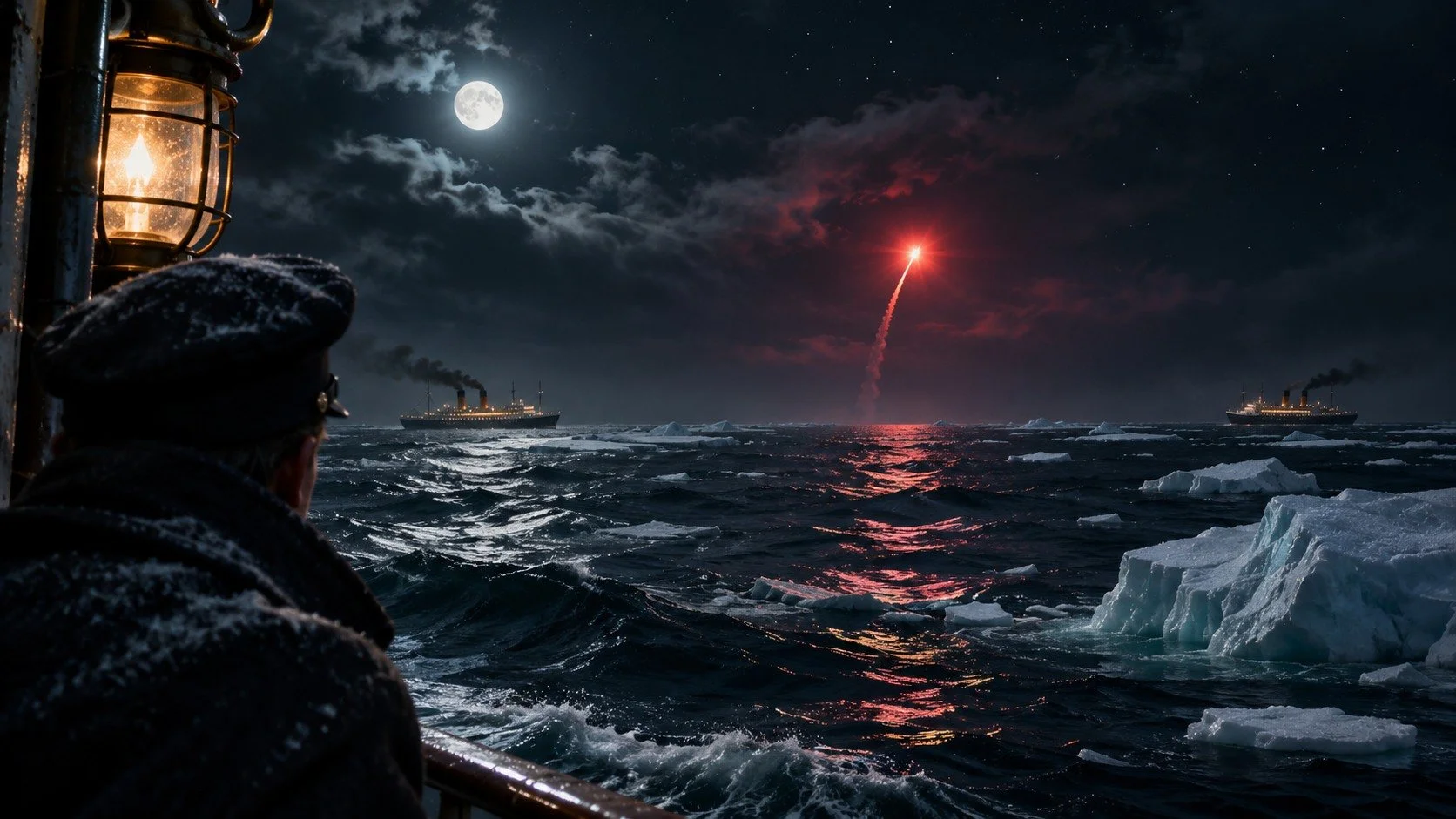
A wireless distress call carries an identity, a position and an urgent request.
How Could A More Distant Ship Become The One That Answered Titanic?
A wireless distress call carries an identity, a position and an urgent request. A rocket seen from a dark bridge carries none of those things with quite the same precision. On the night Titanic sank, Carpathia received the first kind of information. Officers aboard Californian had to interpret the second. What happened to those signals between receipt and action explains much of the difference between the two ships.
What Carpathia Knew
Carpathia's wireless operator received Titanic's distress message. Captain Arthur Rostron could order a course towards a reported position while his crew prepared to take survivors aboard. Knowing what to do did not remove the danger. Ice lay ahead, darkness limited visibility and the coordinates supplied during a disaster could only be as good as the information available to those sending them.
This was a rescue that began before contact with the survivors. An order to prepare blankets, medical assistance or space on board would be of little use if issued only as the first boat came alongside. Rostron had the advantage of knowing the nature of the emergency, which enabled a crew still many miles away to make decisions about people it could not yet see.
What Californian Saw
Californian had stopped amid ice. Her wireless operator had gone off duty. Officers observed rockets and reported them, but the ship did not mount an effective investigation of the emergency while Titanic remained afloat. Crucially, the sight of a light and the receipt of a distress call were never brought together on Californian's bridge in time.
The question for a ship's officers extends beyond whether they could already prove the other vessel was Titanic. Rockets at night were a reason to investigate. Waking the wireless operator could have supplied information missing from the visual observations. A ship can reasonably be criticised for failing to make an inquiry even when nobody can demonstrate how many people a better response would have saved.
Could Californian Have Arrived Before Titanic Sank?
Distance estimates became central to the controversy. A small difference in miles can absorb most of the time remaining to a sinking ship. A vessel at rest also needs time to get under way. Its captain must find a route through ice without turning one emergency into two.
The British Marine Accident Investigation Branch reappraisal considered a minimum separation of roughly 17 nautical miles. Under an exceptionally prompt and direct response, its author judged Californian might have arrived around the time Titanic sank. A more realistic sequence required somebody to investigate, bring the captain to the bridge and approach cautiously until the danger became clear. On that reconstruction the likeliest task would have been recovering people who had already reached lifeboats.
That is an assessment of a counterfactual, dependent on reconstructed positions and assumptions about speed. It deserves to sit alongside the earlier inquiry findings rather than be passed off as the recorded track of a rescue that actually occurred.
Who Reached The Boats?
Carpathia reached the scene at about four in the morning, after Titanic had gone down. She collected the people who had escaped in boats. Her crew could not go back and retrieve the hours lost between the collision and their arrival. They could bring people aboard who had spent those hours exposed at sea.
Californian's failure belongs to the earlier part of the night, when a sign of possible distress could still have prompted a proper inquiry. Carpathia's achievement belongs to the entire passage from first message to final recovery. The distinction matters because the easiest question to ask about a rescue is who was nearest. The better one is who recognised that somebody needed help and began doing what distance still allowed.
