In Isaiah 53, a suffering figure lives to see the outcome of his ordeal.
What Can One Extra Word In Isaiah Tell Us About The Bible?
In Isaiah 53, a suffering figure lives to see the outcome of his ordeal. Some ancient witnesses include a word meaning “light”. In the traditional Hebrew text underlying many familiar translations, that word is absent. Open two modern Bibles and the figure may either see light or see the result of his suffering. The difference is small enough to disappear in a public reading. To a translator deciding what to print, it is a genuine choice.
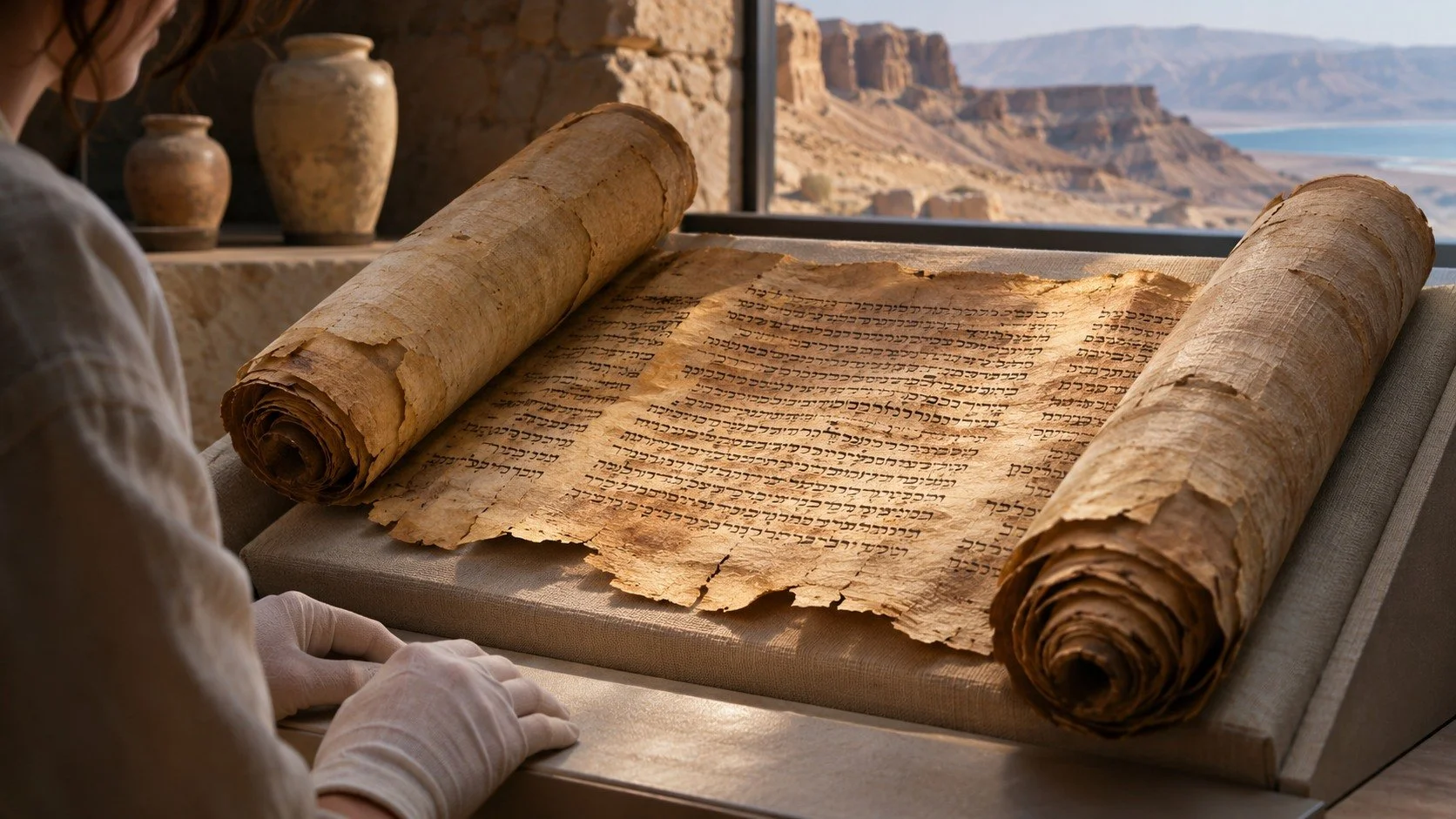
The Great Isaiah Scroll, found near Qumran, gives scholars an ancient Hebrew witness to this passage. Its importance lies partly in its completeness. Many finds preserve only fragments, perhaps a few lines interrupted by holes. Here a reader can follow the book of Isaiah from its opening to its conclusion across a single manuscript more than seven metres long.
What Changed When The Scroll Was Found?
The discovery changed the evidence available to modern readers. The ancient copy had been written, used and stored centuries before anyone produced a modern English Bible. Finding it did nothing to the words already present in medieval manuscripts. It allowed scholars to compare those words with a much earlier copy in the same language.
That distinction helps explain why claims about the scroll can sound contradictory. A reader can recognise the same book across a long interval and still find differences on almost every page. A spelling convention can recur dozens of times without changing a sentence's meaning. One additional word can change the image in a verse. Counting every difference equally gives an impressive statistic with surprisingly little explanatory power.
Why An Older Copy Still Needs Interpreting
The age of a manuscript tells us when a particular reading existed at the latest. It does not by itself tell us when that reading first arose. A later scribe could carefully reproduce an old exemplar. An earlier scribe could already be copying a line that had changed. Manuscripts do not queue neatly in order of reliability according to their birthdays.
That is why scholars also compare other Hebrew witnesses and ancient translations. A Greek translator who includes an idea present in one Hebrew witness may have worked from a related text. Alternatively the translator may have supplied a word to make the sense clearer in Greek. Agreement is evidence worth investigating. Its strength depends on the passage, the language and how that translator normally works.
Why The Word “Light” Matters
Read Isaiah 53:11 with “light” and recovery takes a visible form. Read it without the word and the verb of seeing invites the reader to supply its object from the context. Both readings belong to recognisable versions of the passage. A translation committee has to decide how to represent that history to someone who may never consult a Hebrew manuscript.
A footnote can therefore be one of the most informative parts of a modern Bible. It can tell the reader that the committee selected one rendering and recognised a substantial alternative. It also gives readers from different traditions a better question to ask of one another. Before arguing over what a line means, establish whether the translators were working with the same wording.
The Great Isaiah Scroll cannot settle questions about every biblical book. It does something more tangible. It puts an ancient copy of one whole book beside later witnesses and allows individual decisions to be examined. At Isaiah 53:11 the argument is small enough to hold in a single word. That is precisely what makes it worth seeing.
