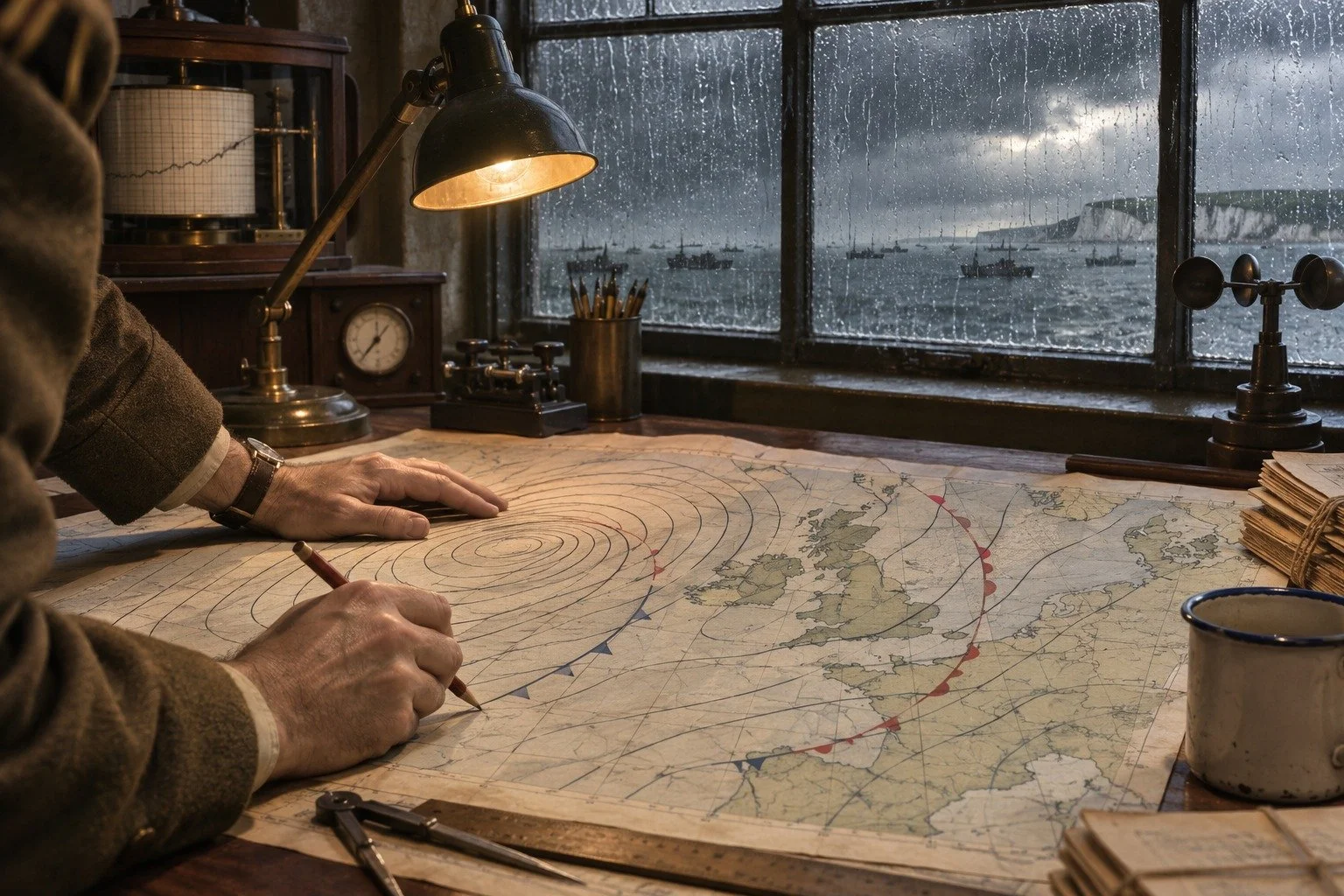
How James Stagg brought rival forecasts to Eisenhower, why 5 June was ruled out and what a brief improvement meant for the Normandy landings.
How Much Good Weather Did The Allies Actually Need?
A forecast of sunshine over Normandy would have been a poor answer to Dwight Eisenhower’s question. A landing craft had to cross the Channel before its passengers could see a beach. Aircraft had to reach their targets. Men coming ashore needed the tide at a useful stage. A few hours of improvement could matter enormously, provided they were the right hours in the right places.
Pressure dramatises the argument over whether the Allied landings should proceed in June 1944. Group Captain James Stagg had the job of taking competing meteorological judgements to the supreme commander. The advice he delivered helped move the invasion from 5 to 6 June. His achievement is easiest to appreciate by asking what he could reasonably know before the first landing, when hindsight was still a day away.
Why Was It So Hard To Change The Date?
Operation Overlord involved ships, aircraft and troops moving from different places on different timetables. Some forces needed to begin moving while other units could still wait. Postponing the invasion late enough could require ships already at sea to turn back, refuel and begin the sequence again. A delay that sounds like a simple change on a calendar becomes an operation in its own right.
The assault also had to fit the tides. At a suitably low stage, obstacles laid on the beaches would be visible, while a rising tide could help subsequent craft approach. Darkness and daylight had separate uses during the airborne and amphibious phases. The conjunction of those conditions gave planners a small set of candidate dates. They could select a day when the tide would cooperate long in advance. Nobody could tell them equally far ahead whether the wind would do the same.
Weather also meant different things to different commanders. Rough seas could swamp small craft and exhaust the men in them. Low cloud could obstruct pilots trying to identify a target or deliver airborne troops. A break sufficient for one part of the plan could remain dangerous for another. The most accurate one-word description of the day would still leave Eisenhower without the information he needed.
Why Did The Forecasters Disagree?
The American team associated with Irving Krick used an approach that placed considerable weight on historical analogues. Find an earlier weather pattern resembling the present one, examine what followed, and use the resemblance to guide the forecast. British forecasters put greater emphasis on tracing the development of fronts and interpreting conditions higher in the atmosphere.
Both methods tried to extract tomorrow from observations available today. They gave different weight to different kinds of evidence. A familiar-looking pressure pattern might support optimism about 5 June. Evidence that a front was evolving differently from the analogue could make that optimism dangerous. With the operation approaching, there was no opportunity to settle the scientific argument by waiting to see who was right.
The film gives this disagreement recognisable human faces. The historical process drew on several teams, including the Royal Navy. Stagg coordinated their judgements. That distinction changes how we understand his responsibility. A lone forecaster can announce a personal conviction. A coordinator has to understand which disagreements matter, decide what advice can survive them, and give a commander enough information to act.
Why Was 6 June Better Than 5 June?
The initial plan called for the landings on 5 June. Deteriorating weather made that date dangerously unattractive. Then the forecasters identified a temporary improvement. The prospect was a window between systems, sufficient to justify considering the next morning. Nobody had promised calm seas and clear skies along the entire invasion front.
That explains why accounts of rough conditions on D-Day can sit comfortably alongside the claim that the forecast succeeded. The military question concerned the difference between two real options. Men could encounter heavy seas on the better day. Pilots could struggle with cloud even though postponing the operation had been sound advice. A useful forecast can accurately warn of serious remaining difficulties and still support a decision to go.
Eisenhower retained responsibility for that decision. Stagg could assess the atmosphere and communicate his confidence. He could not assign the military cost of losing surprise, keeping troops embarked or waiting for a later combination of tide and light. Those judgements belonged to the commander, who had to consider the forecasts alongside consequences beyond any meteorologist’s remit.
Would Waiting Another Fortnight Have Been Safer?
The later June period often appears in accounts of D-Day because a severe Channel storm struck around 19 June and damaged the artificial harbours supporting the invasion. It is a striking illustration of the risks attached to delay. It is also information Eisenhower did not have when deciding whether to go on the sixth.
To use that storm as proof that Stagg could see two weeks into the future gives him the wrong achievement. He helped identify a brief, usable improvement at a time when forecasters could disagree in good faith about what the atmosphere would do in the next day or two. There were enough observations to make a difficult recommendation. There was no reserve of certainty waiting for someone brave enough to claim it.
The usual image of D-Day begins with landing craft approaching the shore. For the forecasters, the consequential moment came while those craft could still be called back. Once they were committed, every remaining error in the forecast would be experienced as wind, water or cloud by people who had never heard of James Stagg.
