Why Did 41 Men Sign the Mayflower Compact Before Landing at Cape Cod?
Who Could Give Orders Once The Passengers Reached Land?
The first men to go ashore from the Mayflower at Cape Cod had an ordinary job to do. The ship had run out of firewood. Fifteen or sixteen men took a boat to the beach and returned that evening with a load of juniper. Before they set out, the passengers had faced a question with no obvious answer. Who had the authority to send anyone ashore in the first place?
The Mayflower had reached a coast outside the territory where its backers had permission to establish a colony. According to passenger William Bradford, some aboard argued that once they stepped on land, the expedition’s leaders would have no power to command them. The men who signed what became known as the Mayflower Compact answered that challenge by promising one another that they would form a government and obey the laws it made.
They could give that promise aboard ship. Only England could issue a new patent. And neither an agreement among passengers nor a document issued across the Atlantic could express the consent of the people who already lived on Cape Cod.
Why Was the Mayflower in the Wrong Place?
The passengers had expected to settle near the mouth of the Hudson River, close to present-day New York. In 1620, the English used the name Virginia for a much larger stretch of the Atlantic coast than the modern American state. That is why a voyage bound for the Hudson could carry permission from the Virginia Company and why the Compact itself described the destination as northern Virginia.
A patent was a written grant of authority. King James I had given the Virginia Company powers over colonisation in a defined territory. The company could, in turn, authorise ventures financed by other investors. The Mayflower expedition set out under one such arrangement, with a patent issued to John Peirce on behalf of its backers. Place mattered. The permission applied where the company had authority to grant it.
After sixty-six days at sea, the Mayflower reached Cape Cod. An attempt to sail south brought the ship into dangerous shoals. Its master, Christopher Jones, turned back towards the sheltered waters of what is now Provincetown Harbour. It was a sound decision for a man responsible for a ship and everyone aboard her. It also left the prospective colony beyond the bounds of its patent.
Jones still had a ship to command. The disputed authority belonged to the people who expected to govern a settlement after the ship sailed home. A passenger could accept the master’s order at sea and quite reasonably ask where a colonial governor’s authority would come from on this particular shore.
What Did the Dissenting Passengers Actually Say?
William Bradford, who sailed on the Mayflower and later governed Plymouth, gave the sharpest account of the dispute. He recalled some passengers saying that once ashore they would be at liberty to act for themselves. His word for their speeches was “mutinous”.
It is worth pausing over who chose that word. Bradford belonged to the English Separatist congregation that had lived in Leiden in the Netherlands. Members of that congregation had spent years worshipping together and negotiating the move to America. Other passengers had joined the venture from outside it. Bradford called some of these people “strangers”. They had signed up for the same voyage without necessarily recognising the same leaders in every circumstance.
The early journal known as Mourt’s Relation, printed in 1622, described signs of division aboard ship. Bradford, writing his history later, supplied the specific objection about the patent. Neither account gives us an identifiable dissenter explaining his position in his own words. We do not know how many passengers spoke up, whether they intended to leave the group or whether any particular man on the later list of signers had been among them.
Their objection nevertheless had substance. The leaders’ own subsequent actions make that clear. Plymouth sought fresh authority from England, and the Council for New England issued another patent in 1621. The men whom Bradford regarded as troublesome had identified a defect that the colony itself took steps to remedy.
The disagreement was over what should happen in the meantime. For a passenger inclined to strike out on his own, the defective patent offered a reason to claim his freedom. For Bradford, the same defect made it urgent to establish obligations everyone could recognise.
What Did Signing the Mayflower Compact Commit a Man to Do?
The agreement is short enough to read in a few minutes. Its most important promises concern decisions that had yet to be made.
First, the signers agreed to form a “civil body politic”. In seventeenth-century English, that meant a body of people able to act together in public affairs. A town or a corporation offered familiar examples. The phrase gave people from different households, with different relationships to the Leiden church, a way to belong to the same civil community.
They then authorised that body to establish offices and make “just and equal laws” for the good of the colony. Finally, the men promised to obey. That final undertaking gave the earlier words their practical force. Agreeing that a settlement needed rules was easy. Signing meant accepting that a rule could bind you even when you would have chosen differently.
The document left much for the settlers to work out. It named no governor, specified no length of service and set out no voting procedure. It assigned nobody a house plot or a share of the provisions. All those decisions could come later because the signers had settled a question that came before any of them. They had agreed that their community could make binding decisions at all.
John Carver became Plymouth’s first governor. His name appears among the traditional signers, but someone reading the Compact alone would never know he held the office. The distinction is revealing. A pledge of allegiance to Carver personally would have had to reckon with what happened when he died or another man took his place. The written promise attached to the government the settlers would establish. It could outlast its first governor, as events soon required it to do.
Why Sign Before the First Boat Went Ashore?
The date in the document is 11 November 1620 on the calendar then used in England. On the modern Gregorian calendar, it was 21 November. Both dates refer to the same day off Cape Cod. The choice of Plymouth as the settlement site still lay weeks ahead.
That interval often disappears in pictures of the Pilgrims arriving in America. Going ashore was a succession of journeys. The first party brought back wood. Other people went to wash clothes. Exploring parties travelled farther in search of a harbour and somewhere to build. Even after the settlers chose Plymouth, people rowed ashore to work and returned to sleep aboard the ship.
A detail in Mourt’s Relation captures how uncertain those early decisions were. The settlers had carried a small sailing boat called a shallop between the Mayflower’s decks. It needed repairs before it could explore the coast. People had lain in it during the crossing, and its timbers had opened up. The settlers hoped to have it ready in five or six days. The carpenter needed sixteen or seventeen.
Some of the men wanted to explore on foot while they waited. Others saw the danger of sending a party away without a boat to carry supplies. The journal records a compromise. Sixteen men went under Myles Standish, with three others appointed to advise him. The expedition received instructions even though those authorising it still had reservations.
There is no evidence that anyone invoked the Compact in that discussion. Its value is easier to see because the journal preserves the disagreement. The passengers could differ over whether the expedition was wise and still recognise a decision about who should go and who would lead. On a crowded ship they had an opportunity to settle that principle face to face. Once several parties were moving along an unfamiliar coast, the opportunity would be harder to recover.
Who Signed, and How Do We Know?
Forty-one men are traditionally identified as signers. The number is familiar. The way it reached us is less so.
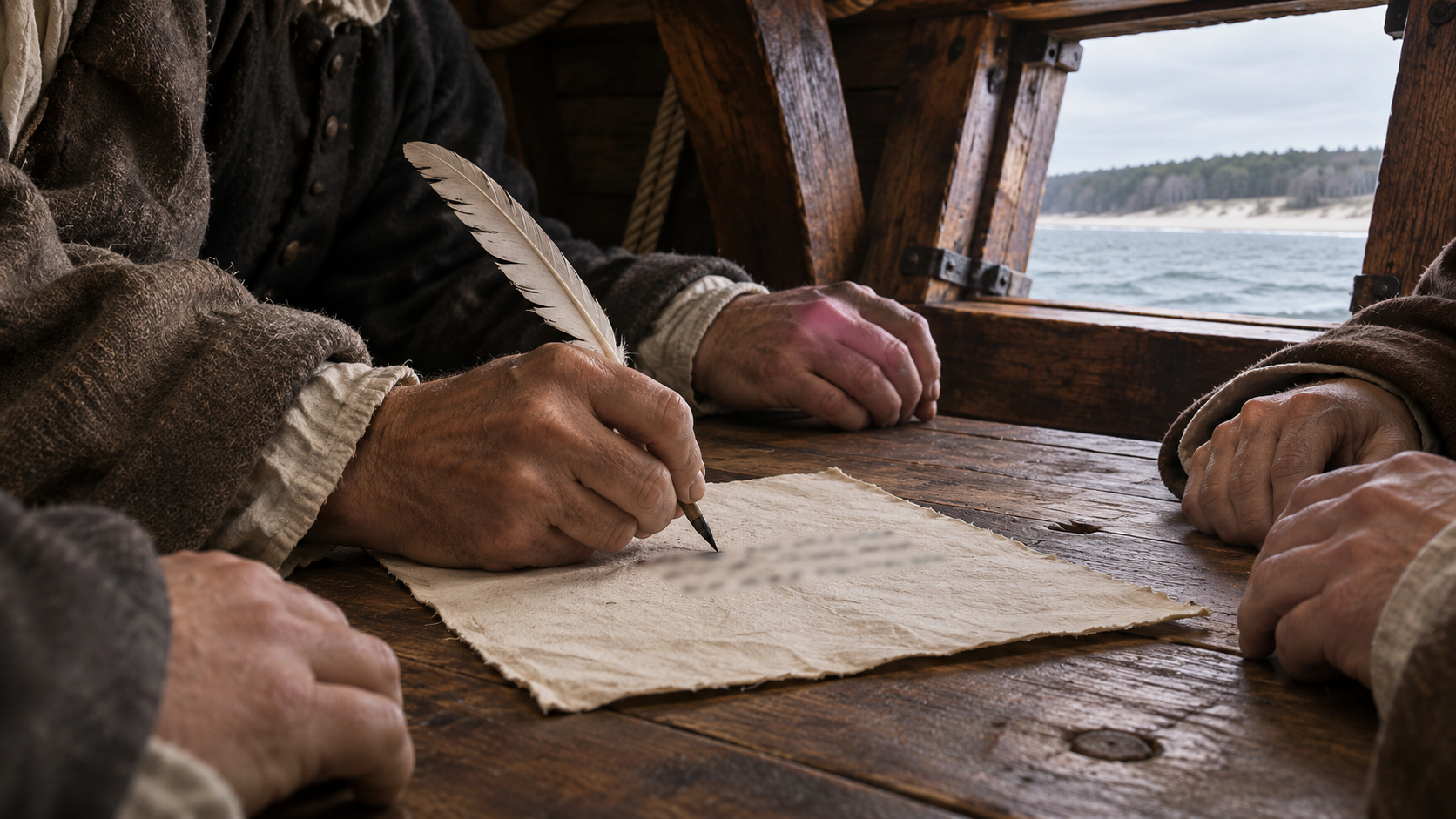
The original signed document has disappeared. The earliest surviving text appeared in Mourt’s Relation in 1622. It preserved the agreement’s wording without printing a list of names. Bradford also copied the text into his history. In 1669, nearly half a century after the voyage, Plymouth historian Nathaniel Morton published a list in New England’s Memorial. That later list underlies the roll of signers widely reproduced today.
Among the names are Carver, Bradford and Standish. Near the end are Edward Doty and Edward Leister, who travelled as servants to Stephen Hopkins. Hopkins himself appears farther up the list. Recognising all three men complicates the idea that each household simply cast one collective vote through its head. In this household, the master and two men in his service were individually associated with the promise.
The list also shows how selective that recognition was. No woman appears on it. Elizabeth Hopkins crossed the Atlantic and gave birth aboard the Mayflower to a son named Oceanus. Her husband and his two servants appear among the people credited with forming the colony’s civil government. She does not. The decisions that government made would shape where she lived and how her family survived the winter.
For readers accustomed to seeing the Compact reproduced with forty-one names set neatly beneath it, the difference between the records matters. We have an early printed account of what the men promised and a later account of who made the promise. We cannot inspect the handwriting, establish the order in which men approached the document or reconstruct what anyone said as he signed.
Whose Land Was Beyond the Ship?
For the passengers, reaching Cape Cod raised a question about English authority. For people living on the Cape, the arrival of the Mayflower was another encounter with Europeans on a coast whose fields, fishing places and settlements already had owners and histories.
Fifteen years before the Mayflower voyage, the French explorer Samuel de Champlain visited Nauset Harbour. He recorded homes around the bay, crops growing nearby and a fishing weir built to catch fish moving with the water. Archaeology adds something even his map could not show. The remains of animals and shellfish gathered at different times of year provide evidence that people lived there across the seasons. In the years after 1620, settlers from Plymouth came back to Nauset to buy food.
The English eventually established Plymouth across the bay at Patuxet, a Wampanoag village devastated by an epidemic before their arrival. Their later dealings with the Wampanoag leader Ousamequin required a separate agreement. He had his own people, interests and decisions to make. By the time of the harvest gathering at Plymouth in 1621, the settlers and their neighbours had begun to establish obligations to one another that nobody aboard the Mayflower could have settled in advance.
Read the Compact with that shore in mind and one small word becomes especially revealing. The men wrote of what we undertook, what we could enact and what we promised to obey. That pronoun did real work among the passengers. It also marked the limit of the agreement. Nobody at Nauset or Patuxet had signed it.
How Did an Agreement Among the King’s Subjects Become an American Founding Story?
The men who signed described themselves as loyal subjects of James I. They dated their undertaking by the years of his reign and identified the honour of their king among the voyage’s purposes. A reader in 1620 could readily understand local self-government as part of life under a monarch. English towns already conducted common affairs through corporate bodies. People could choose local officers while continuing to owe allegiance to the Crown.
Later readers found different stories in the same wording. During the American Revolution, the loyalist writer George Chalmers emphasised the signers’ fidelity to their king. In 1802, addressing a commemorative gathering in Plymouth, John Quincy Adams celebrated their personal assent to government. Each had words in the text to point to. The distance between their readings tells us something about the political work Americans later asked this short agreement to do.
Bradford left a more immediate judgement. In the passengers’ particular circumstances, he thought an act they had undertaken themselves might in some respects prove firmer than a patent. That is a striking admission from a man who believed the colony needed a patent and helped lead a community that obtained one. He understood the difference between permission from an authority in England and the willingness of a man beside him to accept an unwelcome decision.
The earliest printed account preserves the moment that distinction became practical. Immediately after the formal promise comes the shore party, the empty supply of firewood and the boat brought back full of juniper. The document has had four centuries of political interpretation. Its first readers had only to follow the journal into the next paragraph to discover what these people needed from one another that afternoon.
Sources
William Bradford — Of Plymouth Plantation, Mayflower Compact passage — Bradford’s account of the passengers’ objection, the agreement’s wording and his explanation of why a mutual promise carried weight.
Mourt’s Relation — A Journal of the Pilgrims at Plymouth — The early printed account of the agreement, the first shore party, the shallop repairs and the debate over exploring on foot.
Law Library of Congress — The 400th Anniversary of the Mayflower Compact — The Virginia Company patent, the contemporary meaning of a civil body politic and later political interpretations.
Plimoth Patuxet Museums — Mayflower and Mayflower Compact — The crossing, the passenger community and the provenance of Nathaniel Morton’s list of signers.
National Park Service — The Nauset Archaeological District, Eastham — Archaeological and historical evidence for year-round Indigenous settlement, farming and fishing on Cape Cod.
Next Reads
The History of Thanksgiving: What Happened at Plymouth, Why Turkey Won and Who Else Celebrates — Follow the story into 1621, when Ousamequin and his men brought five deer to the Plymouth harvest gathering.
Bonfire Night’s Forgotten Past: Religion, Street Rituals and Whats To Come — The religious and political world of James I, where the survival of a king became an annual occasion for thanksgiving.
What If the Gunpowder Plot Had Succeeded? The Explosion Was Only the Beginning — Fifteen years before the Mayflower sailed, a challenge to the same king exposed how hard it was to establish who
