The Spanish Tourist Cave Where 55 Ice Age Animals Hid Among the Graffiti
Some Visitors Carved Their Names Across Ice Age Art.
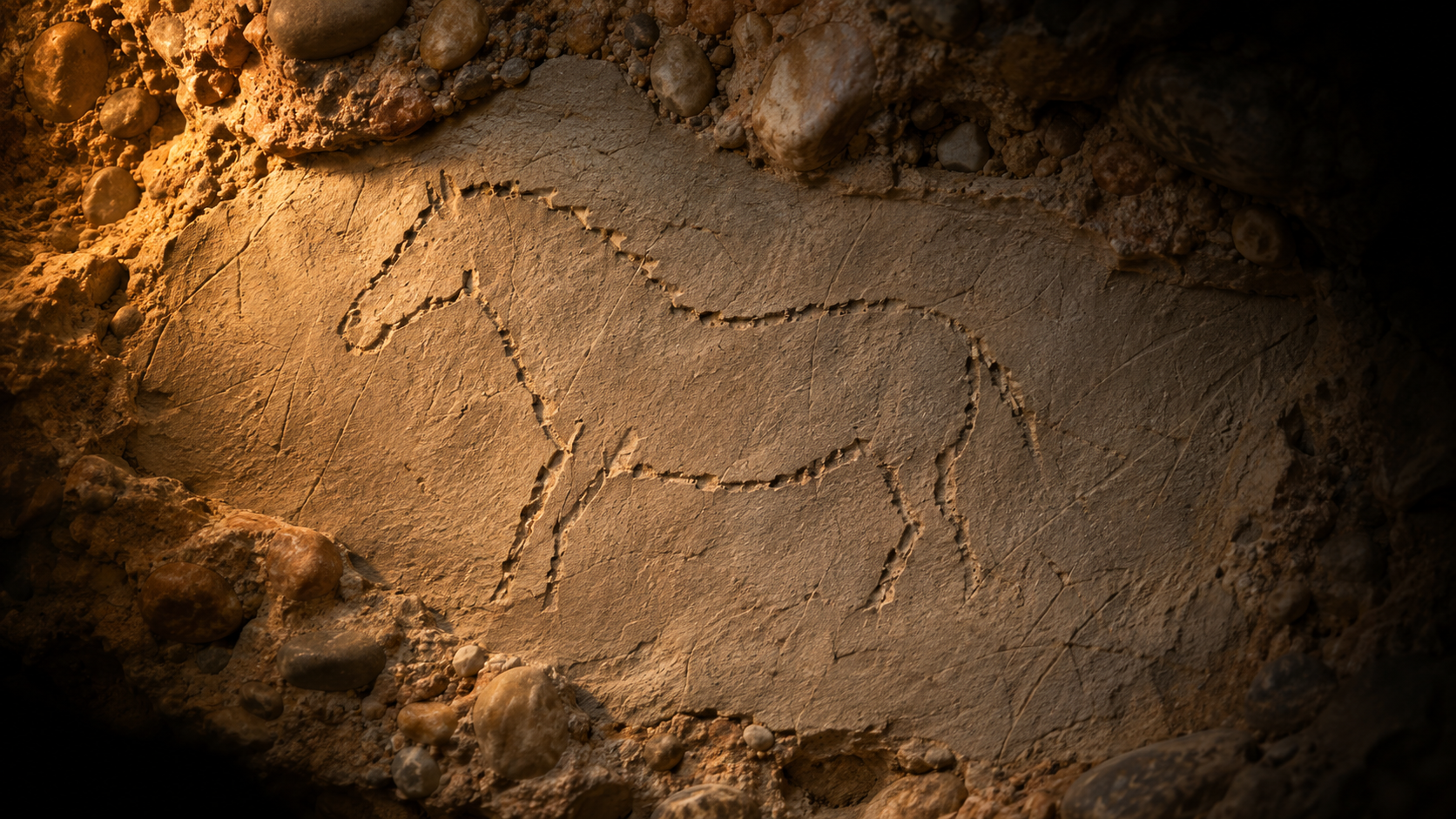
Shine a torch straight at a horse engraved on a cave wall and much of the animal can disappear. Move the light to one side and the edge of a shallow groove casts a shadow. A short curve becomes a muzzle. Follow it far enough and a horse emerges from a patch of stone that looked almost bare a moment earlier.
That trick of the light helps explain how thousands of people passed Ice Age engravings inside the Cova de la Font Major in Catalonia for more than sixty years. The figures occupied patches of soft rock among knobbly, multicoloured stone. Many consisted of just a few shallow lines. Later visitors added scratches, names and dates of their own. In places, someone had stood close enough to cut into a prehistoric image without recognising what was under their hand.
Archaeologist Josep Maria Vergès Bosch recognised the first engravings in October 2019. Seven years later, he and fellow researcher Míriam Salas-Altès published their study of 280 motifs, including 55 animal figures. Among them was a bear whose mouth still appears slightly open.
How a Well Led People Back Into the Cave
The cave lies beneath l’Espluga de Francolí, a town in north-eastern Spain. The River Francolí rises inside a system with more than three and a half kilometres of explored passages. In 1853, people gained access to the cave through a private well in the courtyard of a town house. A collapse, probably during the Roman period, had blocked the main entrance.
Explorers identified that entrance in 1956. It reopened the following year, bringing cavers, curious visitors and treasure hunters underground. In 1993, the cave became a tourist attraction. Part of the route took visitors past the decorated area, a group of small galleries called the Gatoneres de Cal Palletes, about 250 metres from the present entrance.
People had good reason to pay attention to the cave. In another chamber, Iron Age visitors had deposited hundreds of pottery vessels. One still yielded traces of wine. Here was evidence of people bringing possessions and offerings underground, some two thousand years before anyone entered through the courtyard well. Even archaeologists familiar with that history had overlooked a far older record on the walls.
Why the Horse Was So Hard to See
Much of Font Major is formed from conglomerate, a rock containing rounded stones cemented together. Its surface changes colour and bulges unpredictably. To someone deciding where to search for prehistoric pictures, it looked thoroughly unpromising. The Ice Age artists had made a more discriminating choice. Running between the rougher beds were layers of marl, a softer, more even material. Every engraving the researchers recorded was on one of those layers.
Most grooves measured between three and seven millimetres across, but they were shallow. Look at one under a light held close to your line of sight and very little shadow is visible inside it. Light falling across the surface picks out one edge. As Salas-Altès explained after the study appeared, examining the wall from different lighting angles could reveal depressions that were remarkably difficult to see head-on.
Then there is the matter of what counts as part of the picture. One engraved horse appears to stand on the boundary between the marl and the coarser rock below. Its maker may have found a ground line already waiting in the wall. Elsewhere, the lowered muzzle of a deer meets a horizontal crack. The researchers suggest that the crack might represent the ground or the surface of water. Whether the animal was meant to be drinking remains open. The lovely detail is that its maker had room to place the head higher, on an uninterrupted patch of wall, and chose this spot.
A visitor trying to separate an engraving from the natural stone therefore faced a peculiar difficulty. In some pictures, a natural feature may belong to the composition.
What Changed on 30 October 2019?
Vergès was visiting the galleries during an archaeological fieldwork campaign when he noticed that several marks among the graffiti had characteristics familiar from Palaeolithic art. The discovery came by eye. The high-resolution three-dimensional models that helped establish its scale came afterwards.
That sequence matters when looking at a published photograph of cave art. By the time a reader sees a horse picked out in a tracing, someone has found its outline, chosen a viewpoint and distinguished its back and legs from neighbouring scratches. The visitor underground had none of those advantages. Even the expectation that there was a horse to find came much later.
The researchers divided the decorated galleries into five sectors and examined the surfaces digitally. The models allowed them to measure grooves and study their relationships without repeatedly handling the fragile marl. The last stretch of the fifth sector had escaped much of the damage visible elsewhere. Across that sector as a whole, the team counted 33 of the cave’s 55 animal figures.
Nobody can now say how many images earlier visitors erased. The surface that took an Ice Age incision so readily was also soft enough to take a mark from a modern finger. Where repeated contact wore away part of an outline, it took away some of the evidence needed to recognise whatever survived beside it.
What Are the 280 Engravings Of?
Horses, deer, wild cattle and goat-like animals feature in the galleries. One aurochs, a wild relative of domestic cattle, is represented by the front half of its body. Its horns and ears are shown as though seen from the front. The bear has similarly conspicuous ears and a small opening between its jaws. Bears are unusual subjects in surviving Palaeolithic cave art, making this one of the more distinctive animals at Font Major.
Other figures resist such tidy names. A curve may be enough to recognise a belly, yet tell us little about the animal it belonged to. Many outlines lack a hoof, mane, nostril or other detail that might settle the question. The researchers could not assign roughly three in ten of the animal figures to a particular group. For some others, they could narrow the choice to two possibilities. Anyone who has tried to distinguish a goat from a deer in a handful of strokes will appreciate the restraint.
Most of the 280 motifs are non-figurative. Parallel lines occur in pairs and small groups, and some arrangements contain between fifteen and forty strokes. There are also curves and angular shapes. The catalogue sometimes treats a group of related marks as one entry. Counting every stroke separately would give a different and much less informative total.
One panel carries hundreds of loops, some running together in horizontal sequences. Their age is unresolved. An inscription bearing the date 1199 crosses the panel, giving researchers a clue to the order in which marks accumulated. It still leaves an immense stretch of time in which the earlier marks could have been made. Font Major preserves several chapters of people writing and drawing underground, occasionally on the same patch of wall.
How Old Are the Font Major Engravings?
The engravings themselves have yet to be directly dated. The often-repeated figure of 26,000 years comes from evidence for people in the inner galleries around that time. A flint bladelet, for example, came from a layer dated to roughly 26,000 years ago. Earlier evidence places people inside parts of the system around 41,000 to 35,000 years ago.
A tool recovered from a dated layer can help establish when someone was underground. It cannot tell us which animal, if any, that person drew. For that, researchers also examine how the artists constructed their figures. Some heads at Font Major are reduced to three lines. Some limbs end in characteristic forked shapes. Comparable conventions occur at other Mediterranean sites attributed to the earlier Upper Palaeolithic.
Taken together, the archaeological setting and the drawing styles suggest that a substantial share of the engravings predates the Magdalenian period, which began about 19,000 years ago. Assigning every horse, deer and group of lines a single birthday would go well beyond the evidence.
How One Cave Changed the Map of Ice Age Art
Before Font Major, only two individual cave-wall images in Catalonia had been attributed to the Upper Palaeolithic. One, a dark-painted member of the cattle family, was stolen shortly after its discovery and survives in photographs and a tracing. The other is an incomplete possible deer. Even its identification as a human-made mark remains uncertain.
Font Major added 55 animal figures in one place. Judged by that measure, it ranks third among known Palaeolithic cave-art sites on the Mediterranean side of the Iberian Peninsula, behind Ardales and La Pileta in southern Spain. A region once represented by two precarious examples now has a cave where researchers can compare dozens of choices about how to draw a head, suggest a limb or use a crack in the rock.
The discovery has already changed where archaeologists look. A subsequent survey at another Catalan cave, Cova Simanya, also found evidence of Palaeolithic imagery. That may be the most lasting consequence of the horse at Font Major. For decades, the rough walls had helped persuade people to look elsewhere. Archaeologists now have a reason to take a light back into caves they thought they knew.
Sources
Original research in Antiquity — The Palaeolithic rock art of the Cova de la Font Major
Nature — The cave art that hid in plain sight for 26,000 years
