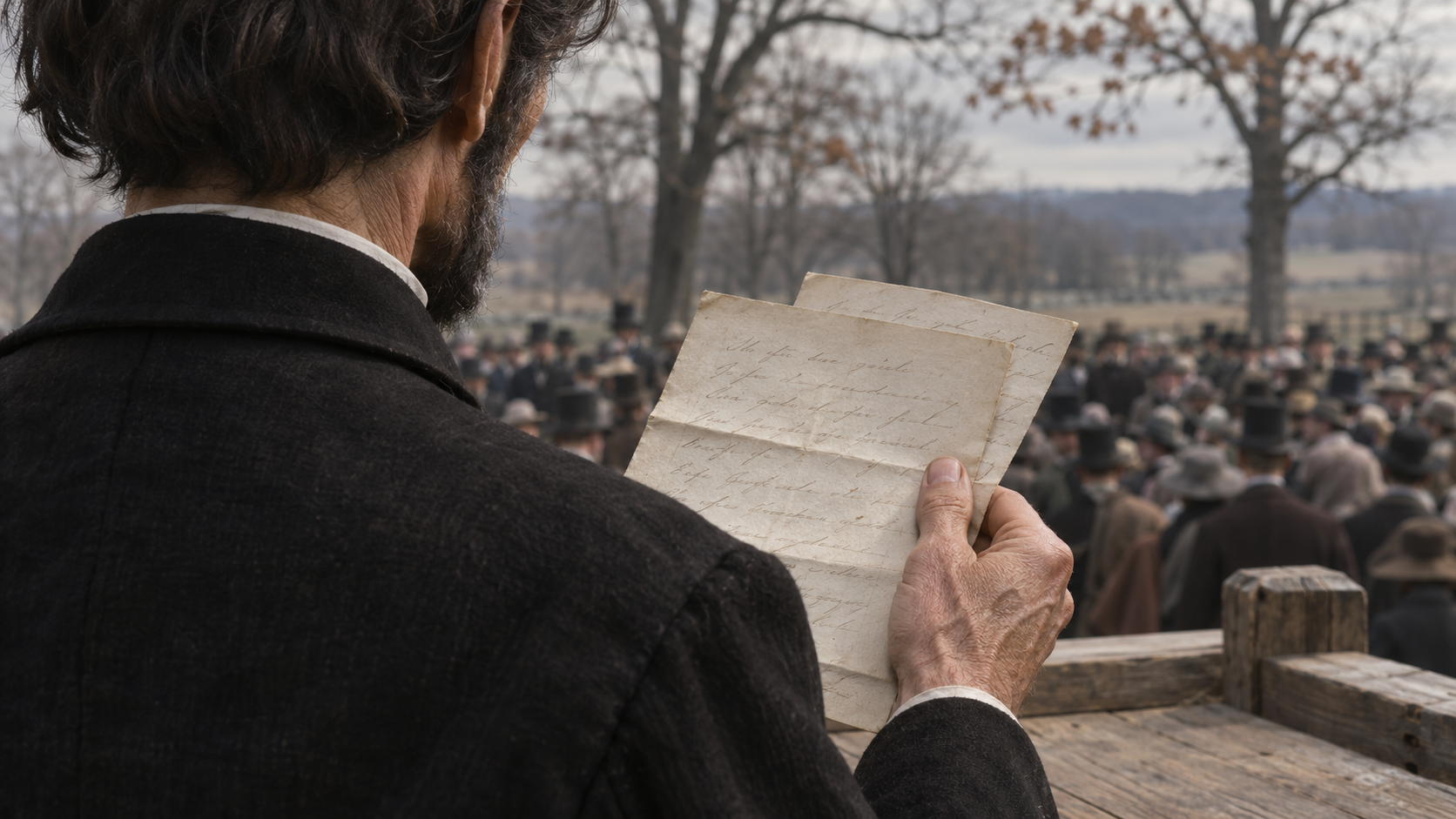
The Two Folded Pages Lincoln May Have Carried at Gettysburg
The Best Clue To Lincoln’s Spoken Words Is Missing From His Earliest Draft.
Near the end of the Gettysburg Address, Abraham Lincoln asked Americans to resolve that their nation would have a new birth of freedom. Did he say “under God”? The two earliest surviving manuscripts leave those words out. Yet a dispatch sent from Gettysburg includes them. A reader who trusts only the pages in Lincoln’s handwriting could cross out two words the crowd almost certainly heard.
Lincoln delivered the address on 19 November 1863 at the dedication of the Soldiers’ National Cemetery in Gettysburg, Pennsylvania. Five copies survive in his handwriting. The earliest, known as the Nicolay copy, may be the manuscript he held. No surviving copy can be identified with certainty as the exact text he spoke. The version most people read today, the Bliss copy, came months later. It owes its existence partly to a problem with a printer.
The Two Sheets Lincoln May Have Carried To Gettysburg
The strongest physical evidence begins with a pair of creases. The two sheets of the Nicolay manuscript have matching folds. Witnesses recalled Lincoln taking a paper from his coat pocket at the ceremony. Put those details together and there is a simple, credible possibility. The folded pages now held by the Library of Congress may once have fitted inside the president’s coat.
Look more closely, though, and the sheets seem an odd pair. Lincoln wrote the first page in ink on Executive Mansion stationery. The second is in pencil on lined paper. John Nicolay, the private secretary who kept the manuscript, offered an explanation in 1894. He said Lincoln brought the first part with him from Washington and wrote the second page before the dedication in Gettysburg.
The paper supports that account up to a point. A sheet from the president’s Washington office is good evidence that work began there. The switch to pencil and a different sheet is consistent with Lincoln revising the ending while staying at the home of David Wills in Gettysburg. The materials cannot establish the hour he wrote either page, and Nicolay set down his account more than thirty years after the event.
That distinction matters for the old story of Lincoln dashing off his speech on the train. The earliest surviving draft points towards preparation in Washington and further work in Pennsylvania. It also shows where Lincoln had the hardest editorial decision to make. Opening with the Declaration of Independence gave him a way into the speech. The ending had to tell people why a cemetery dedication placed an obligation on everyone who would walk away from it.
One Sentence Changed Who Was Being Dedicated
Edward Everett, the principal orator, spoke for about two hours. Lincoln followed him with remarks that Everett himself reckoned at two minutes. The occasion supplied Lincoln with an obvious subject. A part of the battlefield had been set aside for soldiers who had died, and the people assembled there had come to dedicate it.
In the Nicolay draft, Lincoln calls that ceremony something the living may undertake “in all propriety”. Read aloud, the phrase sounds like a judgement about the proper order of proceedings. In the version retained by his other private secretary, John Hay, the equivalent passage calls the act “altogether fitting and proper”. The change is small, but you can hear what it does. The second wording lets a speaker affirm the purpose of the gathering plainly before asking the crowd to reconsider what its presence can achieve.
Then comes a larger difference. In the Nicolay copy, Lincoln moves from the soldiers’ deeds to the great task facing the living. The Hay copy gives that transition an additional sentence about “the unfinished work”. It is easy to pass over those words because they sound so familiar. Try reading the passage without them. The audience still hears that it has a duty. With the sentence restored, it hears where that duty came from. The soldiers had carried a piece of work so far. The living had inherited it.
By this point, the word dedicate has changed hands. At first it describes what public officials can do for a burial ground. By the close it describes what the people standing on that ground must do with the rest of their lives. That turn survives in the earliest draft. The extra sentence gives the listener another moment to grasp it.
The Hay copy is especially valuable because the dispatch from Gettysburg also contains the unfinished-work passage. On that substantial detail, Hay brings us closer to what the audience heard. Yet the Library of Congress considers it likely that Lincoln prepared the Hay copy shortly after returning to Washington. A manuscript can preserve a spoken passage accurately even when it was written out after the speaker went home.
Did Lincoln Say “Under God” At Gettysburg?
The evidence strongly suggests he did. The phrase appears in the contemporary dispatch and in all three copies Lincoln later wrote for charitable projects. Its absence from the Nicolay and Hay manuscripts leaves a narrower and more interesting question. At what point did those two words enter the speech?
One possibility is that Lincoln supplied them as he spoke. Anyone who has read prepared remarks aloud will recognise how easily that can happen. A second possibility is that Lincoln took a further revision to the platform and that its pages have since disappeared. The folds in the Nicolay copy give the first explanation some physical support. Differences between that copy and the contemporary report leave room for the second. Neither the creases nor the wording can decide between them.
There is even a small disagreement about where the phrase belongs. In the dispatch, the words come immediately after shall. In the familiar Bliss text, Lincoln puts them immediately before it. The religious reference survives in both. Its position in the sentence changes.
That is the sort of discrepancy a modern editor could quietly smooth away, particularly if the editor already knew the speech by heart. It deserves to stay visible. There is strong evidence for the two words themselves and weaker evidence for their precise position. We can answer the question about what Lincoln said with more confidence than the question about exactly how he said it.
What The Crowd Contributed To The Record
The report sent from Gettysburg preserves something none of the five manuscripts could record in advance. It marks applause. The first interruption comes after Lincoln invokes the Declaration of Independence and its claim to human equality.
Consider where that response falls. Lincoln has barely begun. Counting back eighty-seven years from 1863 takes his listeners to 1776. He chooses the Declaration’s promise of equality as the starting point for a speech about whether the United States can survive a civil war. Before he has even described the cemetery, people in the crowd have already heard something they wish to applaud.
The dispatch marks another response after Lincoln draws a distinction between the words spoken at the ceremony and the deeds of those who fought there. It also records applause after the passage about unfinished work. On the printed page, that thought flows straight into the final appeal. At Gettysburg, if the reporter placed the interruption accurately, Lincoln had to give the sentence time to land before he could go on.
Those details lend the report a kind of authority that Lincoln’s signature cannot confer. They also have limits. An applause mark records an audible response. It cannot tell us how many people joined in, how long every interruption lasted or what a silent listener made of the speech. And a dispatch that appeared in several newspapers might still represent the work of one reporter. Ten printings of the same account would give us ten copies of one witness’s evidence.
Everett left a different kind of testimony. The next day, the man who had spoken for two hours wrote privately to Lincoln. He wished he had come as close to the central idea of the occasion in his long oration as the president had in a few minutes. The letter settles nothing about the placement of shall. It does establish that a listener with every reason to think carefully about the ceremony recognised what Lincoln had accomplished by the following day.
How A Printer Helped Choose The Version We Read
In February 1864, historian George Bancroft attended a White House reception with a request on behalf of his stepson, Colonel Alexander Bliss. A committee was collecting specimens of authors’ handwriting for a volume to be sold at the Baltimore Sanitary Fair. The proceeds would help soldiers, including men ill in hospital. Would Lincoln contribute the Gettysburg Address in his own hand?
Lincoln agreed. On 29 February he sent Bancroft a copy. He also sent one to Everett, who had requested a manuscript for a separate charitable undertaking. These two documents account for the third and fourth names generally encountered in lists of the address’s surviving versions. The men associated with them had different purposes from Nicolay and Hay. They wanted something the president’s handwriting could help raise money for.
Bancroft’s manuscript presented a practical difficulty. Lincoln had used both sides of the paper. The lithographic process chosen for the volume required a blank reverse. Had the committee wanted only the words, a printer could have set them in type. What the committee hoped to sell was the sight of Lincoln’s handwriting. The one feature that made the contribution valuable also made the layout of the original sheet matter.
So Lincoln produced another copy. This one, known by Bliss’s name, carried a title, a date and his signature. Of the five surviving manuscripts, it is the only one he signed. It went into the volume of facsimiles and gave later publishers a persuasive answer to an editorial question. Faced with several genuine Lincoln texts, which should they reproduce? Here was the last known version, carefully prepared for readers and signed by the author.
Its influence eventually reached the south wall of the Lincoln Memorial in Washington. Visitors who stand there encounter the wording of the Bliss copy. The journey from a president’s desk to a national monument passed through a charity book whose printers needed Lincoln to turn over a sheet of paper and leave the back blank.
Which Gettysburg Address Should You Quote?
For a reading, a classroom recitation or a quotation from the Lincoln Memorial, use the Bliss text. It preserves the form in which Lincoln chose to present the address to later readers. If the subject is his preparation for Gettysburg, start with Nicolay. Its mixed paper, ink, pencil and folds preserve evidence that disappears entirely in a modern transcription.
For an account of the ceremony itself, read the contemporary dispatch alongside the early manuscripts. Doing so changes how one of the speech’s best-known lines sounds. Lincoln predicted that the world would scarcely remember what anyone said there, although it would remember what the soldiers did. On the memorial wall, that prediction has acquired an obvious irony. In the dispatch from Gettysburg, it is followed by applause. For a moment, before anyone could know that schoolchildren would learn the address by heart, the people standing in the cemetery answered him.
Sources
Library of Congress — ‘Four Score and Seven Years Ago…’ — The matching folds, Nicolay’s recollection, the competing reading-copy theories and the history of the five manuscripts.
Associated Press — Text of Gettysburg Address, as Transmitted by AP — The contemporary dispatch, including the placement of “under God” and the recorded interruptions for applause.
Cornell University Library — Cornell University’s Copy — Bancroft’s request, Lincoln’s February mailing and the printing problem that prompted another manuscript.
Next Reads
Abraham Lincoln and Modern America: What Would He Think of the United States in 2025? — Follow the address’s argument about popular government into a later American debate.
What Would the Modern USA Be Like if the Confederates Had Won the Civil War? — A counterfactual exploring what Union defeat could have meant for slavery, citizenship and the survival of the republic.
What If America Lost the War of Independence? A Very Different Modern World — Revisit the revolutionary generation Lincoln invoked in the opening words at Gettysburg.
