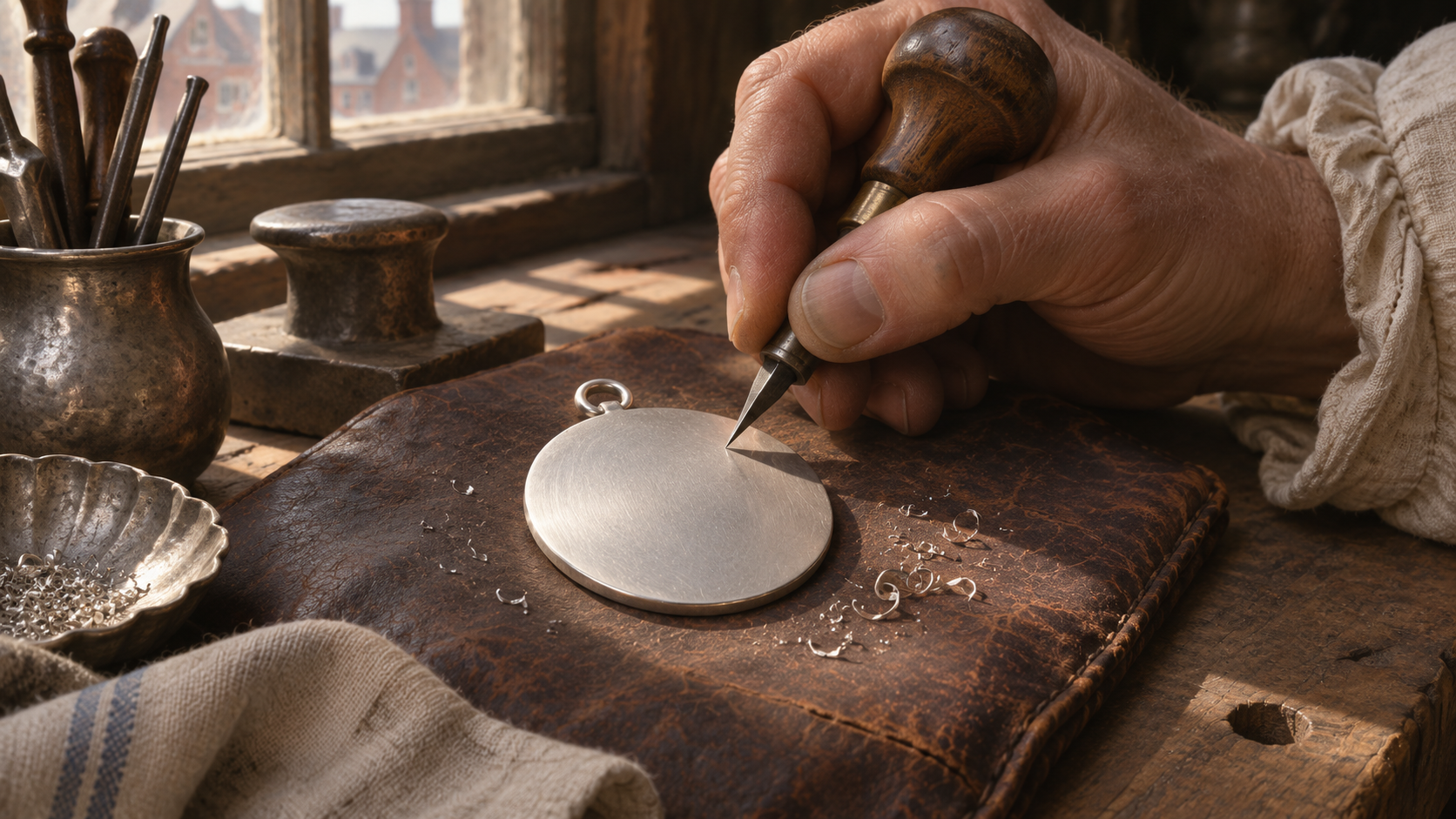
Ambrose Bear Refused To Take The King’s Silver Back.
At Watertown in July 1776, a Wolastoqey leader named Ambrose Bear handed the president of the Massachusetts council two pieces of silver. One was a gorget, a curved ornament worn at the throat. The other was heart-shaped. Between them they bore the royal arms and the likenesses of King George the Third and Queen Charlotte. When the council tried to return them, Bear refused. The president offered to have new pieces made bearing General George Washington and emblems of the united colonies.
That exchange helps explain why American revolutionaries commissioned a silver peace medal for members of the Wabanaki Confederacy in 1777. They needed allies against Britain on the north-eastern approaches to the rebellious colonies. A portrait medal gave them a familiar way to recognise Wabanaki leaders who had agreed to help. The choice of portrait owed something to a diplomat who had made his own view of the old one unmistakable.
One of those medals eventually reached George the Third himself. British officials obtained it under threat of military force and sent it to the king as a war trophy. To understand why anyone in London wanted a piece of silver engraved with a rebel general, it helps to start with what the Americans had asked Wabanaki families to risk.
Who Came to Watertown?
On a modern map, the journey to Watertown looks like a trip from the American and Canadian borderlands to a town near Boston. In 1776, there was no United States–Canada boundary for the delegates to cross. The Saint John River connected Wolastoqey communities, and Mi’kmaq territory extended across much of what is now Atlantic Canada. To Massachusetts officials looking north, these communities occupied approaches to British territory. To families who lived there, the river and coast connected homes, trading places and relatives.
Wabanaki is a collective name for distinct peoples. The delegates at Watertown came from Wolastoqey and Mi’kmaq communities. Older English records often call the Wolastoqey the Maliseet, or identify them by the Saint John River. The written agreement also mentions the Passamaquoddy. Where their name appears makes a difference. The delegates undertook to ask their Passamaquoddy neighbours to join them. Those neighbours retained a decision of their own.
Washington had already sought help in defending the north-east. The delegates travelled by sloop from Machias to Salem and continued to Watertown by carriage. They arrived on 10 July, less than a week after Congress adopted the Declaration of Independence. On 18 July, the Declaration was read aloud in Watertown. The following day, representatives of Massachusetts Bay and the visiting delegates concluded their Treaty of Alliance and Friendship.
Those adjacent dates give the Declaration a sequel often missing from the familiar story in Philadelphia. Congress had asserted that independent states could make alliances. At Watertown, Massachusetts officials acting on behalf of the United States had to find people willing to make one with them. Bear and his fellow delegates were among the first diplomats to hear what the Americans proposed to do with the independence they had just declared.
What Did Massachusetts Promise in Return for Six Hundred Men?
The sixth article of the treaty set a striking target. The Americans wanted six hundred men, or as many as the participating communities could provide. The recruits would travel to Boston and then join Washington’s army in New York. For a family on the Saint John River, that meant a man leaving home to serve hundreds of miles away. His enlistment could last up to three years, with a longer term possible by agreement.
The negotiators went into details that rarely feature in accounts of revolutionary diplomacy. Who would carry the men to Boston? When would their wages begin? Who would bear the loss if a man took his own gun into service and came home without it? Massachusetts undertook to provide sea passage and provisions. An ordinary recruit would draw the same pay as an American private, receive a dollar for the use of his gun and receive its value if he lost it in service.
Three delegates offered to go straight to Washington. The treaty recorded their names and specified when their pay would start. Their individual decisions survive alongside the much larger recruitment target. Three men had volunteered in person. Six hundred was a figure that still depended on conversations in villages far from Watertown.
The agreement also asked something of people who stayed home. Its terms would cut off assistance, correspondence and trade with the British during the war. Massachusetts in turn promised to supply its trading agent at Machias with goods Wabanaki households needed. Read those clauses together and the importance of the trading post becomes clear. If a family gave up one place to obtain supplies, the shelves at the other place had better be stocked.
There was also the question of what would happen when an alliance went wrong close to home. Two articles dealt with robbery and other injuries. If an American harmed a Wabanaki person, the injured party could seek restitution from the state. A corresponding obligation fell on the offender’s community when an American suffered harm. Both sides agreed to seek redress peacefully. Alongside the grand business of making war on a king, the delegates had found room for the person who needed their property back.
Why Silver Carried Weight
Wabanaki leaders had dealt with French and British officials who gave portrait medals for generations. In 1770, only six years before Watertown, the governor of Nova Scotia sent the Wolastoqey leader Pierre Tomah a silver medal showing George the Third and Queen Charlotte. Other men received insignia too. An American envoy could approach people who had seen a royal portrait worn in their own community and knew who had given it and on what occasion.
At Watertown, Bear demonstrated how much depended on the person receiving the gift. He and his companions had taken a sword from a trader on the Saint John River who wanted their support for Britain. Bear offered the weapon to Washington. When the council president returned the weapons brought to the meeting, he expressed confidence that Bear would use them against a common enemy. The attempt to return the royal silver drew a different response. A sword could change sides easily enough. A king’s likeness remained a king’s likeness whoever fastened it around a man’s neck.
On 25 February 1777, the American agent John Allan wrote to the Massachusetts council with a list of gifts he needed. Silver medals came first. The letter and the earlier council exchange give us two unusually good pieces of evidence about the commission. One explains why officials wanted a new design. The other places medals among the things the man responsible for maintaining relations actually asked Massachusetts to send.
The council had promised a new gorget and heart in 1776. The Washington peace medal displayed in London was made in Boston in 1777. The promise establishes what Massachusetts officials intended to put on diplomatic silver. The identity of the first Wabanaki owner of the particular medal that reached Britain remains uncertain.
Why Put Washington on One Side and Thirteen Hands on the Other?
The medal shows Washington with his initials. He was commander of the Continental Army, still more than a decade away from becoming president. For someone who had heard the terms offered at Watertown, he had a precise identity. He was the man to whom recruits had been asked to report and under whose orders they would serve. His name already figured in their negotiations before an engraver put his likeness into silver.
Turn the medal over and the design becomes stranger to modern eyes. An Indigenous figure sits at the foot of a classical column crowned by thirteen hands. The number stands for the thirteen colonies acting together. An engraver working for the British Crown could place a single sovereign on a medal and leave little doubt about whose authority it represented. The American design had to convey how a general, a council in Massachusetts and thirteen newly independent states belonged in the same agreement.
There is a revealing difference between the picture and the meeting that helped inspire it. The seated figure has no name. The treaty preserves the names of men who negotiated pay, offered service and undertook to speak to their neighbours. The design shows how the commissioners wished their alliance to appear. The words spoken at Watertown preserve something the engraving leaves out. One of the people represented by that seated figure had been quite prepared to hand the silver back.
Who Could Speak for the Wabanaki?
During the treaty discussions, Bear acknowledged a limit on the delegates’ authority. They would need to consult their communities. Several Mi’kmaq chiefs subsequently told Allan that they had never authorised the agreement. That objection could coexist with the decision of individual Mi’kmaq men to fight alongside the revolutionaries. A volunteer could answer for himself. A delegation promising to bring hundreds of men to Boston had to persuade people who had been nowhere near the council chamber.
There were older promises to weigh as well. Mi’kmaq and Wolastoqey communities had negotiated peace and trade with Britain long before the Declaration of Independence. British agreements had provided for trading posts, and the regional peace and friendship treaties involved no surrender of land. The Americans at Watertown now wanted earlier commitments set aside wherever they conflicted with the alliance. For people who had spent years establishing what Britain owed them, that was a considerable request.
One delegation put the matter to Allan in terms that made sense from their side of the Atlantic. Why had Old England and New England come to blows? The quarrel looked to them like a father fighting his son. Before joining such a fight, they wanted to know who was in the right. Americans who believed the Declaration had answered that question still had to make their case to people with reasons of their own for keeping the peace.
The practical cost became apparent at Machias. Mi’kmaq and Wolastoqey participants in the fighting complained that expected goods and provisions had failed to arrive. Men eventually left for their villages. A medal could travel with an envoy and survive the journey home. Keeping a trading post supplied required boats, goods and people willing to send them again. The American promise most easily tested by a household was also one that Massachusetts struggled to keep.
How Did a Wabanaki Peace Medal Reach the British King?
In September 1778, British representative Michael Francklin met Wolastoqey and Mi’kmaq leaders on the Saint John River. Leaders surrendered gifts they had received from the American side, and Francklin personally decorated chiefs and captains. The British Museum’s exhibition account describes military coercion behind the confiscation of its medal. Sending it to George the Third as a trophy allowed British officials to show their king an apparent recovery of allegiance. The circumstances of its surrender give us reason to ask how much allegiance it proved.
Even the identity of the person who handed it over remains uncertain. Pierre Tomah took part in the meeting, but the account of the surrendered American gifts does not itemise them. Before winter, he was talking to Allan again. Diplomacy on the river continued after the moment British officials could present in London as a victory.
George the Fourth gave the medal to the British Museum in 1825. A second example with the same design had a different history among the Mi’kmaq in New Brunswick. In the twentieth century, people at Eel Ground understood it as a chief’s badge of office. Georgina Barlow’s family traced ownership through her mother, Rose Francis. Both accounts allowed for a chief wearing the medal. The question was whether it belonged to him by virtue of his office or whether a woman in the family had authorised him to wear it. In 1979, a Canadian court recognised Georgina Barlow as its owner.
The two medals leave us with different records of what happened when someone wore Washington’s image. The one sent to London passed from a king to a museum with its status as a trophy intact. The other preserved the memory of a woman lending something precious for a public occasion. Nearly two centuries after the revolutionaries commissioned a gift for Wabanaki leaders, the decisive question about that piece of silver was who had inherited it from her mother.
Sources
Cape Breton University, L’nu Resource Centre — Treaty of Watertown — The text of the 1776 agreement, including recruitment, pay, restitution and trade at Machias.
Nicholas N. Smith — Gift Diplomacy: Medals for the Wabanaki — Bear’s refusal of the royal insignia, Allan’s request for medals and the evidence concerning Pierre Tomah.
Rosalie Marie Francis — The Mi’kmaq Nation and the Embodiment of Political Ideologies — Mi’kmaq decision-making, the limits of the delegates’ authority and the consequences of supply failures.
Record Lighting — Declaring Independence: USA 250 — The British Museum exhibition designer’s account of the commission, the British seizure and the royal donation in 1825.
The Numismatic Bibliomania Society — The Second GW Peace Medal — Harald Prins’s account of the matching medal, the competing claims to it and Georgina Barlow’s ownership.
Next Reads
The History of Thanksgiving: What Happened at Plymouth, Why Turkey Won and Who Else Celebrates — A gift of five deer helps recover the Wampanoag leader Ousamequin’s role in an earlier New England alliance.
What If America Lost the War of Independence? A Very Different Modern World — A counterfactual history of British victory and what it might have meant for Indigenous treaty rights.
George Washington and Modern America: What Would He Think of the USA in 2025? — How the general’s experience of war shaped his later thinking about the Union and foreign alliances.
