

Why Drones Became One of the Most Important Weapons in War
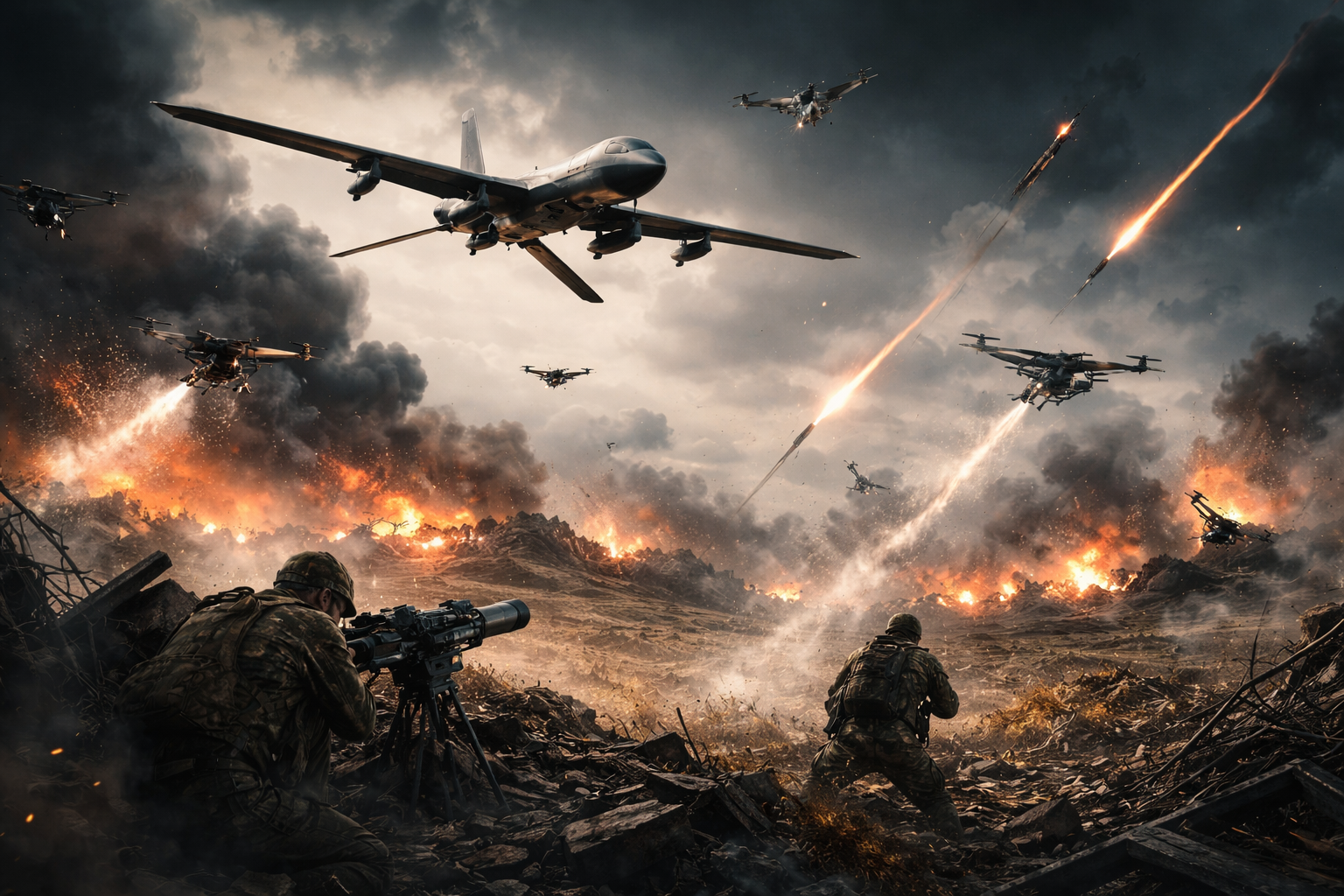
How Drones Took Over Modern War
The Rise of Drones From World War I Curiosity: To War-Defining Weapon
Drones became important in war because they compress the old tradeoff between cost, distance, and risk. A military can now watch, track, and sometimes kill targets without putting a pilot in the cockpit, and in many cases without using an expensive fighter jet or missile. This shift has transformed the nature of warfare, encompassing counterterrorism campaigns, trench warfare, and regional missile-and-drone barrages.
That shift is visible almost everywhere modern conflict is unfolding. In Ukraine, small first-person-view drones have turned open ground into a killing zone. In the current Iran conflict, long-range drones have become part of a wider pressure campaign against military bases, cities, shipping lanes, and air defenses. Drones are no longer a specialist tool. They are now part of the core grammar of war.
The deeper point is that drones did not become decisive simply because they fly without a pilot. They became decisive because they are cheap enough to use in large numbers, smart enough to find or track targets, and flexible enough to serve in surveillance, strike, decoy, and attrition roles at the same time.
The story turns on whether mass, software, and autonomy keep making drones cheaper to lose than the targets they destroy.
Where This Story Really Begins
The roots of drone warfare go back more than a century. During World War I, Britain and the United States experimented with pilotless aircraft. One of the best-known early examples was the American Kettering Bug, designed in 1917 and first flown in 1918. It was, in effect, an early aerial torpedo: a small unmanned aircraft meant to fly toward a target and crash into it.
But those early systems were crude. Navigation was limited. Reliability was poor. Military aviation itself was still young. So the basic idea existed long before modern electronics made it practical.
Silicon Valley or the war on terror did not suddenly invent drones. What changed was not the dream. What changed was the enabling technology: radio control, satellite links, miniaturized cameras, GPS, digital mapping, cheap sensors, and now machine vision.
From Target Drones to Real Combat
For decades, many unmanned aircraft primarily served as targets for gunnery practice or reconnaissance tools. The real wartime breakthrough came when militaries realized drones were perfect for missions that were dull, dangerous, or politically sensitive.
In the Vietnam War, U.S. unmanned reconnaissance aircraft such as the Firebee flew missions over heavily defended areas. That was an important turning point. The drone’s value was no longer theoretical. It was practical: send the machine where losing a pilot would be costly militarily and politically.
Later conflicts expanded that logic. In the Balkans, Iraq, and Afghanistan, drones increasingly became part of surveillance and target-hunting systems. By the early 2000s, the Predator revolutionized the equation by integrating endurance, live video, and weapons. A drone could circle for hours, confirm a target, and strike without handing off the mission to another aircraft.
That fusion of watching and hitting was revolutionary. Older airpower often separated detection from attack. Drones brought them together in one loop.
How Drones Are Used in War Now
Modern drones fill several roles at once.
Some drones serve as surveillance tools. They scout terrain, track troop movement, and feed live video to commanders.
Some are artillery helpers. They find targets, correct fire, and assess damage in real time.
Some are strike platforms. These include larger armed drones that carry missiles, as well as loitering munitions, sometimes called kamikaze drones, which circle until they dive into a target.
Some are disposable battlefield tools. Small FPV (first-person view) drones, often adapted from commercial designs, let operators fly directly toward a tank, trench, bunker, or vehicle with explosive payloads.
Some act as decoys or saturation weapons. Their job is not necessarily to destroy a target by themselves, but to force defenders to reveal radars, waste interceptors, or split attention.
That is one reason drones matter so much now. They are not one weapon. They are a whole family of capabilities, from persistent surveillance to cheap guided attack.
How Deadly Are They?
They can be highly lethal, but their deadliness depends on type, target, and context.
A large armed drone can kill like a light attack aircraft. A loitering munition can destroy radar, artillery, or armor. A small FPV (first-person view) drone may carry a modest explosive charge, but on a crowded battlefield it can still kill or maim individuals, destroy vehicles, and make routine movement extremely dangerous.
In some wars, drones are deadly not because each is powerful, but because they are ubiquitous. Constant airborne surveillance means concealment is harder. Constant threat means logistics slow down. Troops disperse, dig deeper, camouflage more, and still face the risk of discovery.
This dynamic is what makes drone warfare psychologically powerful as well as tactically effective. A cheap drone can pin down a far more expensive force by providing real-time surveillance and targeting information, which can significantly disrupt the operations of larger military units.
The Wars That Made Drones Central
The modern story of drone warfare runs through several conflicts.
The U.S. wars in Afghanistan and Iraq made armed drones globally famous.
Pakistan, Yemen, Somalia, and Libya became closely associated with cross-border drone strike campaigns and remote counterterrorism.
The 2020 Nagorno-Karabakh war showed how drones and loitering munitions could help break older battlefield assumptions about armor, air defense, and exposed troop formations.
Then Ukraine pushed the change into overdrive. There, drones became not just a niche tool but a mass battlefield system used by both sides in huge numbers. Reconnaissance drones, FPV strike drones, long-range attack drones, and interceptor drones all became part of daily combat.
That is the key shift. Earlier wars proved drones were useful. Ukraine helped prove they could become structurally central.
What Most Coverage Misses
Most coverage treats drones as important because they remove pilots from danger. That is true, but incomplete.
The real military revolution is economic. Drones are revolutionizing warfare due to their rapid production, quick adaptation, and lower cost of loss compared to many systems designed to counter them. A relatively cheap drone can damage or destroy a much more expensive vehicle, force an air-defense missile launch, or disrupt shipping and power infrastructure at a disproportionate cost.
That changes strategy. It rewards mass, iteration, and software updates over exquisite platforms alone, allowing for rapid deployment and adaptation to changing battlefield conditions. The side that adapts fastest can gain a serious edge even without absolute air superiority.
This principle is also why commercial technology matters so much. Cameras, chips, navigation tools, batteries, and software improvements from civilian markets can quickly migrate into military use.
The Current Iran Conflict and the New Regional Drone War
The current Iran conflict shows drones in a different role from the classic post-9/11 model. The conflict is not just about a single state using drones to target militants in remote areas. It is about a state and its network projecting pressure across a region.
Iran has spent years building drone capacity, especially systems that can travel long distances and be launched in large numbers. In the current conflict, drone attacks have been part of broader missile and proxy-style pressure on Gulf states, Israel, regional bases, and maritime traffic. Even where many drones are intercepted, they still impose cost, confusion, and defensive strain.
That is a crucial point. A drone campaign does not need perfect accuracy to be strategically useful. It can still force air defenses to stay on constant alert, raise the cost of shipping, spook markets, and signal reach.
In that sense, drones sit between terrorism, airpower, and missile warfare. They are slower and often less destructive than ballistic missiles, but they are cheaper, more flexible, and easier to scale.
How They Are Operated
Not all drones are operated the same way.
Larger military drones are usually flown by crews on the ground using control stations, video feeds, and data links. Some use line-of-sight radio links for takeoff and landing. Others use satellite communications for long-distance missions.
Smaller tactical drones may be flown by nearby operators with handheld controllers, tablets, or FPV goggles. In battlefield conditions, that creates a constant contest between control and disruption. Electronic warfare units try to jam signals, spoof navigation, or sever links. Drone operators respond with signal-hopping, better antennas, inertial backups, fiber-optic tethers in some cases, and more onboard automation.
That contest is now central to drone warfare. The question is no longer just who has drones. It is who can keep them useful in a jammed, contested environment. This shift has transformed the nature of warfare, encompassing counterterrorism campaigns, trench warfare,
Will Drones Become AI-Operated?
In part, they already are.
The most important distinction is between remotely piloted, automated, and truly autonomous systems. Many drones today are still flown by humans but use software to stabilize flight, follow routes, avoid obstacles, or lock onto a visual target. Some newer systems can continue toward a target even after communications are jammed or lost.
That does not yet mean a fully independent robot war is here at scale. Human operators still remain deeply involved in most real combat use. But the trend is unmistakable: more onboard vision, more target recognition, more navigation without GPS, more swarm coordination, and more machine assistance in the kill chain.
The hardest political and legal question is not whether AI will be used in military drones. It already is. The real question is how much decision-making humans keep over target selection and attack.
The Battlefield That Comes Next
Drones matter because they have made airpower cheaper, more persistent, and more widely available. They give weak actors new reach, strong actors new options, and every military a new problem to solve.
The fork in the road is not whether drones will remain in war. They will. The real fork is whether militaries can defend against mass low-cost drone attacks faster than drone makers improve range, autonomy, and scale.
Watch three signposts: whether AI-guided drones become routine under jamming, whether armies redesign vehicles and infantry tactics around permanent aerial exposure, and whether states can produce enough cheap interceptors to restore the cost balance. If they cannot, drones will not just shape the next era of war. They will define it.
