A Ship Goes Down, the Ladder Goes Up: Why a Reported Iranian Warship Sinking Raises Wider-War Risk
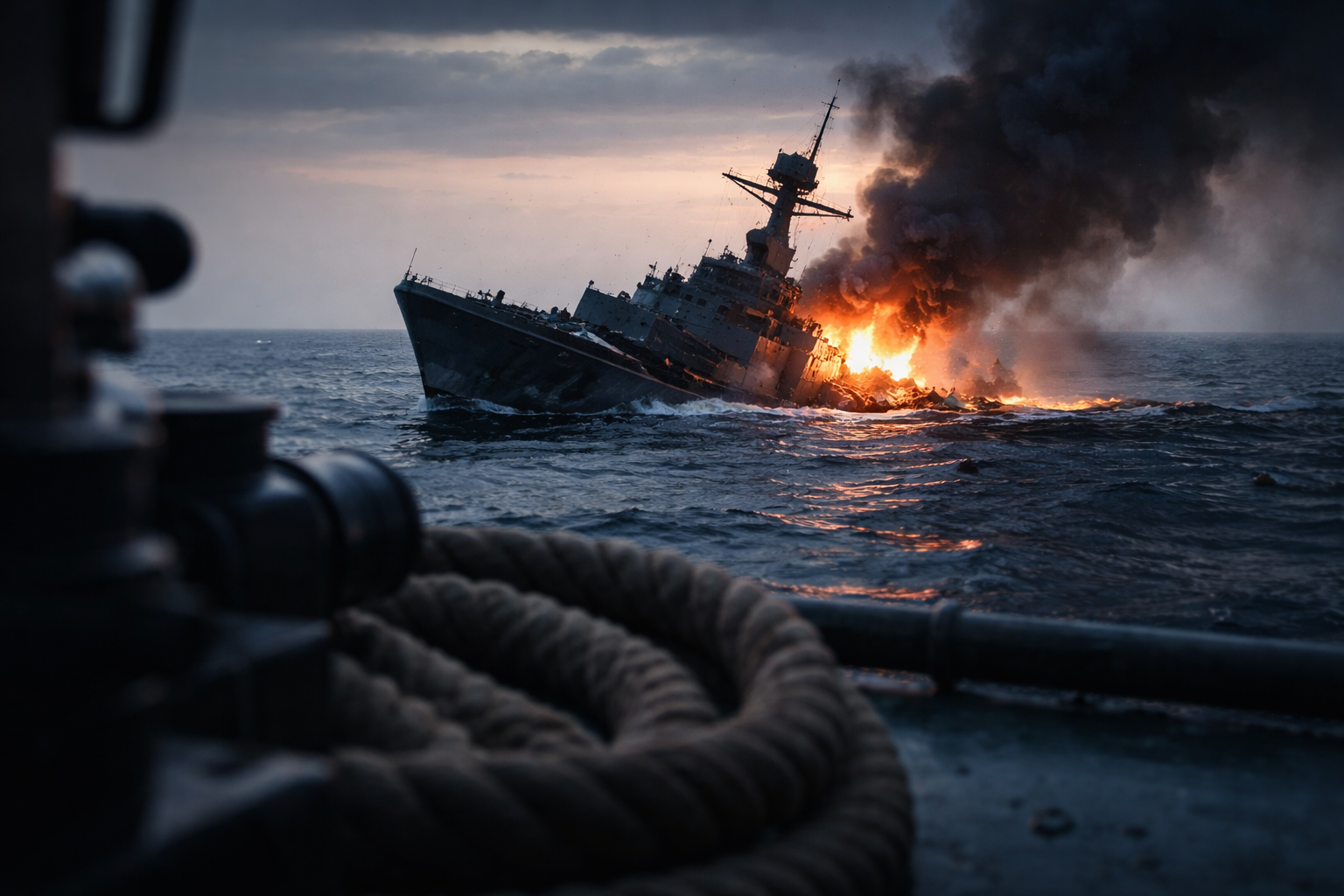
“Sunk” Is the Headline; Port Geography Is the Mechanism
U.S. Says It Sank an Iranian Warship—A Sea-Line Escalation With No Easy Off-Ramp
The U.S. military says an Iranian warship is going down in the Gulf of Oman—and it paired that claim with an unusually direct call for Iranian forces to “lay down” arms and abandon posts.
U.S. Central Command described an Iranian Jamaran-class corvette as struck at a pier in Chah Bahar, with the vessel “currently sinking.”
The headline is a ship. The real risk is the latter: naval combat compresses decision time, magnifies misreads, and turns signaling into something that can kill people in minutes.
Most coverage will focus on whether the ship was truly “sunk.” The deeper mechanism is that a strike at a pier is not the same as a fleet fight at sea—and that changes what Iran can plausibly do next without looking weak at home.
The story turns on whether this is a contained punishment strike or the opening move in a broader sea-control transition that pulls commercial shipping into the conflict.
Key Points
The U.S. military says it struck and sank an Iranian Jamaran-class corvette at a pier in Chah Bahar, in the Gulf of Oman, and urged Iranian personnel to abandon posts.
“Sunk” can mean different operational outcomes: destroyed at the pier, disabled and later flooded, or rendered non-operational even if parts remain afloat; independent confirmation may lag.
A claimed warship sinking is an escalation step because it shifts the fight from strikes on land to direct loss of naval platforms—raising pressure in crowded sea lanes.
A strike in port (at a pier) changes incentives: it can be read as a warning about access, logistics, and sea denial rather than an attempt to win a ship-on-ship battle.
Naval signaling often uses calibrated steps—warnings, shadowing, jamming, limited disabling fire—so the jump to a “sinking” claim raises the risk of rapid retaliation and accidents.
What happens next depends on Iran’s response choice: symmetric naval moves (risky), asymmetric pressure on shipping (plausible), or political signaling plus proxy actions (likely).
A warship is not just steel and missiles.
It is a symbol of sovereign control, a mobile sensor platform, and a tool for enforcing claims at sea. When one side says it has sunk the other’s ship, it is telling three audiences different things: the enemy’s commanders, domestic publics, and every commercial operator trying to decide whether a route is still safe.
The Gulf of Oman sits at the mouth of the Persian Gulf and connects to the Strait of Hormuz—one of the world’s most sensitive maritime chokepoints. Even when fighting is “limited,” shipping markets price in risk fast because insurance, crew safety, and rerouting decisions move on fear as much as on facts.
A Jamaran-class corvette is typically described as one of Iran’s more advanced domestically built surface combatants. Even if a single ship does not change the balance of power, the claim of sinking changes the narrative of control—and stories can drive escalation.
Sinking a ship is also a message to every other ship
Operationally, “sunk” is a blunt word for a range of realities. You can hit, burn, lose propulsion, list, and become a total loss on a vessel without it immediately disappearing under water. A ship can also settle on the bottom in shallow water near a port, leaving visible wreckage that is still “sunk” in military terms because it is no longer an operational asset.
That ambiguity matters because it creates room for both sides to claim victory. The U.S. can present decisive action; Iran can argue survivability, rescue, or exaggeration. In fast-moving conflicts, those competing claims are not side notes—they shape what each leadership feels it must do next.
The risk boundary is this: once you accept ship losses as normal, the next “reasonable” step becomes easier to justify. That is how ladders work.
Two escalation stories: “one-off” punishment vs a sea-lane dominance play
There are two broad models for what this claim represents.
Model one is a limited pressure strike. The intent is to impose a cost, deter a specific activity, and signal that escalation is reversible if Iran stops. In this model, the U.S. chooses targets that are militarily meaningful but strategically contained.
Model two is a transition toward sea control and sea denial. The intent is to shape where Iran can operate, how it supplies forces, and how confidently it can threaten shipping. In this model, a strike on a ship is less about the ship and more about controlling the “permission structure” of the sea around Iran.
You can often tell which model is winning by the follow-on: whether you see more messaging about restraint and deconfliction or more moves that force commercial traffic to choose sides.
Navies can’t “half-escalate” once ships start dying
Naval escalation is uniquely challenging to manage because it is public, kinetic, and geographically cramped. Radar tracks, flight decks, and missile warnings create short fuses. Commanders have minutes, sometimes seconds, to interpret intent.
At sea, “signaling” is not just words. It includes ship positioning, aircraft overflights, radar illumination (a form of threat display), electronic jamming, and live-fire patterns. The point is to show capability and resolve without triggering the other side’s need to respond with lethal force.
But the constraint is brutal: once ships are hit and crews are at risk, the political demand for retaliation spikes, and commanders get narrower rules of engagement. That is how an incident becomes a campaign.
Hitting at a pier compresses Iran’s response menu
Hinge insight: A strike on a warship at a pier is not merely a naval kill; it is a geographic signal that threatens Iran’s access and logistics, which pushes Iran toward asymmetric retaliation rather than ship-on-ship escalation.
Here is the mechanism. If a ship is struck in port, the action reads as a warning about sanctuary: "Your platforms are vulnerable even when not actively fighting.” That expands perceived vulnerability beyond the open sea into the infrastructure that sustains operations—ports, fuel, maintenance, command nodes, and coastal routes.
For Iran, matching that move symmetrically (by sinking a comparable U.S. warship) is far harder and far riskier. So the incentive shifts toward responses that are deniable, distributable, and cheaper—pressure on commercial shipping, drones and missiles against regional bases, cyber disruption, or proxy actions.
That is why the “where” matters. It changes what looks like a credible, domestically saleable response.
The next warnings, patrol patterns, and shipping disruptions
If this is intended to remain limited, you would expect to see clearer guardrails: explicit warnings to avoid certain military zones, visible deconfliction messaging, and target selection that avoids dragging neutral commercial traffic into the blast radius.
If it is drifting toward sea-lane dominance, you would expect to see more actions that reshape shipping behavior: maritime advisories that widen, more interceptions, more strikes on maritime-related infrastructure, and heightened disruption around chokepoints.
The fastest measurable signals in the next 24–72 hours are operational: changes in patrol density, the scope and wording of official warnings, and whether commercial operators begin rerouting or pausing transits at scale.
What Most Coverage Misses
Hinge: The location of the strike—at a pier—matters more than the ship class because it signals a willingness to contest sanctuary, which nudges Iran toward asymmetric retaliation that can spread risk to commercial traffic.
That mechanism shifts incentives on both sides. The U.S. gains a visible “control” narrative, but it also increases the chance that Iran chooses responses that are harder to deter because they are dispersed and deniable. Meanwhile, shippers and insurers respond not to legal arguments but to perceived unpredictability.
Two signposts would confirm this hinge quickly: first, whether official messaging starts framing ports and maritime infrastructure as legitimate targets; second, whether the next Iranian response emphasizes commercial pressure (shipping incidents, threats, or disruptions) rather than direct naval duels.
What Happens Next
The next phase usually splits into two clocks: the immediate 24–72 hours and the longer multi-week adaptation.
In the short term, the danger is a rapid action-reaction loop at sea, because close encounters and ambiguous intent produce “hair-trigger” decisions. That risk rises further if either side tries to demonstrate dominance through aggressive patrols and overflights.
In the weeks ahead, the contest shifts to endurance and control. Commercial shipping becomes a strategic instrument because it is economically sensitive and politically loud. The key consequence is not just a ship count, but whether sea routes remain usable at predictable cost—because that affects energy markets, supply chains, and allied cohesion.
Watch for concrete decisions: expanded maritime exclusion warnings, changes in regional basing posture, and any announced international naval coordination efforts. If dates for diplomatic meetings or emergency multilateral sessions are announced, those become the “off-ramp tests” for whether leaders still want a controlled outcome.
Impact
A container line’s operations team has to decide whether to keep crews on a route when the headline reads “warship sunk.” Even a small risk premium can trigger rerouting that adds days and cost.
An insurer may temporarily raise war-risk premiums or tighten coverage terms for transits near chokepoints. That can move faster than governments can negotiate.
A regional employer may pause travel, relocate staff, or switch suppliers if air routes and ports become unreliable. Those are quiet, immediate costs that don’t wait for a formal end state.
The Gulf’s dilemma
The core dilemma is that both sides want to appear unafraid while also trying to avoid a runaway conflict they cannot fully control. Naval power is designed to signal. The problem is that naval power also makes accidents lethal.
If this stays limited, it will be because leaders build a believable boundary and stick to it, even under domestic pressure. If it expands, it will likely expand sideways—into shipping, infrastructure, and regional basing—because those are the pressure points that change behavior fastest.
The signposts to watch are simple: how the warnings change, how shipping behavior changes, and whether the next responses aim for symbolic wins or systemic disruption.
This moment will be remembered as significant if it marks the point when sea-lane control—not just strikes on land—became the central mechanism of escalation.
