UK Draws a Hard Line on Falklands as US Pressure Exposes a Fracturing Alliance
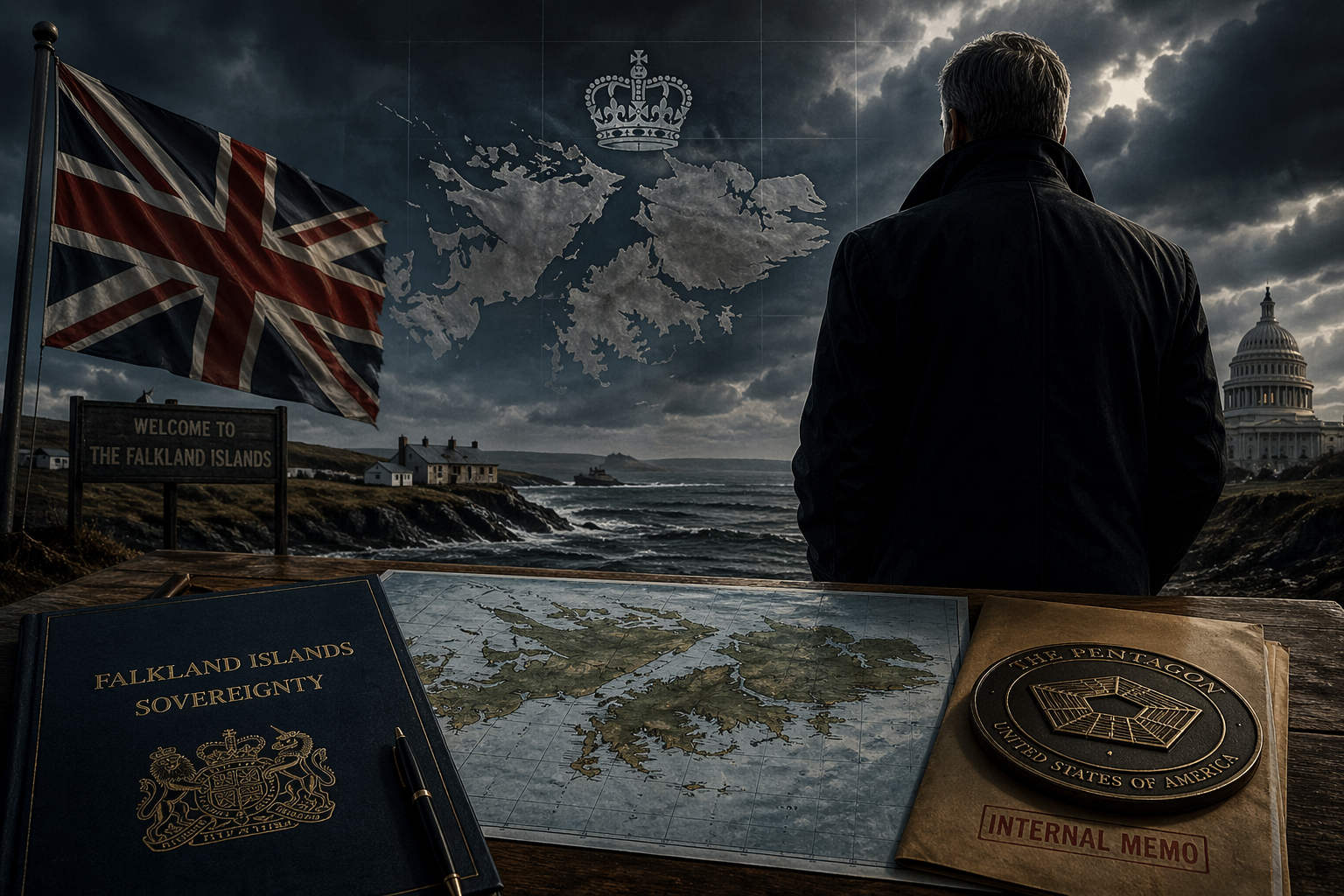
Britain Stands Firm as US Weighs Falklands Shift in High-Stakes NATO Rift
A Quiet Threat with Loud Consequences: The Falklands Return to Global Tension
A leaked Pentagon memo reveals how alliance politics, war pressure, and sovereignty collide—and why Britain’s response is about far more than a remote set of islands
The statement was simple. The implication was not.
“Sovereignty rests with the UK.”
That line, delivered with deliberate clarity, was not just a routine reaffirmation. It was a signal directed at Washington, not at Argentina or the United Nations.
Because this time, the pressure is coming from inside the alliance.
A leaked internal Pentagon communication has revealed that senior US officials have explored whether to reconsider diplomatic support for British control of the Falkland Islands as part of a broader strategy to pressure NATO allies over their stance in the Iran conflict.
That suggestion alone would once have been unthinkable.
Now, it is being discussed at high levels.
And Britain has chosen not to blink.
What Has Actually Happened
At the center of the escalation is a document—not policy, not law, but something arguably more revealing: internal strategic thinking.
According to available information, the Pentagon email outlined potential ways to “punish” allies considered insufficiently supportive of US military operations, including reviewing long-standing diplomatic positions on European-held territories such as the Falklands.
The trigger is clear: frustration.
The US administration has grown increasingly vocal about what it sees as a lack of meaningful support from NATO partners in the Iran war, particularly around access, basing, and operational cooperation.
The Falklands—normally a settled issue in Western diplomatic practice—has suddenly been pulled into that wider negotiation space.
Not because the islands changed.
Because leverage did.
Britain’s response was immediate and unambiguous:
The position is “longstanding””
The position is “unchanged””
Sovereignty remains British
Self-determination of islanders is “paramount””
No hedging. No recalibration. No diplomatic softening.
That matters.
Why This Is Bigger Than It Looks
On the surface, the issue is about a disputed territory in the South Atlantic.
In reality, it is about something much more uncomfortable:
Whether alliances still operate on shared principles—or on transactional pressure.
The Falklands have long sat in a stable but sensitive equilibrium:
Britain exercises control
Argentina maintains its claim
The US historically avoids taking a formal sovereignty position while supporting stability
That balance worked because it avoided forcing a permanent alignment.
The Pentagon memo disrupts that equilibrium.
It introduces a new variable: conditional support.
Not based on law. Not based on self-determination.
Based on compliance.
That shift—if it were ever formalized—would ripple far beyond the Falklands.
Because it would redefine how smaller disputes are used inside larger geopolitical bargaining.
The Real Logic Behind the Pressure
Strip away the language, and the logic becomes clearer.
The Falklands are not the objective.
They are a pressure point.
The underlying message implied by the memo is simple:
Support us militarily—or expect consequences elsewhere.
That is not a territorial argument.
It's a signaling mechanism.
And it reflects a broader trend in modern geopolitics:
Allies are increasingly treated as negotiable assets, not fixed relationships.
The Pentagon email reportedly framed the situation as correcting a perceived imbalance—reducing what it described as “entitlement” among European allies.
In other words, reciprocity enforced through pressure.
From a purely strategic perspective, it is rational.
From an alliance perspective, it is destabilizing.
What Media Misses
What Media Misses
The easy framing is this: a dispute over the Falklands.
The real story is this: a stress test of the Western alliance model.
Because if sovereignty positions can be reconsidered as bargaining chips, then:
Security guarantees become conditional
Diplomatic support becomes negotiable
Historical commitments become leverage
That is not just about Britain.
It affects every country relying on alliance credibility.
And it raises a more profound question:
If support depends on alignment in unrelated conflicts, is it still support—or is it compliance dressed as partnership?
The Historical Weight Behind the Moment
This event is not happening in a vacuum.
The Falklands dispute carries deep historical gravity.
Britain has controlled the islands since the 19th century
Argentina maintains a competing sovereignty claim
A war in 1982 resulted in British victory and continued control
Islanders have overwhelmingly expressed a desire to remain under British governance
That last point matters most to Britain’s position: self-determination.
It is the legal and moral anchor behind its stance.
And it is precisely why the UK response is so rigid.
Because once that principle is treated as negotiable, the entire argument weakens.
What Happens Next
Three possible paths now sit in front of this situation.
1. The Likely Path
The memo remains internal positioning, never translating into formal US policy.
The alliance absorbs the tension.
The rhetoric fades.
The structure holds.
2. The Dangerous Path
The US signals eveaboutlimited ambiguity on Falklands support.
That would
Embolden Argentina diplomatically
Complicate UK strategic positioning
Introduce long-term uncertainty into a previously stable dispute
Even without action, ambiguity alone changes behavior.
3. The Underestimated Path
The real impact lands elsewhere.
Not in the Falklands themselves—but in how allies recalibrate trust.
If partners begin to assume that support is conditional, they will:
Hedge
Diversify alliances
Reduce reliance on single security guarantees
That is how long-term shifts begin.
Quietly.
The Line Britain Cannot Cross
Britain’s response is not just political.
It is structural.
If it softens its position—even rhetorically—it signals that sovereignty is negotiable under pressure.
That would weaken not only the Falklands' case but also every similar claim tied to self-determination.
So the response had to be absolute.
Not escalatory. Not emotional. Just immovable.
“Sovereignty rests with the UK.”
That line is less about defiance.
More about drawing a boundary.
The Deeper Meaning
This moment is not about whether the US will change its Falklands stance.
It is about the fact that the question is being asked at all.
Because that alone reveals something shifting underneath the surface:
Alliances are becoming less automatic.
Support is becoming more conditional.
And even settled issues are being reopened as tools of leverage.
The Falklands have not changed.
But the rules around them might be starting to change.
And once that begins, it rarely stops at one island.
