Bomb Damage at Iran’s Evin Prison Sparks Fears for Detained Britons as the Iran War Spreads Its Human Cost
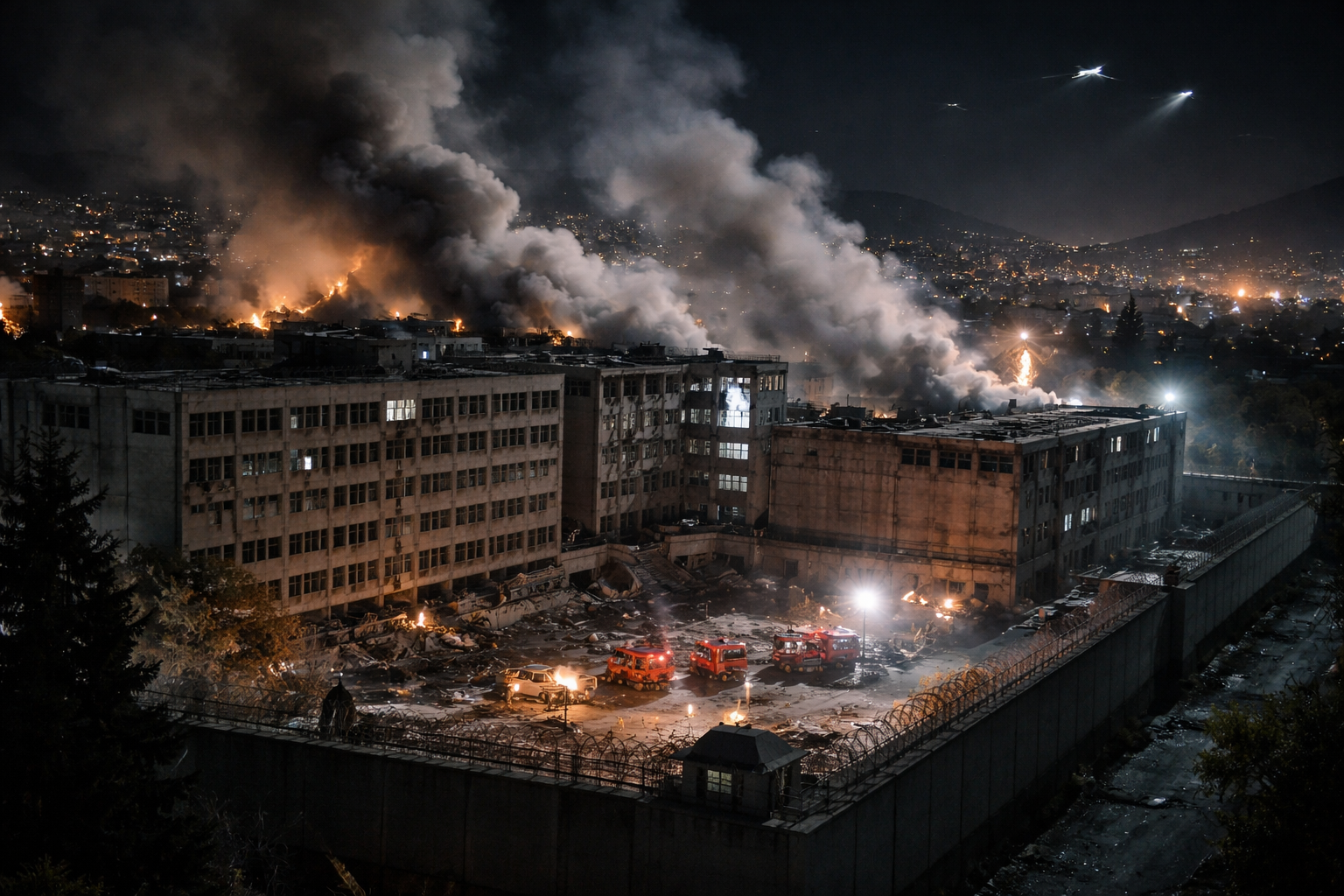
Evin Prison Bomb Damage Sparks Fears for Detained Britons
A British family says blasts linked to the fighting around Tehran have struck close enough to Iran’s Evin prison to damage the wing holding two detained Britons
The blasts have caused windows and ceilings inside the facility to shake. The claims come at a time when the Iran war has shifted from an abstract geopolitical issue to a direct human story for Britain, with a specific location involved.
Lindsay and Craig Foreman, a British couple sentenced to 10 years on espionage charges they deny, have told relatives they can hear jets overhead and bombs hitting nearby areas as the capital is bombarded for a fourth day. Their contact with the outside world is already limited. In a war, this constraint poses a significant danger.
One important part of this story is often missed: in a violent conflict, detainees face serious risks not just from direct attacks but also from problems like poor management, chaotic transfers, and governments struggling to check on their safety when communication and staffing are affected.
“The story turns on whether detainees can be kept safe and accounted for while Tehran is under sustained attack.”
Key Points
A British family says blasts near Tehran’s Evin prison have damaged the wing where Lindsay and Craig Foreman are held, raising fears of injury, fire, or wider prison instability.
The foreman's son says their calls are short and made from a communal landline, meaning even basic welfare checks depend on the prison still functioning normally.
The family is concerned that fighting in the capital could disrupt staffing and deliveries, affecting their access to essential items like food and water.
The case highlights a wider wartime risk: foreign detainees can become higher-value leverage while also becoming physically more vulnerable as prisons sit inside target-rich cities.
The family says the UK has had no consular access for months and wants a clearer strategy for getting the couple home.
The key signals in the next 24–72 hours include the continuation of attacks near the prison, the movement of prisoners, and the further narrowing of phone access.
Evin Prison sits in Tehran and is widely known as Iran’s high-security detention site for political prisoners, dual nationals, and foreign detainees.
In practice, it is also a pressure point in Iran’s long-running pattern of using detention as geopolitical leverage—especially when relations with Western states harden.
Lindsay and Craig Foreman were arrested in January 2025 while traveling through Iran as part of a global motorcycle trip. Iran later accused them of gathering information in multiple parts of the country and convicted them on spying charges. Their family says the couple denies the allegations and maintains they were traveling openly.
Even in peacetime, families and governments face limited visibility into conditions inside Iranian detention facilities. In wartime, that limited visibility becomes a compounding threat: if a prison wing is damaged, staff cannot reach work, supplies do not arrive, or internal order breaks down, outside governments may not learn what has happened until it is too late to influence events.
Political and Geopolitical Dimensions
For London, the Foremans’ case collides with two competing imperatives. The first is the classic duty of care: protect British nationals abroad, especially those imprisoned without transparent legal process. The second is crisis statecraft: in a live war environment, every move can be read as escalation, weakness, or bargaining.
For Tehran, foreign detainees can become more useful in a conflict. If Iran believes it needs leverage, prisoners can become chips for sanctions relief, prisoner swaps, or political signaling. At the same time, Iran also has an incentive to keep high-profile foreign detainees alive. A death in custody during wartime is an international liability that can harden opposition and shrink diplomatic options.
Plausible scenarios to watch:
Contain-and-control: Evin remains operational, prisoners remain in their cells, and phone access continues in limited windows.
Signposts: routine calls continue; there are no reports of mass transfers; prison shops/food distribution remain functioning.
Security crackdown inside Tehran: more arrests after protests or wartime unrest push Evin into overcrowding and tension.
Signposts: reports of new detainee inflows, tighter internal restrictions, and shorter or canceled calls.
Strategic leverage posture: Iran signals willingness to discuss detainees indirectly while keeping them isolated.
Signposts: semi-official statements about “humanitarian” considerations; renewed messaging around “espionage” narratives.
Technological and Security Implications
Missiles are not the only weapons used in wars. Wars also involve communications denial, logistics pressure, and institutional disruption. Prisons face heightened vulnerability to these pressures due to their reliance on stable staffing, controlled movement, regular deliveries, and a minimal level of order.
If blasts are close enough to break windows and ceilings, the risk set broadens fast: injuries from debris, panic incidents, secondary fires, or lock failures. Even if no one directly suffers injuries, damage can necessitate ward consolidation, decrease safe cell capacity, and initiate emergency measures.
A further danger is informational: families rely on brief phone calls from a shared landline. If power goes, lines are cut, or guards restrict access, the outside world loses the only thread of verification. In hostage-style environments, that is when misinformation spreads and worst-case assumptions take over.
Plausible scenarios to watch:
Degraded communications: calls become sporadic, then stop.
Signposts: missed call windows; families report “no access” for days; wider blackouts in Tehran.
Emergency relocation: prisoners are moved to other facilities to reduce exposure or restore control.
Signposts include sudden silence, rumors of transfers, and families being told that detainees are "elsewhere" without further details.
Local incident escalates: a nearby strike triggers injuries, disorder, or a clampdown inside the prison.
Reports indicate instances of violence within the facility, unmet medical needs, and abrupt limitations on visitation or communication.
Social and Cultural Fallout
Inside Iran, wartime stress alters the social contract in real time. Ordinary services break first, then trust. If Tehran becomes a “ghost town” under sustained attack, prison staffing is not just a bureaucratic issue—it becomes a human one. Guards may not report. Medical staff may not arrive. Disruptions occur in the supply chains that provide for both citizens and institutions.
For British audiences, this story sharpens the emotional reality of the conflict. The war is not only about state objectives, alliances, and deterrence. Named people who can't escape airstrikes, choose where to hide, or call home are also affected.
Plausible scenarios to watch:
Humanitarian pressure rises: families and rights groups amplify detainee safety and medical access demands.
Signposts include coordinated family statements, increased pressure from the UK parliament, and heightened media intensity.
National security framing hardens: Iran frames detainees more aggressively as intelligence threats.
Signposts: state media narratives intensify; legal appeals stall; harsher prison restrictions.
What Most Coverage Misses
The overlooked hinge is not whether Iran will “use hostages” in the abstract—it is whether the wartime breakdown of systems makes detainees effectively untrackable.
In a functioning state, a detained foreign national is a controlled asset: located, guarded, documented, and managed. In a stressed state under bombardment, the risk flips. Transfers can happen quickly, records can fragment, and different units can take control of a facility. That is when detainees can disappear from reliable accounting without any single actor intending it as a policy.
This is why “consular access” is not a diplomatic nicety. In a crisis, it is a verification tool. The absence of access for months sharply constrains the UK's ability to confirm welfare during a fast-moving war. That changes how urgent and how challenging the next diplomatic moves need to be.
Why This Matters
In the short term (24–72 hours), the most affected are the detainees themselves and their families, because the risk of injury, disrupted medical care, and sudden relocation rises with every day the capital remains under attack.
For the UK government, the next few days will test crisis-response capacity: maintaining contact with families, pursuing protective access, and coordinating with partners who may have more established channels into Tehran.
In the longer term (months/years), this case could shape how Britons assess travel risk in conflict-adjacent states and how the UK frames deterrence against “wrongful detention” tactics. It also adds a domestic political edge: a war that now visibly intersects with British lives can reshape public tolerance for escalation, sanctions, or military support decisions.
Decisions and events to watch:
Whether attacks continue in Tehran beyond the current phase, and whether any are reported near Evin again.
Any indication prisoners are being moved or communications are being restricted?
Any statement from the UK that transitions from expressing general concern to outlining a specific diplomatic route for release is significant.
Real-World Impact
A British family in London watches their phone every evening, knowing the next call might be cut short by a queue, a guard’s decision, or a blackout.
A UK employer with staff who travel regularly revises risk policies overnight, adding Iran-adjacent routes and “detention risk” briefings that used to feel theoretical.
A British-Iranian household splits its attention between two fears: relatives in Tehran under bombardment and the knowledge that a prison system under strain can become unpredictable quickly.
The Moment Britain’s Iran War Story Turned Personal
This is the effect war has when it moves from briefing rooms to prison wings. The Foremans’ case compresses geopolitics into a single, brutal question: can a state at war still keep prisoners safe, fed, and accounted for—and can outside governments verify any of it in time to matter?
If the conflict continues to intensify in Tehran, the Foremans could become both more valuable as leverage and more vulnerable as human beings. Those two realities can coexist, and that is what makes this moment dangerous.
Watch for three concrete signposts: sustained phone access, any hint of transfers, and any verified change in the prison’s ability to deliver food, water, and basic medical care. How those signals move in the next week will show whether the situation remains a hostage-diplomacy story—or becomes a wartime humanitarian emergency with British names on it. Governments often recall this moment when the next crisis arises.
