British Columbia School Massacre: Suspect Named as Death Toll Corrected. What Happens Next?
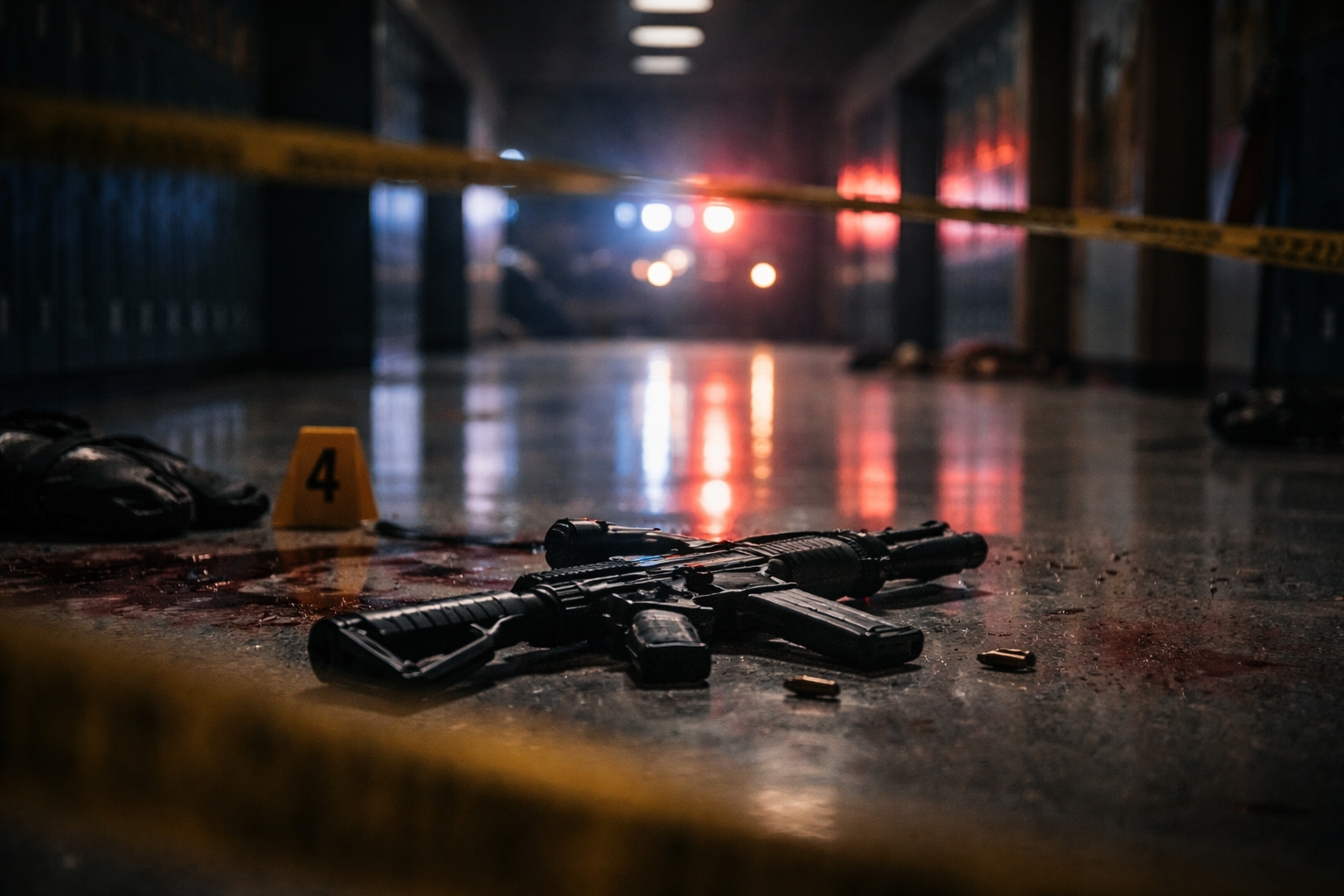
Tumbler Ridge Shooting: Police Identify Gunman, Rewrite the Timeline
How a Small Town Became Canada’s Latest School Shooting Flashpoint
A remote Canadian town is currently engulfed in a devastating headline: a school attack, a deceased suspect, and a casualty count that underwent a dramatic shift once doctors, not rumors, made the final decision.
Police say the suspected shooter is 18-year-old Jesse Van Rootselaar, a resident of Tumbler Ridge, British Columbia, found dead at the school with what investigators describe as a self-inflicted injury. Officers also recovered two firearms—a long gun and a modified handgun—as the investigation widens from a school building to at least one connected home.
But the detail that will shape what happens next is not just the name or the weapons. It’s the system of warnings, legal thresholds, and response choreography that almost worked or ultimately failed.
The story turns on whether the warning sign and intervention pipeline broke down before the first call for help.
Key Points
Police have identified the suspect as 18-year-old Jesse Van Rootselaar, a Tumbler Ridge resident, found deceased at the school with what appears to be a self-inflicted injury.
RCMP say the first report of an active shooter at Tumbler Ridge Secondary School came in at about 1:20 p.m. Local officers arrived within two minutes after receiving the first report of an active shooter at Tumbler Ridge Secondary School at Pacific on February 10.
The RCMP corrected early fatality reporting: they now say nine people total, including the shooter, are deceased, after an initially believed fatal transport victim was later confirmed to be alive and among the critically injured.
RCMP say two female victims (a 12-year-old and a 19-year-old) were airlifted and remain in serious condition.
Deceased victims at the school include a 39-year-old female educator, three 12-year-old girls, and two boys aged 12 and 13; two additional deceased victims (a 39-year-old female and an 11-year-old male) were located in a local residence.
RCMP say they believe the suspect acted alone and that there are no outstanding suspects and no ongoing threat.
The “systems story” now hinges on what authorities knew before February 10, what legal tools existed, and how fast those tools can realistically move.
Background
Tumbler Ridge is a small community in northeastern British Columbia, far from the major-city infrastructure that often defines public expectations of emergency response. That geography matters: fewer officers on hand, longer distances for specialized medical care, and a heavier reliance on pre-planned coordination between police, emergency health services, schools, and community facilities.
The RCMP describe the incident as beginning on February 10, when they received a report of an active shooter at the local secondary school. A public alert was issued while officers responded. Later, RCMP confirmed a secondary location connected to the incident, where additional deceased victims were found.
In the aftermath, two parallel realities emerged:
The operational reality of an unfolding threat involves getting in, stopping the killing, and evacuating survivors.
the information reality—early numbers, partial clarity, and the difficult corrections that arrive only once patients are identified, stabilized, and tracked through care.
Analysis
The minute-by-minute verified timeline (what the police have actually put on the record)
The key verified timestamps and sequence—based on RCMP public releases—look like this:
On February 10, at approximately 1:20 p.m.,, Pacific, RCMP received a report of an active shooter at Tumbler Ridge Secondary School. Officers from the local detachment and surrounding detachments responded immediately, with local members arriving within two minutes.
The RCMP say that when officers arrived, there was active gunfire, and as they approached the school, rounds were fired in their direction. Officers entered to locate the threat and, within minutes, found the suspect deceased from what appeared to be a self-inflicted injury.
The RCMP describe evacuating over 100 students and faculty to a community center once it was safe enough to begin moving people out. They also describe approximately 25 individuals initially presenting with possible injuries—later clarified as no discernible physical injuries after medical assessment at the local clinic—while two victims with significant injuries were airlifted to hospital and remain in serious condition.
The public alert was cancelled later that same day when police said they did not believe there were outstanding suspects or an ongoing threat.
This is a “thin” timeline by design: police are prioritizing operational facts over investigative specifics. What’s missing—motive, planning, contacts with agencies, and the suspect’s access route—will define the next phase.
Confirmed vs Shifting Numbers: Why the Death Toll Changed
The RCMP has now explicitly acknowledged that early reporting was wrong—and explained why.
They say that initially it was believed a female victim with significant injuries who was transported from the scene had succumbed. The RCMP later confirmed she was alive and is one of the two airlifted victims now listed as being in serious condition. That correction matters because it tells you what kind of event the shooting was operationally: multiple victims moving across different points of care, triage under pressure, and identity confirmation lagging behind the public’s demand for numbers.
The current police position is that nine people total, including the shooter, are deceased. Police also describe two additional victims who died in a local residence connected to the incident. At the school, the deceased include a 39-year-old educator, three 12-year-old girls, and two boys aged 12 and 13.
The most responsible way to read the numbers is to treat the total deceased and the two seriously injured as stable unless police update them again and treat any “injured totals” beyond those as the most fluid category in fast-moving incidents.
The Response Timeline: Speed Helps, But It’s Not a Force Field
The RCMP emphasizes a critical operational detail: officers arrived within two minutes. In a high-casualty school incident, minutes are the difference between a contained tragedy and a catastrophe that grows room by room.
However, response speed is not a decisive factor. It can stop escalation; it can’t rewind harm already done. That’s why the public-safety question will shift quickly from “Where were police?” to “What existed upstream that could have reduced the probability of such an incident happening at all?”
That upstream question includes:
how threat reports are logged and escalated,
What mental health crisis interactions do (and do not) trigger,
and how firearm access can persist even when a community believes risk has been “handled.”
What We Can Responsibly Infer Without Speculation
Three careful inferences are justified by the facts already confirmed—without guessing motive.
First: the event moved fast enough that officers were taking fire on approach, which implies the incident was still active at the point police arrived. That reinforces the importance of immediate-entry training and procedures.
Second: the correction to early fatality reporting signals the real-world fog of multi-victim care—meaning early “injury totals” are inherently less reliable than confirmed deceased counts, and public communication must expect corrections.
Third: the existence of a connected residence with additional deceased victims suggests the incident is not confined to a single location. Even without asserting sequence or motive, it implies the investigative scope includes domestic context, travel between scenes, and possible pre-incident events that weren’t visible to the school until the moment of attack.
What Most Coverage Misses
The hinge is this: Canada’s policy debate often jumps straight to “more laws,” but the practical outcome here may depend more on how existing powers are triggered, documented, and reviewed than on any new headline rule.
Mechanism: even where tools exist—mental health apprehensions, firearms seizure authorities, licensing rules—public safety outcomes depend on thresholds, follow-up, and whether agencies can share the right information at the right time under the law. A system can “touch” the same person multiple times and still fail to convert those touches into durable risk reduction if the standard for ongoing restriction is high, the documentation is incomplete, or the process is time-limited and reversible.
Signposts to watch:
whether officials disclose prior interactions that created a record of concern (and what the legal outcome of those interactions was),
and whether investigators identify specific procedural gaps—missed referrals, expired authorizations, or failures in inter-agency handoffs—that can be fixed without waiting for new legislation.
What Changes Now
In the next 24–72 hours, the center of gravity is likely to move from the crime scene to three places: hospitals, investigators’ briefings, and the political response.
The most affected are the survivors and families—first in trauma and grief, then in the secondary consequences: school closures, counseling demand, and the long tail of medical and psychological recovery.
In the short term, officials will focus on:
confirming identities and notifying families,
tightening the account of how events moved across locations,
and clarifying the suspect’s access to firearms and any prior interactions with public services.
In the longer term—months, not days—the core decisions will revolve around institutional accountability and reform: what changes in school safety protocols, how crisis interventions are documented and reviewed, and what reforms are possible in licensing, storage, and enforcement.
The main consequence is trust: public confidence can drop fast after mass casualty events because people experience the system as something that should have seen it coming, even when predicting individual violence is inherently difficult.
Real-World Impact
A parent sits in a community center with a paper wristband and a phone that won’t stop vibrating, waiting for a name to appear on a reunification list.
A teacher in a neighboring district quietly scans their classroom door hardware and wonders whether their school’s “lockdown drill” is theater or protection.
A small-town clinic operates at the limit of its capacity, with the closest advanced care facility located far away and only accessible by air.
A local employer tries to function while half its staff are shaken, absent, or suddenly responsible for someone else’s kids.
The Question Canada Can’t Avoid Next
This incident will be remembered for the lives lost—but it will be judged by what the system does afterward.
If investigators show that the warning pipeline had clear opportunities—reporting channels, documented risks, enforceable legal levers—then accountability becomes procedural, not rhetorical. If they show that the pipeline was thin or fragmented, the debate shifts toward capacity: staffing, mental health response depth, and the reality of service access in remote regions.
Either way, the fork in the road is the same: build reforms that reduce risk without collapsing into performative security, or allow the story to harden into fatalism.
The next decisive signposts will be a stable victim count and identity confirmations, a clearer sequence across locations, and official disclosures about what was known, when it was known, and what the system could legally do with it.
SEO PRIMARY (Title Tag)
