Brussels Police Use Tear Gas and Water Cannon as Student Protest Turns Violent
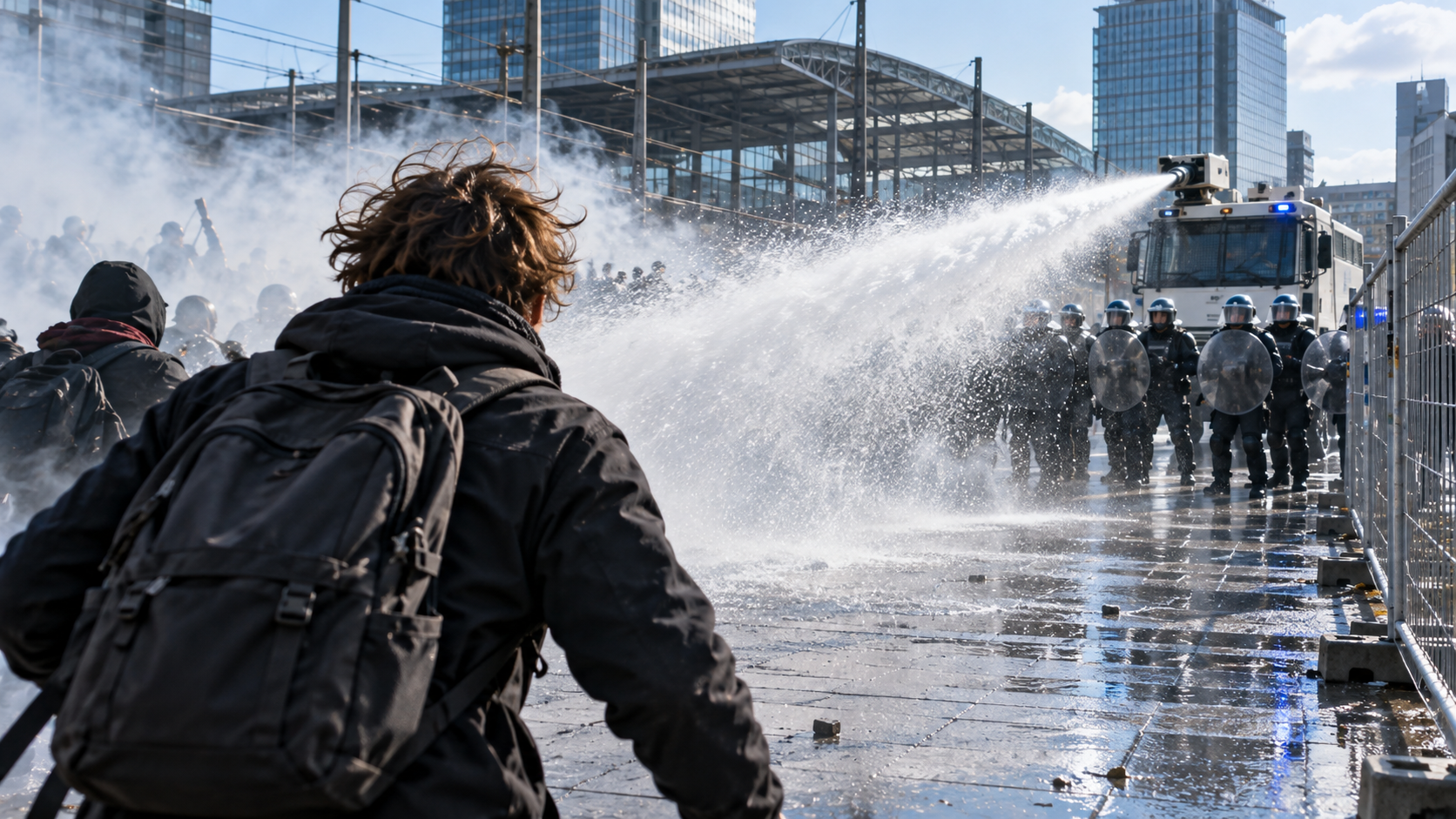
Barricades and Projectiles Mark Fresh Brussels Protest Clashes
Education Protest Erupts Into Clashes Near Brussels-Midi Station
Clashes near Brussels-Midi station deepen a dispute over education costs, austerity and policing, while Liège also sees police intervention.
Police used tear gas and water cannon during clashes at an education protest in Brussels on Saturday, 17 October 2026. Demonstrators erected a barricade with construction fencing and threw projectiles near Brussels-Midi railway station.
The confrontation followed a march opposing education reforms, austerity and what participants described as police repression. It brought another Belgian student mobilisation into conflict with the authorities after earlier demonstrations this month.
The March From Central Station
Students and supporters initially gathered near Brussels Central Station. Teachers and trade union activists were among those present. The gathering began without authorisation, but demonstrators subsequently received permission to march towards Brussels-Midi.
Police deployed in large numbers and stopped and searched several people. By about 12.30pm, tensions near the destination had escalated into clashes. Officers advanced on the crowd after deploying water cannon and tear gas.
Belgian Interior Minister Bernard Quintin said on X that events had moved beyond protest and pledged to restore order. His response framed the immediate confrontation as a public-order problem. The demonstrators’ underlying complaints concern the affordability and accessibility of education.
The available evidence does not establish that everyone on the march took part in violence. Nor does the presence of students establish the identity or affiliation of each person who confronted officers.
What Protesters Are Challenging
Belgian student groups have objected to rising education costs and reforms they fear will restrict access to higher education. Those fears sit alongside broader opposition to spending cuts and government policies.
The distinction between a reform’s intended purpose and its feared consequences matters. Students’ concerns establish what is driving the demonstrations; they do not, by themselves, prove what every proposed change will do.
Saturday’s mobilisation also followed clashes around the 9 October trade union demonstration. That recent history helps explain why policing itself has become part of the dispute, alongside the policies that first brought people into the streets.
Liège’s Peaceful Start Gives Way to Intervention
In Liège, roughly 250 people gathered outside Liège-Guillemins station on Saturday morning before marching towards the centre. Workers and parents joined young demonstrators in a procession that began peacefully.
Participants’ concerns extended to public transport costs, working conditions and social inequality. Some students described the pressure of combining paid work with study and the risk of having to abandon their education.
The situation changed later. A sit-in at Place Saint-Lambert obstructed bus services, and the procession subsequently moved towards the Cadran area. Some protesters began moving barriers to form barricades before police dispersed the crowd.
Officers later surrounded around 30 demonstrators near the Saint-Lambert shopping gallery. A water cannon was used. Describing Liège only through its peaceful morning gathering would therefore leave out a material part of the day.
The Connection With France
The Belgian mobilisation has developed partly in the wake of the French school protest movement. Across the border, education grievances have overlapped with arguments about public spending and living standards.
That connection does not establish common leadership or identical demands. Belgium’s disputes have their own institutions and policy choices. The parallel is that complaints about education have become entangled with wider dissatisfaction and confrontation over policing.
Verified totals for arrests and injuries from Saturday’s Brussels clashes were not established in the material checked for this article. Those figures, and a fuller account of the sequence of police interventions, remain necessary to assess the day’s human cost.
Sources
Reuters — Protesters clash with police in Brussels — 17 October 2026; confirms the Brussels confrontation, student groups’ stated concerns and Bernard Quintin’s response.
Anadolu Agency — Police, protesters clash in Brussels as education protests continue in Belgium — 17 October 2026; details the march route, authorisation, confrontation near Midi and participants’ grievances. Its local chronology draws on RTBF and Belga.
The Brussels Times with Belga — Police surround peaceful demonstrators in Liège — 17 October 2026; establishes the later police cordon, water cannon use and disruption following the peaceful start.
Next Reads
French School Revolt Inflicts “Heaviest Toll In Decades” As PM Confronts Violence, Injuries And Widespread Damage — Background on the neighbouring education movement and its policing dispute.
France Braces For Fresh Nationwide Student Protests After €30 Million Damage, Thousands Arrested And Teenagers Maimed — A 12 October account of the mobilisation planned for the following day.
France Hit By Nationwide Strikes And Student Revolt As €54 Billion Budget Battle Explodes — Earlier context on the overlap between student demands, industrial action and public spending.
