Chile wildfires trigger emergency measures and mass evacuations — the real danger is the system, not the flames
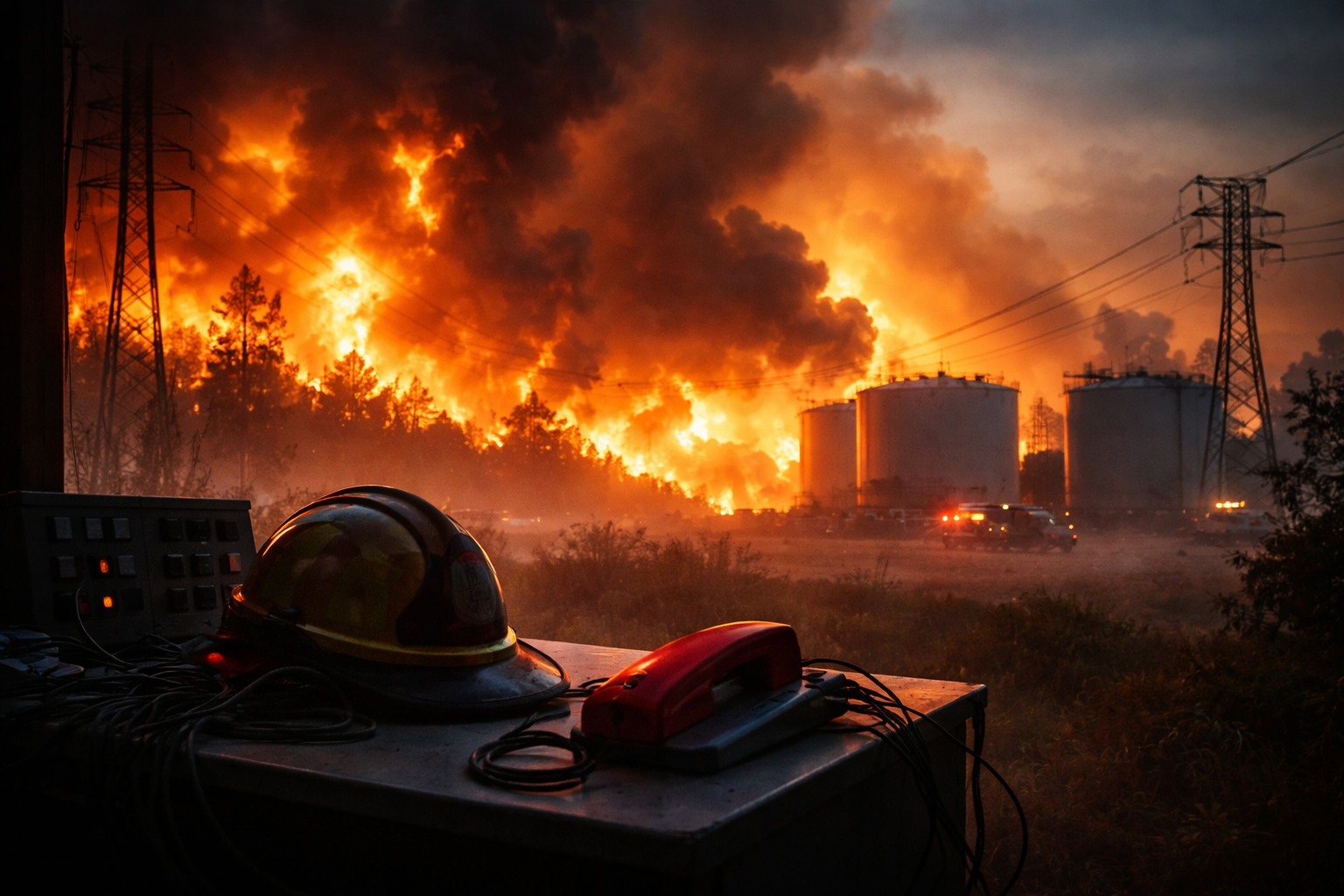
Chile declares emergency measures as wildfires force mass evacuations. Why utilities, roads and hospitals — not fire size — decide what happens next.
Chile has declared emergency measures in the southern regions of Ñuble and Biobío as wildfires accelerated and authorities estimated roughly 20,000 people had been forced to evacuate. Fire services have reported multiple active blazes, with national totals around the high teens and a concentration in the affected southern regions.
The headline image is fire and smoke. The actual crisis is interdependence: wind pushes flame fronts, but it’s roads, power, water pressure, hospitals, telecoms, fuel logistics, and command-and-control that decide whether evacuation becomes a managed movement — or a cascading failure.
The story turns on whether the emergency powers can keep critical services functioning faster than the fire can knock them out.
Key Points
Chile has activated emergency measures for Ñuble and Biobío amid fast-moving wildfires and mass evacuations estimated around 20,000 people.
The operational challenge is not only “fire size” but wind + fuel load + evacuation logistics, which can outrun containment plans and overwhelm local capacity.
When smoke and heat threaten utilities and transport corridors, the emergency becomes a systems problem: power interruptions break communications; water outages reduce firefighting effectiveness; blocked roads trap evacuation traffic.
A declared emergency can accelerate response by enabling movement restrictions, requisition of assets, and extraordinary administrative measures, and by tightening the chain of command.
The trade-off: emergency powers can cut red tape, but they also raise the stakes for decision quality, because choices about evacuations, curfews, and resource allocation become legally and politically consequential.
The most important near-term signals aren’t just hectares burned — they’re whether critical sites (grid nodes, water systems, hospitals, fuel distribution) stay online under stress.
Background
Chile’s summer fire seasons have increasingly been shaped by a familiar and brutal mix: hot spells, dry vegetation, and gusty winds that turn small ignitions into fast-spreading incidents. In early January, humanitarian and monitoring updates had already recorded hundreds of fires nationally and warned of high fire danger in affected zones.
On 18 January, the government escalated with emergency measures specifically for Ñuble and Biobío, as evacuations surged and responders reported multiple active blazes.
A key practical detail in Chile: evacuations are not just “announced”. They are executed through structured civil protection alerts and coordination, and can involve mobile emergency alert messaging systems that push evacuation instructions directly to phones in the affected area. When conditions degrade quickly, that last-mile alerting becomes the difference between a clean exit and a panicked scramble.
Analysis
Wind and fuel load: why today’s fires move like a system shock
Wind does two things at once: it increases the oxygen supply at the fire edge and it throws embers ahead of the main front, creating spot fires that “teleport” risk into new neighbourhoods. That matters because emergency services are typically organised around a perimeter mindset — contain lines, protect assets, extinguish hotspots. Spotting behaviour turns that into a whack-a-mole problem.
Fuel load makes it worse. Dense, dry vegetation (and in some regions plantations and mixed wildland–urban edges) creates continuous burnable material that reduces the number of “natural brakes” on spread. In practical terms, it compresses the time window: officials can order evacuations, but residents have less time to pack, decide routes, and move before smoke and heat make roads unsafe.
Evacuation logistics: the hidden constraint is roads, not warnings
Evacuations scale non-linearly. Moving 2,000 people out of a small area is one type of task; moving 20,000 across multiple communes while fires are active is something else entirely. The bottlenecks aren’t motivational — they’re infrastructural:
Choke points: a limited number of exit roads concentrate traffic.
Visibility and safety: smoke reduces visibility, increases collision risk, and can force closures.
Coordination bandwidth: police, firefighters, municipal staff, and volunteers all draw on the same comms and transport resources.
Shelter throughput: reception centres can become congested, delaying onward movement and increasing health risks for vulnerable groups.
The hardest decisions are also the least cinematic: when to reverse traffic flows, when to close a road for responder access, and when to tell people to leave now even if the fire still looks far away.
Critical sites: the emergency is a utilities-and-services race
The weak point in modern wildfire response is infrastructure interdependence. Fires don’t need to burn a hospital to endanger it; they can:
knock out power (or force shutdowns),
disrupt telecoms (towers, fibre, power to exchanges),
reduce water pressure (pumps need electricity; mains can be damaged; demand spikes),
contaminate air at levels that overwhelm respiratory capacity and emergency departments.
Even a “small” outage becomes a multiplier. If power goes, phones die; if phones die, evacuation routing gets messier; if routing fails, roads jam; if roads jam, ambulances and fire engines lose minutes they cannot spare.
This is why the most important maps in a fast-moving fire are often not burn-perimeter maps but grid nodes, water treatment sites, fuel depots, and transport corridors.
Emergency powers: how the declaration changes speed, command, and liability
Chile’s constitutional emergency framework matters because it changes what government can do quickly in a defined zone. Under a state of catastrophe / disaster-type declaration, the President can legally restrict movement and assembly, requisition assets, place limitations on property rights, and adopt extraordinary administrative measures aimed at restoring normality.
Two operational effects follow.
First, chain of command: the President can delegate powers to designated authorities (including “defence” or zonal chiefs in the emergency area), which can reduce coordination friction between agencies and speed decisions on traffic control, access restrictions, and protection of key facilities.
Second, administrative velocity: extraordinary measures can enable faster contracting, resource redeployment, and compulsory access to equipment or sites when time matters more than normal procedure.
On liability: emergency declarations don’t magically erase accountability — but they do clarify the legal basis for intrusive actions (mandatory evacuations, restricted zones, requisitions). That can reduce hesitation among officials worried about overstepping authority, while simultaneously raising the scrutiny later: when you wield emergency powers, every trade-off becomes part of an official record, and mistakes can turn into legal and political disputes.
What Most Coverage Misses
The hinge is infrastructure interdependence: the worst outcomes come when fire triggers a chain reaction across power, water, telecoms, roads, and healthcare capacity — not when the burn area hits a particular number.
Mechanism: if utilities wobble, the response slows at the exact moment speed matters most. Firefighting becomes less effective (water pressure, comms, dispatch), evacuations become riskier (traffic control, information flow), and critical services get forced into defensive shutdowns. That is how a “containable” fire becomes a regional emergency.
Signposts to watch over the next 24–72 hours:
announcements of power, water, or telecoms interruptions in evacuation zones, especially repeat outages;
emergency measures expanding from “firefighting” to transport controls and protection of utilities/industrial hubs, which signals authorities are treating this as a system-stability event.
What Changes Now
In the short term (next 24–72 hours), the most affected are residents in evacuation areas, frontline responders, and people reliant on fragile services: those needing powered medical equipment, oxygen, regular medication access, or dependable transport. What changes now is the operational posture: the state is signalling it will prioritise rapid movement control and asset protection as much as fire suppression, because those are the levers that prevent escalation.
Over the longer term (months and years), the story is less about one weekend of fires and more about repeated stress tests. The direction of travel is clear: wildfire is increasingly treated as a civil protection and infrastructure resilience issue, not merely an environmental one — because modern life fails through dependencies.
The “because” line is simple: a region’s risk is defined by how quickly it can move people and keep critical services running when the map turns orange.
Real-World Impact
A family receives an evacuation alert, but their nearest exit road is already smoke-choked. They leave earlier than they would have — not because flames are visible, but because they’ve learned that “waiting for proof” is how roads jam.
A clinic cancels non-urgent appointments because staff cannot reliably travel and air quality is deteriorating. The backlog piles up quietly while emergency care surges loudly.
A small business loses a day of trade not because it burns, but because power flickers, card machines fail, deliveries stop, and staff are displaced.
A local council tries to stand up shelter capacity fast, then hits the boring limits: bedding, transport, volunteer coordination, and reliable communications.
The next 48 hours will decide whether this is a fire story or a governance story
Wildfires always produce dramatic pictures. But the defining question in Ñuble and Biobío is whether emergency measures can keep the region’s critical functions intact under compound stress — wind, fuel, smoke, and mass movement.
If the grid stays stable, roads stay passable, and evacuation messaging remains trusted and timely, the story will narrow back towards containment and recovery. If utilities wobble and corridors fail, the crisis broadens into a test of state capacity, emergency law, and public trust — and it will be remembered as a moment when Chile’s infrastructure, not its forests, became the main frontline.
Watch the signposts: expanding evacuation zones, repeated service interruptions, and any shift towards tighter movement controls to protect critical sites. If those escalate, the historical significance is not just that Chile burned again — it’s that modern interdependence turned fire into a systemic national risk.
