China’s 100-Ship Naval Surge Across East Asian Waters
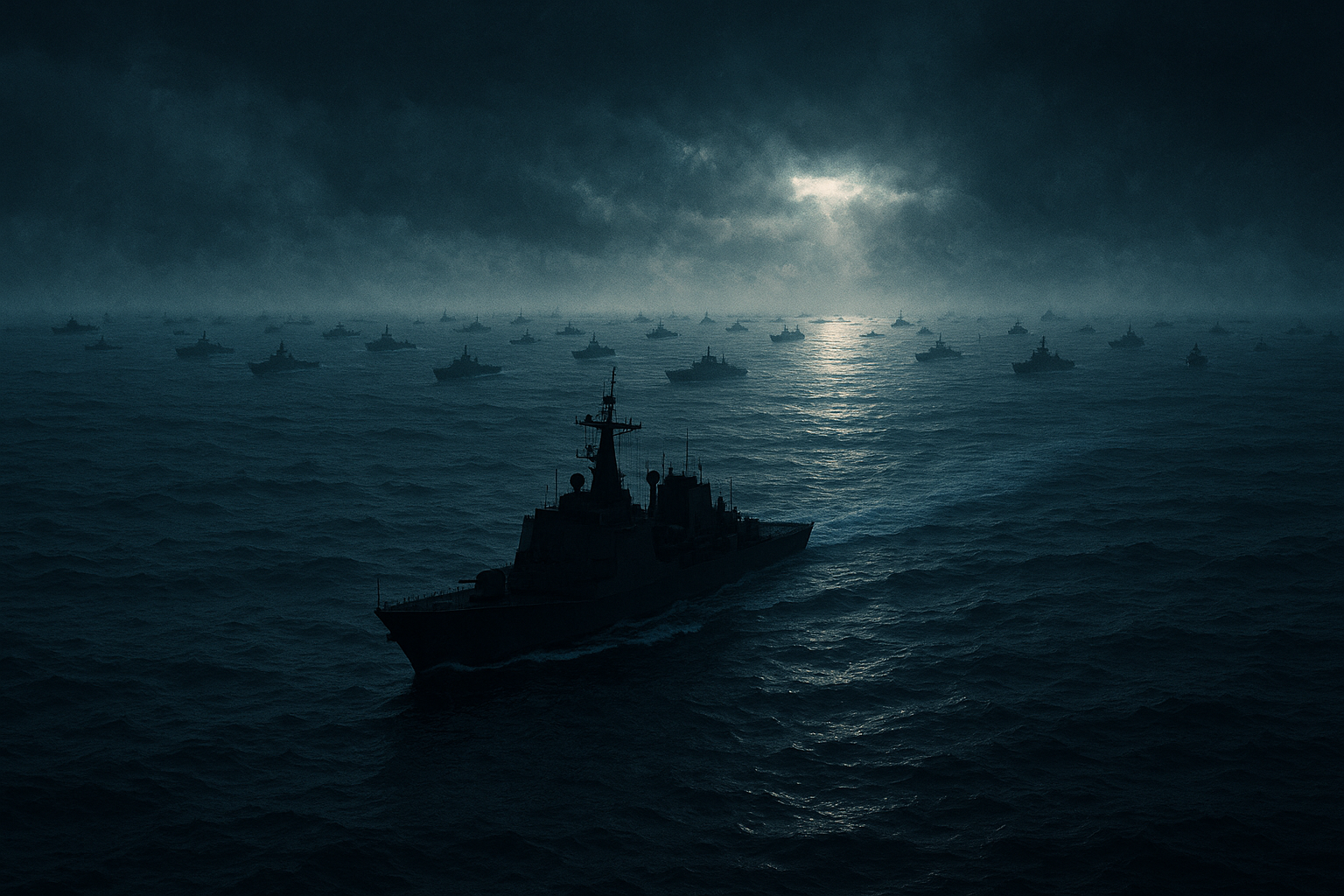
China has quietly staged its largest maritime show of force in peacetime, pushing more than 100 naval and coast guard vessels across East Asia’s most contested waters. It is not a war – but it is a rehearsal, a message, and a stress test of the regional order all at once.
Key Points
China has deployed over 100 naval and coast guard vessels from the Yellow Sea through the East and South China Seas into the western Pacific – its largest coordinated maritime surge to date.
The operation coincides with rising tensions over Taiwan, tougher rhetoric from Japan, and growing security ties between the US, its allies, and regional partners.
Beijing frames the activity as normal training, but the scale, geography, and timing suggest a deliberate test of how far it can push without triggering a crisis.
The surge blends navy warships, coast guard cutters, and quasi-civilian vessels – a hallmark of China’s “grey-zone” strategy below the threshold of open conflict.
For the UK and Europe, the stakes are economic as much as military: East Asian sea lanes are critical for trade, energy flows, and the future of global security architecture.
The big unknown is whether this becomes a one-off show of force – or the new normal baseline for Chinese maritime presence.
Background and Context
A navy built for the long game
Over the past decade, China has transformed the People’s Liberation Army Navy (PLAN) from a largely coastal defence force into a blue-water fleet able to project power far from home. It now fields the world’s largest navy by ship count, with hundreds of surface vessels and a growing submarine fleet, and is still expanding.
Key features of this build-up include:
Mass and modernity – a rapid turnover of older ships in favour of modern destroyers, frigates, corvettes, and coast guard vessels.
Layered presence – PLAN warships backed by the China Coast Guard and a loose network of “maritime militia” fishing or commercial vessels that can be mobilised to support state aims.
Strategic geography – focus on the “first island chain” (Japan–Taiwan–Philippines) and the South China Sea, where China claims wide areas and has built military outposts on artificial islands.
This long-term naval expansion sits alongside newly fortified bases, anti-ship missile systems along the Chinese coast, and a dense network of sensors and aircraft – all designed to deter or complicate intervention by outside powers.
A region already on edge
The surge comes at a moment when:
Taiwan is increasing defence spending and tightening security ties with the US and like-minded partners.
Japan has abandoned decades of strict military self-restraint, committing to higher defence budgets and signalling it might respond militarily to a Chinese attack on Taiwan.
The Philippines has opened more bases to US forces and repeatedly clashed with Chinese ships around contested shoals and reefs.
The US, Australia, the UK and others are expanding naval exercises and new groupings (such as AUKUS) to counterbalance Chinese power.
Against that backdrop, any move involving 100+ Chinese vessels is inherently political – even if no shot is fired.
What Has Actually Happened?
The 100-ship surge
Intelligence assessments and regional reporting indicate that China has coordinated more than 100 naval and coast guard vessels across East Asian waters in recent days, before dialling back slightly to “only” around 90 ships as the activity evolved.
The deployment stretches across:
The Yellow Sea, closer to the Korean Peninsula
The East China Sea, including waters near Japan and around the disputed Senkaku/Diaoyu Islands
The South China Sea, where China’s sweeping claims overlap with those of the Philippines, Vietnam, Malaysia and others
The western Pacific, east of Taiwan and the Philippines
Rather than forming one huge armada, the ships are spread across multiple sectors, creating a web of Chinese presence.
Mixed fleet, mixed signals
The surge reportedly includes:
PLAN warships – destroyers, frigates and support vessels
China Coast Guard cutters, often used to enforce maritime claims and harass foreign vessels
Auxiliary and possibly militia-linked ships, which can provide logistics, intelligence or simply bulk out numbers
Some ships have engaged in:
Simulated anti-access/area denial drills (trying to keep foreign forces out of a contested zone)
Mock strike and blockade scenarios around key chokepoints and approaches to Taiwan
Beijing has not officially announced a named exercise on the scale implied by the deployments, instead presenting the activity as routine seasonal training. But the coordination, simultaneous movements across widely separated areas, and sheer number of ships suggest something far more deliberate.
Why It Matters – and Who It Affects
Testing red lines without crossing them
From Beijing’s perspective, a surge like this serves several overlapping purposes:
Normalisation – make large Chinese formations a regular feature of the regional seascape so neighbours become desensitised.
Signal to Taiwan and Japan – demonstrate that China can mount multi-axis pressure around Taiwan and nearby Japanese territory.
Message to Washington and its allies – show that the balance of naval numbers close to China’s shores is increasingly in Beijing’s favour.
Training under realistic conditions – practise command, control, logistics and coordination at scale, in the waters that would matter most in a real crisis.
Crucially, all of this happens below the threshold of open conflict. There are no missile launches, no live fire across borders – just an overwhelming presence that is hard to classify as either “peace” or “war”.
Regional states caught in the middle
For frontline states, the risks are immediate and practical:
Japan faces sustained Chinese naval and coast guard activity around the Senkaku/Diaoyu Islands and in nearby waters, forcing its own navy and coast guard to respond, often at high tempo.
The Philippines sees similar swarming tactics around contested reefs in the West Philippine Sea, raising the chance of ramming, collisions, or blockades of its small outposts.
Taiwan must track and shadow vessels that could, in a crisis, form the outer shell of a blockade or invasion support fleet.
Every extra ship at sea increases the odds of:
Navigational incidents
Dangerous close passes or “shouldering” manoeuvres
Rapid escalation if an accident is misread as a deliberate act
Why the UK should care
From a UK perspective, this is not some remote quarrel:
Trade exposure – A huge share of UK imports and exports, directly or via partners, moves through East Asian sea lanes and the wider Indo-Pacific. Any crisis that disrupts shipping or raises insurance costs would show up on British shelves, balance sheets, and energy bills.
Allied commitments – The UK now explicitly describes itself as an Indo-Pacific “tilt” power, sending carrier strike groups east and joining frameworks like AUKUS. A more contested maritime environment means greater demand – and risk – for Royal Navy deployments.
Systemic stakes – The rules that govern freedom of navigation, the use of coast guards, and the line between civilian and military actors at sea are being rewritten in practice. If they are rewritten in China’s favour in East Asia, the precedent will not stay there.
Big Picture: What This Tells Us About the Future
From one-off show to standing posture?
One of the most important questions is whether this 100-ship surge is:
A single, symbolic spike – timed to answer specific comments or exercises by Japan, Taiwan, or the US, and then quietly scaled down; or
The beginning of a new baseline, where massed Chinese deployments become a semi-permanent feature, forcing neighbours to either match presence or accept a more crowded, China-dominated seascape.
If the second scenario unfolds, we might see:
Chronic strain on regional navies and coast guards, which are much smaller and less able to surge continually.
Greater risk of “accidental” crises, where tactical confrontations at sea drag political leaders into escalatory decisions.
More arms racing, as states seek submarines, anti-ship missiles, and surveillance systems to offset China’s numbers.
The creeping rehearsal for a Taiwan crisis
While this is not a rehearsal for a specific operation in a one-to-one sense, it does test several elements that would be crucial in a Taiwan contingency:
Coordinating large numbers of ships in multiple sectors
Managing logistics and resupply at sea
Practising the maritime “shield” that could protect an inner ring of amphibious or missile forces
Gauging how quickly the US, Japan, and others react – and where their own red lines appear to lie
Each surge gives Chinese planners more real-world data on how the region responds, and therefore how much risk Beijing can take in future.
What to Watch Next
1. Duration and drawdown
Do ship numbers drop sharply after a few days, or does a large core remain at sea for weeks?
Are vessels simply rotated out and replaced, sustaining a high-tempo presence that becomes semi-permanent?
2. Live-fire and air-sea integration
Does the activity escalate into announced or unannounced live-fire drills, missile tests, or anti-submarine exercises in the same areas?
How many aircraft and drones are integrated into the pattern – especially near Taiwan and Japanese airspace?
3. Allied and regional responses
Watch for:
Expanded US and Japanese patrols in contested zones
More assertive Philippine actions around its outposts, potentially with allied ships in company
New statements or deployments from Australia, the UK, and European navies operating in the region
4. Legal and diplomatic framing
Do regional governments pursue fresh legal cases, new codes of conduct, or formalised “incident at sea” agreements?
Or does the reality of Chinese numbers at sea gradually outpace the ability of diplomacy to keep up?
5. Domestic messaging inside China
State media narratives will signal whether Beijing wants its public to see this primarily as:
Defensive training,
A response to “provocations” by others, or
A confident step towards great-power maritime status.
Whats Next?
China’s 100-ship surge across East Asian waters is not just about hulls on a map. It is about normalising a new level of Chinese maritime presence, probing how others respond, and rehearsing the mechanics of crisis without crossing into open war.
For East Asian states, this raises immediate questions about deterrence, readiness, and escalation. For the UK and other trading nations, it underscores how closely global prosperity is tied to the stability of one region’s contested seas.
Whether this proves to be a short-lived show of force or the template for a new normal will shape maritime security – and the wider balance of power – for years to come.
