

China’s Quiet Encirclement Of Taiwan Is Intensifying — And The World Is Barely Reacting
The Slow-Burn Crisis Around Taiwan That Could Suddenly Explode
The New Military Pattern Around Taiwan That Signals Something More Dangerous Than War
There is no single moment to point to. No declaration. No missiles fired.
And that is precisely the problem.
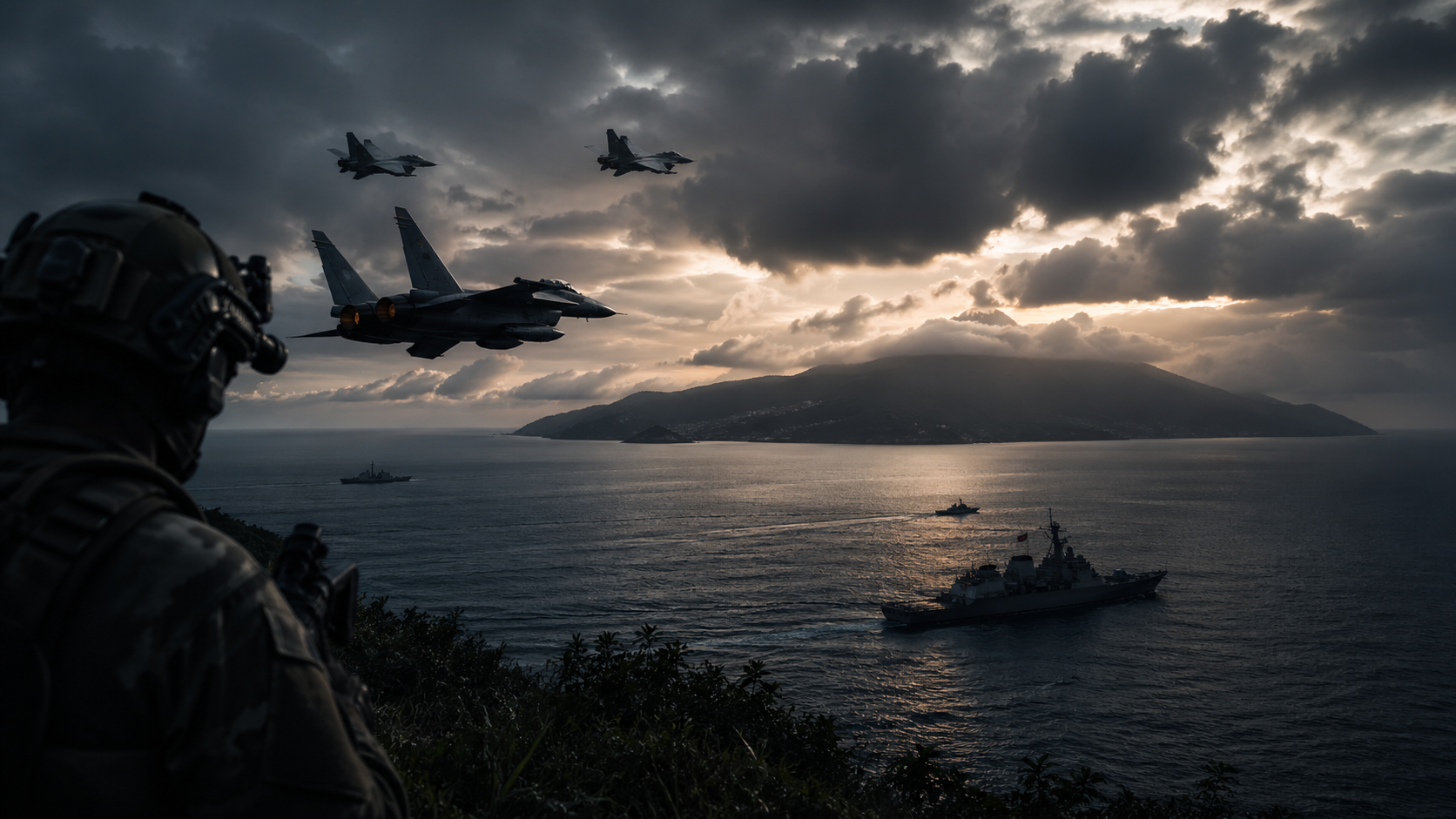
Taiwan has once again detected fresh Chinese military activity near its territory—aircraft in the sky, ships at sea, and a pattern that is no longer occasional but constant. In the latest reported window, Taiwan tracked around 10 Chinese military aircraft and more than 11 naval vessels, with multiple aircraft entering its air defense identification zone (ADIZ).
Taiwan responded in a way that now feels routine: scrambling aircraft, deploying naval assets, and activating missile systems to monitor the situation.
Routine is the keyword.
Because what looks like repetition is actually transformation.
What Just Happened — And Why It Matters
The immediate facts are straightforward:
Chinese military aircraft operated near Taiwan, with several entering sensitive airspace zones
Naval vessels were detected operating around the island
Taiwan’s military responded with surveillance and defensive positioning
None of this, on its own, is new.
But frequency is the story.
In April alone, Taiwan has tracked hundreds of Chinese aircraft and ships, reflecting a sustained operational tempo rather than isolated incidents.
This is not a spike.
It is a baseline.
And that changes the meaning of every new sighting.
The Strategy Behind The Movement
China’s approach is widely understood as “grey-zone” pressure—actions that fall short of open war but steadily shift the balance of power.
Instead of one decisive strike, the strategy relies on accumulation:
More aircraft flights
More naval patrols
More frequent ADIZ incursions
More normalisation of military proximity
Since 2020, this pattern has intensified, with China gradually increasing the scale and frequency of operations around Taiwan.
The goal is not immediate conflict.
It is conditioning.
Over time, repeated presence reshapes expectations—for Taiwan, for regional actors, and for the international community.
What was once alarming becomes familiar.
What was once an escalation becomes background noise.
The Illusion Of Stability
Here’s the contradiction at the heart of this situation:
Things look stable precisely because they are not.
There are no explosions. No dramatic headlines. No formal escalation.
But the underlying reality is shifting in real time.
Chinese warships have recently been detected operating closer to sensitive areas, including near key island groups in the Taiwan Strait.
On other days, aircraft counts surge sharply—sometimes dozens in a single day, with many entering Taiwan’s defensive airspace zones.
And layered on top of that are broader signals:
Aircraft carrier movements through the Taiwan Strait
Long-duration airspace restrictions in nearby seas
Continued expansion of naval capability and projection
Each piece alone is manageable.
Together, they form a system.
What Most People Miss
The real shift is psychological.
China is not just testing Taiwan’s military response.
It is testing:
Reaction speed
Political thresholds
International attention span
Public tolerance for constant pressure
This matters because crises are easier to respond to than slow change.
A sudden escalation forces decisions.
A gradual one invites delay.
And delay, in geopolitics, often becomes acceptance.
Taiwan’s Position — Prepared But Pressured
Taiwan is not passive in this regard.
Each detection triggers a calibrated response:
Air force monitoring and interception
Naval shadowing of vessels
Deployment of coastal missile systems
The island is also investing in new capabilities—including drones, surveillance systems, and integrated air-sea defense networks—to adapt to the evolving threat environment.
But even effective responses come with a cost:
Operational fatigue
Resource strain
Constant readiness pressure
Over time, the challenge becomes not just defense—but endurance.
The Wider Geopolitical Context
This activity is not happening in isolation.
It sits within a broader strategic picture:
China continues to assert sovereignty claims over Taiwan
Taiwan maintains that its future must be decided by its own people
Regional powers, including the US and Japan, are increasingly engaged
Military capabilities on all sides are expanding
At the same time, China’s military modernization—including carrier expansion and joint-force capabilities—signals long-term preparation rather than short-term signaling.
This is a system under construction.
Not a momentary crisis.
The Risk That Lingers Beneath The Surface
The most immediate danger is not deliberate war.
It is a miscalculation.
When aircraft and ships operate in close proximity, repeatedly, over long periods, the probability of the following increases:
Miscommunication
Navigation errors
Escalatory responses
increases.
And in a high-tension environment, even a small incident can trigger a chain reaction.
That is the paradox of grey-zone strategy:
It avoids war — while quietly increasing the conditions that could cause one.
The Bigger Picture
The latest Chinese military activity near Taiwan is not a breaking point.
It is part of a pattern that is gradually changing the situation.
What is happening is not dramatic enough to dominate headlines every day.
But it is consistent enough to reshape reality.
And that is where its real power lies.
