Cyclone Vaianu Slams New Zealand: Floodwaters Rise, Power Fails, and Hundreds Flee in Hours
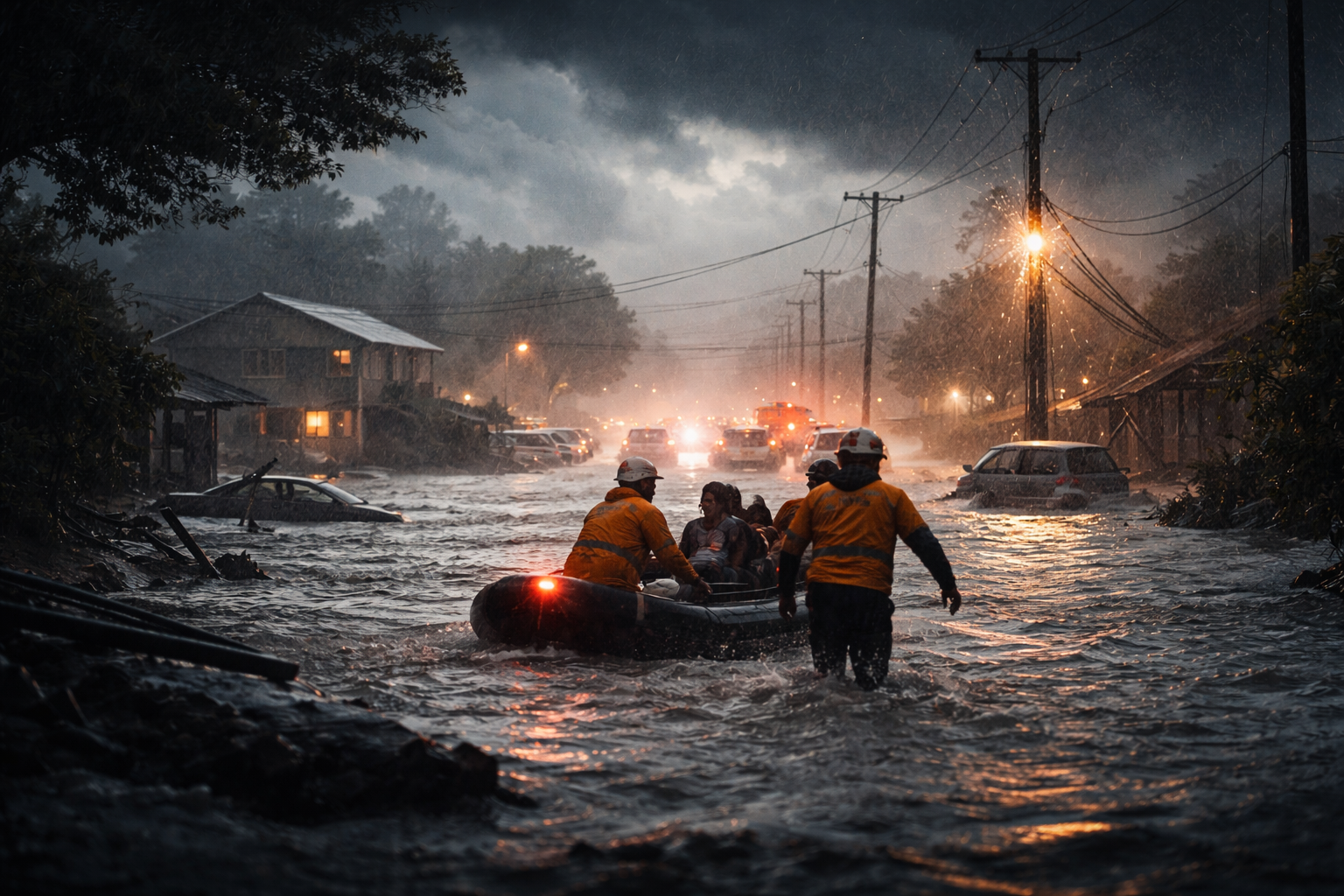
New Zealand Under Siege as Cyclone Vaianu Triggers Floods, Outages and Emergency Evacuations
A fast-escalating storm system has forced evacuations, cut power, and exposed how vulnerable parts of New Zealand remain to extreme weather shocks.
A Sudden Shift From Warning to Crisis
Cyclone Vaianu did not arrive quietly.
Within hours of making landfall on New Zealand’s North Island, the storm transformed from a forecasted threat into a real-time emergency—flooding roads, cutting power, and forcing hundreds of residents to evacuate as conditions rapidly deteriorated.
The cyclone crossed the coast near the Maketu Peninsula with winds exceeding 130 km/h, bringing heavy rain, dangerous swells, and what officials described as “life-threatening” conditions.
Entire regions were pushed into emergency mode. Roads disappeared under water. Rivers surged. Electricity networks failed.
And for many communities, the question shifted from what might happen to how bad the situation could still become.
Evacuations, Flooding, and a System Under Strain
Even before landfall, thousands had been told to leave vulnerable areas.
By the time Vaianu hit, that warning proved justified.
Floodwaters spread quickly across parts of the North Island, particularly in already saturated regions where the ground could no longer absorb rainfall. Emergency services scrambled to respond as the following:
Homes were evacuated
Roads became impassable
Rivers burst their banks
Power outages spread across affected areas
Local authorities declared states of emergency in multiple regions, a move reserved for the most severe scenarios.
Prior rainfall compounded the danger in places like Thames-Coromandel and Waikato, increasing the risk of landslides, falling trees, and rapidly rising water levels.
This was not just a storm. It was a cascading disruption.
The Real Danger Was Already Built In
What made Vaianu especially dangerous was not just its wind speed or rainfall.
It was timing.
New Zealand had already endured multiple severe weather events in early 2026, leaving infrastructure stressed and ground conditions unstable.
When a system like Vaianu arrives on top of that, the impact multiplies.
Flooding becomes more likely.
Evacuations become more urgent.
Recovery becomes harder before the storm even passes.
This is the hidden pattern behind many modern weather disasters:
The damage is not created in the moment.
It is accumulated over time—then triggered all at once.
What Media Misses
The headline is the cyclone.
The real story is exposure.
Storms like Vaianu are increasingly revealing how thin the margin for disruption has become.
It is not just about how strong a cyclone is.
It is about the small amount of buffer that exists when it arrives.
Infrastructure already strained
Communities already recovering
Emergency systems already stretched
When those conditions exist, even a moderate-to-severe storm can escalate into a high-impact crisis.
That is what Vaianu represents.
Vaianu represents not just a weather event, but also a system stress test.
A Pattern That Is Getting Harder to Ignore
Cyclone Vaianu is not happening in isolation.
Across the Pacific, the 2026 cyclone season has already produced multiple intense systems, including others forming near Fiji and Australia.
Meteorologists have increasingly warned of a shift:
Cyclones may be less frequent
But they are becoming more intense
Slower-moving
And more disruptive once they hit land
That combination is critical.
A slower-moving storm means prolonged rainfall.
Prolonged rainfall means flooding.
Flooding means infrastructure failure.
The chain reaction is becoming more predictable—even if the exact path of each storm is not.
What Happens Next
The immediate danger is not over.
Even as winds begin to ease, the most dangerous phase for many areas may still lie ahead:
Rivers continue to rise after rainfall stops
Landslides remain a risk on saturated ground
Power outages can persist for days
Transport disruption spreads beyond the impact zone
There is also a secondary phase that receives less attention:
Recovery under uncertainty.
Communities must rebuild while knowing another storm could arrive within weeks or months.
That changes behavior.
It changes planning.
And over time, it changes entire regions.
The Aftershock
Cyclone Vaianu will pass.
The water will recede.
The power will return.
The roads will reopen.
But the deeper impact lingers longer.
Each storm like this redraws the baseline of what is considered “normal.”
What once felt rare begins to feel expected.
What once felt extreme begins to feel survivable—until it becomes unbearable.
And that is the quiet shift happening beneath the headlines.
The storm is the event.
The vulnerability it exposes is the main focus of the story.
