

Czech Republic Town Hall Shooting: What’s Confirmed, What Isn’t, and Why Early Narratives Mislead
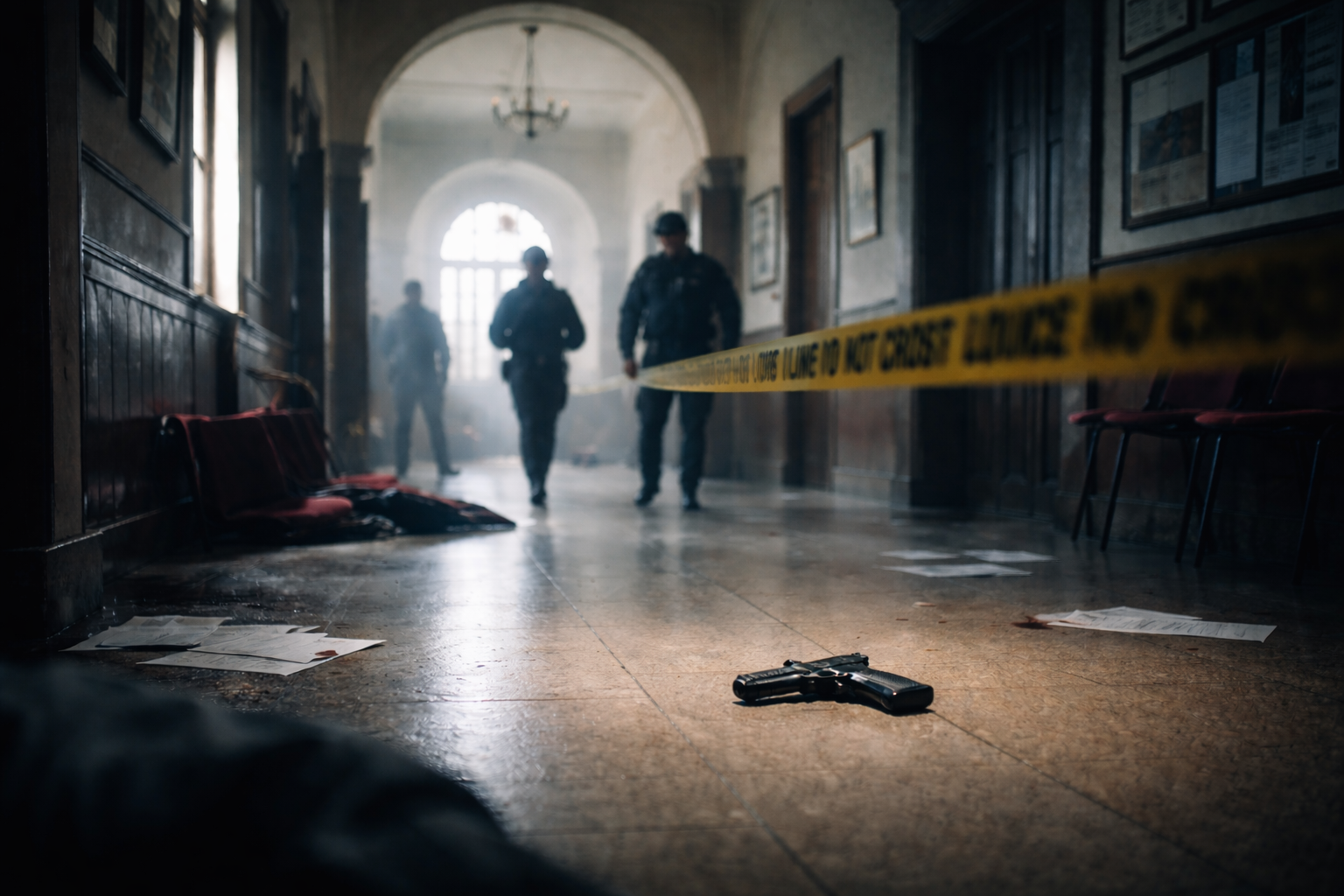
Czech Town Hall Shooting: Confirmed Timeline and What’s Next
Czech authorities say a shooting at the town hall in Chřibská (North Bohemia, near Děčín) left one person dead and multiple others wounded, including police officers. The incident was contained, and officials said there was no ongoing threat to the public.
The fast-moving part of this story is not the “why” (that usually comes later, if at all). It’s the shape of the event: a rare setting (a municipal office), early confusion about casualty counts, and the way initial headlines can inflate (or minimize) perceived risk.
The story turns on whether the public internalizes the event as a contained, targeted incident—or as a broader signal of escalating, unpredictable violence.
Key Points
Authorities said the shooting occurred at the Chřibská town hall in northern Czechia, and the scene was secured within hours.
One person was killed; early reports mentioned four wounded, but later official updates widely reported at least six injured, including multiple police officers.
Officials indicated the attacker also died at the scene; early accounts differed on whether the person was shot or took their life after the attack.
Police said there was no further danger and ruled out terrorism or extremist motivation in early statements.
The most consequential near-term question is institutional response: security posture at public buildings, local policing protocols, and how quickly accurate public information stabilizes.
Background
Town hall attacks are uncommon precisely because they sit at the intersection of routine civic life and symbolic authority. Municipal buildings are designed for access—permits, local disputes, minor administration—not as hardened targets. That mismatch matters: it increases initial uncertainty, and it creates a brief window where the public does not know whether a situation is localized or spreading.
In this case, the location repeatedly identified by officials and major reporting was Chřibská, a small town in the Ústí nad Labem Region (North Bohemia). Police statements early in the day emphasized two stabilizing facts: the building was secured, and the incident did not appear to be ideologically driven.
Analysis
The first-hour problem: casualty numbers move before facts do
Early breaking-news reporting frequently undercounts injuries, then revises upward. That’s not always an error; it’s the reality of triage. In the first hour, the operational question for responders is to stop the threat and treat the wounded, not to produce a clean public accounting.
Here, the public narrative shifted from “one dead, four wounded” to “one dead, at least six wounded,” with later detail specifying police officers among the injured and, in some accounts, the mayor as well. The practical takeaway is that initial numbers are often placeholders—and audiences tend to treat them as final.
Plausible scenarios (not predictions) and signposts:
Scenario A: numbers stabilise quickly once hospitals report admissions and police confirm who counts as “injured.”
Signpost: consistent totals repeated by police and health services across multiple updates.Scenario B: numbers remain fluid as minor injuries are recorded or reclassified.
Signpost: language shifts from “wounded” to “treated,” “hospitalized,” or “serious condition.”
Scene status and the credibility hinge: “no further danger” is the key sentence
When police say there is no further danger, they are doing two things at once: describing a tactical reality (the attacker is no longer an active threat) and attempting to prevent a second-order harm (panic, misinformation, copycat fear).
In this case, authorities said the attacker also died and that the building had been secured. Some early accounts described the suspect as being “fatally shot,” while others described a self-inflicted death. Both can be true in different cases; what matters for the public is that the operational risk ended.
Plausible scenarios and signposts:
Scenario A: a clear official reconstruction emerges quickly (sequence of shots, response time, outcome).
Signpost: police briefings align on the attacker’s death as either suicide or police action.Scenario B: Partial ambiguity persists because officials prioritize investigative integrity.
Signpost: repeated use of careful phrasing—“the attacker died at the scene”—without detail.
Motivation: why “not terrorism” changes the public meaning of the event
Officials moved early to rule out terrorism and extremist motives. That has immediate consequences:
It reduces the perceived probability of coordinated follow-on attacks.
It changes what “prevention” looks like—from intelligence-led disruption to local threat management, including firearms enforcement and interventions around personal disputes.
At least one official line described the likely motive as relationship-based (a category that can include domestic, workplace, or interpersonal grievances). Early motive labels can be wrong, but they often reflect preliminary investigative signals—known relationships, prior disputes, or context at the scene.
Plausible scenarios and signposts:
Scenario A: targeted interpersonal attack with a limited risk envelope.
Signpost: confirmation of a prior relationship to someone at the building or a specific grievance.Scenario B: motive remains unclear, and officials avoid speculation.
Signpost: public updates focus on procedure and victim support, not cause.
What Most Coverage Misses
The hinge is this: the biggest risk in the first hours is not only the attacker—it’s information lag, because it shapes public behavior and political reaction before facts settle.
The mechanism is simple. A town hall shooting is emotionally “loud”: it feels like an attack on civic order. In the absence of stable details, people substitute meaning—terror, social breakdown, randomness. This prompts the need for swift policy responses, despite the possibility of a contained and personal motive behind the incident.
What would confirm such an event in the next day or two:
Signpost 1: whether officials keep repeating “no further danger” while the public conversation keeps escalating anyway (a mismatch between reality and perception).
Signpost 2: whether local authorities announce security changes or public-building restrictions quickly—often a response to fear and optics as much as evidence.
Europe relevance: rare setting, familiar dynamics
Even in countries with relatively low rates of public shootings, Europe has seen how rare events can dominate perceived risk. The pattern is consistent: a shocking venue (school, hospital, municipal building) produces outsized attention, which can distort proportionality.
The correct lens is not “Is Czechia becoming unsafe?” But how does a society metabolize a low-frequency, high-salience event without letting fear become policy by reflex?
What Happens Next
Who are most affected now are local: the wounded and their families, municipal staff, and residents who rely on the town hall for services.
In the next 24–72 hours, expect:
confirmation of the final casualty and injury count, including how many were hospitalised and how many were treated on scene,
a clearer statement on the attacker’s death (suicide versus police action),
Authorities should provide a basic motive framing if they believe it is safe and accurate to share.
Over the next weeks and months, the long tail is institutional:
municipal building security practices may tighten (access controls, staffing, police proximity).
political pressure may rise around firearms enforcement and “warning signs.”
Public trust may be affected if early information is later corrected dramatically—because corrections are interpreted as concealment even when they’re normal.
The main consequence is psychological and procedural because early ambiguity invites the public to fill gaps with the most emotionally available story.
Real-World Impact
A clerk in a nearby town hall quietly checks the public entrance twice, then asks a colleague to stop meeting residents alone inside offices.
A small business owner who needs a permit postpones a visit to the municipal office, unsure whether services are open or safe.
A local police unit reviews body-camera and dispatch timing to understand whether the first minutes can be tightened, even if the threat ended quickly.
Parents walking past the building reroute their children for a few days—not because of new danger, but because memory sticks to place.
The Next 48 Hours Will Decide the Narrative
This event will be remembered in one of two ways: as a contained tragedy inside a municipal building or as a symbol of widening public vulnerability. Which version wins depends less on speculation and more on whether officials can lock in three stable facts: final casualty figures, the attacker’s status and method of death, and a disciplined motive framing that avoids fantasy.
The fork in the road is between clarity and myth—and once myth hardens, it becomes harder to reverse than any early mistake.
Watch for a consolidated police timeline, consistent hospital reporting, and any immediate security measures around municipal buildings. The historical significance here is not only what happened in Chřibská—it’s how quickly a democracy’s everyday civic spaces can feel fragile when information arrives slower than fear.
