The Greenland Tariff Shock: How a Threat Reprices the World
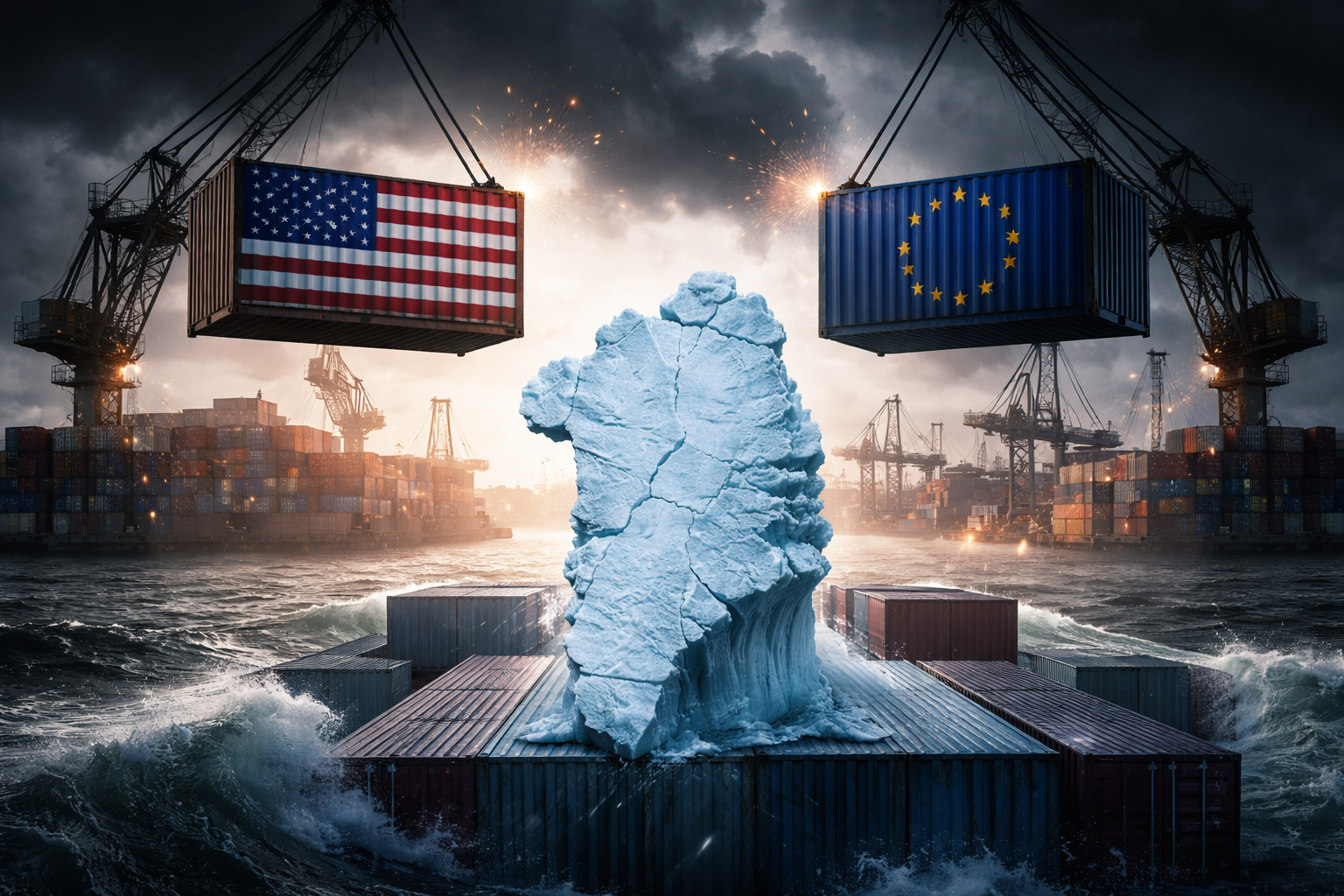
Tariff threats linked to Greenland are moving FX, rates, and equities now. Here’s the transmission mechanism and the next 72-hour decision points.
Tariff threats tied to Greenland are circulating at the highest political level—and markets are already moving on the possibility that those threats turn into policy.
The immediate catalyst is blunt: the U.S. president has said tariffs would be imposed on a set of European countries—including the UK—unless the U.S. is allowed to buy Greenland. Whether that threat becomes enforceable law is not yet settled. But uncertainty alone is enough to reprice risk.
This is why “nothing has happened yet” is rarely true in markets. A tariff threat can hit currencies, rates, equities, and commodities before a single container is taxed—because investors trade the probability distribution, not the press conference.
The story turns on whether the threat hardens into a formal, executable tariff order—or gets defused through a negotiated off-ramp.
Key Points
Confirmed: The U.S. president has said a new tariff wave would begin February 1 on eight European nations, including the UK, and be tied to the Greenland dispute.
Confirmed: European officials are preparing responses, including an emergency summit on Thursday, while keeping diplomacy open.
Disputed/unclear: The exact scope (which products, what exemptions, how enforcement works) remains unclear until a formal policy text is published.
Disputed/unclear: The sequencing and intensity of retaliation—including whether the EU triggers its Anti-Coercion Instrument—is not confirmed.
Unknown: Whether upcoming political set pieces produce escalation or an off-ramp, including the U.S. president’s Wednesday Davos address and follow-on talks.
Unknown: Whether the spillover shifts from trade into capital, services, and investment restrictions, which would widen the shock well beyond tariffs.
Background
The immediate dispute is political and territorial: Greenland is a self-governing territory within the Kingdom of Denmark, and the U.S. president has tied trade penalties to pressure over Greenland’s future.
The policy claim in play is specific enough to move money but not yet specific enough to price with precision. The U.S. president has described tariffs starting in February on imports from a defined list of European countries, including the UK. Europe is publicly weighing countermeasures while also signaling it prefers de-escalation.
A separate layer matters: the EU has tools designed for coercion scenarios. One is an existing tariff package that could be reactivated; another is the Anti-Coercion Instrument, which can reach beyond goods trade into areas like services, procurement, and investment access. Which route Europe chooses—and how quickly—is a major variable for markets.
Analysis
Why markets react to threats
Markets move early because they are probability machines. The moment a credible actor signals a policy path, investors start discounting future cash flows, margins, supply chain costs, and growth—and they hedge what they cannot forecast.
A tariff threat creates two kinds of uncertainty at once:
First, the direct question: will tariffs be imposed, on what, and for how long? Second, the reaction-function question: what will the other side do, and what else becomes “conditional” in future negotiations? The second question often carries a higher premium, as it alters the game's rules over years rather than weeks.
That is why assets can fall (or safe havens rise) even when the policy has not been implemented. The repricing is the cost of not knowing.
The transmission channels occur in the following order: first FX, then rates, and finally risk assets.
FX (foreign exchange) often moves before equities because currencies are the fastest expression of relative risk and expected policy divergence. If investors think Europe is facing a negative growth shock (tariffs) or higher political risk (coercive trade), they demand a higher risk premium to hold European currency exposure. That can show up as weakness in the euro and sterling and a defensive bid for the dollar, even if the long-run effect would be “dollar negative.”
Rates (government bonds) then price the growth/inflation mix. Tariffs are mechanically inflationary at the border, but they can also be growth-negative if they squeeze demand and hit exporters. Bond markets attempt to decide which dominates: “stagflation risk” (bad) or “growth scare” (often bond-bullish). With threat-driven policy, the distribution is wide—and that typically means higher volatility and a premium for safe collateral.
Equities reprice in two steps. First comes a broad risk-off move (less appetite for cyclicals, exporters, and high-beta sectors). Then comes differentiation: companies with U.S. revenue exposure, vulnerable supply chains, or thin margins get hit harder; defensives and “beneficiaries” (some domestic-facing firms, some commodity producers, and some defense names) can outperform.
Commodities are split into two categories: safe-haven assets (where uncertainty drives demand) and growth-sensitive commodities (where trade friction threatens demand). The same headline can lift gold while pressuring oil, depending on how investors read the macro impulse.
The Europe/UK exposure map: who takes the hit first
If the proposed tariff is broad-based (an across-the-board import tax), the first-order losers are straightforward: European and UK exporters into the U.S., especially those competing on price and operating on tight margins. If the tariff is targeted (sectoral carve-outs), the pain concentrates sharply—but the market still hedges broadly until details are known.
The most exposed clusters typically include:
Industrials with complex cross-border supply chains (autos and auto components, machinery, aerospace supply chains); consumer brands reliant on discretionary demand; and manufacturers where a 10% border cost is hard to absorb without price increases. For the UK specifically, any sector that is both export-exposed and politically salient tends to be vulnerable to uncertainty shocks, because firms may pause investment and hiring until they know the rules.
There is also a second-order UK/Europe channel that has nothing to do with containers at ports: financial conditions. When global risk sentiment deteriorates, UK and European credit spreads can widen, equity risk premiums can increase, and currency volatility rises. That tightens conditions for households and firms even before trade volumes change.
Commodities: safe havens, industrial metals, and the Arctic overlay
Tariff threats often boost safe-haven demand, particularly when the geopolitical subtext is coercion rather than trade balancing. Some market commentary and price action today has reflected that “flight to safety” impulse.
But Greenland adds an additional layer: the Arctic is not just a map problem; it is a logistics and resource problem. Greenland is frequently discussed in terms of strategic location and critical mineral potential. That does not mean a tariff threat instantly changes physical supply—but it can change investor expectations around Arctic investment, defense posture, and the political risk premium attached to future projects.
What Most Coverage Misses
The hinge is that this is not a “tariffs story” so much as a “conditionality story.”
A normal tariff dispute is about trade balances, industry protection, or domestic politics. This one is being framed as leverage over a strategic territorial issue. That matters because it teaches markets that access to the U.S. market may become contingent on positions taken in security disputes—which widens the set of future scenarios investors must hedge.
Mechanically, that pushes up the “policy risk premium” in three places at once: currency hedging costs, corporate hurdle rates for investment, and cross-border capital allocation. Even if the tariff is never implemented, the risk premium can persist if investors believe the threat itself is now a reusable instrument.
Two signposts that would confirm this shift in the coming days:
movement from tariff talk into formal legal text and enforcement guidance, and
a European response that reaches beyond goods into services, investment access, or procurement, signaling the dispute is no longer “just trade.”
What Happens Next
The next 72 hours are about decision points, not outcomes.
First, watch for paperwork. A press statement moves markets for a day; an executive order, proclamation, or published implementation notice moves markets for a quarter. Confirmation would look like formal documentation that specifies scope, tariff lines, exemptions, and a start date aligned to February 1.
Second, watch for European sequencing. The EU is weighing multiple tracks, including an emergency summit on Thursday and potential reactivation of a tariff package shortly after. If Europe signals it will trigger the Anti-Coercion Instrument, the market will likely price a wider conflict surface (services, investment, banking activity), not just goods.
Third, watch for diplomatic off-ramps. Public confirmation that talks are advancing—especially via the working group referenced by Danish officials—would be the cleanest signal that markets can fade the risk premium. Conversely, language that frames the issue as “non-negotiable” on both sides raises the odds of escalation.
Signals that would confirm escalation:
A formal tariff instrument with implementable details, retaliation calendars with specific trigger dates, suspension of trade-deal processes, and explicit linkage of additional measures to security actions.
Signals that would confirm an off-ramp:
A declared pause, a narrower scope than feared, explicit exemptions, or a jointly described negotiation pathway that removes the “until Greenland is acquired” condition.
Real-World Impact
A UK exporter quotes U.S. customers in dollars today and learns that a 10% tariff threat can force repricing before any law changes, because buyers demand contingency discounts.
A European manufacturer delays a capital expenditure decision, not because it knows tariffs are coming, but because it cannot price its U.S. margin for the next quarter with confidence.
A UK pension fund increases currency hedges as volatility rises, which is a quiet way that political risk becomes a real cost inside long-term portfolios.
A shipping and logistics planner builds two parallel schedules—one for “normal” and one for “tariffs live”—because the operational bottleneck is not the tariff itself, but the scramble when rules change overnight.
The Trade War That Starts as a Spreadsheet
Markets can tolerate bad news; they struggle with rule changes that lack a timetable. The Greenland tariff shock is, at its core, a test of whether threats are now policy—and whether policy is now conditional on strategic alignment.
Over the next few days, the fork in the road will be visible in bureaucratic details: do we get implementable text, enforcement guidance, and a retaliation sequence—or do we get a negotiated framework that allows everyone to step back without losing face?
Either way, the historical significance is not the tariff rate. It is the precedent that geopolitical leverage can reprice global capital faster than any tariff collector can stamp a form.
