

Deadly Landfill Collapse Triggers Massive Rescue Operation in Indonesia
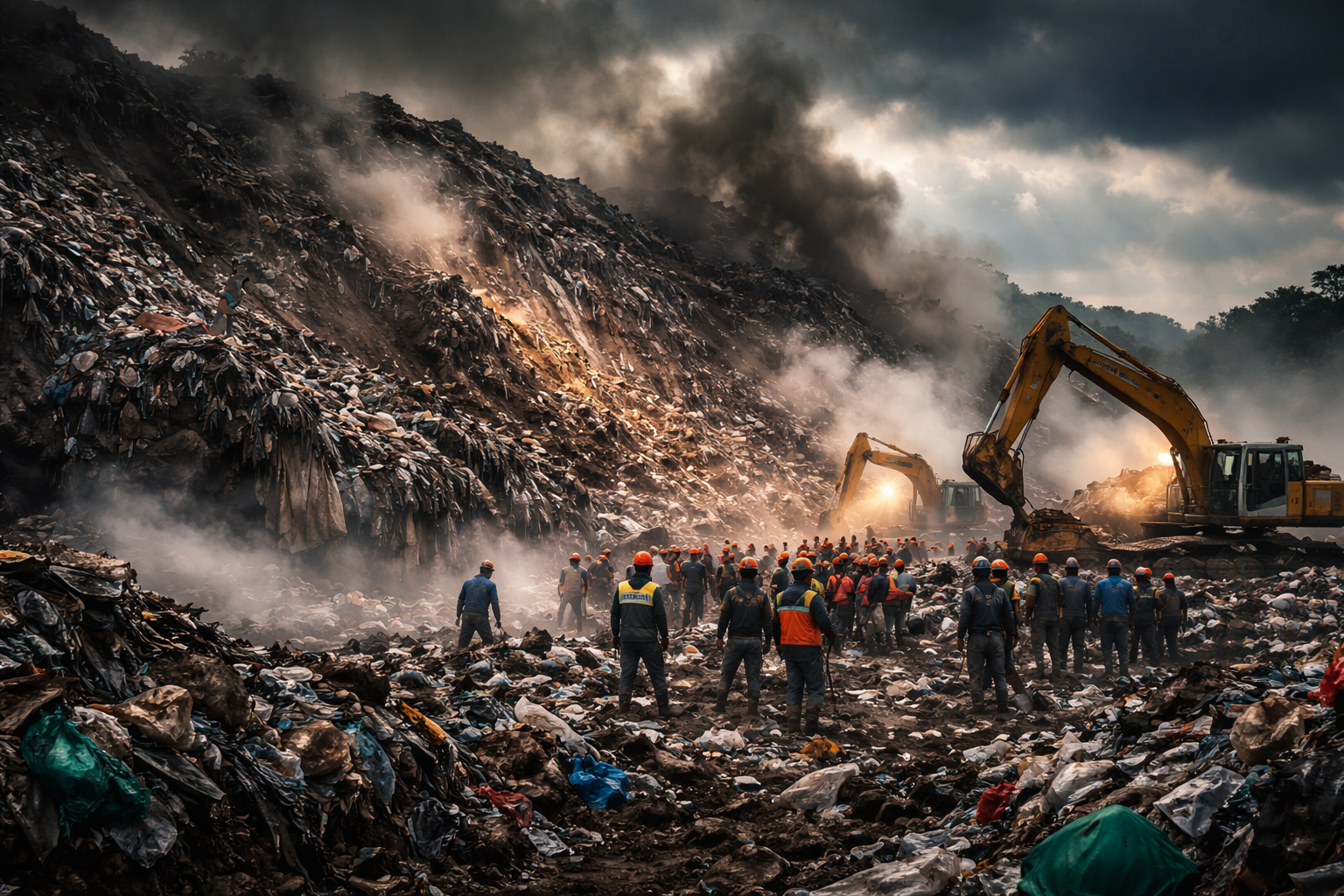
Mountain of Waste Collapses Near Jakarta, Leaving Workers Missing
Deadly Waste Avalanche Buries Workers at Jakarta Landfill
A catastrophic collapse at Indonesia’s largest landfill has triggered a large-scale rescue operation near Jakarta, where search teams are racing to find survivors buried under thousands of tons of waste.
The disaster unfolded at the sprawling Bantargebang landfill complex in Bekasi, a city on the eastern edge of the Indonesian capital. A massive mound of garbage suddenly gave way after heavy rainfall destabilized the site, sending an avalanche of refuse across the working area where trucks, workers, and informal waste pickers were present.
As of March 9, 2026, authorities have confirmed multiple fatalities and several people still missing. Hundreds of rescuers—including police, soldiers, and disaster-response teams—are digging through unstable debris using excavators, sniffer dogs, and heavy machinery.
Beyond the immediate tragedy, the incident exposes deeper structural pressures facing megacities like Jakarta: rapidly rising waste volumes, overloaded landfills, and communities that depend on these dangerous environments for survival.
The story turns on whether Indonesia can reduce its reliance on massive open dumps before similar disasters become routine.
Key Points
A massive garbage mound collapsed at the Bantargebang landfill near Jakarta after heavy rain destabilized the site.
At least several people have died and others remain missing as rescue operations continue.
More than 200–300 rescue personnel, supported by heavy equipment and sniffer dogs, are searching the debris.
The landfill processes roughly 6,500–7,000 tons of waste every day from the Jakarta metropolitan region.
The disaster has renewed scrutiny over landfill safety, overcapacity, and waste management in Southeast Asia’s largest cities.
Where the Disaster Began: A Garbage Mountain Outside Jakarta
The collapse occurred at the Bantargebang Integrated Waste Treatment Facility, Indonesia’s largest landfill and the primary dumping ground for the capital region.
Sprawling across roughly 110 hectares, the site receives thousands of truckloads of waste daily from Jakarta’s population of more than 10 million people.
Over decades, the landfill has grown into towering layers of compressed waste—effectively forming artificial hills made of plastic, organic matter, and industrial debris.
Such structures behave less like solid ground and more like unstable slopes. When heavy rainfall saturates the waste mass, the internal layers can shift, triggering sudden landslides similar to natural avalanches.
That is exactly what appears to have happened here.
Officials say relentless rain soaked the landfill before the collapse, weakening the structure of the massive garbage pile until it suddenly slid downhill across part of the working area.
Workers, truck drivers, and people operating food stalls near the site were caught in the path of the debris.
The Race to Find Survivors
Search operations began almost immediately after the collapse.
Rescue crews from Indonesia’s national disaster agency and local authorities deployed excavators, earth-moving machines, and trained search dogs to locate victims buried under the garbage.
The effort is dangerous.
Unlike rock or soil, landfill debris shifts unpredictably. The waste mass can release toxic gases, ignite methane pockets, or collapse again under the weight of heavy machinery.
Rescuers must therefore move carefully, digging through layers of refuse that can conceal voids and unstable pockets.
The victims include landfill workers and drivers delivering waste to the site, highlighting the everyday hazards faced by people operating in the shadow of the world’s largest urban waste systems.
Authorities have warned that the death toll could rise as more victims are located beneath the debris.
Why Landfill Disasters Happen
Garbage landslides are a known risk in massive dump sites, particularly in fast-growing cities.
Landfills expand vertically over time as waste accumulates faster than it can be processed or recycled. As the piles grow higher, the pressure inside them increases.
Rainwater infiltration can further destabilize the structure.
When saturated, the waste mass behaves almost like mud—losing friction and sliding downhill under its own weight.
In densely populated urban regions, landfill sites also attract informal recycling workers who search through the waste for valuable materials. These communities often work directly on the unstable slopes, placing them at extreme risk during collapses.
This dynamic is common across parts of Southeast Asia and Latin America, where megacities generate enormous waste streams but lack the infrastructure to process them safely.
What Most Coverage Misses
The immediate story is a tragic landfill collapse.
But the deeper issue is structural: megacities are running out of space to manage their waste.
Jakarta produces tens of thousands of tons of trash every day. Facilities like Bantargebang have effectively become towering waste reservoirs—physical symbols of a system that depends on dumping rather than reducing or recycling.
When landfill heights grow faster than safety systems evolve, disasters become a mathematical probability rather than a surprise.
Another overlooked factor is the informal economy built around these sites. Thousands of waste pickers rely on landfills for income, working directly on unstable slopes where formal safety oversight is minimal.
That economic reality makes the problem far harder to solve than engineering alone.
The Human Stakes
For communities living near landfill sites, the consequences extend far beyond a single disaster.
Landfills produce methane gas, toxic leachate that contaminates groundwater, and constant odor pollution. Residents often live with health risks while depending on the facility for jobs.
In the case of Bantargebang, entire neighborhoods have grown around the landfill complex.
Workers sort recyclables, truck drivers deliver waste, and informal vendors sell food to people working at the site.
When the garbage mountain collapses, it is not just a workplace accident—it is a disaster affecting an entire ecosystem of livelihoods.
What Happens Next
Rescue operations will continue until authorities are confident no victims remain trapped in the debris.
But the broader questions are already emerging.
Indonesia has begun exploring waste-to-energy projects and other initiatives designed to reduce reliance on massive landfill sites. Yet such transitions take years, and the scale of urban waste production continues to grow.
The critical signposts to watch now include:
Whether safety reviews are ordered for Bantargebang and other major landfills
Whether waste diversion programs accelerate in Jakarta
Whether informal workers are relocated or formally integrated into safer systems
Disasters like this one often fade quickly from global headlines.
But the underlying forces—rapid urbanization, rising consumption, and overwhelmed waste systems—remain.
And unless those pressures change, the mountains of garbage surrounding the world’s largest cities will continue to carry risks that are literally waiting to collapse.
