Drones Strike Iraqi Kurdistan Prime Minister’s Office as Iran Tensions Threaten New Escalation
Explosive Drones Target Iraqi Kurdistan PM as Regional Crisis Deepens
Erbil Under Pressure After Drones Target Kurdistan Prime Minister
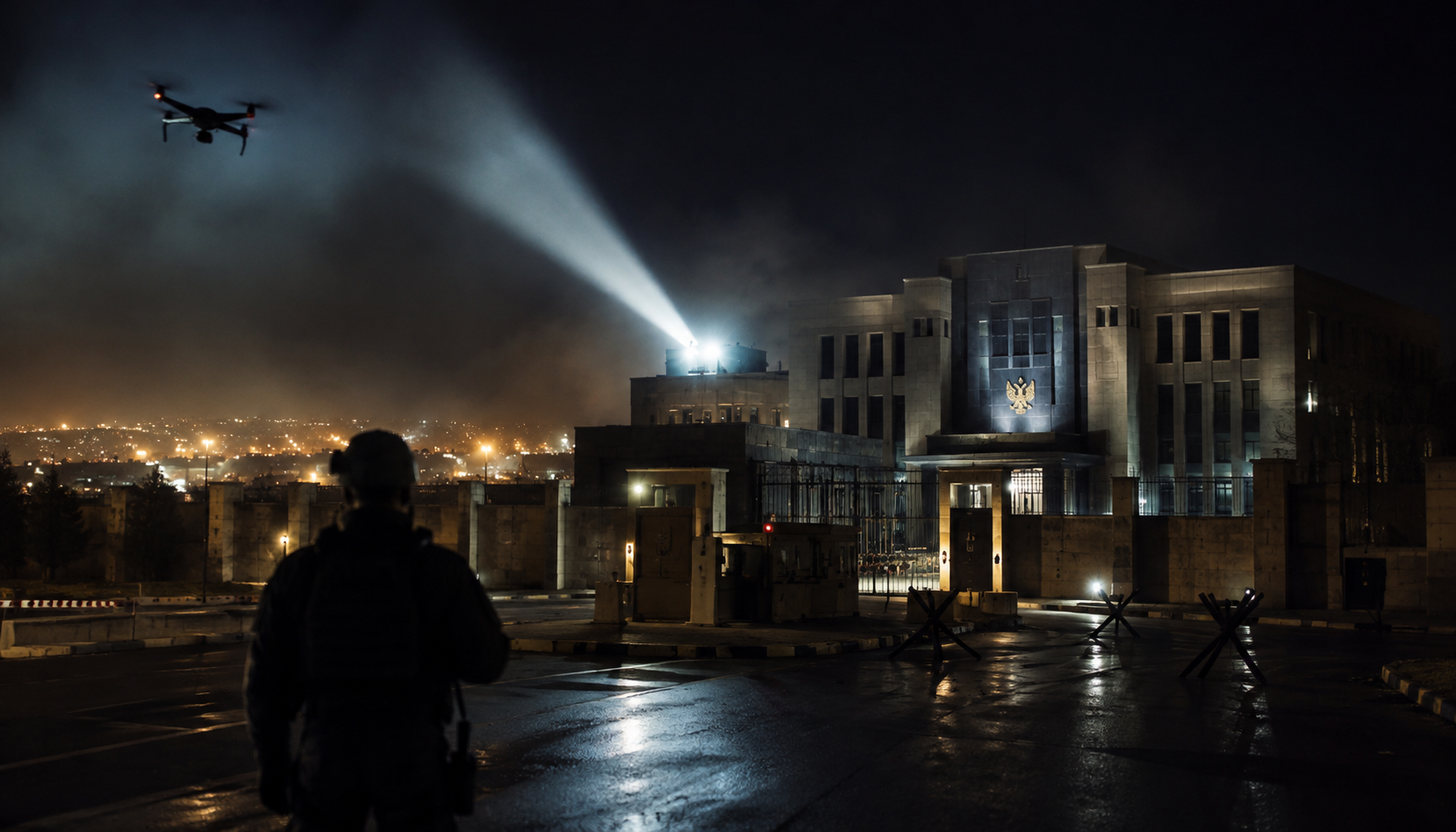
Two explosive-laden drones have targeted the private office of Iraqi Kurdistan Prime Minister Masrour Barzani in an attack that pushes one of Iraq’s most politically sensitive regions deeper into the Middle East’s widening security crisis. A second drone targeted the residence of the head of the Kurdistan Region’s security and intelligence apparatus.
No casualties were reported. Yet the absence of deaths should not disguise the significance of the targets. This was an attack aimed at the political and security leadership of the Kurdistan Region at a time when Erbil is already struggling to avoid being pulled into conflicts surrounding Iran, the United States and their regional allies.
What Happened in Pirmam
The attacks took place shortly after midnight on Monday, August 17, in the Pirmam district of Erbil province.
Kurdish counter-terrorism authorities said two explosive-laden Hadid-110 drones were used. One targeted Barzani’s private office while the other targeted the residence of the director of the region’s security and intelligence agency.
The Kurdistan Regional Government said the drones had been launched from Iranian territory. No deaths or injuries were reported.
That distinction matters. Kurdish authorities have identified where they believe the drones originated, but the available evidence does not by itself establish who ordered the operation or whether it was carried out directly by the Iranian state, another armed organisation or actors operating with some degree of autonomy.
Barzani condemned the attacks as reckless and unacceptable. He described them as a dangerous escalation and a direct threat to the Kurdistan Region’s security and stability.
Why These Targets Matter
The choice of targets makes this more serious than another attempt to damage isolated infrastructure.
Barzani is the prime minister of the autonomous Kurdistan Regional Government and one of the most important political figures in northern Iraq. Targeting his private office sends a message directly towards the regional leadership.
The second target is just as revealing. Striking the home of the head of the region’s security and intelligence apparatus means the attack was directed simultaneously towards political authority and the machinery responsible for protecting it.
Even without casualties, that combination carries an obvious psychological and strategic effect.
It tells Kurdish leaders that offices, residences and senior officials can potentially be reached.
That changes the security calculation.
Iraqi Kurdistan Is Already Under Pressure
Monday’s attack did not happen in isolation.
Erbil and the wider Kurdistan Region have faced repeated drone and missile threats during the worsening regional confrontation. Military facilities, energy infrastructure, political locations and areas associated with Iranian Kurdish opposition groups have all come under pressure.
The pattern has forced air defence and counter-drone capability much higher up the region’s political agenda.
It has also exposed an uncomfortable weakness. The Kurdistan Region has significant security forces of its own, but its airspace sits within the sovereignty of the Iraqi state. Erbil therefore depends partly on Baghdad and international partners for the kind of integrated air defence needed against repeated missile and drone attacks.
That arrangement becomes much harder to sustain when inexpensive unmanned aircraft can repeatedly penetrate or threaten politically sensitive locations.
The Most Dangerous Part Is the Location of Origin
The KRG’s assertion that the drones crossed from Iranian territory gives the incident much wider geopolitical significance.
Iran shares a long border with Iraqi Kurdistan and has repeatedly viewed developments across that frontier through the lens of its own national security. Iranian Kurdish opposition organisations have historically operated from areas of northern Iraq, creating a recurring source of tension between Tehran, Baghdad and Erbil.
Kurdish leaders, however, have repeatedly insisted that the Kurdistan Region does not want its territory used as a platform for attacks on neighbouring states.
That has not prevented the region from becoming increasingly exposed.
Only days before the latest strike, Kurdistan Region President Nechirvan Barzani publicly questioned why the region continued to face attacks when its leadership had sought to remain outside the wider confrontation.
That question now carries considerably more weight.
An attack on energy infrastructure can be explained as economic coercion. An attack near a military installation can be framed through the presence of foreign forces. An attack directed at the private office of the regional prime minister is harder to separate from political intimidation.
This Does Not Yet Prove Tehran Ordered the Strike
There is an important line between saying a drone originated from Iran and proving that the Iranian government authorised its mission.
That line should not be blurred.
The Kurdistan authorities have attributed the drones’ launch location to Iranian territory. Publicly available information at this stage does not establish the complete chain of command behind the attack.
That uncertainty may become one of the most consequential parts of the investigation.
If evidence eventually connects the operation directly to Iranian state forces, the diplomatic implications would be serious. It would represent a deliberate attack against senior political and security targets inside neighbouring Iraq.
If another organisation launched the drones from Iranian territory, a different question emerges: how was an armed group able to operate explosive drones across an international border against senior Iraqi officials?
Either scenario places pressure on Tehran.
Baghdad Faces Its Own Sovereignty Problem
The attack also creates a problem for Iraq’s federal government.
Erbil may operate with substantial autonomy, but the Kurdistan Region remains part of Iraq. An armed drone crossing an international border and striking the office of a senior Iraqi political leader is therefore not simply a Kurdish security matter.
It is an Iraqi sovereignty issue.
Repeated attacks expose the limits of Baghdad’s ability to control the country’s airspace, restrain armed organisations and protect strategically important territory.
They can also deepen tensions between Baghdad and Erbil.
Kurdish leaders have repeatedly demanded stronger federal action after attacks on the region. Each new incident increases the political cost of appearing unable to prevent the next one.
Drones Are Changing the Balance
The strategic problem extends well beyond Iraqi Kurdistan.
Cheap attack drones have transformed the economics of regional warfare.
A government can spend enormous sums protecting a leadership compound, military base or energy facility. An attacker may need only a relatively inexpensive unmanned aircraft, explosives and sufficient intelligence about the target.
Even when the drone fails to kill anyone, the defender must react.
Air defences activate. Security procedures change. Officials move. Airports can be disrupted. Energy companies reassess risks. Foreign investors reconsider exposure. Governments spend more money protecting an expanding list of potential targets.
Repeated attacks therefore impose costs even when they produce little visible physical destruction.
The threat itself becomes part of the weapon.
Why Kurdistan Is Especially Exposed
Iraqi Kurdistan occupies an unusually difficult strategic position.
It borders Iran. It contains Iranian Kurdish opposition movements. It maintains close political and economic ties with Western states. American forces have operated in the region. Its energy industry is internationally connected. At the same time, its leadership insists it does not want to become a battlefield for conflicts originating elsewhere.
Geography makes that neutrality increasingly difficult to protect.
Every escalation involving Iran raises the risk that Kurdish territory becomes strategically useful to somebody — as a military location, intelligence platform, logistical corridor, opposition sanctuary or pressure point.
Erbil may reject all of those roles.
Its neighbours and adversaries do not necessarily have to accept that interpretation.
The Economic Risk Goes Beyond Monday’s Attack
Security pressure on Kurdistan also threatens something much larger than individual government compounds.
The region contains oil and gas infrastructure that matters to both its own finances and Iraq’s wider economy. Previous drone attacks have already demonstrated how relatively small weapons can disrupt energy production and electricity supplies.
That creates a second layer of vulnerability.
Political leadership can be targeted for intimidation. Security institutions can be targeted to weaken confidence. Energy facilities can be attacked to impose an economic cost.
Together, those possibilities create a form of pressure that does not require conventional invasion or sustained bombardment.
A handful of drones can produce consequences far larger than their size suggests.
The Risk of Miscalculation Is Growing
Perhaps the greatest danger now is not that Monday’s strike immediately triggers a major conflict.
It is that repeated incidents gradually normalise attacks that would once have been considered extraordinary.
A drone approaches Erbil. Air defences respond. Another strikes an energy installation. Another targets a political compound. Nobody is killed. Governments condemn it. The cycle begins again.
Until one attack succeeds differently.
A drone that kills a senior Kurdish official, foreign soldier or civilian could transform political pressure into demands for retaliation within hours.
The more frequently these attacks occur, the greater the probability of such an outcome.
That is why an incident with no casualties can still mark an escalation.
What Happens Next
The immediate priority will be determining exactly where the drones were launched, how they reached Pirmam and who controlled them.
Kurdish authorities will also face pressure to strengthen protection around political compounds and other sensitive sites. That is likely to renew demands for more capable counter-drone and air-defence systems.
Baghdad faces an equally difficult task. It must demonstrate that attacks against Iraqi territory carry consequences while trying to prevent the country becoming another arena for a wider regional conflict.
Iran, meanwhile, faces growing scrutiny because Kurdish authorities have explicitly said the drones originated from its territory.
What remains unknown is ultimately the most important question: who gave the order?
Until that is established, Monday’s strike should not be portrayed as proof of direct Iranian state responsibility. What can be said with far greater confidence is that the threshold has moved again.
Drones are no longer merely threatening military bases or distant infrastructure in Iraqi Kurdistan. They have now been directed at the office of the region’s prime minister and the home of one of its most important security officials. If attacks at that level become routine, Erbil’s attempt to remain outside the wider regional confrontation may become much harder to sustain.
