

Dubai Under Threat: Why the Gulf’s Most Global City Has Become a Target in the Iran War
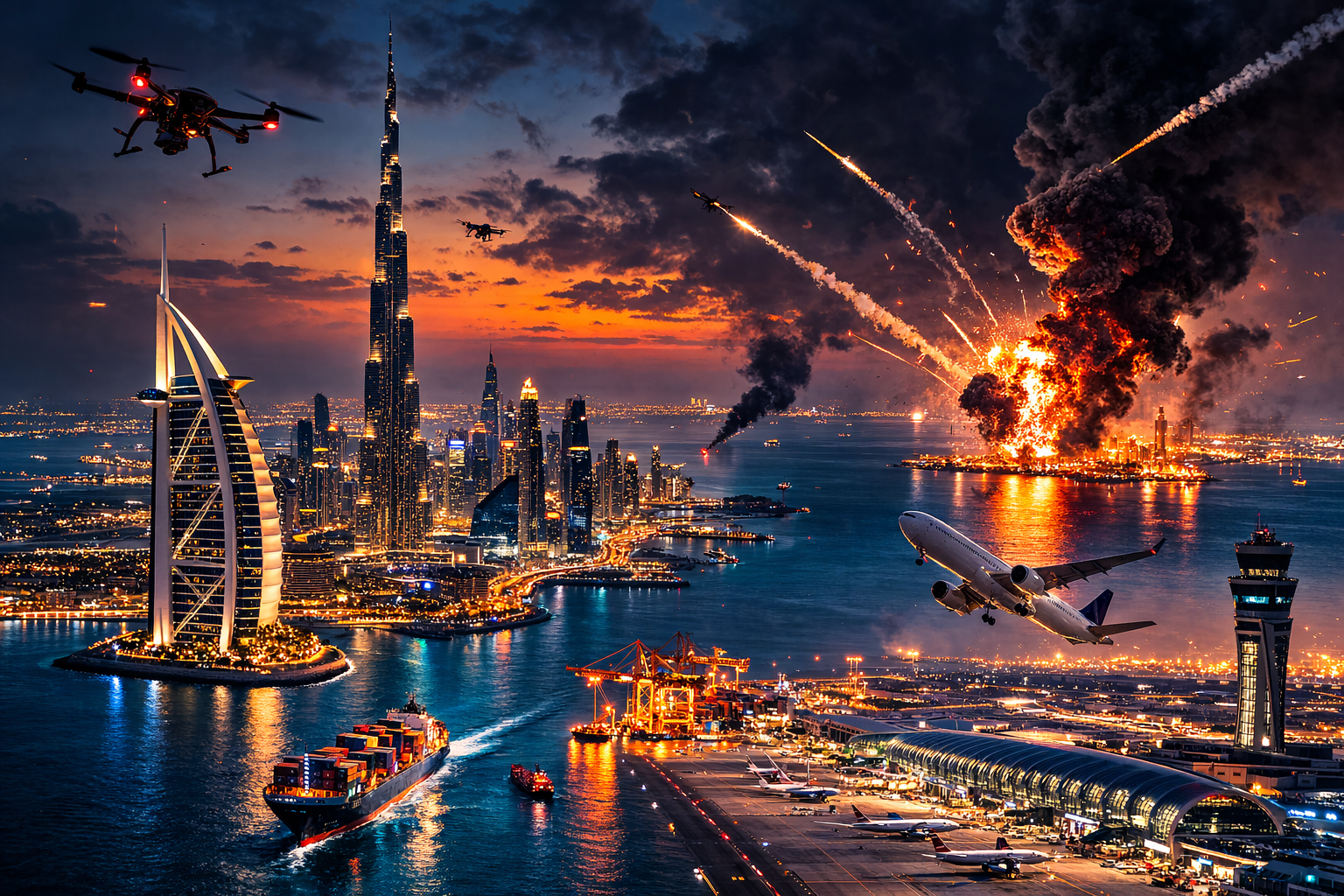
Dubai Is Now a Target: The Infrastructure War Spreading Across the Gulf
Dubai’s Biggest Strength Has Become Its Greatest Vulnerability
Dubai has long marketed itself as the Middle East’s safest global hub—a crossroads for finance, aviation, tourism, and technology. But the widening regional war around Iran has begun to challenge that assumption.
Iranian drones have struck near Dubai International Airport, injuring several people and disrupting air traffic, while attacks on shipping and oil facilities across the Gulf escalate.
The incidents mark a shift in the conflict: critical civilian infrastructure, not just military targets, is increasingly within range.
Dubai’s vulnerability is not simply geographic. Its role as a global logistics, aviation, and data hub means even limited attacks can ripple far beyond the UAE.
The story turns on whether Dubai’s infrastructure remains a symbolic pressure point or becomes a sustained battlefield in the regional conflict.
Key Points
Iranian drones have struck near Dubai International Airport, injuring four people and triggering wider aviation disruption across the Gulf.
The UAE has faced hundreds of drone and missile attacks since late February as the war expanded beyond Iran’s borders.
Shipping routes, oil facilities, and data centers across the Gulf now face targeted or threatened attacks.
The Strait of Hormuz—through which a major share of global oil flows—is experiencing severe disruption and maritime attacks.
Even limited strikes on Dubai carry global consequences because the city sits at the center of aviation, finance, and digital infrastructure.
How Dubai Became Part of the Battlefield
For decades, Gulf wars largely bypassed Dubai.
The UAE maintained strong security partnerships with the United States while simultaneously cultivating trade links across the region. The strategy helped the country build a reputation as the Middle East’s most stable commercial hub.
The current conflict has changed that dynamic.
After the United States and Israel launched strikes on Iran in late February, Tehran began retaliatory attacks across the region. Gulf states hosting Western military facilities or supporting the campaign became immediate targets.
The UAE quickly moved into that category.
By early March, Iranian missile and drone attacks had struck civilian and commercial areas across the Emirates, including Dubai and Abu Dhabi.
Air defenses intercepted most of the projectiles, but falling debris still caused damage and casualties.
Even limited damage has symbolic impact.
Dubai is not just a city. It is one of the world’s busiest air travel hubs, a major shipping gateway, and the headquarters for multinational corporations operating across the Middle East, Africa, and South Asia.
Attacking it sends a signal far beyond the battlefield.
The Infrastructure That Makes Dubai Powerful—and Vulnerable
Dubai’s global role rests on three pillars of infrastructure.
Aviation
Dubai International Airport handles tens of millions of passengers annually and serves as a central connection point between Europe, Asia, and Africa. Drone strikes near the airport highlight how fragile that network can be, as they pose significant risks to flight safety and can lead to further airspace restrictions and disruptions in travel plans.
Airspace closures across the Middle East have already forced thousands of flights to reroute or cancel, producing the region’s largest aviation disruption since the COVID-19 pandemic.
Energy and shipping
The UAE sits beside the Strait of Hormuz, one of the world’s most critical oil chokepoints.
Attacks on tankers and energy facilities have already pushed oil prices higher and triggered emergency releases from strategic reserves in several countries.
Dubai’s port infrastructure—especially Jebel Ali—is one of the largest logistics hubs on Earth. Even small disruptions can cascade through global supply chains, leading to delays in delivery, increased costs for consumers, and potential shortages of essential goods.
Digital infrastructure
Modern conflicts increasingly target information networks.
Recent strikes on data centers in the Gulf illustrate how cloud infrastructure has become a strategic asset in wartime.
The UAE hosts major regional data hubs used by governments, financial institutions, and global tech firms.
Disrupting them can paralyze everything from banking systems to military logistics.
The Escalation Logic Behind Infrastructure Attacks
Iran’s strategy reflects a classic form of asymmetric pressure.
Confrontation with the United States or Israel carries enormous risks. Instead, Tehran can expand the conflict horizontally—spreading disruption across regional infrastructure.
The targets reveal the logic:
shipping routes
oil and gas facilities
aviation networks
financial centers
digital infrastructure
Each one affects the global economy.
Attacks in the Gulf, therefore, raise the cost of war not only for military adversaries but also for international markets.
The strategy is designed to create political pressure abroad.
If energy prices spike, flights halt, and supply chains seize up, governments far from the battlefield begin demanding de-escalation.
What Most Coverage Misses
Much reporting frames the threat to Dubai as purely military—missiles, drones, and air defenses.
But the real vulnerability is systemic.
Dubai is arguably the most interconnected city in the Middle East, meaning disruptions compound quickly. A single drone incident near the airport can affect international aviation schedules, cargo networks, and tourism flows simultaneously.
The same logic applies to shipping and digital infrastructure.
A strike near Jebel Ali port can delay global container shipments. A damaged data center can disrupt financial services across multiple countries.
In other words, Dubai is not just a target.
It is a leverage point in the global economic system, as its financial infrastructure supports numerous international transactions and investments.
That makes even limited attacks strategically powerful.
The Gulf’s Other Hidden Weakness
Another infrastructure vulnerability looms beneath the surface: water.
Many Gulf states, including the UAE, rely heavily on desalination plants to produce drinking water. In some countries, desalinated water provides up to 90% of the supply.
These facilities sit along coastlines and are difficult to defend.
Experts warn that attacks on desalination infrastructure could trigger immediate water shortages and potential civil unrest.
So far, both sides appear cautious about crossing that line because the humanitarian consequences would be severe.
But the vulnerability remains.
What Happens Next
The trajectory of the conflict will determine whether Dubai remains a symbolic target or becomes a sustained frontline.
Several indicators will reveal the direction:
Whether drone and missile attacks on UAE infrastructure intensify
Whether shipping in the Strait of Hormuz remains restricted
Whether airspace closures across the Gulf expand
Whether cyber or digital infrastructure attacks increase
If the conflict escalates, Dubai’s global role could become a strategic liability rather than a shield.
The city was built to connect the world.
That same connectivity now means any strike on its infrastructure can send shockwaves across global aviation, trade, energy markets, and the digital economy.
In the emerging logic of modern warfare, the most connected cities are often the most exposed, as their intricate networks can be targeted to disrupt essential services and create widespread chaos.
