

Thai Cargo Ship Explosion in the Strait of Hormuz Leaves Crew Missing as Shipping Attacks Escalate
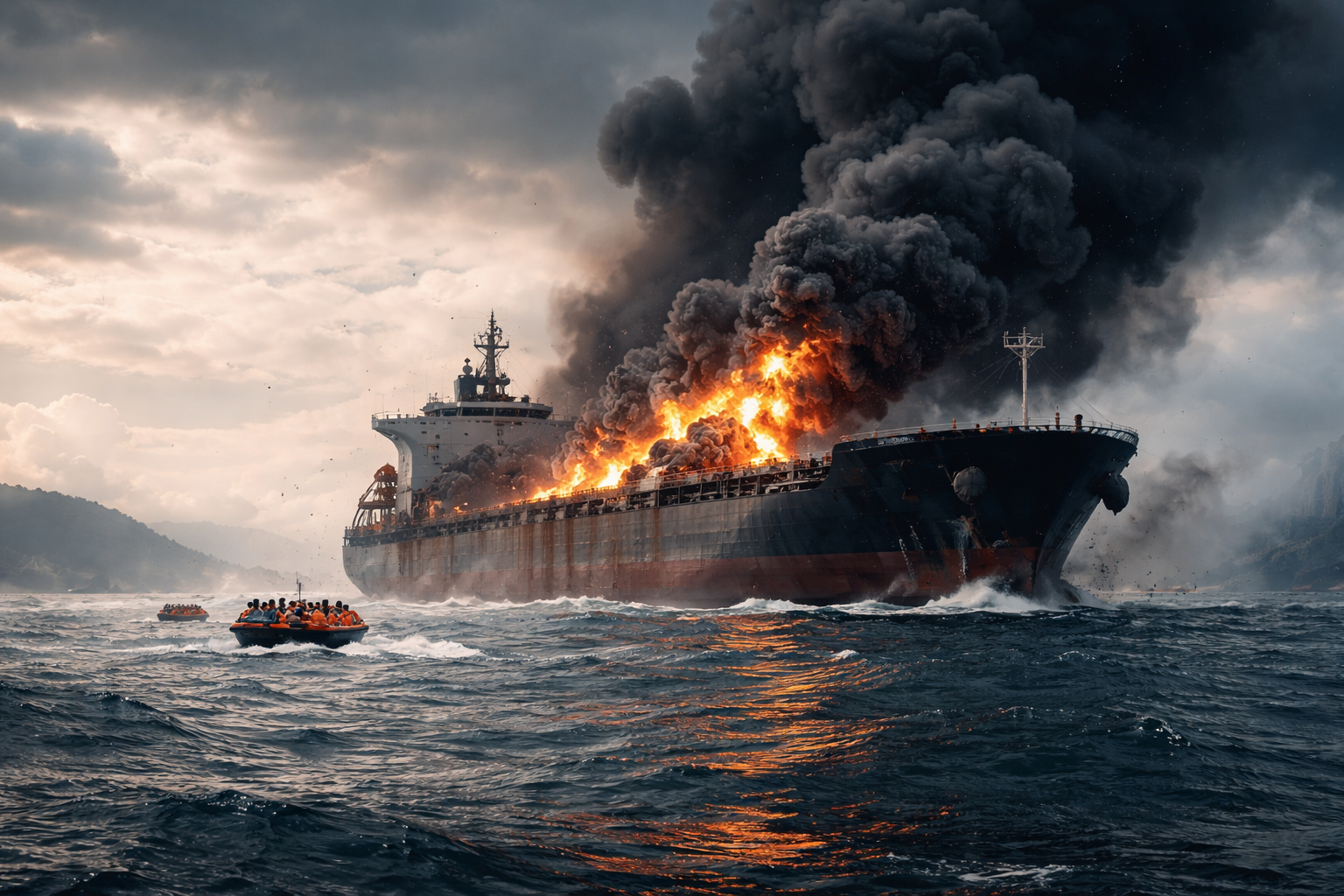
Explosion on Thai Cargo Ship Leaves Crew Missing in Hormuz War Zone
A Thai cargo vessel exploded after being struck by projectiles in the Strait of Hormuz, leaving three crew members missing and forcing the rest of the crew to abandon ship as flames spread through the engine room.
The attack on the bulk carrier Mayuree Naree marks one of the clearest signs yet that commercial shipping is now directly caught in the widening Middle East conflict. As of March 11, 2026, at least three vessels were hit in the area within hours, pushing one of the world’s most critical trade corridors into open danger.
Twenty crew members escaped in lifeboats and were later rescued by the Omani navy, but three sailors who were inside the engine compartment when the explosion occurred remain missing.
The deeper story is not just about one damaged ship. It is about how modern maritime war spreads risk far beyond military targets.
The story turns on whether commercial shipping becomes a deliberate pressure point in the conflict.
Key Points
Projectiles struck the Thai-flagged cargo ship, Mayuree Naree, in the Strait of Hormuz, resulting in an explosion and fire in the engine room.
Twenty crew members evacuated and were rescued by the Omani navy, while three remain missing.
Nearby incidents on the same day also struck two additional commercial vessels.
Iran’s Revolutionary Guards claimed responsibility for targeting the ship after issuing warnings about shipping in the region.
Since the war's inception on February 28, Gulf shipping routes have witnessed attacks on more than a dozen merchant ships.
The Strait of Hormuz carries roughly a fifth of the world’s oil supply, meaning disruptions quickly ripple through global markets.
The Moment the Ship Was Hit
Two projectiles struck the Mayuree Naree, a Thai-flagged bulk carrier owned by Precious Shipping, as it transited the Strait of Hormuz.
The impact caused an explosion at the stern, triggering a fire in the engine compartment and damaging the ship’s propulsion systems.
Crew members quickly abandoned the vessel in lifeboats as smoke and flames spread through the lower decks. Rescue vessels from Oman later recovered 20 sailors from the water.
Three crew members working inside the engine room during the blast have not been found.
Their fate remains uncertain.
Why the Strait of Hormuz Is the World’s Most Dangerous Shipping Lane
The Strait of Hormuz is only about 21 miles wide at its narrowest point, but it serves as the main export route for oil and gas from the Persian Gulf.
Each day, a massive share of global energy exports moves through the channel.
That geographic choke point creates a strategic vulnerability. Any military actor able to threaten ships there can disrupt global trade without ever striking an oil field.
Since the outbreak of the current conflict between Iran and a U.S.–Israeli coalition, shipping companies have already faced drone attacks, explosive boats, and projectile strikes across the Gulf.
The attacks have targeted vessels flying many different flags, underscoring how globalized shipping makes neutral actors difficult to separate from geopolitical rivals.
A Pattern of Escalation at Sea
The strike on the Thai ship did not occur in isolation.
The same wave of attacks also damaged two additional commercial vessels:
the container ship One Majesty, operated by Japan’s Mitsui O.S.K. Lines
the bulk carrier Star Gwyneth, flagged in the Marshall Islands
Both ships suffered damage but remained operational and reported no casualties.
Altogether, maritime authorities have recorded at least a dozen attacks on ships in or near the Gulf since late February.
The incidents range from projectile strikes to drones and explosive boats.
The pattern suggests a deliberate strategy: targeting shipping lanes to apply economic pressure without directly confronting Western navies.
What Most Coverage Misses
Much of the immediate reporting focuses on oil markets and military escalation.
But the most important shift may be operational, not economic.
Commercial shipping relies on predictability. A tanker captain can plan around storms, port congestion, and piracy risks. What shipping cannot easily absorb is unpredictable military targeting inside narrow waterways.
Even a small number of attacks forces insurers to raise premiums and shipping companies to reroute vessels or halt sailings.
That means the real leverage comes from uncertainty.
A single strike like the one that damaged the Thai vessel can ripple outward through shipping insurance markets, charter rates, and global freight costs.
In other words, the strategic goal may not be to sink ships. It may simply be to make the route feel unsafe.
The Human Toll of Shipping Attacks
Merchant sailors are rarely part of geopolitical narratives.
Yet they are often the first people caught in conflicts at sea.
Most crews on commercial vessels come from countries far removed from the political disputes driving the attacks. They are engineers, deckhands, and navigators working long rotations far from home.
When ships experience strikes, they encounter fires, explosions, and the need to evacuate into open waters.
In this case, 20 crew members survived because they were able to launch a lifeboat in time.
But the three missing sailors highlight a reality often overshadowed by strategic analysis: the people in the engine room or on deck during an attack have almost no protection.
The Strategic Crossroads for Global Shipping
The attacks raise a difficult question for governments and shipping companies alike.
Should merchant vessels continue sailing through the Strait of Hormuz without armed escort?
So far, naval forces have been reluctant to offer widespread convoy protection because of the risk of escalation and the sheer volume of shipping traffic.
If attacks continue, insurers and shipowners may make the decision themselves by withdrawing vessels from the route.
That would have immediate consequences for global energy markets and supply chains, potentially leading to increased prices and shortages of essential goods.
The signposts to watch now are clear:
whether more ships are struck in the coming days
whether naval escorts begin for commercial vessels
whether oil tankers start avoiding the strait entirely
If those shifts occur, the attack on a single Thai cargo ship may come to mark the moment when the Gulf’s commercial shipping lane turned into an active war zone.
