

Drone Strike Sets Oil Tanks Ablaze at Oman’s Salalah Port
Gulf Energy War Escalates as Drones Hit Oman Oil Storage
Drone Strike Ignites Oil Tanks at Oman’s Salalah Port as Gulf Energy War Widens
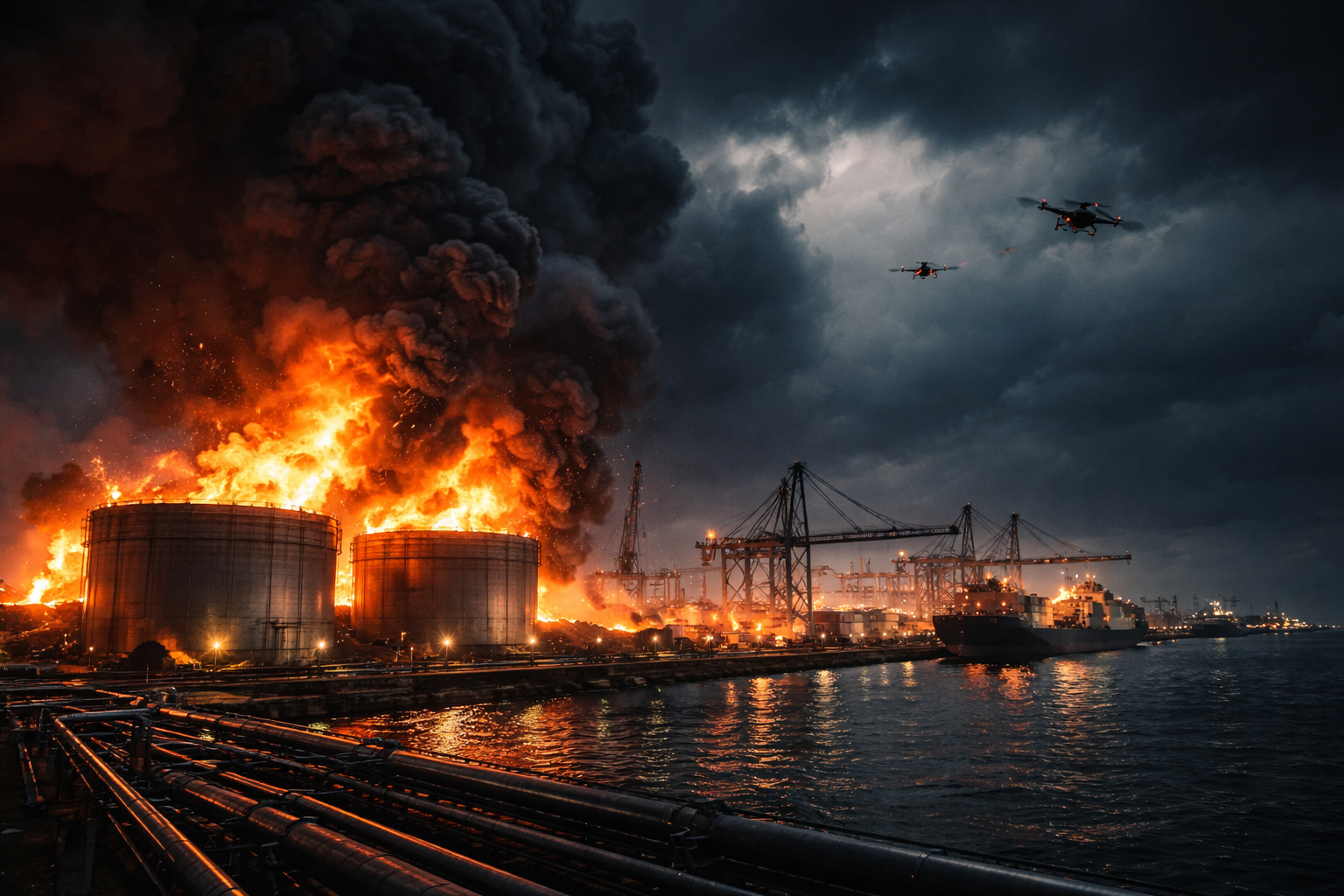
Oil storage facilities at the Port of Salalah in Oman were struck by drones on March 11, 2026, triggering fires in fuel tanks and forcing authorities to respond to a major blaze at one of the region’s key logistics hubs.
The strike comes as the expanding confrontation involving Iran, the United States, and Israel increasingly targets energy infrastructure across the Gulf, turning ports, pipelines, and storage depots into strategic pressure points in the global oil system.
Drones reportedly struck fuel storage tanks within the port complex, but no merchant vessels sustained damage, and authorities have yet to confirm any casualties.
What makes this attack notable is not simply the fire or the damage. It is where the strike occurred: outside the Persian Gulf’s most obvious battle zone.
The story turns on whether the war is shifting from controlling shipping lanes to systematically disabling the infrastructure that keeps oil moving at all.
Key Points
Drone strikes hit oil storage tanks at Oman’s Port of Salalah, causing fires and suspending some port operations.
The attack is part of a widening campaign targeting energy infrastructure across the Gulf region amid the Iran-US-Israel conflict.
Reports indicate that the strike did not damage any merchant ships in the port.
Salalah is a major container and logistics hub on the Arabian Sea shipping routes, making it a significant economic target.
The strike signals that ports outside the Strait of Hormuz itself are now vulnerable, widening the conflict’s geographic footprint.
Energy markets are already volatile due to disruptions affecting up to 20% of global oil trade moving through the Hormuz corridor.
How the Salalah Strike Unfolded
The attack occurred when multiple drones targeted fuel storage infrastructure inside the port complex.
Security sources reported intercepting several drones, but others managed to reach the storage tanks and ignite fires.
Salalah lies on Oman’s southern coast, far from the narrow choke point of the Strait of Hormuz. The port serves as a major container transshipment hub and energy logistics center, handling both regional trade and oil-related cargo moving through the Arabian Sea.
A video circulating shortly after the strike showed large flames and thick smoke rising from the storage area while emergency services responded to contain the fire.
Authorities have not yet confirmed the scale of damage or how long port operations may be disrupted.
What is clear is that the attack expands the geographic scope of the ongoing Gulf infrastructure campaign.
Why Gulf Energy Infrastructure Is Becoming the Battlefield
Energy infrastructure has long been the region’s most vulnerable strategic target.
Unlike warships or military bases, oil storage tanks, pipelines, and export terminals are large, stationary, and difficult to defend fully against drones or missiles.
In the current conflict, attacks have increasingly focused on:
oil storage facilities
export terminals
pipelines
LNG plants
commercial tankers
This approach exploits a fundamental weakness in the global energy system: the concentration of critical infrastructure in a small number of locations.
Roughly one-fifth of the world’s seaborne oil trade normally passes through the Strait of Hormuz, making the surrounding region one of the most strategically sensitive energy corridors on the planet.
Even limited attacks can ripple through global markets.
Energy disruptions linked to the conflict have already pushed oil prices sharply higher and forced some producers to cut output due to storage bottlenecks.
The Strategic Importance of Salalah
At first glance, Salalah may seem like an unusual target.
The port sits outside the Persian Gulf, on the Arabian Sea, and is typically viewed as a safer alternative route for shipping, avoiding the Hormuz chokepoint.
That is precisely why it matters.
Salalah functions as
a major transshipment hub linking Asia, the Middle East, and Africa
a logistics point for energy storage and distribution
a fallback port if traffic through Hormuz is disrupted
Striking Salalah sends a clear signal: no Gulf energy node is automatically safe simply because it sits outside the narrow strait.
In strategic terms, that widens the battlespace dramatically.
What Most Coverage Misses
The immediate headlines focus on the fire and the drones.
But the deeper significance lies in how the geography of the conflict is expanding.
For decades, analysts assumed that any oil disruption crisis in the Gulf would revolve around the Strait of Hormuz itself. Naval blockades, tanker seizures, and mine warfare were the expected scenarios.
The Salalah strike suggests a different strategy.
Instead of trying to physically block the strait, attackers can disable the infrastructure that supports the energy system around it: storage depots, export terminals, and logistics ports.
This approach is far cheaper militarily and far harder to defend against.
A handful of relatively inexpensive drones can threaten assets worth billions and disrupt flows affecting the entire global energy market.
In other words, the real vulnerability is not just the shipping lane.
It is the network of ports and storage facilities that makes the shipping lane usable.
The Economic Shockwaves Already Building
Energy markets are highly sensitive to any threat to Gulf infrastructure.
The region produces roughly a third of the world’s oil, and disruptions in export logistics can tighten supply quickly.
Recent developments in the wider crisis have already triggered:
spikes in oil prices
reduced tanker traffic
shipping insurance surges
rerouting of vessels around longer maritime paths
When energy storage or export capacity is damaged, producers face another problem: oil that cannot leave the region begins to pile up in storage tanks.
Analysts have warned that some Gulf producers have only days of spare storage capacity during the current disruption.
That creates a paradox.
Even as prices rise due to supply fears, some producers may be forced to cut output simply because they cannot export their oil.
What Comes Next in the Gulf Energy War
The strike on Salalah raises a critical question about the next phase of the conflict.
Three paths now appear possible.
The first is continued infrastructure strikes across the region. Energy depots, pipelines, and terminals remain soft targets.
The second is direct attempts to close or control shipping lanes, including the Strait of Hormuz itself.
The third is escalation toward state-on-state military confrontation, which would likely bring Western naval forces more directly into the conflict.
Which path emerges will depend on several signals:
whether additional ports or storage sites are targeted
whether tanker traffic through Hormuz declines further
whether Gulf states expand air defense deployments around energy facilities
The attack on Salalah may ultimately prove to be a warning shot.
If the pattern continues, the conflict may shift from a naval crisis into something broader and more destabilizing: a systematic campaign against the infrastructure that powers the global oil economy.
