

Elon Musk Documentary Erupts at Venice as Ashley St. Clair Reveals $40m NDA Claim
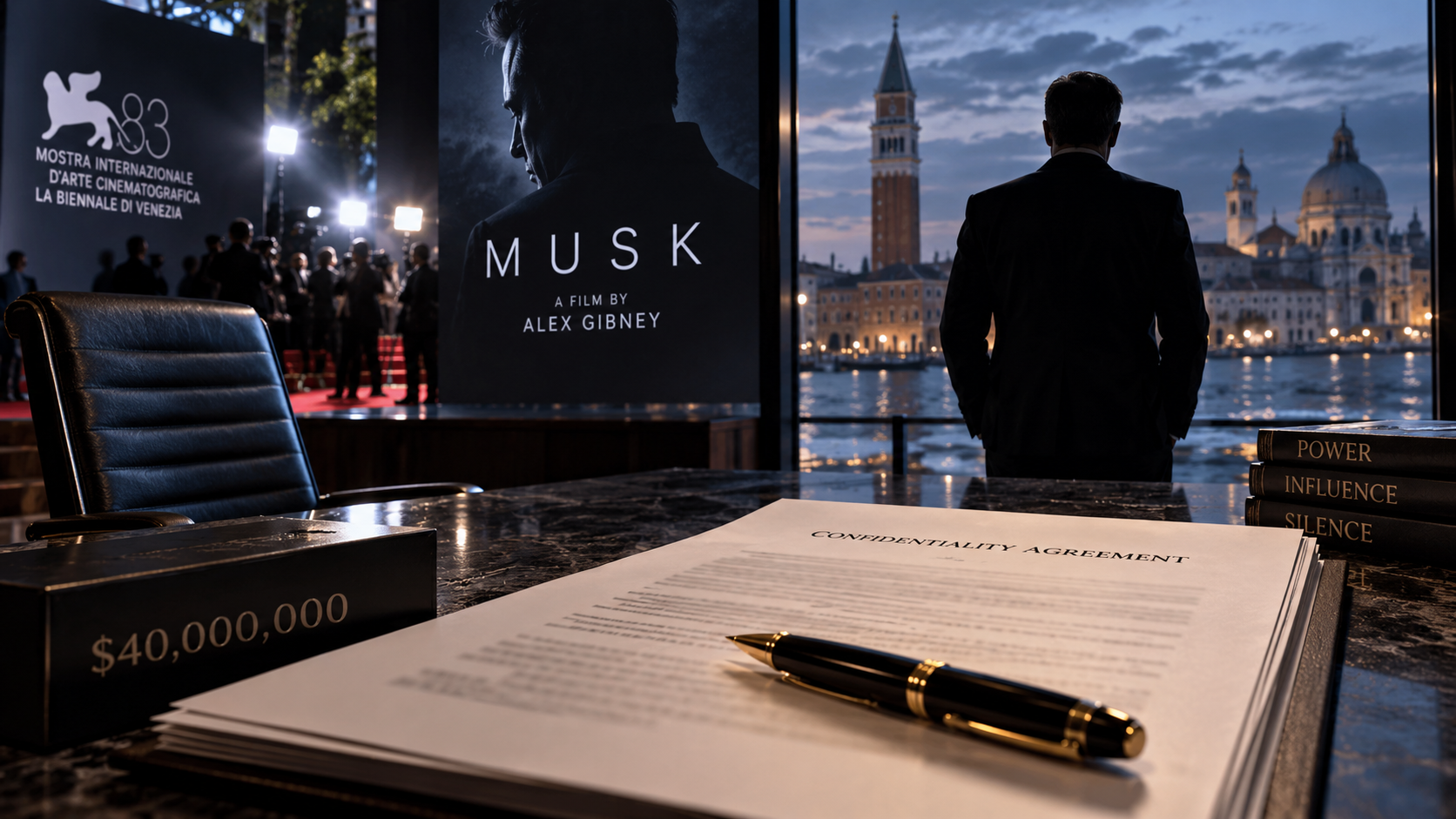
New Elon Musk Documentary Opens With a Problem Money Couldn’t Silence
The $40 Million Silence
A sweeping new documentary about Elon Musk has arrived at the Venice Film Festival with one of the billionaire’s most personal disputes suddenly back in the spotlight. Ashley St. Clair, who appears in Alex Gibney’s Musk, says she rejected a proposed non-disclosure agreement worth roughly $40 million rather than accept restrictions on what she could say about Musk and people around him.
The timing gives the allegation new force. What began as a dispute surrounding St. Clair’s relationship with Musk and financial support for their child has now been folded into a 225-minute examination of Musk’s extraordinary concentration of wealth, technological influence and political reach. Musk declined to participate in the documentary and has previously dismissed the project as a “hit piece.”
Ashley St. Clair Says She Walked Away From About $40 Million
St. Clair has previously described an extraordinary proposal that she says was presented after the birth of her son. According to her account, the arrangement began with a proposed $15 million payment for a home and capital before developing into a broader agreement involving the lump sum and payments of around $100,000 every month for approximately 21 years.
Taken together, those payments would amount to a little over $40 million. But the crucial part of St. Clair’s allegation is not simply the amount: she says accepting the money would have required her to agree to extensive confidentiality and non-disparagement restrictions relating to Musk and people associated with him.
St. Clair says she refused. Speaking again around the Venice premiere, she framed the decision as a question of what her ability to speak was worth, saying an offer of that magnitude forced her to consider why someone would place such a high financial value on silence.
The allegation should still be treated as exactly that: St. Clair’s account of a proposed agreement. The existence and complete terms of the alleged $40 million package have not been independently established through a publicly available signed agreement, and Musk has not publicly confirmed St. Clair’s description of the NDA.
The Money Dispute Has Been Public for More Than a Year
The wider financial dispute between Musk and St. Clair was already public long before the documentary reached Venice. In March 2025, Musk said he had given St. Clair $2.5 million and was sending her $500,000 a year while saying at the time that he did not know “for sure” whether the child was his.
St. Clair challenged his version of events, arguing that the payments were support for their child rather than money simply being given to her. Their disagreement therefore involves competing claims about support, control and the circumstances surrounding their relationship, rather than a single uncontested version of events.
That distinction matters because the documentary does not arrive in a vacuum. St. Clair has increasingly spoken publicly about Musk after saying she rejected the proposed confidentiality arrangement, turning something that might otherwise have remained a private dispute into part of the broader debate surrounding one of the world’s most influential businessmen.
And that is precisely where Gibney’s film places it.
‘Musk’ Is Really About Power
The Venice Film Festival describes Musk as an examination of the man behind a carefully constructed public legend. Gibney goes considerably further in his own director’s statement, arguing that the familiar image of Musk as an almost superhuman inventor and entrepreneur obscures a more troubling story about power and the way that power is exercised.
It is a formidable subject. Musk’s influence stretches across electric vehicles, rockets, satellite communications, artificial intelligence, social media and politics. Tesla, SpaceX, Starlink, X and his other ventures have placed him at points where private corporate power increasingly overlaps with infrastructure that governments, militaries, businesses and ordinary citizens depend upon.
Gibney’s central argument is therefore larger than whether viewers like Musk. The documentary asks what happens when exceptional financial resources, privately controlled technology and enormous cultural reach become concentrated around a single individual.
St. Clair’s NDA allegation fits neatly into that theme because it reduces an abstract question about billionaire power to something brutally simple: how much money can one person offer another in exchange for contractual silence?
Musk Refused to Participate
Musk was offered the opportunity to take part in the documentary but declined. Before its release, he publicly criticised the project as a “hit piece,” meaning one of the most important voices missing from Gibney’s examination is Musk himself.
That absence matters. Musk is openly critical rather than a neutral corporate biography, and Gibney makes no attempt to disguise his thesis. The filmmaker says his investigation changed the way he viewed Musk and describes the film as a story about power and its abuse.
Viewers will therefore have to distinguish between documented events, testimony from people who know or encountered Musk, interpretation by the filmmakers and allegations that remain disputed or unproven.
The structure itself is unusual. The documentary runs for 225 minutes with a ten-minute interval, making it closer in length to an epic feature than a conventional documentary profile. Its listed participants include St. Clair, Musk’s former wife Justine Musk, writer Kara Swisher, Tesla co-founder Martin Eberhard, Zoë Schiffer and artificial-intelligence pioneer Geoffrey Hinton.
An AI Elon Musk Adds Another Layer
One of the film’s strangest decisions is its use of an artificial-intelligence representation of Musk. The device is constructed around Musk’s own public statements and plays with his interest in simulations and AI while allowing the documentary to create a version of the central figure who declined to sit for an interview.
It is a deliberately provocative technique because Musk himself sits close to the centre of the global AI race. The documentary is consequently examining a technology billionaire partly through the technologies whose rapid development he has helped accelerate.
That creates another tension running through the project. Musk has repeatedly warned publicly about powerful artificial intelligence while simultaneously building businesses deeply involved in developing it. Gibney uses those contradictions as part of a wider attempt to separate the mythology surrounding Musk from the decisions, behaviour and enormous institutional reach beneath it.
Why the $40 Million Claim Matters
There is an obvious temptation to treat St. Clair’s story primarily as celebrity drama. A billionaire, a former partner, a child, extraordinary sums of money and allegations of attempted silence make an irresistible combination.
But the more consequential issue is the imbalance the story illustrates. An ordinary confidentiality agreement is one thing. An alleged arrangement potentially worth more than most people could earn across several lifetimes poses a different question: when wealth reaches Musk’s scale, does money stop functioning merely as compensation and begin functioning as a form of extraordinary leverage?
St. Clair says she decided the answer mattered enough to walk away.
Her decision also gives her presence in Musk unusual significance. Had she accepted the arrangement exactly as she describes it, the testimony now appearing in a major documentary about Musk might have been contractually impossible or considerably restricted. Instead, she is sitting alongside Gibney at one of the world’s largest film festivals explaining why she chose to speak.
What Happens Next
Musk screened for the press and industry in Venice before its festival presentation and is scheduled for a limited theatrical release in the United States on October 16, followed by a wider release on October 23.
The film will almost certainly provoke arguments over whether Gibney has produced a necessary examination of concentrated power or the hostile portrait Musk anticipated when he labelled it a hit piece. Its extraordinary running time, confrontational thesis and use of testimony from people who have had personal or professional relationships with Musk ensure it will not arrive quietly.
St. Clair’s allegation may prove one of its most memorable elements because it turns the film’s vast subject — power — into a number anyone can understand: roughly $40 million. What remains unproven is whether the proposed agreement existed precisely as she describes it and what Musk’s reasoning would have been; what is now undeniable is that St. Clair rejected whatever arrangement she says was put before her and chose to tell her story in public instead.
