Epstein Files Meltdown: DOJ Removes Memo After Naming High-Profile Figures
DOJ Pulled Epstein Memo: What the File Chaos Means Now
DOJ Deletes Epstein Memo Naming Powerful Figures After Botched File Release
The U.S. Department of Justice is in damage-control mode after a major Epstein-files release produced two outcomes at once: new, disturbing detail—and a fresh credibility crisis over how the government is handling transparency, victim privacy, and politically radioactive material.
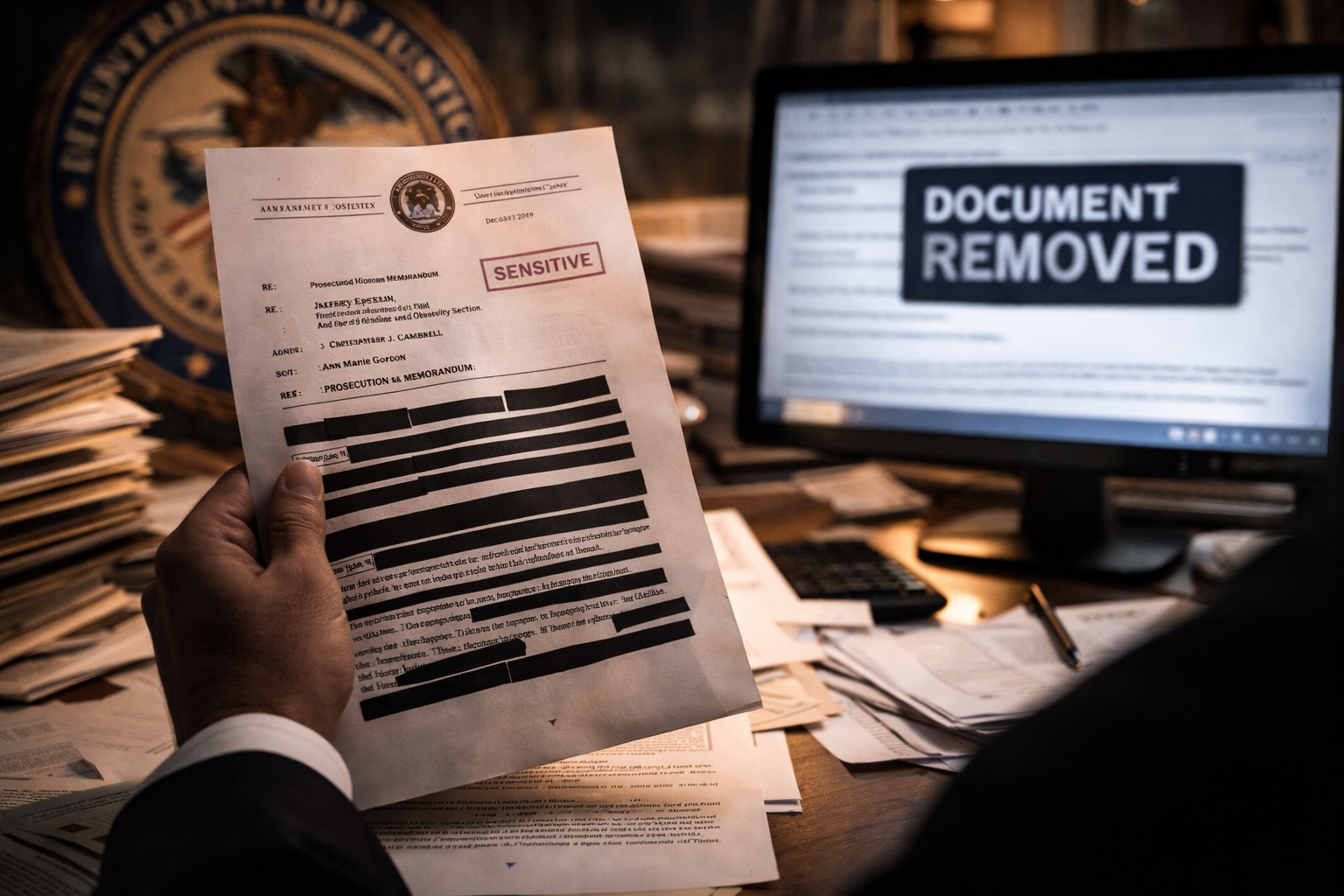
One flashpoint is an 86-page prosecution memo from December 2019 that appeared in the newly released cache and summarized victim and witness interviews as prosecutors assessed whether any of Epstein’s associates or employees could be charged. The memo’s legal analysis is largely redacted, but portions describing allegations and investigative steps are not. The DOJ has since pulled thousands of documents and media files for additional review and redaction, citing “technical or human error,” after victims’ advocates reported that identifying information was exposed in the release.
People demand names and accountability, but law and ethics mandate the protection of victims—and standards of evidence-quality remain unyielding in the face of public anger. The part that’s easy to miss is how badly a chaotic release can reduce the odds of future accountability, even when it’s meant to increase it.
The story turns on whether the DOJ can restore trust while keeping victim protections and evidentiary standards intact.
Key Points
The DOJ released millions of Epstein-related records under the Epstein Files Transparency Act, then temporarily removed thousands of items after redaction failures exposed sensitive victim information.
An 86-page 2019 prosecution memo (prepared after Epstein’s death) outlines how prosecutors evaluated potential criminal liability beyond Epstein and Ghislaine Maxwell; the memo describes interviews and includes some unredacted names, while much legal analysis is blacked out.
DOJ leaders have publicly argued the newly released materials do not establish grounds for new charges absent fresh, credible evidence, even though the files include graphic and disturbing content.
Victims’ representatives warned that disclosure mistakes can create real-world risk, including harassment and threats, and asked courts to force stronger protective steps.
In response to the blowback, DOJ has moved toward restricted access for lawmakers to view unredacted materials on DOJ systems, limiting copying while allowing oversight.
The political temperature remains high, with critics arguing the release is either too redacted to be meaningful or too sloppy to be safe, feeding suspicion from multiple directions at once.
Background
Jeffrey Epstein died in federal custody in August 2019 while facing sex-trafficking charges. The only person besides Epstein to be federally charged and convicted in connection with the trafficking scheme remains Ghislaine Maxwell, convicted in 2021 and sentenced to prison.
The Epstein Files Transparency Act compelled the DOJ to release an extensive volume of investigative material. That kind of release is inherently messy: the files include duplicates, mixed formats, and materials spanning decades—some containing information that cannot legally be disclosed (such as child sexual abuse material), and much containing sensitive victim-identifying details that must be protected.
The DOJ’s latest release delivered a flood of documents, images, and videos—then quickly ran into a second crisis: redactions that didn’t fully work, exposing names, contact details, and other identifying information. The department has acknowledged mistakes and pulled thousands of files to reprocess them.
Analysis
The Memo Problem: “Named” Is Not the Same as “Chargeable”
The 86-page prosecution memo at the center of the current controversy is not a charge sheet. It is an internal tool: prosecutors lay out what witnesses said, what investigators found, where corroboration exists, and where it does not—then assess whether evidence meets charging standards.
That distinction matters because public debate often treats the release as a scoreboard: if a name appears, people assume guilt; if charges don’t follow, people assume a cover-up. But federal prosecutors are constrained by proof beyond a reasonable doubt, by statutes of limitation, by witness credibility assessments, and by whether allegations can be corroborated with independent evidence.
In the memo’s case, prosecutors ultimately charged only Maxwell beyond Epstein. That outcome may reflect investigative limits, legal limits, or both—but it does not automatically resolve the question the public is asking: who enabled what, and why did the system fail for so long?
Scenario signposts to watch
If DOJ (or Congress) publishes a clear explanation of what categories of evidence were deemed insufficient—without exposing victims—public pressure may shift from “names” to “standards.”
If additional victims or corroborating records emerge in a structured way (not via chaotic dumps), prosecutors could reopen lines of inquiry—though DOJ leadership has signaled skepticism.
The Privacy Failure: Why This Became a Security Issue, Not Just a PR Mess
Redaction mistakes aren’t an abstract compliance problem. They can create immediate risk for victims: harassment, doxxing, threats, and financial harm. When that happens, the government’s “transparency” posture starts to look like negligence—and courts, Congress, and oversight bodies become more willing to clamp down.
The DOJ’s removal of thousands of items for re-redaction shows the department recognizes the liability and moral exposure here. But it also means the public now has a new reason to suspect manipulation: files disappear, people assume they were “too revealing,” and the process loses legitimacy.
Scenario signposts to watch
Evidence of consistent, repeatable redaction standards (the same details protected across duplicates) would signal the process is stabilizing.
More victims coming forward with documented harm would intensify calls for judicial or legislative constraints on future releases.
The Oversight Pivot: Congress Wants Unredacted Access Without Another Leak
One pragmatic compromise now taking shape is controlled oversight: lawmakers can review unredacted materials on DOJ systems, under restrictions that limit copying and distribution.
This is not full public transparency—but it’s a recognition of a hard truth: if the public-facing process cannot protect victims, the only way to keep oversight alive is to shift “maximum transparency” into bounded transparency: access for elected officials with rules, logs, and guardrails.
Scenario signposts to watch
It remains to be seen whether bipartisan lawmakers view this as a genuine victory in oversight, or if they view it as a strategy to delay action.
The question is whether the Department of Justice establishes a structured index and metadata layer to ensure meaningful oversight, rather than merely a pile of documents.
The Trust Spiral: “File Chaos” Creates Conspiracy Fuel on All Sides
When the government releases millions of files without clear organization, context, or stable redaction, people fill gaps with narratives. This is true for partisans, activists, and even neutral observers who can't tell what's new, what's duplicate, what's background, and what's verified.
Such confusion matters because the Epstein case sits at the intersection of elite networks, institutional failure, and sexual violence—exactly the kind of story where trust is fragile and suspicion is self-reinforcing.
Scenario signposts to watch
The next meaningful “delta” is not another batch; it’s a coherent map: timelines, categories, charging decisions, and what’s legally unreleasable.
If DOJ continues pulling and reposting materials, the trust spiral deepens.
What Most Coverage Misses
The hinge is this: a chaotic transparency rollout can make accountability harder, not easier.
The mechanism is incentive-driven. Once the DOJ demonstrates it cannot reliably protect victims in public releases, the institution becomes incentivized to tighten access, slow releases, and centralize control—because the legal and human costs of another mistake are enormous. At the same time, the public interprets tighter control as proof of concealment, increasing political pressure, which further pushes agencies into defensive process choices.
What would confirm this in the next days and weeks is straightforward:
More restrictions replacing public access (limited terminals, tighter age gates, narrower search tools, delayed re-posting).
Formal audits or inspector general scrutiny focusing less on “who’s named” and more on whether the DOJ complied with disclosure obligations while preventing harm.
What Changes Now
In the short term (the next 24–72 hours and the coming weeks), the most affected groups are:
Victims and their families, facing direct safety and privacy risks if identifying details leak again, are the most affected groups.
The story now revolves around the credibility of DOJ and FBI leadership, whose decisions will determine whether the public perceives this as incompetence, bad faith, or both.
Legislators and oversight bodies will determine the acceptability of controlled access or whether they advocate for a completely new model.
In the longer term (months and beyond), the stakes are institutional: a transparency law that produces real harm can trigger backlash strong enough to reshape how future sensitive disclosures work—because the government will argue, credibly, that it must choose victim protection over maximal public release.
The main consequence is that future disclosures are likely to become slower and more restricted because the DOJ now has to prioritize victim safety and legal exposure, not just volume.
Real-World Impact
A victim advocate opens the latest dump to check whether a client’s name is protected—and finds a detail that can identify her. Phones start buzzing. Safety planning replaces healing.
A newsroom builds an investigation around a set of documents, only for key items to be pulled for re-redaction, forcing editors to decide whether they can publish anything without risking harm.
A member of Congress asks staff to review materials for oversight, but staff cannot access unredacted records—so the lawmaker has to choose between symbolic outrage and real, constrained review.
A compliance officer at a major institution watches the chaos and prepares for reputational spillover: even unproven allegations can trigger shareholder questions, board inquiries, and internal risk reviews.
The Transparency Trap Around the Epstein Files
The public’s demand is clear: identify enablers, map the network, and explain why the justice system never reached higher.
However, the state's constraint is equally clear: the public's suspicion cannot replace prosecution standards, nor can victims become collateral damage. The crucial question is whether the DOJ can establish a process that is both transparent and competent, as a lack of competence can turn transparency into a weapon against the very people the system is meant to safeguard.
Watch for three signposts: whether pulled materials are re-posted with consistent redactions, whether lawmakers treat controlled access as meaningful oversight, and whether an audit forces the DOJ to prove it complied with the law in full. This moment will be remembered less for how many pages were released and more for whether the system proved it can tell the truth without hurting the people it failed the first time.
