New Zealand’s Most Infamous Sentence Is Being Challenged—and the Fallout Could Be Huge
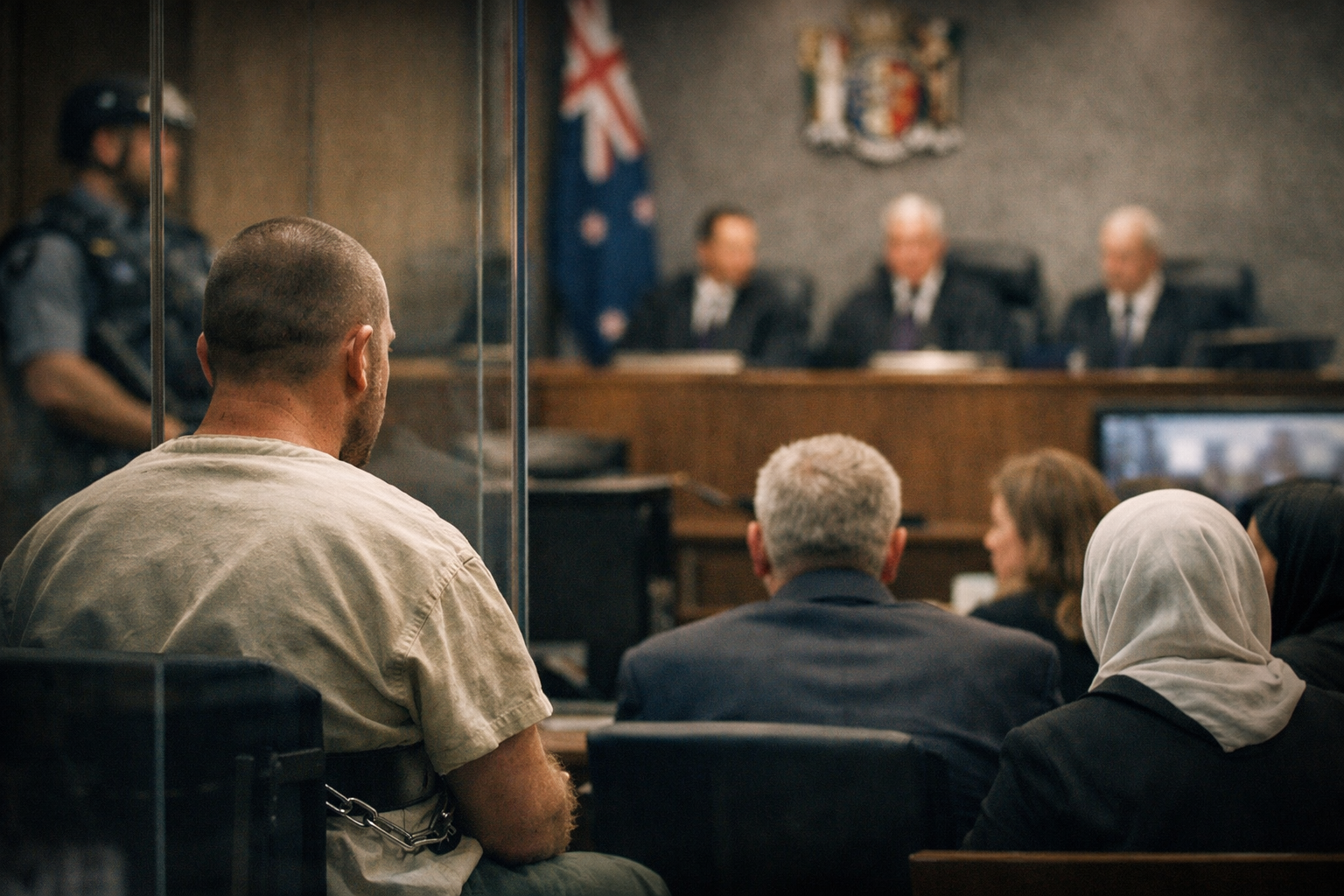
Christchurch Mosque Shooter Appeal: Life Sentence Under Review
Christchurch Mosque Shooter’s Appeal Tests New Zealand’s Hardest Sentence
The man convicted of the 2019 Christchurch mosque attacks is due to begin a Court of Appeal hearing in Wellington challenging the outcome that made history: New Zealand’s first sentence of life imprisonment without parole.
This is not just another procedural step. The appeal reopens a case the country tried to close with finality—legally, emotionally, and politically. It forces the courts to balance two things that rarely sit comfortably together: the system’s duty to correct injustice if it exists and the public interest in certainty after a mass-casualty terrorist crime.
One underappreciated hinge is that the court is being asked to examine the validity of the guilty pleas themselves, not merely the length or harshness of the punishment. That changes what “wins” could look like and how disruptive this process may become.
The story turns on whether the guilty pleas can be credibly challenged years later without re-traumatizing victims and destabilizing the legitimacy of the original outcome.
Key Points
A Court of Appeal hearing in Wellington is scheduled to begin Monday for the Christchurch mosque shooter’s attempt to challenge his convictions and sentence.
He was convicted on 51 murder counts, 40 attempted murder counts, and one terrorism count and received life without parole, the first such sentence in New Zealand.
A central issue is the push to vacate the guilty pleas, with the argument that they were not the product of a rational, capable decision at the time.
Setting aside the guilty pleas could shift the legal pathway towards a trial, rather than a mere re-sentencing, thereby increasing the risks for the families of the victims, witnesses, and public institutions.
The hearing is also a stress test for open justice (public scrutiny of courts) versus harm minimization in cases where notoriety is part of the offender’s intent.
What happens next matters beyond this case because it shapes how New Zealand’s courts handle late-stage challenges in extreme violence cases.
Background
On March 15, 2019, a white supremacist gunman attacked two mosques in Christchurch during Friday prayers, killing 51 people and injuring many others. The killings were broadcast online and accompanied by extremist propaganda designed to amplify attention.
After initially pleading not guilty, the offender later entered guilty pleas and was sentenced in August 2020 to life imprisonment without the possibility of parole—a punishment reserved for the most extreme cases and never previously imposed in New Zealand.
That sentence was intended to serve several purposes at once: to reflect the scale and intent of the crime, to protect the public permanently, and to affirm a moral boundary around terrorism and hate-driven violence.
The appeal now brings the case back into the court system in Wellington, with heightened sensitivity around court processes, public attention, and the psychological impact on those still living with the consequences.
Analysis
What the appeal is really about: final punishment versus valid process
Most people hear “appeal” and think it means a bid for a softer sentence. Here, the deeper question is procedural: whether the court should revisit the foundation of the outcome—how the convictions were entered and whether the legal process produced a verdict that can stand without doubt.
That distinction matters because legal systems are built to tolerate unpopular outcomes if the process is clean. If an appellate court believes a plea was not genuinely informed or voluntary, it has tools to intervene even when the crime is undeniable.
The court’s job is not to relitigate public outrage. It is to determine whether the law’s requirements were satisfied at the time the pleas were entered and whether any alleged defects are serious enough to justify reopening the case years later.
Why “vacating guilty pleas” is a high-bar claim
Courts typically treat guilty pleas as powerful evidence of finality. Setting them aside is possible, but the bar is intentionally high because the alternative is a system where outcomes never settle.
To succeed, an appellant generally needs to show something more than regret or strategy. The argument must go to capacity, understanding, coercion, or a failure so serious that the plea cannot be treated as a reliable admission.
In this case, the stated thrust—publicly described in recent coverage—is that conditions of confinement at the time of the plea undermined rational decision-making. If the court takes that argument seriously, it becomes a factual inquiry with real institutional implications: it requires scrutiny not only of courtroom moments but also of the surrounding environment that may have shaped the decision.
The victims’ dilemma: justice as closure versus justice as a living process
For survivors and families, the pain is not abstract. Reopening the legal process can feel like a betrayal of the case's completion promise.
Even if the appeal does not change the outcome, the act of revisiting the facts, the offender’s voice being heard again, and the media cycle around proceedings can create a second wave of harm. In mass violence cases, “process” is not neutral; it has psychological weight.
At the same time, the justice system cannot declare a case closed simply because reopening it is painful. The system’s legitimacy depends on its willingness to test itself—even in the ugliest cases—because the alternative is rule by sentiment.
So the real tension is structural: the law’s need for consistent standards versus society’s need for emotional finality after atrocity.
Open justice versus attention control in extremist violence
New Zealand’s courts operate under open justice principles—proceedings are generally public, and reporting is a safeguard against abuse.
But extremist violence introduces a complication: attention is sometimes part of the weapon. The Christchurch attack was engineered for amplification, and any renewed spotlight risks serving the very incentive structure terrorism seeks to create.
That does not mean secrecy is the answer. It means courts and institutions must become more precise about what transparency is for. Transparency is meant to validate process and accountability, not to provide an unlimited stage. Managing that boundary—without compromising fairness—is one of the hardest governance problems modern courts face.
What Most Coverage Misses
The hinge is this: if the court seriously entertains vacating the guilty pleas, the appeal becomes a question about the integrity of the original legal endpoint—not just the severity of punishment.
Mechanism: if pleas were set aside, the system would be pushed toward trial-like dynamics—disclosure issues, witness burdens, evidentiary reassembly, and a longer runway of public attention. That changes incentives for every stakeholder: prosecutors must prepare for a broader fight, institutions must plan for renewed public risk, and victims’ communities face extended exposure because the process shifts from “review” to “reconstruction.”
Signposts to watch: first, whether the court frames the hearing as primarily about the validity of the pleas rather than sentence severity; second, whether it indicates an appetite for further fact-finding (for example, by treating prison-condition claims as central rather than peripheral). Those cues will tell observers whether this is heading toward a narrow ruling or a much more disruptive pathway.
What Happens Next
In the short term—days to weeks—the court will determine what parts of the challenge it will hear and how it will characterize the core issue. That framing matters because it sets the scope: a narrow lane (sentence review) versus a wider one (plea validity and conviction integrity).
In the longer term—months to years—the outcome shapes how New Zealand handles late-stage challenges in extreme cases. If the legal system signals that guilty pleas can be credibly attacked years later under certain conditions, it may recalibrate expectations in other high-severity cases.
The main consequence is institutional: confidence in finality changes because courts must show that “final” means “final after a process that meets the standard,” not “final because society needs it to be.”
Key events to watch are the court’s interim signals during the hearing, followed by the timing and breadth of any written decision.
Real-World Impact
A community liaison worker in Christchurch prepares for a spike in calls, because anniversaries are already hard—and live legal coverage can make grief feel current again.
A newsroom editor in Wellington assigns extra legal staff to avoid misreporting procedural nuance, because a single mistaken headline can inflame tensions and spread misinformation.
A courtroom security planner treats the hearing as a high-risk event because notoriety cases draw unpredictable attention, and copycat dynamics are a known concern in extremist ecosystems.
A policymaker reviewing counter-extremism programs watches the appeal’s media cycle, because the way institutions communicate during hearings can either reduce or amplify the incentive structure around publicity.
The Hard Question New Zealand Has to Answer Again
The purpose of New Zealand's harshest sentence was to establish an unyielding boundary. This appeal forces the system to show whether that line is moral, legal, or both.
If the court narrows the case to a tight procedural review, the country may get a kind of contained reopening—painful, but finite. If the court treats the guilty pleas as genuinely in question, the process could become longer, messier, and more disruptive, even if the ultimate outcome stays the same.
The signposts are concrete: how the judges define the central issue, how much factual inquiry they invite, and whether they signal that the guilty pleas are being treated as presumptively stable or genuinely contestable.
Either way, this moment will be remembered as a test of whether a democracy can hold two truths at once: that a crime can be beyond comprehension and that the justice system must still be comprehensible.
