Explosions Heard Across Addis Ababa As Ethiopia’s War Enters A More Dangerous Phase
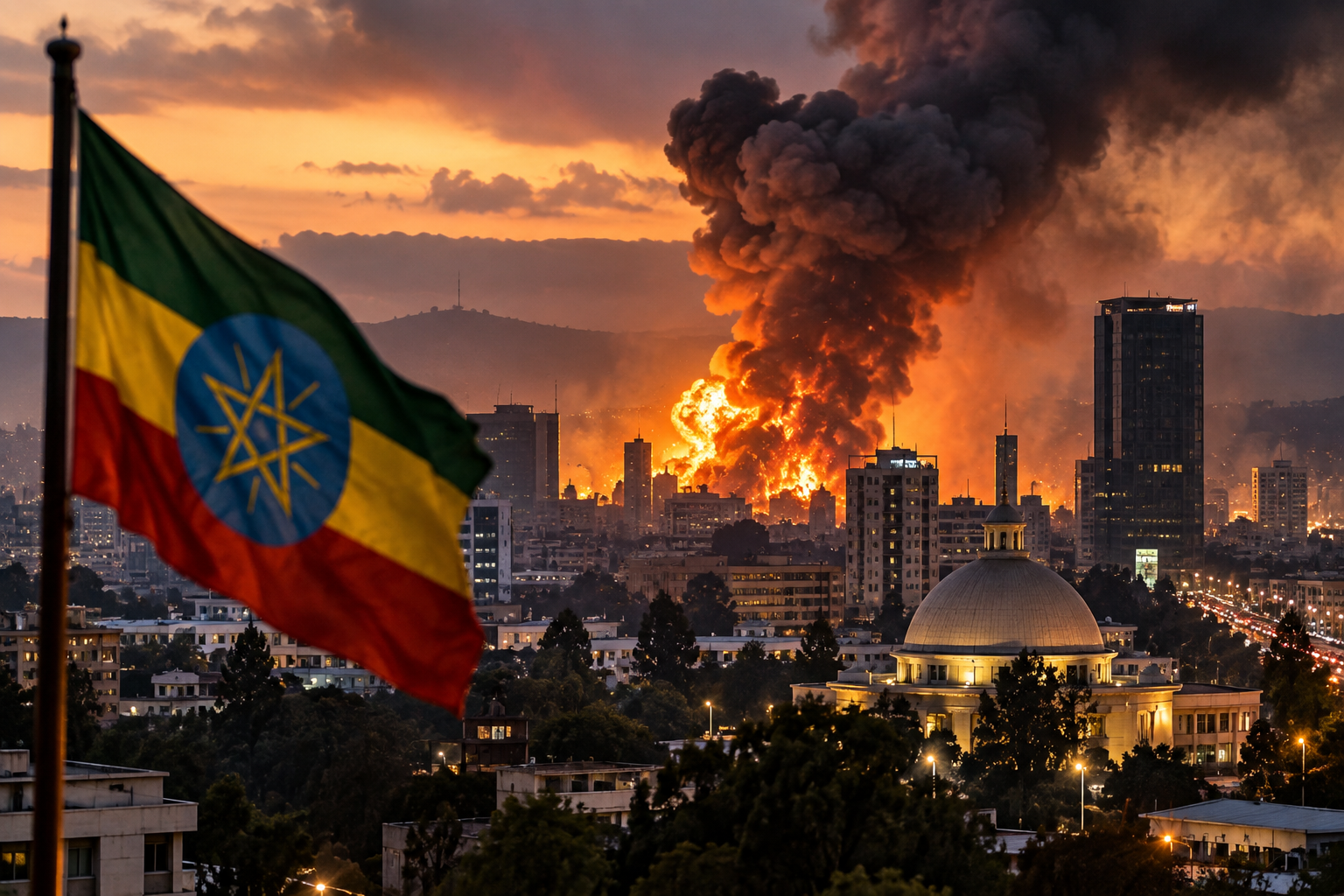
Three Blasts Heard In Ethiopian Capital As Drone Strike Claims Emerge
Explosions Over Addis Ababa
Three blasts were reported in different parts of Addis Ababa after authorities banned drone flights, while an opposition-linked source claimed attacks had targeted the capital.
Explosions were heard across Addis Ababa on Wednesday night and into the early hours of Thursday, bringing Ethiopia’s rapidly worsening security crisis into the heart of the country’s capital.
An Ethiopian intelligence official confirmed that three blasts had occurred in three separate locations. One was heard near the national defence headquarters. Residents in the same area later described another explosion near a factory.
What caused the blasts has not yet been established publicly.
An opposition-linked source claimed that several drone strikes had been carried out in Addis Ababa, including attacks directed at the military headquarters. That claim remains unverified. No clear damage was initially visible near the base, and Ethiopian authorities had not publicly confirmed that the explosions were caused by hostile drones.
That uncertainty matters. If the explosions were confirmed as attacks by forces fighting the federal government, it would mark a significant change in a conflict that has so far been concentrated hundreds of kilometres to the north.
Three Blasts, But No Confirmed Cause
The first reports emerged after residents and diplomatic personnel heard explosions in the capital.
An intelligence official later confirmed three separate blasts. A diplomatic source described hearing an explosion at around 7pm near the defence headquarters, followed by a siren. Residents in the area also reported hearing another blast after midnight.
The immediate question is whether Addis Ababa was attacked.
There are competing possibilities. The opposition-linked claim points to armed drones. Another possibility raised in the initial information is that at least some of the noise could have been connected to military activity or training.
There has been no authoritative public account establishing the cause.
That makes the distinction between confirmed fact and battlefield claim especially important. Explosions occurred. A blast was reported near the defence headquarters. An opposition-linked source says drone strikes were responsible. The final explanation remains unresolved.
The Drone Ban Came Hours Earlier
The timing adds another layer of concern.
On 30 September, Ethiopia’s National Intelligence and Security Service imposed an indefinite ban on the operation of drones across Addis Ababa and surrounding areas.
The measure took effect immediately. Authorities said drone permits would no longer be issued until further notice and warned that unauthorised aircraft could be detected, intercepted and forced to land.
The ban was introduced against the backdrop of growing evidence that drones are becoming more important in the renewed fighting.
Recent days have already brought reports of drone attacks against military facilities and airports outside the capital. The conflict-monitoring organisation ACLED said suspected suicide drones had targeted Ethiopian National Defence Force sites in Bishoftu, Kombolcha and near Bahir Dar before the Addis Ababa ban was announced.
If opposition forces have now developed the ability to reach the capital, the strategic consequences would be substantial. The federal government has held an important advantage in the air throughout earlier phases of Ethiopia’s conflicts. A credible long-range drone threat would complicate that advantage even if the physical damage from individual attacks remained limited.
Ethiopia’s Northern Conflict Is Escalating Again
The explosions cannot be separated from the fighting further north.
The latest clashes are the most serious escalation since the end of the 2020 to 2022 civil war between Ethiopia’s federal government and forces from Tigray.
That war formally ended with the Pretoria Agreement in November 2022. The agreement halted large-scale fighting after a conflict that caused enormous loss of life, displacement and destruction.
The political settlement never removed all of the underlying tensions.
Those tensions have now broken back into open warfare. Forces associated with the Tigray People’s Liberation Front have joined six other armed groups in an alliance opposing Prime Minister Abiy Ahmed’s government.
Fighting has spread across several fronts in Tigray, Amhara and Afar.
Federal forces and allied groups have been advancing towards Mekelle, the regional capital of Tigray. Opposition forces have also captured territory in neighbouring Afar, although battlefield claims from both sides remain difficult to verify independently.
The United Nations warned on 23 September that the situation was deteriorating rapidly, pointing to intensified fighting in and around Tigray and the spread of hostilities into neighbouring areas. It called on all parties to de-escalate, protect civilians and return to dialogue under the Pretoria framework.
Civilians Are Already Paying The Price
The renewed war is not an abstract contest over territory.
Tens of thousands of people have already fled fighting in Afar. People who were displaced during the previous war now face the prospect of being uprooted again.
Around the Hitsats displacement camp in north-western Tigray, residents have described hearing artillery and seeing drones overhead. The camp is home to thousands of people who have already spent years living with the consequences of the earlier conflict.
Mekelle has also experienced disruption to banking, communications and basic economic activity.
Fuel shortages and rising black-market prices are placing further pressure on households and businesses.
The longer the fighting continues, the greater the danger that Ethiopia returns to the humanitarian conditions that defined the earlier war: mass displacement, interrupted aid deliveries, damaged infrastructure and communities cut off from essential services.
Why Addis Ababa Changes The Picture
Addis Ababa is not simply another Ethiopian city.
It is the political centre of the federal state, the headquarters of major national institutions and one of Africa’s most important diplomatic capitals. The African Union is based there, along with numerous embassies and international organisations.
Until now, the principal battlefields have been far from the capital.
A confirmed hostile drone operation inside Addis Ababa would therefore carry political significance beyond the amount of physical damage caused.
It would demonstrate that the war’s geographic boundaries are less secure than previously assumed. It could also lead to tighter airspace controls, greater security around government facilities and increased restrictions on civilian drone activity.
The development also fits a wider pattern in which relatively inexpensive unmanned aircraft are changing the balance between governments and armed groups. Long-range drones can threaten infrastructure without requiring an attacking force to capture the territory between the front line and its target.
That possibility is especially important in Ethiopia, where distance has traditionally offered the capital a measure of protection from fighting in the north.
The Horn Of Africa Is Already Under Pressure
Ethiopia’s internal conflict is unfolding inside a region crowded with overlapping disputes.
Relations between Ethiopia and Eritrea have deteriorated sharply since the end of the previous Tigray war. Eritrea fought alongside the Ethiopian federal government during that conflict, but the relationship later soured.
Ethiopia’s efforts to secure reliable access to the Red Sea have added another layer of tension. The issue sits within a wider struggle over trade routes, ports and regional influence across the Horn of Africa.
That strategic geography matters because the region lies beside the Red Sea and the approaches to the Bab el-Mandeb Strait, one of the world’s most important shipping corridors. The strategic importance of Bab el-Mandeb means instability on the African side of the waterway can intersect with conflicts in Yemen and the wider Middle East.
Taylor Tailored has previously identified Ethiopia and the Horn of Africa as a major geopolitical flashpoint, driven by internal conflict, disputes over sea access and tensions involving neighbouring states.
Those risks are no longer theoretical.
Ethiopia’s government has accused Eritrea, Sudan and Egypt of supporting the opposition alliance. All three countries deny the accusation. Eritrea’s role is particularly sensitive because it was once a military partner of Addis Ababa against the Tigrayan forces it is now accused of assisting.
What Happens Next
The first question is whether Ethiopian authorities establish what caused the Addis Ababa explosions.
Confirmation of hostile drone strikes would be a major escalation. It would mean forces opposing the government had demonstrated the ability to threaten the capital itself.
The second question is whether the fighting around Tigray and Afar continues to expand.
Federal forces are pushing towards Mekelle while opposition groups are trying to retain and extend territorial gains. Further advances by either side could encourage escalation rather than negotiation.
The third is whether regional states become more directly involved.
For now, claims about external military support remain disputed. But Ethiopia sits beside Sudan, Eritrea, Somalia and Djibouti, while its disputes with Egypt over the Nile and with neighbours over Red Sea access add strategic pressure around an already dangerous war.
The explosions in Addis Ababa do not yet prove that Ethiopia’s northern conflict has reached the capital.
They do show how quickly the perception of safety can change.
Until the cause is established, the most important fact is also the simplest: three blasts were heard in different parts of Ethiopia’s capital at the same moment that the country’s northern war is intensifying and authorities are treating drones as a growing security threat.
Sources
Reuters — Explosions heard in Ethiopia's capital as war waged in north — Supports reports of explosions, the opposition-linked drone strike claim, the lack of independent verification and the wider northern battlefield picture.
Associated Press — Explosions in Addis Ababa follow Ethiopian government's drone ban — Supports confirmation of three blasts, the reported location near the defence headquarters, the uncertainty over their cause and civilian conditions in Tigray.
United Nations in Ethiopia — UN Secretary-General statement on Ethiopia — Supports the UN assessment of deteriorating security in northern Ethiopia and its call for de-escalation and renewed dialogue.
Next Reads
The Next Big Geopolitical Flashpoint: 2026–2030 Conflict Zones You’re Not Watching — Includes Ethiopia and the Horn of Africa among the major conflict risks to watch.
Houthis At Bab El-Mandeb: Saudi Arabia’s Oil-Route Risk — Explains why instability around the Horn of Africa and Red Sea matters to global shipping.
Houthis Accuse Saudi Arabia of Deadly Yemen Prison Strike as Conflict Escalates — Provides further context on the conflict risks surrounding the Bab el-Mandeb and the wider Red Sea region.
