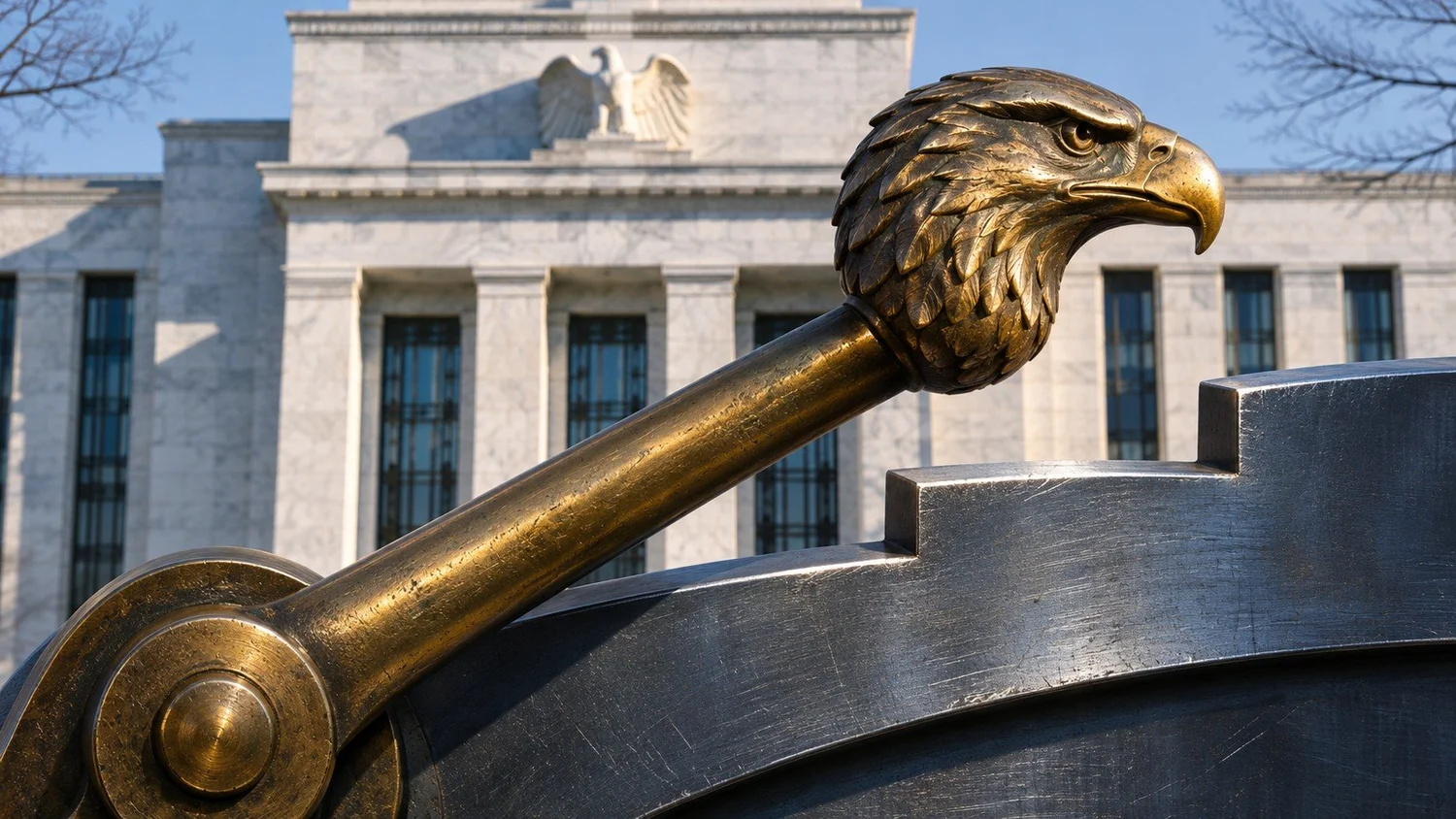
Why Is the Question at the Fed's December Meeting No Longer How Much to Cut?
For most of the past two decades, the question hanging over a December meeting of the US Federal Reserve was how much it would cut. This year the question has flipped. With America's central bank meeting on 8 and 9 December, markets and most forecasters now treat another interest rate rise as close to certain. The only real argument left is whether it will be a quarter of a percentage point or a half.
That is a striking position for an economy that, only last year, was expected to spend 2026 easing policy. It also matters well beyond Washington. US interest rates set the price of the dollar, pull on government borrowing costs around the world and feed into the swap rates that British lenders use to price fixed-rate mortgages. Here is what has changed, what the Fed is likely to do and what to watch before the decision.
Where US Interest Rates Stand Now
The Fed's benchmark federal funds rate sits in a range of 3.75% to 4%. It got there on 16 September, when the Federal Open Market Committee (FOMC) under chair Kevin Warsh raised rates by a quarter of a point in a unanimous 12–0 vote.
At its next meeting, on 28 October, the committee held rates steady. That decision was not unanimous: governor Lisa Cook and Cleveland Fed president Beth Hammack both dissented, voting for another quarter-point increase. Warsh used his press conference to stress his determination to bring inflation back to the Fed's 2% target, and analysts read the meeting as a hike postponed rather than abandoned.
The 9 December decision will be the last of the year and will come with a fresh set of economic projections from Fed officials, often called the "dot plot".
The Inflation Numbers Behind the Shift
The case for a December rise hardened on 10 November, when the October consumer prices index (CPI) came in hotter than expected.
- Headline CPI rose 0.4% in the month. That was slower than September's 0.6% but double the roughly 0.2% economists had pencilled in.
- Core CPI, which strips out food and energy, rose 0.3%, the same pace as September and again above forecasts.
- Shelter costs rose 0.3% and accounted for more than 30% of the overall increase, according to Morningstar's breakdown.
- Energy rose 0.7% after a 5.2% jump in September, while food rose 0.5%.
Because of data disruptions from the October 2025 US government shutdown, the Bureau of Labor Statistics did not publish an annual inflation rate for October. That makes the month-on-month figures, and the Fed's own preferred gauge, more important than usual.
The Fed targets the personal consumption expenditures (PCE) price index rather than CPI. Fed vice chair Philip Jefferson has cited headline PCE inflation of 3.6% in September, with core PCE at 3.1%. Oxford Economics' nowcast puts headline PCE at 3.8% for October, and PIMCO estimates core PCE rose about 0.36% in the month, lifting the annual core rate to around 3.3%. The official October PCE figures are due this week and are widely seen in markets as the last major data point before the meeting.
Why energy matters so much this time
The background is the Iran war, now about nine months old, and the disruption it has caused around the Strait of Hormuz. Fed governor Christopher Waller has said that even as tanker traffic through the strait picks up, shipping remains expensive: maritime insurance and ship-to-ship oil transfers add an estimated $20 to $30 a barrel to crude prices, according to his remarks reported by The National.
Economists' worry is not simply that energy is expensive. It is that high fuel and freight costs are now bleeding into food and the broader "core" basket. Oxford Economics says high energy prices are lifting food inflation and spilling into core prices, which is exactly the kind of second-round effect central banks fear most.
A Quarter Point or a Half?
Few forecasters now expect the Fed to stand still in December. Morningstar's senior US economist Preston Caldwell said the October data effectively guaranteed a rate rise. The open question is size.
The case for 50 basis points
Waller, a voting member of the committee, has said he would back a half-point move if inflation stayed firm. In his words, hiking by only a quarter point "would put our credibility at risk". Dallas Fed president Lorie Logan, also a voter this year, has said she supports at least two more increases and suggested the Fed may be able to move more quickly this winter than it did in the autumn.
The case for 25 basis points
Most forecasters still expect the smaller move. Shortly after the CPI release, CME Group data reported by The National put the odds at roughly 90% for a quarter-point rise and about 10% for a half-point. Oxford Economics expects 25 basis points and thinks markets are overpricing the chance of 50. PIMCO's baseline is a quarter-point rise in December followed by another in January, with some risk of a further move in March.
Is This 2022 All Over Again?
The comparison is tempting: in 2022 the Fed raised rates at the fastest pace in four decades as inflation surged. PIMCO's economists argue the parallel is weak, for three reasons.
- Wages: wage pressures have not re-accelerated the way they did in 2021–22.
- Source of inflation: the pressure is mostly energy, freight, tariff and chip costs being passed through to consumers, with no convincing evidence yet that it is embedding in wages, services or inflation expectations.
- Starting point: by PIMCO's estimate, the policy rate is about one percentage point below where a standard "Taylor rule" would put it, compared with a gap of roughly eight percentage points in early 2022.
In PIMCO's framing, this is a recalibration rather than the start of a long tightening cycle. The Fed, it argues, is tightening now precisely so that a temporary energy shock stays temporary. Fed officials' own September projections pointed the same way, with PCE inflation forecast to end 2026 around 3.7% before easing to 2.3% in 2027.
Analysis: that optimistic path depends heavily on oil. If shipping through Hormuz deteriorates again, energy costs could keep feeding into core prices and push the Fed into a longer series of rises. If oil continues to ease, December may prove to be close to the peak.
What It Means Outside America
For British readers, a higher US policy rate does not change Bank Rate directly. Its effects arrive indirectly:
- The dollar: higher US rates tend to support the dollar, which can push up the sterling price of oil and other dollar-priced commodities.
- Bond yields: US Treasury yields act as a global benchmark. After the October CPI release, the 10-year Treasury yield returned to about 5%, according to The National, and rising global yields can lift the gilt and swap rates behind UK fixed-rate mortgages.
- Markets: equities have been volatile. US shares surged on 23 November, with the S&P 500 recording its best single session since April as Nvidia shares soared on Jensen Huang's reinstatement, but higher rates remain a headwind for highly valued stocks.
None of this means UK borrowing costs will move in lockstep. The Bank of England sets policy for British conditions. But a Fed still raising rates makes it harder for global borrowing costs to fall quickly.
What to Watch Before 9 December
- October PCE inflation (this week): a core figure near or above PIMCO's 0.36% monthly estimate would strengthen the hawks' hand.
- Speeches from voting members: if more officials echo Waller's call for 50 basis points, pricing could shift quickly.
- Oil and shipping costs: any renewed disruption around Hormuz feeds straight into the inflation outlook.
- The new projections: the December dot plot will show how many further rises officials expect in 2027.
The Bottom Line
The Fed is not facing the runaway inflation of 2022, but it is facing an inflation problem that refuses to fade, driven by a war-related energy shock that is spreading into everyday prices. A December rise now looks all but settled. The more consequential decision may be what the committee signals about 2027, because that will tell borrowers on both sides of the Atlantic whether this is the last turn of the screw or the start of a longer squeeze.
Sources
- Morningstar: Hot October CPI seen tilting Fed to more rate hikes in 2027
- The National: Hot inflation report puts pressure on the Fed to raise rates in December
- PIMCO: Inflation is sticky, but this isn't 2022 all over again
- Oxford Economics: US PCE nowcast – broadening pressures lock in December rate hike
- Admiral Markets: Fed holds rates at 3.75% to 4% as Cook and Hammack vote for a hike
- Federal Reserve: Chair Warsh's press conference transcript, 16 September 2026
- Federal Reserve: December 2026 calendar
- investingLive: Fed's Jefferson says inflation is the key signal for rates
Next Reads
- Inflation and Interest Rates Explained: Why Bank Rate Moves and Why Mortgages Don't Track It Cleanly
- Strait of Hormuz Ship Strikes and the Price of the Next Barrel
- Nvidia's Rally on Jensen Huang's Return: What Moved the Share Price
- Why Can a Budget Leak Move Mortgage Rates Before the Chancellor Speaks?
