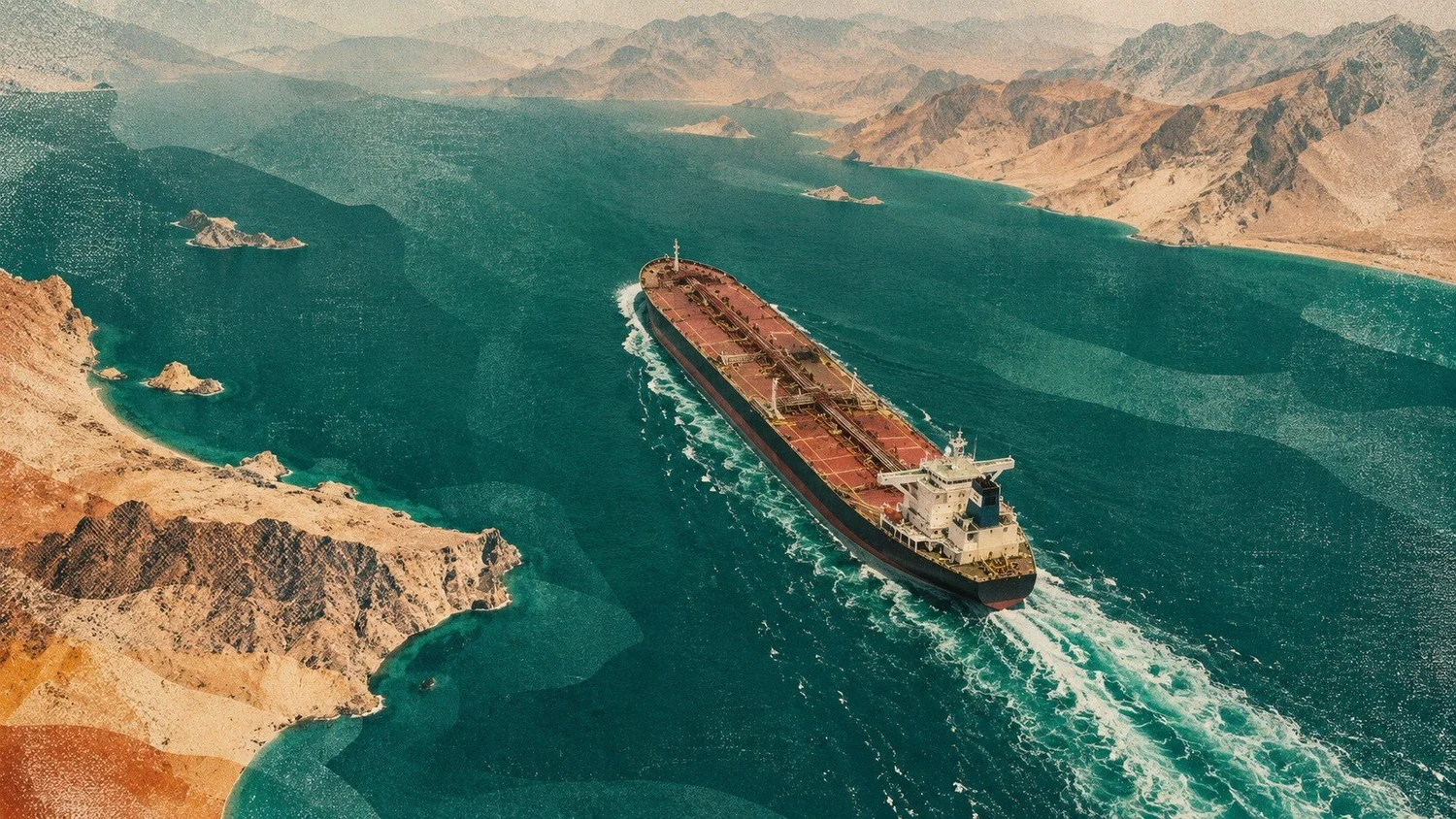
All Three Ships Continued Through Hormuz as Oil Climbed Back Above $90.
Three vessels were struck while sailing east through the Strait of Hormuz on Monday 23 November. All three continued their journeys and every crew member was accounted for, according to the UK Maritime Trade Operations centre. On Tuesday, Brent crude touched its lowest price since August before recovering to $90.42 a barrel at 2.23pm GMT.
Those two pieces of news can sit together. A shipowner has to decide whether the next voyage can go ahead. An oil buyer also has to ask how much crude is available elsewhere, how soon it can arrive and what stocks are already within reach. On Tuesday there were reasons to worry about the voyage and reasons to expect more barrels on the market.
What Happened to the Ships?
The British maritime centre described the objects that struck the vessels as unidentified projectiles. Its account establishes the direction of travel and the outcome for the three crews. It leaves open who was responsible and how much damage each vessel sustained. The fact that a ship can carry on under its own power answers an urgent question for those aboard. It cannot tell us what the next crew will encounter.
The time on the incident warning is 8.25pm UTC on Monday. The centre received the report after the event and circulated it on Tuesday. Its first assessment left the environmental impact open as well as the damage to the ships. Those qualifications matter if photographs or accounts from another recent incident are circulating alongside this one. The warning connects three vessels to a particular evening. It does not name them or identify their cargoes. Counting three vessels as three lost oil cargoes would go well beyond the information the crews supplied.
Eastbound travel takes vessels out of the Persian Gulf towards the Gulf of Oman. Much of the concern about the Strait of Hormuz comes from what lies on the Gulf side of that passage. Producers can have oil ready for sale, a buyer waiting and a terminal able to load it, yet still depend on a ship completing this one stretch of the journey.
How Much Oil Depends on the Strait?
The US Energy Information Administration estimates that 20.9 million barrels of oil a day passed through Hormuz in the first half of 2025. That was about a quarter of global oil trade carried by sea. Against a different measure, total worldwide consumption of petroleum liquids, it was roughly a fifth. Both figures describe the same flow. The quarter is the more useful comparison for someone trying to understand the exposure of shipping.
Those figures provide a baseline from before the latest incidents. They cannot be used as a count of barrels interrupted on Monday. In particular, multiplying the historical daily flow by the number of days in the week would assume a complete closure. The three journeys in the maritime report continued.
Some Gulf crude can bypass Hormuz through pipelines in Saudi Arabia and the United Arab Emirates. The US agency estimated their combined bypass capacity at about 4.7 million barrels a day. A pipeline can serve producers with access to its network and export terminal. A tanker already loaded elsewhere has no equivalent option simply because there is an open pipeline on a map. That is one reason an interruption can change the value of oil in one location more than in another.
Why Was Brent Near a Three-Month Low?
Away from Hormuz, a valve on Libya’s Sharara pipeline had reopened. The head of Libya’s National Oil Corporation said oil had begun moving into storage at Zawiya. That restores a step in the export chain. A barrel entering storage still has to be loaded and delivered, but buyers have a better prospect of obtaining it than when the line was shut.
There was also evidence of a wider cushion. Deutsche Bank estimated that the increase in observed global liquids inventories in October implied an excess of supply over demand of about 1.7 million barrels a day that month. That estimate describes oil accumulating across markets. It does not tell a refinery whether the right grade of crude is available at its own port on the date it needs it.
The distinction helps explain Tuesday’s movement. Brent futures had reached their weakest level since 27 August earlier in the session. By 2.23pm they were up $1.05 against the previous settlement. US benchmark West Texas Intermediate was up $1.01 at $81.18. These were afternoon readings. They show the direction had changed during the day, without establishing how much of the change came from any single report.
What Would Turn a Shipping Scare Into a Supply Shortage?
A producer can keep pumping for a time even if ships arrive late. Tanks at the export terminal fill, while buyers draw down stocks near their refineries. If traffic resumes, the cargoes can move and those stocks can be replenished. If delays persist, storage space at one end and available crude at the other become the constraints. Oil can be plentiful in aggregate and scarce where a particular buyer needs it.
That makes completed sailings, actual loading volumes and changes in stocks more informative than a declaration that the route is open or closed. Monday’s three crews made it through. Whether the vessels scheduled behind them can collect and deliver their cargoes on time is the question that matters for the next barrel sold.
Sources
- UK Maritime Trade Operations — Warning 219-26 — The incident time, crew report and outstanding damage assessment.
- Reuters — Oil rebounds from three-month lows on Hormuz threat | Reuters — Afternoon oil prices and evidence on alternative supplies.
- US Energy Information Administration — International - Analysis - U.S. Energy Information Administration (EIA) — Historical flows and estimated pipeline bypass capacity.
Next Reads
- Why The Strait Of Hormuz Matters To The World Economy — How alternative export routes work.
- Tanker Crew Unaccounted For After Second Attack Near Oman — An earlier shipping incident with a different outcome for the crew.
- Trump Says Hormuz Is Open. Iran Says It's Closed. The Shipping Data Tells A Stranger Story — How vessel movements can clarify conflicting claims.
