Flydubai Cockpit Violence Sends Israel-Bound Jet Plunging Before Saudi Emergency Landing
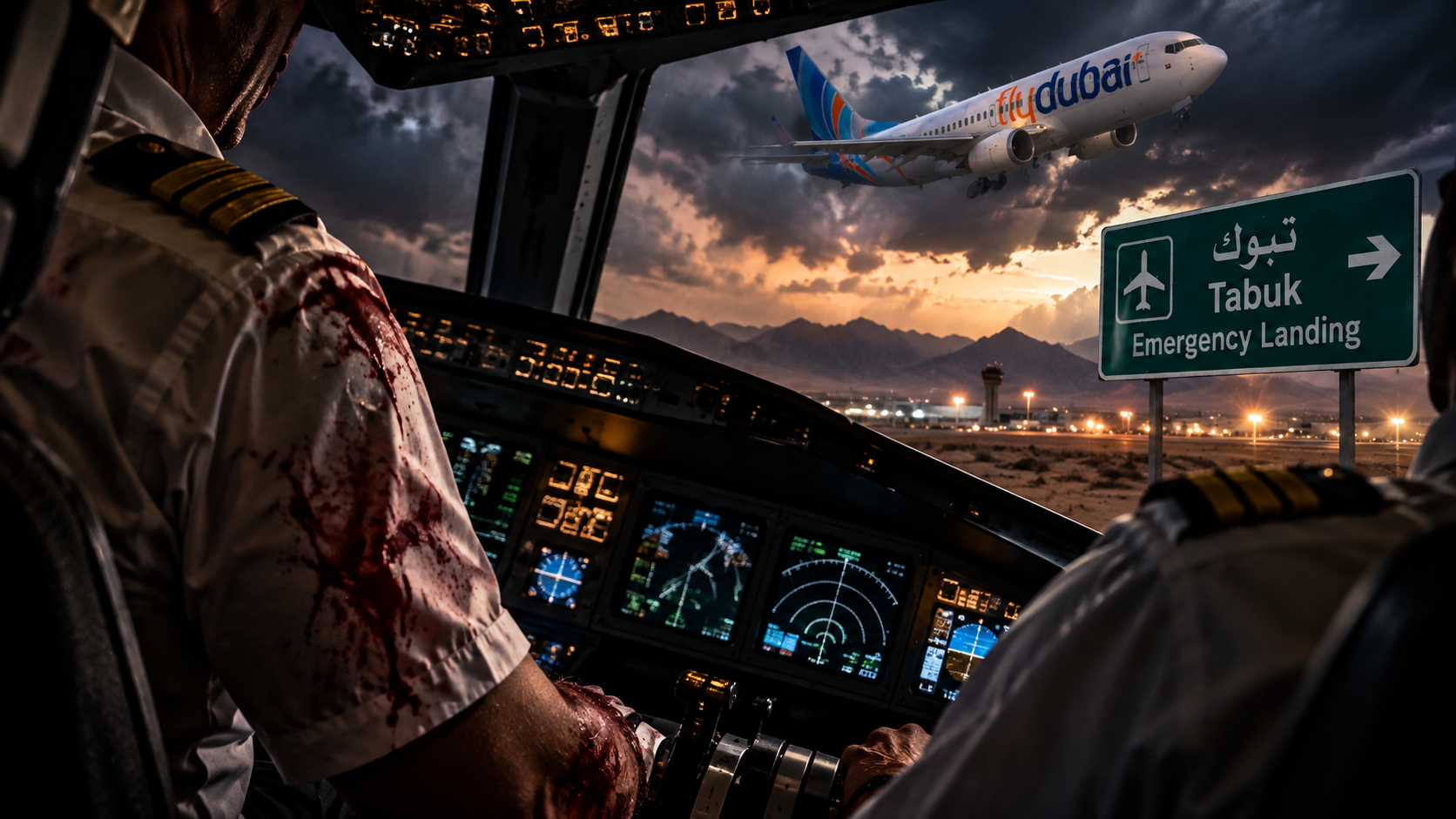
Flydubai Flight Lands Safely In Saudi Arabia After Alleged Cockpit Stabbing
Flydubai FZ1073 Emergency Landing In Saudi Arabia
A violent cockpit incident turned a routine Dubai-to-Tel Aviv flight into a regional security emergency.
Flydubai flight FZ1073 landed safely in Tabuk, Saudi Arabia, on 30 September after an incident involving the flight crew, a sharp loss of altitude and emergency transponder signals that initially raised fears of a hijacking. All passengers were reported safe and accounted for.
What happened inside the cockpit remains under investigation.
Flydubai has confirmed that the Boeing 737 experienced an incident while en route from Dubai International Airport to Ben Gurion International Airport and diverted to Tabuk. The airline has not publicly given a full account of the confrontation or identified a motive.
Saudi authorities said the captain and first officer were injured and taken to hospital. Israeli officials later said they were examining whether the episode may have been an attempted attack rather than a simple dispute between crew members.
That distinction matters. Early information moved quickly from reports of a fight between pilots to allegations that one pilot had used a knife. The more serious claims have not yet been fully established by a completed investigation.
The Flight Suddenly Lost Thousands Of Feet
The most striking part of the flight path came before the aircraft reached Saudi Arabia.
Public flight-tracking data showed FZ1073 descending with unusual speed from cruising altitude. One set of tracking data indicated a fall of almost 14,000 feet in less than 30 seconds, while other accounts placed the broader descent from roughly 33,000 feet to around 17,000 feet within about a minute.
The exact sequence remains important because it helps explain why the event immediately triggered a security response.
The aircraft transmitted the transponder code 7700, which signals a general emergency. It also transmitted 7500, the internationally recognised code for unlawful interference with an aircraft.
Those codes do not, by themselves, establish what was happening inside the cockpit. They tell air traffic controllers that the crew is facing a serious emergency and, in the case of 7500, that unlawful interference may be involved.
The jet later stabilised and continued towards Tabuk in north-western Saudi Arabia.
The airport there reported receiving a distress call before the aircraft landed safely.
What Is Known About The Cockpit Fight
Officials briefed on the incident said a physical confrontation took place between the pilots.
One Israeli official said one of the pilots was armed with a knife. Later assessments shared by Israeli officials went further, alleging that the co-pilot stabbed the captain before other crew members intervened.
That remains an allegation under investigation rather than a final finding.
Both pilots were injured. Saudi authorities said the captain and first officer were taken to hospital after the landing.
Passenger accounts described shouting near the front of the aircraft and a sudden change in the plane's movement. Some passengers reported seeing signs of blood after the confrontation.
The airline itself has used much narrower language. Flydubai said FZ1073 “experienced an incident while en route”, landed safely in Tabuk and that all passengers were safe and accounted for.
That gap between the airline's limited statement and the more detailed security claims is one reason the story is still developing.
Why Israel Scrambled Fighter Jets
The emergency signals carried particular significance because the aircraft was bound for Israel and was carrying a large number of Israeli passengers.
Israeli authorities initially treated the incident as a possible hijacking or other serious security threat. Fighter aircraft were scrambled while officials tried to establish what was happening aboard the jet.
Israel has not experienced a successful commercial-airliner hijacking in decades, but aviation security remains unusually sensitive because of the country's history of attacks on aircraft and airports.
The flight was also approaching Israeli airspace during a period of heightened regional security.
Israeli officials later said the immediate situation was under control, while the government began working on arrangements to bring passengers home.
The episode shows how quickly an onboard emergency can become an international security event when an aircraft is crossing several states and transmitting codes associated with unlawful interference.
Why The Saudi Landing Was Significant
Tabuk was not the flight's intended destination.
The city sits in north-western Saudi Arabia, relatively close to Jordan and the northern Red Sea. Its airport serves civilian traffic while the wider area also has strategic military importance.
Saudi Arabia does not have formal diplomatic relations with Israel, but its airspace has become increasingly important to flights moving between Israel, the Gulf and Asia.
The kingdom lifted longstanding restrictions on Israeli overflights in 2022. Since then, Saudi authorities have also dealt with emergency landings involving flights carrying Israeli passengers.
For FZ1073, the immediate priority was straightforward: get the aircraft safely on the ground.
The fact that the landing was completed without reported passenger fatalities is the most important confirmed outcome.
It also underlines how aviation incidents in the Gulf can intersect with the region's wider security environment. The risk surrounding Middle Eastern airspace has already forced airlines to make rapid operational decisions during periods of military tension.
The Terror-Attack Theory Is Still An Assessment
The strongest claims about motive came after the aircraft had landed.
Israeli officials said the government was examining whether the incident may have been an attempted terror attack. Their account alleged that the co-pilot attacked the captain and that cabin crew then helped regain control of the aircraft.
At the time of writing, that assessment had not become a public final finding from the airline, Saudi authorities or a completed aviation-security investigation.
There were also conflicting early accounts about the identities and nationalities of the two pilots and about the precise motive behind the confrontation.
Those contradictions are a warning against treating the first version of a fast-moving aviation emergency as settled fact.
The evidence currently supports several points with much greater confidence: there was a serious cockpit incident; both pilots were injured; the aircraft transmitted emergency signals; it descended rapidly; it diverted to Saudi Arabia; and the passengers were reported safe.
What investigators still have to establish is why the confrontation happened and whether it was an attempted attack, an individual act of violence or something else.
What Investigators Will Need To Establish
Aviation and security investigators will now be interested in both the human events inside the cockpit and the technical record of the flight.
The cockpit voice recorder should help establish what was said and what happened in the minutes before and during the confrontation. The flight data recorder can show control inputs, altitude, speed, aircraft attitude and the sequence of the rapid descent.
Investigators will also want to know who selected the 7500 and 7700 transponder codes, when each code was transmitted and whether the aircraft's sudden descent resulted from intentional control inputs, a struggle at the controls or another factor.
Crew interviews and passenger testimony will be important, but the recorded data will be central to reconstructing the sequence.
The event also raises questions about cockpit-access procedures, crew screening and how quickly cabin crew or qualified passengers could intervene if both pilots became incapacitated.
Those questions should not be answered from speculation. They depend on the evidence gathered from the aircraft and the people onboard.
A Safe Landing, But An Unresolved Story
Flydubai's immediate operational message is clear: the aircraft landed safely and the passengers survived the diversion.
The unanswered part is what turned the cockpit into the centre of the emergency.
If investigators confirm an intentional attack by a member of the flight crew, the case will become far more than an unusual workplace confrontation. It would raise difficult questions about insider threats, cockpit security and how airlines detect risks involving people who already have authorised access to the flight deck.
If the motive proves different, the same evidence will still have to explain a violent event serious enough to injure both pilots and trigger emergency codes associated with unlawful interference.
For now, the safest conclusion is the narrowest one.
FZ1073 suffered a serious cockpit incident on 30 September, descended sharply, transmitted emergency signals and diverted to Saudi Arabia. The aircraft landed safely in Tabuk. The passengers were accounted for. Both pilots were injured.
The investigation now has to explain the part that matters most: why it happened.
Sources
Reuters — Israeli officials say diverted flydubai incident may be attempted 'terror attack' — Supports the later Israeli assessment, alleged stabbing, emergency codes, rapid descent and hospitalisation of both pilots.
Associated Press — A fight between pilots forces a flight to Tel Aviv to make an emergency landing, officials say — Supports the cockpit confrontation, knife allegation, flight path, Israeli security response and Saudi landing.
Gulf News — flydubai flight to Israel reports incident, lands safely, passengers safe — Carries Flydubai's statement confirming FZ1073 landed safely in Tabuk with all passengers accounted for.
Next Reads
What Iran’s Airspace Disruption Really Signals Amid US–Iran Tensions — Explains why commercial aviation reacts so quickly when security conditions change across Middle Eastern airspace.
The Middle East Just Got Even More Dangerous As Saudi Arabia Comes Under Missile Attack — Provides wider context on Saudi Arabia's exposure to renewed regional security threats.
UK Air Traffic Control Failure Sparks Major Flight Chaos at Heathrow, Gatwick, Manchester and Stansted — A separate look at how aviation emergencies and system failures can quickly cascade across flight networks.
