

The Middle East Just Got Even More Dangerous As Saudi Arabia Comes Under Missile Attack
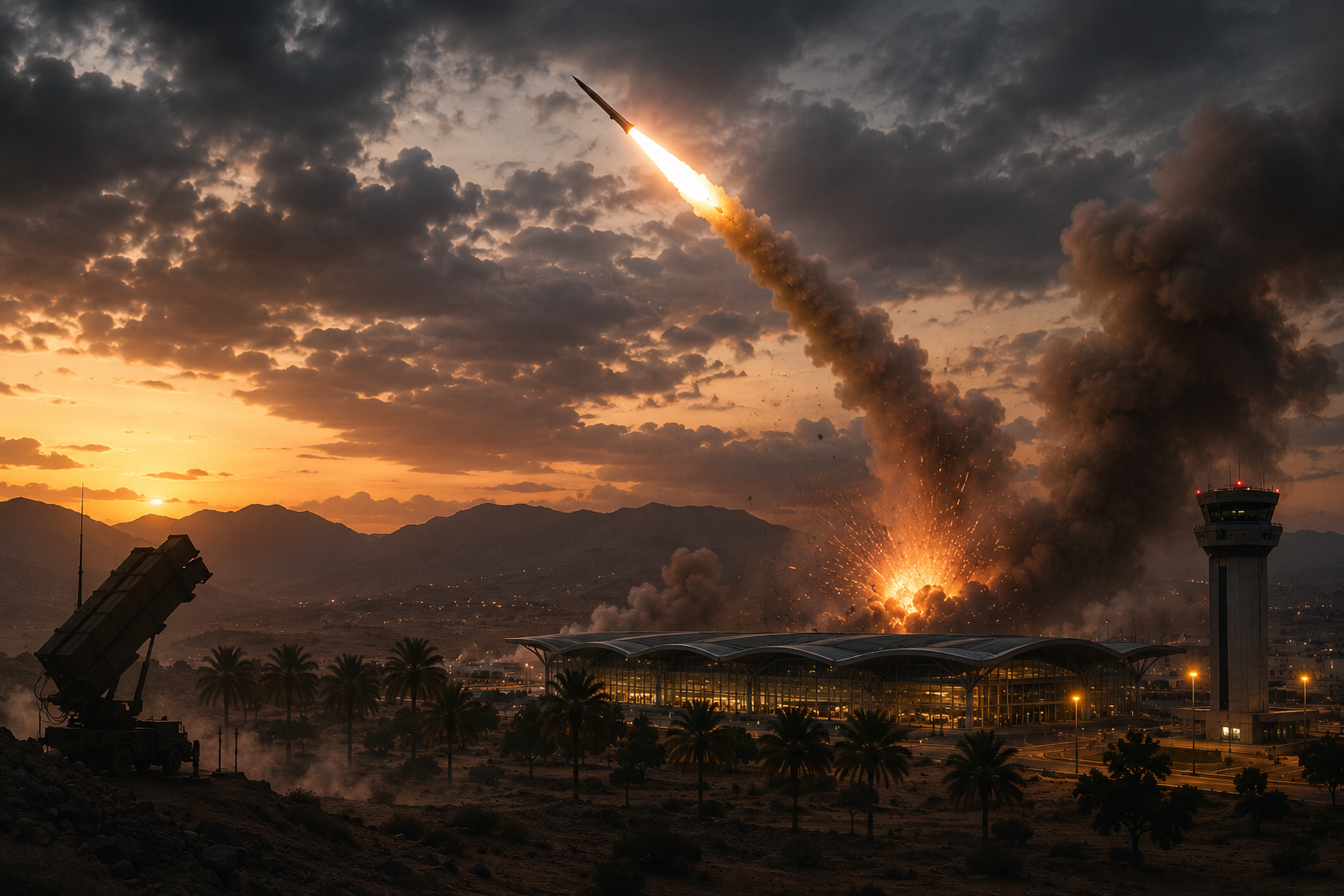
The Four-Year Calm Is Over: Missiles Rain Towards Saudi Arabia
Houthi Missiles Shatter Saudi Arabia’s Four-Year Calm — And Threaten To Reignite Yemen’s Forgotten War
The attack on Saudi Arabia’s Abha International Airport marks far more than another exchange of fire. It risks destroying an unofficial truce, reopening one of the Middle East’s most destructive conflicts and extending the confrontation between Iran and the United States across the Arabian Peninsula.
For almost four years, Saudi Arabia and Yemen’s Houthi movement had avoided returning to the devastating cross-border warfare that once sent ballistic missiles and explosive drones towards Saudi cities, airports and oil installations.
That uneasy calm has now been broken.
On 13 July 2026, the Iran-aligned Houthis launched ballistic missiles and drones towards Abha International Airport in southern Saudi Arabia. Saudi air defences reportedly intercepted the incoming missiles, and no deaths or injuries were initially reported. The Houthis described the operation as retaliation for an attack on Sana’a International Airport, which remains under their control.
The incident represents the most serious direct military confrontation between Saudi Arabia and the Houthis since the United Nations-brokered truce of April 2022 dramatically reduced cross-border attacks.
It also comes at an extraordinarily dangerous moment. Iran and the United States are already engaged in escalating hostilities, tanker traffic through the Strait of Hormuz has fallen, missiles have struck commercial vessels and Gulf financial markets are under pressure. A renewed Saudi-Houthi war could connect the conflict in Yemen, the Red Sea shipping crisis and the confrontation surrounding Iran into one widening regional struggle.
What Happened?
The confrontation began with a dispute over Iranian flights into Houthi-controlled Yemen.
An Iranian aircraft was reportedly attempting to land at Sana’a International Airport carrying a Houthi delegation returning from the funeral of Iran’s late supreme leader. Yemen’s internationally recognised government said the flight had not received the necessary authorisation and accused Iran of violating Yemeni sovereignty.
Forces aligned with the Saudi-backed Yemeni government subsequently attacked the airport runway to prevent the aircraft from landing. The plane was forced to divert to Hodeidah, another city controlled by the Houthis.
The Houthis blamed Saudi Arabia for the airport strike.
Their military spokesman, Yahya Saree, declared that the attack marked the end of the “de-escalation phase” and warned airlines against using Saudi airspace. The movement then launched missiles and drones towards Abha, a major city close to the Yemeni border.
Saudi Arabia said its defences intercepted missiles heading towards the kingdom’s southern region.
Although the immediate attack caused no reported casualties, its political meaning is difficult to overstate. The missiles were not merely intended to damage an airport. They were a deliberate announcement that Saudi territory was once again a legitimate Houthi target.
The History Behind The Conflict
The Houthis, formally known as Ansar Allah, emerged from Yemen’s northern Saada region. The movement developed from a revivalist political and religious organisation representing sections of Yemen’s Zaidi Shia population.
After years of conflict with Yemen’s central government, Houthi forces captured the capital, Sana’a, in 2014. Yemen’s internationally recognised president fled, and the country descended into civil war.
In March 2015, Saudi Arabia assembled a military coalition and intervened in support of the displaced Yemeni government. Riyadh feared that an Iranian-aligned armed movement was establishing control over a neighbouring country along Saudi Arabia’s southern border.
The conflict quickly became one of the world’s worst humanitarian crises.
Saudi-led aircraft conducted thousands of strikes across Yemen, while Houthi forces launched missiles and drones into Saudi territory. Riyadh, Jeddah, Najran, Jizan and Abha were repeatedly threatened. Saudi airports, military sites, oil installations and civilian infrastructure were targeted.
In September 2019, attacks on the Abqaiq and Khurais oil facilities temporarily disrupted a substantial portion of Saudi oil production. The Houthis claimed responsibility, although the United States and Saudi Arabia attributed the operation more directly to Iran.
During 2020 and 2021, the Houthis continued launching drones and missiles towards Saudi airports, Aramco facilities and population centres. A 2021 missile strike in Saudi Arabia’s Eastern Province injured children and damaged homes, while attacks also targeted installations in Jizan and Riyadh.
Saudi Arabia responded with airstrikes against missile sites, weapons depots, drone facilities and Houthi leadership targets inside Yemen.
Neither side achieved a decisive victory.
How The Four-Year Calm Developed
A United Nations-brokered truce began in April 2022.
Although the formal agreement expired six months later, large-scale fighting did not immediately resume. Cross-border missile attacks on Saudi Arabia largely stopped, Saudi airstrikes declined and direct negotiations gradually developed between Riyadh and the Houthis.
The diplomatic environment also changed.
Saudi Arabia increasingly sought an exit from the Yemen conflict. The war was expensive, militarily inconclusive and damaging to the kingdom’s international reputation. Crown Prince Mohammed bin Salman was simultaneously trying to attract investment, expand tourism and deliver the vast development projects associated with Saudi Vision 2030.
Persistent missile attacks were incompatible with presenting Saudi Arabia as a secure global commercial and tourism centre.
Iran and Saudi Arabia restored diplomatic relations through a China-mediated agreement in 2023. That reduced some immediate tensions and encouraged hopes that Tehran might support, or at least tolerate, a settlement in Yemen.
Fighting inside Yemen continued at a lower level, and no comprehensive peace agreement was reached. However, Saudi Arabia and the Houthis avoided returning to sustained direct warfare. The Council on Foreign Relations described fighting between the Houthis and Saudi coalition as having largely subsided, even while the Houthis continued attacking Red Sea shipping.
The calm was therefore real but fragile.
It was not peace. It was an undeclared understanding in which Saudi Arabia reduced military pressure while the Houthis largely stopped striking the kingdom.
Why The Houthis Attacked Now
The immediate explanation is retaliation for the damage to Sana’a airport.
However, the deeper reasons concern sovereignty, deterrence, Iranian influence and the Houthis’ desire to demonstrate that they cannot be controlled by Saudi pressure.
Defending Control Of Sana’a
The Houthis govern most of Yemen’s densely populated north-west, including the capital. Control of Sana’a airport is politically and strategically important.
Preventing an Iranian aircraft from landing challenged the Houthis’ claim that they exercise sovereign authority over the territory they hold. By striking Saudi Arabia, the movement attempted to impose a cost for interference with flights into its capital.
Protecting The Iranian Connection
Iran is the Houthis’ most important external partner.
Tehran has provided political backing, military knowledge and weapons-related support. Western and Gulf governments have repeatedly accused Iran of helping the Houthis develop increasingly sophisticated missile and drone capabilities.
Direct flights between Iran and Houthi-controlled Yemen would strengthen that relationship symbolically and potentially logistically.
Yemen’s internationally recognised government argues that unauthorised Iranian flights could carry personnel, military technology or equipment. Iranian and Houthi officials present them as legitimate civilian and diplomatic connections.
The attack on the airport transformed that dispute into a military confrontation.
Restoring Deterrence
The Houthis have built their regional reputation on retaliation.
When attacked, they frequently respond by demonstrating that they can threaten airports, energy facilities, shipping lanes or cities far beyond Yemen.
Failing to retaliate for the Sana’a runway strike could have been interpreted by their supporters and opponents as weakness. Targeting Abha allowed the Houthis to send a direct message without immediately striking Riyadh or a major oil installation.
It was a calibrated escalation — dangerous enough to demonstrate capability, but initially limited enough to leave space for de-escalation.
Exploiting Wider Regional Conflict
The attack also occurred during an expanding confrontation involving Iran and the United States.
That timing matters.
The Houthis have previously coordinated their political and military posture with the wider Iranian-led “axis of resistance”, while retaining significant independence over their own decisions. During the Gaza conflict, they attacked vessels in and around the Red Sea, claiming to act in support of Palestinians.
By reopening the Saudi front while Iran is under pressure, the Houthis can force Washington and Riyadh to divide their attention across several theatres.
Iran does not necessarily need to order every Houthi operation directly to benefit from it. The existence of an allied movement capable of threatening southern Saudi Arabia and the Bab al-Mandab Strait gives Tehran additional strategic leverage.
Why The Attack Is So Significant
The immediate military damage appears limited. The strategic damage could be considerable.
The Informal Truce Has Been Breached
The four-year period of relative calm rested on restraint rather than a signed, comprehensive settlement.
That restraint has now been violated.
Once missiles have again been launched towards Saudi territory, the threshold for further attacks becomes lower. Saudi retaliation could then provoke another Houthi response, creating an escalation cycle similar to those seen before 2022.
Saudi Arabia’s Security Strategy Has Been Challenged
Saudi leaders spent years trying to reduce regional tensions.
Riyadh restored relations with Iran, pursued negotiations with the Houthis and concentrated on economic transformation rather than permanent warfare.
The missile attack raises an uncomfortable question: did de-escalation actually restrain the Houthis, or did it provide them with time to strengthen their military position?
Critics of the Saudi approach may argue that concessions failed to produce a durable settlement. Supporters will counter that four years of reduced violence were valuable and that renewed diplomacy remains preferable to another costly war.
Abha Airport Is A Symbolic Target
Abha lies in Saudi Arabia’s south-west, relatively close to Yemen. Its airport was repeatedly attacked during the earlier phase of the conflict.
Targeting it again revives memories of a period when civilian aviation across southern Saudi Arabia faced persistent disruption.
The Houthis’ warning to airlines is designed to increase the psychological and economic impact of the operation. Even intercepted missiles can force flight diversions, raise insurance costs and damage perceptions of security.
Yemen’s Peace Process Is In Jeopardy
Years of negotiations have failed to produce a permanent political settlement.
The collapse of planned prisoner exchanges, arguments over airport access and growing threats from both sides suggest that confidence was already deteriorating before the latest attack. Reuters reported that a planned prisoner exchange had fallen apart as tensions intensified.
Renewed cross-border warfare could push negotiations back by years.
The Risk Of A Saudi Military Response
Saudi Arabia now faces a difficult decision.
Failing to respond forcefully could encourage the Houthis to conclude that they can strike Saudi territory without meaningful consequences.
Responding too aggressively could reopen the entire war.
Saudi and coalition officials had already warned earlier in July that future threats to the kingdom would be met with “unprecedented” force. Those warnings followed earlier Houthi threats concerning Iranian flights into Sana’a.
Possible Saudi responses include additional attacks on Sana’a airport, strikes against Houthi missile launch sites, weapons depots, command centres or air-defence infrastructure.
Saudi Arabia could also increase support for Yemeni government forces attempting to place military pressure on Houthi-controlled territory.
However, a major ground campaign would be extremely risky. Saudi-backed forces remain divided, Yemen’s political landscape is fragmented and the Houthis have had years to fortify their positions.
A limited retaliatory strike is therefore more likely than an immediate return to a full-scale invasion. Yet limited operations do not always remain limited.
Iran’s Role
Iran will be central to how the confrontation develops.
Saudi Arabia has long viewed the Houthis as part of Iran’s regional network. The Houthis reject suggestions that they are merely an Iranian proxy and point to their movement’s local Yemeni origins.
Both descriptions contain part of the truth.
The Houthis have their own ideology, leadership, domestic interests and political ambitions. They are not simply controlled from Tehran. Yet Iranian assistance has greatly enhanced their ability to manufacture, modify and deploy long-range missiles and drones.
The dispute over Iranian flights has therefore become a test of whether Saudi Arabia can prevent Tehran from expanding its access to Houthi-controlled Yemen.
The Houthis’ response suggests that any attempt to restrict that connection may now trigger attacks on Saudi territory.
The Threat To Global Shipping
Renewed fighting could quickly extend beyond Saudi Arabia.
The Houthis control territory overlooking the Red Sea and the Bab al-Mandab Strait, one of the world’s most important maritime passages. Ships travelling between Europe and Asia use the route to reach the Suez Canal.
Since 2023, Houthi attacks have forced many vessels to avoid the Red Sea and sail around southern Africa, increasing journey times, fuel costs and insurance premiums.
If the Saudi-Houthi conflict resumes, commercial vessels linked to Saudi Arabia, the United States or their allies could face additional danger.
The latest escalation also coincides with instability around the Strait of Hormuz. That creates the possibility of simultaneous disruption at two of the world’s most important energy and trading chokepoints: Hormuz in the east and Bab al-Mandab in the west.
Such a scenario would place enormous pressure on global shipping, oil markets and supply chains.
The Implications For Oil Markets
Saudi Arabia remains one of the world’s largest oil exporters.
Previous Houthi attacks demonstrated that relatively inexpensive drones and missiles could threaten highly valuable energy infrastructure. Even when attacks cause limited physical damage, the possibility of disruption can raise oil prices.
Brent crude rose as Gulf tensions intensified, while Saudi and other regional stock markets came under pressure. Reuters reported Brent trading above $85 a barrel amid wider US-Iran hostilities, attacks on tankers and the renewed Houthi threat.
An attack on a major Saudi processing facility, export terminal or pipeline would produce a far more severe market reaction than the Abha operation.
Saudi air defences have improved, but no system can guarantee the interception of every missile or low-flying drone.
What It Means For The United States
Washington is unlikely to treat the attack as an isolated Yemeni dispute.
The United States regards Saudi security, Gulf energy exports and freedom of navigation through regional waterways as major strategic interests.
Reports indicate that President Donald Trump had backed a tougher Saudi posture towards the Houthis before the latest exchange, after Riyadh raised concerns about increasing Iranian activity and Houthi threats.
If attacks continue, Washington could provide intelligence, air-defence support, weapons or direct military assistance.
However, greater American involvement would reinforce the Houthi argument that the conflict forms part of a wider US-led campaign against Iran and its allies.
That could encourage attacks against American ships, bases or regional partners.
What It Means For Israel
Israel has already faced missile and drone attacks from Yemen.
A renewed Saudi-Houthi conflict could either distract the Houthis from Israel or encourage them to expand operations across several fronts.
The second outcome is more dangerous.
The Houthis may portray attacks on Saudi Arabia, Israel and Western-linked shipping as components of one campaign against a regional coalition aligned with Washington.
That would make it increasingly difficult to separate the Yemen war from the broader conflict involving Iran, Israel and the United States.
What Happens Next?
Several scenarios remain possible.
The least damaging outcome would involve mediation by Oman, the United Nations or another regional power. Saudi Arabia and the Houthis could privately agree to halt further attacks, restore airport arrangements and return to negotiations.
A more dangerous outcome would involve limited Saudi retaliatory strikes followed by another Houthi missile barrage.
The worst-case scenario would see sustained Saudi air operations, Houthi attacks on oil infrastructure, renewed Red Sea shipping assaults and a major ground offensive inside Yemen.
For now, both sides still have reasons to avoid total war.
Saudi Arabia wants economic stability and has little desire to return to an open-ended military intervention. The Houthis risk facing Saudi, Yemeni and potentially American attacks at a time when their Iranian ally is already confronting intense regional pressure.
But deterrence can fail when each side believes escalation will force the other to retreat.
A Warning Shot Across The Gulf
The missiles launched towards Abha did not merely end a quiet period along the Saudi-Yemeni border.
They exposed how little of the underlying conflict had been resolved.
The Houthis still control Sana’a. Yemen remains divided. Saudi Arabia still views Iranian influence on its southern frontier as a major security threat. Iran continues to regard the Houthis as a valuable regional partner. No permanent peace agreement exists.
For four years, these unresolved realities were contained by an informal understanding.
That understanding has now been punctured by missiles.
Whether the attack becomes a brief eruption or the opening act of another Saudi-Houthi war will depend on the decisions taken in Riyadh, Sana’a, Tehran and Washington over the coming days.
The region is already dangerously close to a wider conflict. Reigniting Yemen’s war could remove one of the last remaining barriers preventing separate Middle Eastern crises from merging into a single, far more destructive confrontation.
