The Day Hormuz Changed: Iranian Missile Attack On Oil Tankers Leaves Crew Member Dead
Missiles Over Hormuz: The Attack That Could Ignite A Much Bigger War
Iran’s Deadly Hormuz Tanker Strike Pushes The Gulf Towards A Dangerous New Phase
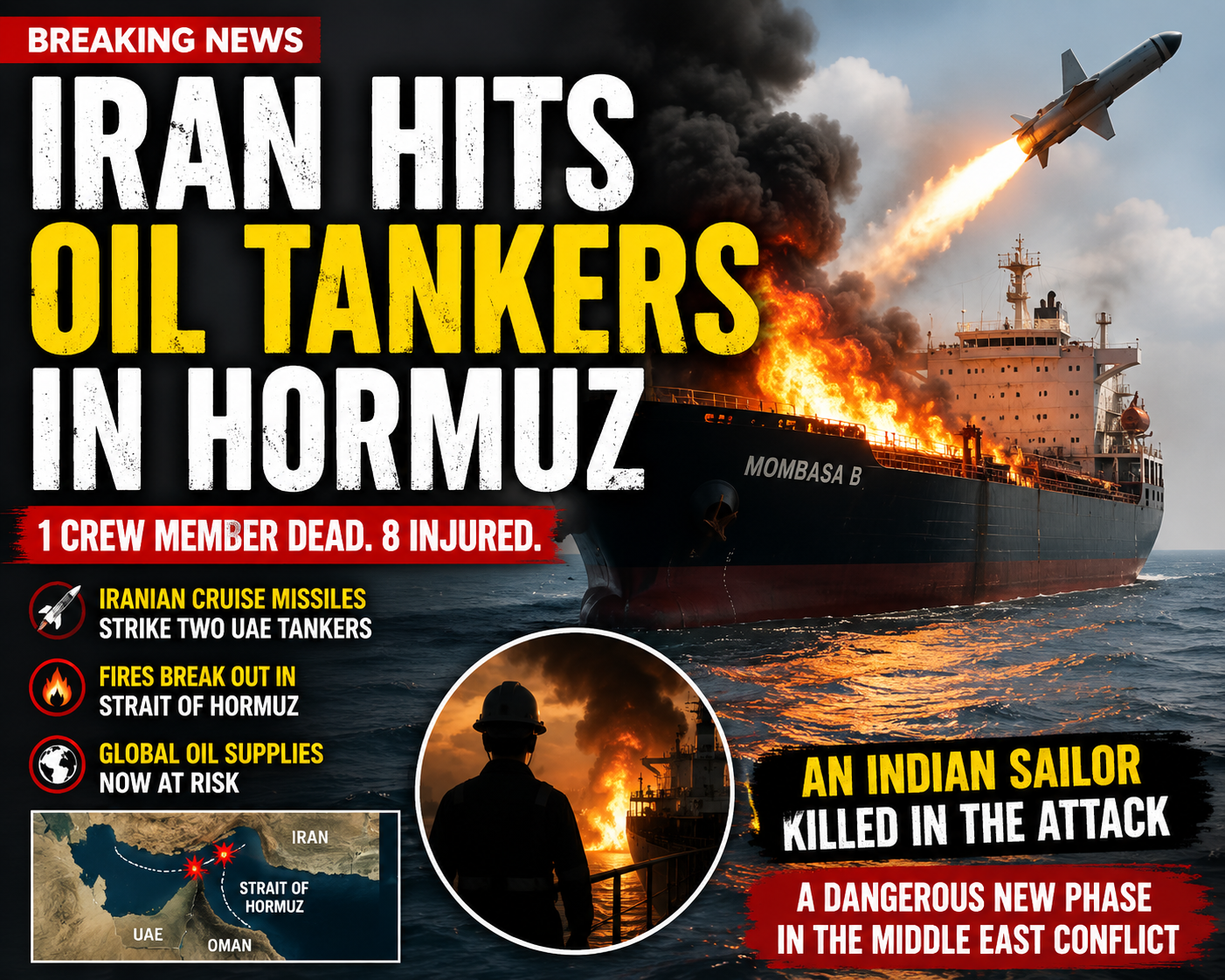
Iranian cruise missiles have struck two oil tankers in the Strait of Hormuz, killing an Indian seafarer and injuring eight others. The attack has transformed a battle over shipping routes into a direct assault on civilian crews — raising pressure for retaliation and threatening another severe disruption to global energy supplies.Commercial Tankers Become Targets In The Strait Of Hormuz
Two Emirati oil tankers have been seriously damaged after being struck by Iranian cruise missiles while travelling through the Strait of Hormuz.
The vessels have been identified as the Mombasa B and the Al Bahyah, both very large crude carriers operated by ADNOC Logistics and Services, the shipping division of the Abu Dhabi National Oil Company.
According to the United Arab Emirates Ministry of Defence, the missiles hit the tankers while they were using the southern shipping passage through the strait, inside Omani territorial waters.
Fires broke out aboard both ships following the explosions. Emergency crews eventually brought the fires under control, but ADNOC L&S said the vessels had sustained “significant damage”.
One crew member was killed and eight others were injured, four of them seriously. The casualty figures may still be revised as authorities assess the condition of those taken for treatment.
The attack represents a significant escalation because the targets were not Iranian, American or Israeli warships. They were commercial tankers carrying civilian crews through one of the world’s most important international shipping routes.
What Is Known About The Victim?
The sailor killed in the missile strike was an Indian national, not an American.
The Indian Embassy in Abu Dhabi has confirmed the death and said it was working with local authorities to support the injured crew members and the victim’s family. India has also reportedly summoned a senior Iranian diplomatic representative to lodge a formal protest over the attack.
The victim’s name, age and home region had not been publicly confirmed at the time of publication. This may reflect efforts to notify relatives before further personal details are released.
Six of the injured crew members were also reported to be Indian nationals, while two were Ukrainian. Publicly available reports have differed slightly over the total number and nationalities of those injured, although the UAE’s confirmed headline figure remains eight wounded.
The Indian seafarer appears to have been aboard one of the two tankers when the missile struck and ignited a fire. Authorities have not yet disclosed precisely where on the vessel the fatal impact occurred or whether the sailor died immediately.
Iran Claims Responsibility
Iran’s Islamic Revolutionary Guard Corps has claimed responsibility for targeting the tankers.
The IRGC alleged that the vessels had ignored warnings and were attempting to use what Tehran described as an unauthorised or “mined” route through the strait. Iranian officials have objected to ships using the southern passage near Oman under American guidance rather than following a route closer to the Iranian coastline.
Tehran has increasingly attempted to regulate or control shipping movements through Hormuz, including demands that vessels register with an Iranian-backed maritime authority.
The United States has rejected Iran’s claim to determine which commercial vessels may use the international waterway. Washington has instead supported a southern passage that keeps ships farther from the Iranian coast.
That disagreement has now become lethal.
By firing cruise missiles at the tankers, Iran appears to be demonstrating that it is prepared to enforce its preferred shipping arrangement through military force. The decision also sends a warning to Gulf governments and international shipping companies that cooperation with American naval protection could expose their vessels to attack.
Why The Strait Of Hormuz Matters
The Strait of Hormuz is the narrow entrance connecting the Persian Gulf with the Gulf of Oman and the wider Arabian Sea.
Oil and gas exports from Saudi Arabia, Iraq, Kuwait, Qatar, Bahrain and the UAE normally pass through the waterway. Iran also relies upon the strait for much of its own maritime trade.
Figures from the US Energy Information Administration show that flows through Hormuz have accounted for approximately one-fifth of global oil and petroleum-product consumption and more than one-quarter of worldwide seaborne oil trade.
Around one-fifth of internationally traded liquefied natural gas also passes through the strait, much of it exported from Qatar.
There are pipelines capable of bypassing Hormuz, particularly in Saudi Arabia and the UAE, but they cannot replace the strait’s total capacity. A sustained reduction in tanker traffic would therefore remove millions of barrels of oil from the accessible international market.
Even when oil continues to move, each attack raises insurance premiums, crew costs and shipping charges. Tanker operators may refuse assignments, vessels may turn back, and insurers may exclude war-related losses unless shipowners pay exceptionally high additional premiums.
Several oil and liquefied-natural-gas tankers have already reversed course or delayed journeys as security deteriorated.
The Attack Deepens The US-Iran Confrontation
The tanker strikes occurred amid renewed American military operations against Iran and Iranian attacks across the Gulf.
President Donald Trump has announced the reinstatement of a maritime blockade covering Iranian ports. US authorities have warned that vessels attempting to enter or leave designated Iranian areas without authorisation could be intercepted, diverted or seized.
Washington says neutral ships travelling to non-Iranian destinations will still be permitted to move through Hormuz.
Trump has also proposed charging commercial cargo operators a fee equivalent to 20 per cent of their cargo’s value in return for American protection and safe passage.
The proposal is highly controversial. The United States has traditionally argued that Hormuz is an international waterway through which vessels possess rights of transit passage. Charging compulsory protection fees could undermine that position and allow Iran to claim that both countries are attempting to impose competing toll systems.
The tanker attack nevertheless strengthens Trump’s argument that an armed maritime-security operation is necessary. It provides visible evidence that civilian ships are being deliberately targeted and that diplomatic warnings have failed to guarantee safe navigation.
What If The Dead Crew Member Had Been American?
The victim was Indian, meaning the attack does not constitute the killing of a US citizen.
However, had an American sailor been killed, the political and military repercussions could have been considerably more immediate.
Direct American Retaliation Would Become More Likely
The death of an American national in a deliberate Iranian missile strike would create enormous pressure on the White House to retaliate directly against the military unit responsible.
Likely targets could include Iranian coastal missile batteries, launch vehicles, radar systems, naval command centres or IRGC installations involved in monitoring Hormuz.
The United States could characterise such action as self-defence or as a response intended to prevent further attacks on American citizens and international shipping.
Because Washington is already conducting strikes against Iranian military assets, an American fatality would be more likely to expand the target list and accelerate operations than initiate an entirely new conflict.
Congress Would Demand Answers
An American death would intensify scrutiny of the administration’s legal authority to continue or enlarge military operations.
Members of Congress would demand briefings on whether the ship had been travelling under American escort, whether intelligence agencies had warned of an imminent threat and whether US policy had exposed civilian crews to unnecessary danger.
Supporters of Trump would probably argue that the killing proved Iran could only be deterred through overwhelming force. Critics would be likely to claim that the blockade and competing claims of control over Hormuz had drawn civilian vessels deeper into the conflict.
US Naval Escorts Could Expand
Washington could respond by creating larger escorted convoys for commercial shipping.
That would require additional destroyers, air-defence systems, surveillance aircraft, drones, minesweepers and potentially carrier-based aircraft.
The danger is that concentrating American and Iranian forces in the narrow strait would increase the probability of miscalculation. A missile wrongly identified, a radar lock interpreted as an attack or an Iranian patrol boat approaching too closely could trigger a much wider exchange.
The Conflict Could Become Personal For Trump
The killing of an American civilian by a weapon Iran openly admitted launching would become a powerful domestic political issue.
Trump would face pressure to demonstrate that attacks on Americans carry an intolerable price. A restrained response might be portrayed as weakness, while a major retaliatory strike could expose US bases, allies and shipping to further Iranian missiles and drones.
The critical question would no longer be whether Washington responded, but how far the response went.
India Now Faces Its Own Strategic Decision
Although the victim was not American, the death places India in a difficult position.
India maintains important relations with both the Gulf Arab states and Iran. It also depends heavily on imported energy and has millions of citizens living or working across the Gulf region.
New Delhi is therefore likely to condemn the killing and demand accountability while avoiding direct military involvement.
India may also press Iran to guarantee the safety of Indian seafarers, seek compensation for the victim’s family and demand clearer protections for commercial shipping.
However, repeated Iranian attacks killing Indian nationals could gradually force India towards closer maritime-security cooperation with the United States, the UAE and other Gulf partners.
That would be strategically damaging for Tehran. India has historically tried to preserve an independent relationship with Iran, including cooperation involving trade, regional connectivity and access to Central Asia.
An Attack With Global Consequences
The immediate tragedy is the death of an Indian sailor who was performing a civilian job aboard a commercial ship.
The wider danger is that the attack establishes a precedent in which Iran openly fires missiles at tankers that refuse to follow its preferred route through an international waterway.
Shipping companies cannot operate normally when passage depends on choosing between competing American and Iranian instructions — with the possibility that obeying one side makes a vessel a target for the other.
Each additional attack increases the probability of tanker shortages, supply disruption, rising insurance costs and higher global fuel prices.
It also raises the risk that the next fatality will involve a citizen of a country prepared to respond militarily.
The sailor killed aboard the Emirati tanker was Indian. But the missiles that struck the Mombasa B and Al Bahyah have moved every commercial crew travelling through Hormuz closer to the front line of an increasingly unpredictable war.
