France Takes Children Offline, but Age Checks May Be the Real Danger
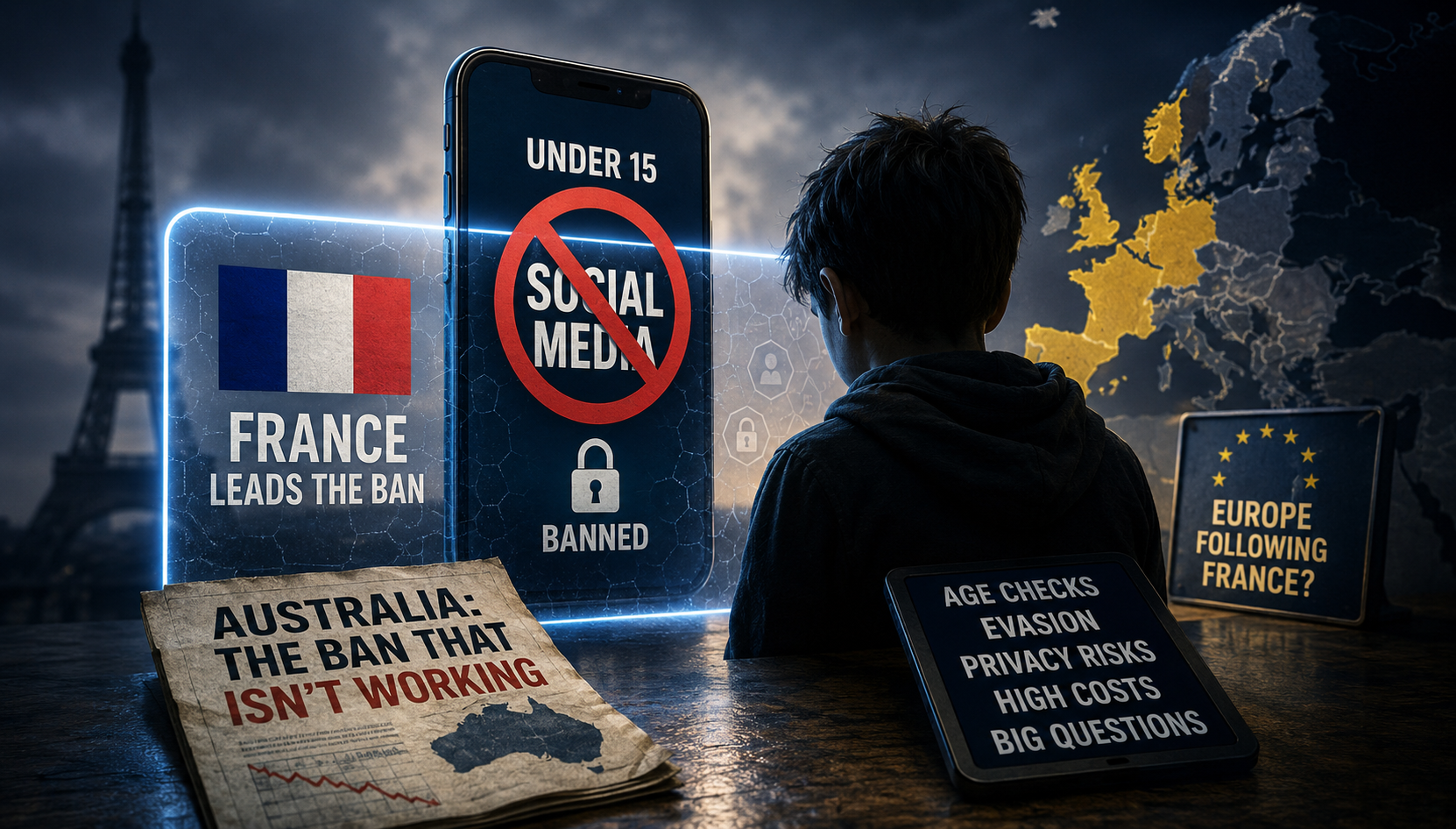
Europe Rushes to Copy France Despite Australia’s Broken Social Media Ban
France’s Social Media Ban Could Become Europe’s Next Expensive Illusion
France has become the first European country to approve a nationwide social media ban for children under 15, opening the door to one of the continent’s most intrusive digital experiments.
The measure is politically powerful and emotionally easy to sell. Social media companies have failed to protect children, parents are worried, and evidence of addictive design, bullying and harmful content continues to mount. Yet Australia’s experience suggests that passing a ban is far easier than making one work.
What France Has Actually Approved
French lawmakers approved the legislation on 21 July 2026, with implementation planned from 1 September. Children under 15 will be prevented from opening social media accounts, while platforms will have four months to identify and close existing accounts held by underage users.
The law does not rely on parents enforcing the restriction. Responsibility falls largely on technology companies, which must use age-verification systems accepted by France’s data protection regulator.
Educational services and some open-source platforms are exempt. However, the final boundaries remain less clear for services that combine messaging, entertainment, video and social networking. That matters because children can simply migrate from a prohibited platform to a similar service outside the initial regulatory definition.
The French government wants the ban operating at the beginning of the school year, but the legislation may still face constitutional scrutiny and examination by European institutions. France previously had to revise the proposal after concerns that its original platform-specific approach conflicted with the EU’s Digital Services Act.
Europe Is Already Moving in the Same Direction
France is unlikely to remain alone. Spain, Denmark and Greece have been developing or advocating tougher minimum-age restrictions, while EU governments are increasingly treating age assurance as the foundation of future child-safety rules.
The European Commission is encouraging member states to deploy a common age-verification application by the end of 2026. The system is intended to let users prove that they meet an age threshold without disclosing their identity or unnecessary personal information.
That infrastructure could make national restrictions easier to copy. Instead of every country building its own identification system, governments could connect social media access to a shared European digital framework.
The pressure on platforms is also increasing independently of France. In April, the Commission provisionally concluded that existing measures used by Facebook and Instagram were inadequate because children could enter a false date of birth without an effective check.
France may therefore be the first country to legislate a broad ban, but it is part of a much larger European shift. The central question is no longer whether governments will demand stronger age checks. It is whether those checks can prevent access without creating a continent-wide identification system for ordinary internet use.
Australia Shows How Quickly a Ban Can Unravel
Australia introduced the world’s first national under-16 social media restriction on 10 December 2025. Platforms including Facebook, Instagram, Snapchat, TikTok, X, YouTube, Reddit and Twitch were required to take reasonable steps to stop under-16s creating or retaining accounts.
The headline numbers initially looked impressive. Platforms restricted or removed access to approximately 4.7 million accounts during the first stage of enforcement, with the Australian government later reporting that the total had exceeded five million.
Account removals, however, are not the same as removing children from social media.
A 2026 study of Australian teenagers found that fewer than one-third of 14 and 15-year-olds were initially complying. Two months later, reported compliance had fallen to approximately one in 20. Teenagers considered those who followed the ban less socially popular, while many said they would only leave social media if most of their friends did the same.
Separate testing exposed an even more basic problem. Researchers created 50 accounts claiming that their users were 16. Almost none of the major platforms requested documentary proof or another strong age check, and some accounts received material apparently aimed at younger users.
Children can enter a different date of birth, borrow an adult’s credentials, create replacement accounts, use virtual private networks or migrate to excluded services. Researchers interviewing Australian children found that young users quickly learned how the controls operated and where they could be bypassed.
Australia is now proposing to double maximum corporate penalties to A$99 million and give the eSafety Commissioner stronger information-gathering powers. The escalation is effectively an admission that the original enforcement structure was not strong enough.
The Hidden Cost Has Not Been Properly Counted
France has not published a clear consolidated estimate covering regulation, enforcement, legal challenges, public communications, technical infrastructure and the handling of disputed age decisions.
The direct government cost may initially appear small because platforms will bear much of the expense of checking users. Australia allocated A$6.5 million to its age-assurance technology trial before implementation.
That is negligible beside national expenditure. France’s state and agency budgets are projected at more than €700 billion, while annual debt-interest costs alone were expected to reach €64.8 billion in 2026. Its national police budget is approximately €14.3 billion, with more than €25 billion allocated across major public-security programmes.
Even a French programme costing tens of millions of euros would therefore represent a tiny fraction of total government spending. The more serious cost would be dispersed across private companies, regulators, courts, identity providers, schools, parents and millions of adult users who may be required to prove their age.
There is also an opportunity cost. Money spent constructing sophisticated age gates could instead fund school counsellors, specialist mental-health services, digital-literacy teaching, enforcement against criminal abuse, or research into the design features that keep children compulsively engaged.
The Ban Could Create a Wider Surveillance System
A workable ban requires platforms to distinguish almost every child from almost every adult. That cannot be achieved reliably through a simple declaration of birth date.
The available options include identity documents, payment information, facial-age estimation, behavioural analysis or government-supported digital credentials. Each creates a different risk involving privacy, exclusion, inaccurate classification or the storage of sensitive information.
Age assurance may eventually become technically effective. Yet the stronger it becomes, the more intrusive it is likely to feel. A weak system will be bypassed by teenagers; a powerful system could require adults to repeatedly prove who they are before accessing lawful services.
Research examining British age-verification rules found sharp increases in interest in virtual private networks as users reacted to concerns about privacy and surveillance. That does not prove France will experience the same response, but it illustrates how access controls can redirect behaviour rather than eliminate it.
France is addressing a genuine failure. Social media platforms have enjoyed years of access to children while relying on ineffective self-declared age limits and business models designed around attention.
But Australia demonstrates the danger of judging a policy by the number of accounts deleted rather than the number of children genuinely protected. France may have become Europe’s first country to impose the ban. Unless enforcement is credible, privacy-preserving and difficult to evade, it could also become Europe’s first warning that legislation cannot simply switch off adolescence online.
