Gunfire in Moscow: Senior Russian Intelligence Officer Targeted in Brazen Hit
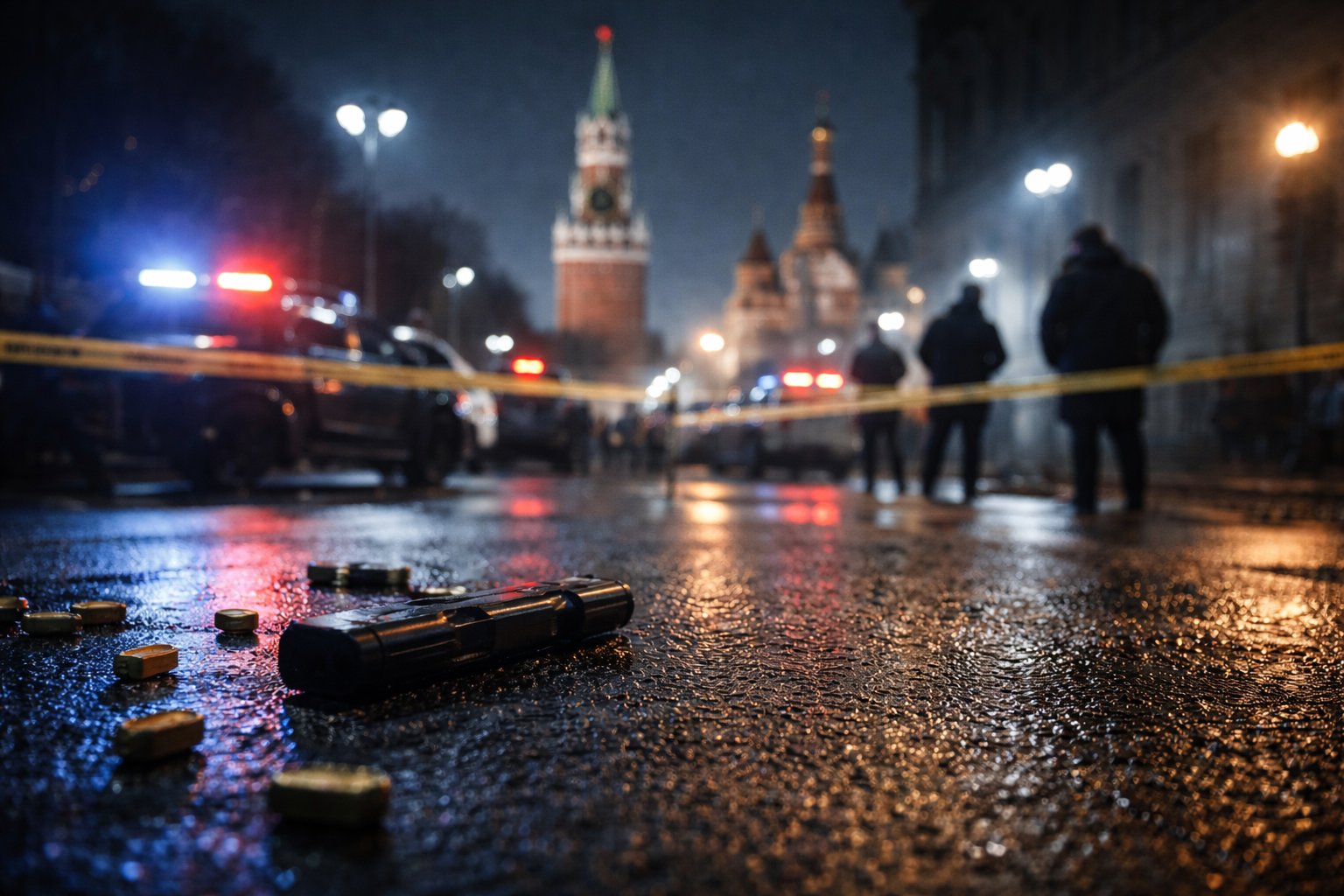
Senior Russian GRU Official Shot in Moscow: What Changes Now
Senior Russian Military Intelligence Official Shot in Moscow—and the War Just Moved Closer to the Kremlin
The attacker who shot the senior Russian military intelligence official multiple times in Moscow remains unidentified.
On its face, this is one more targeted attack in a war that has already blurred front lines. But the location and the rank change the meaning. Moscow is supposed to be the safest grid square in the Russian state.
The deeper question is what the attack does to decision-making inside Russia’s security elite—because even an unsuccessful hit can succeed strategically if it reshapes trust, movement, and command confidence.
The story turns on whether this was an external penetration, an internal settling of accounts, or a signal attack meant to force policy choices.
Key Points
A senior GRU-linked Russian officer was shot several times in northwest Moscow and hospitalized; the assailant escaped and remains unidentified as of the latest official updates.
The Kremlin’s rapid attention and security-service involvement elevate this beyond “crime” into a state-security event with political and operational consequences.
A growing pattern of targeted attacks on Russian military and security figures has been associated by Russian authorities with the Ukraine war, even when attribution is contested or unclear.
The immediate operational effect is fear and friction: tighter protection, restricted movement, and more internal checks—often at the cost of speed and initiative.
If this continues, the strategic effect is larger: paranoia inside the command system, greater reliance on coercive security measures, and more incentive to escalate in ways meant to restore deterrence.
The most important uncertainty is attribution, because each plausible culprit implies a different failure: borderless reach, insider compromise, or factional instability.
Background
Russia's military intelligence apparatus, commonly known as the GRU, operates at the forefront of Russian state power, specializing in covert action, battlefield intelligence, and influence operations. Senior figures in that ecosystem carry more than rank; they carry access, networks, and institutional memory.
Targeted violence against high-profile Russian figures since 2022 has taken different forms—explosives, ambushes, and attacks in occupied territories and, increasingly, inside Russia. Russian officials have publicly framed some incidents as operations linked to Ukraine. Ukrainian entities have claimed responsibility in some cases, while others have remained disputed or unconfirmed.
What is different here is the Moscow setting and the apparent ease of access to a protected individual. Even when a target survives, the state absorbs the message: the attacker got close enough.
Analysis
What This Attack Signals About State Capacity in Moscow
For an assassination attempt in Moscow to happen at all, at least one protective layer failed. That failure could be physical (access to a building), informational (predictable routines), or human (insider knowledge).
States like Russia are built to absorb ordinary crime. They are not built to absorb repeated demonstrations that elites are reachable. That’s why the reaction tends to be disproportionate: more checkpoints, more surveillance, more internal vetting, and more pressure on local security commanders to show “control.”
But control has a cost. Each new layer of protection slows meetings, complicates travel, and reduces the informal contact that senior systems rely on. Over time, that can degrade coordination—especially in a war where speed and improvisation already matter.
A Timeline of Similar Targeted Attacks—and the Pattern That Matters
The last four years have produced a recognizable “inside-the-war” rhythm: high-profile attacks, then a security clampdown, then renewed claims of penetration and reprisal.
A short, relevant timeline of notable incidents often discussed in this pattern includes:
August 2022: A car bomb killed Daria Dugina near Moscow, signaling early that high-profile figures linked to the war narrative could be targeted.
April 2023: The killing of pro-war blogger Vladlen Tatarsky in St. Petersburg by an explosive device, showing the tactic could hit symbolic figures in major cities.
May 2023: The car-bomb attack on Zakhar Prilepin, a prominent pro-war figure, reinforcing that targeted attacks can be sustained over time.
2024–2025: A series of attacks and deaths involving senior Russian military officers, including explosive-device incidents that Russian authorities and commentators frequently linked to wartime sabotage dynamics.
February 2026: The Moscow shooting of a senior GRU-linked official—moving the pattern closer to the center of state security, with direct implications for how top officers live and move.
The key pattern isn’t any single method. It’s the cumulative message: elite immunity is thinning.
The Plausible Attribution Spectrum—and What Each Implies
Attribution here is not just about blame. It’s about diagnosis. Different culprits imply different failures and trigger different policy responses.
1) Ukrainian intelligence or aligned networks (credible but unconfirmed in this case)
Mechanism: degrade Russian command confidence, force diversion of security resources, and demonstrate reach inside Russia.
If true, the most likely next steps are intensified counterintelligence operations, retaliatory messaging, and higher domestic security budgets.
2) Insider-enabled operation (state penetration or corruption)
Mechanism: a targeted hit often requires routine knowledge—where someone lives, how security behaves, when doors open.
If this is the driver, the “response” becomes purges, loyalty checks, and a deepening climate of suspicion inside the security apparatus.
3) Intra-elite conflict or factional reprisal
Mechanism: war systems create new money flows, new power brokers, and new grievances. Targeted violence can become a tool of internal discipline.
If such motivation is the driver, the Kremlin faces a worse problem than foreign reach: instability inside the coalition that sustains the war.
4) Criminal motive dressed as political violence (unlikely, but possible)
Mechanism: criminals exploit wartime confusion, while the state frames it as sabotage to avoid reputational damage.
If this is the driver, official narratives can diverge from the underlying reality—often increasing public cynicism and elite mistrust.
In the near term, public messaging may lean toward external blame because it is politically usable. Internally, security services will behave as if insider compromise is possible—because that is the most dangerous scenario.
What Most Coverage Misses
The hinge is that attempted assassinations can be strategically successful even when the target survives.
The mechanism is simple: once senior officers believe they can be reached at home, they change behavior—less movement, fewer meetings, narrower trust circles, and more reliance on hardened channels. That slows decisions and reduces operational creativity, which matters in a long war where adaptation wins.
Signposts to watch:
Whether Russia announces new protective protocols for senior officers, such as housing changes, movement restrictions, or expanded guards, will be a key indicator to watch.
Whether investigators or officials hint at inside assistance, even indirectly, through arrests, access details, or talk about "accomplices" is a matter to watch.
What Changes Now
The people most affected immediately are Russia’s senior military and security leadership—and the units responsible for protecting them. In the next 24–72 hours, expect visible tightening in Moscow security routines and an emphasis on demonstrating control, because the state cannot allow the perception that the capital is porous.
Over the next few weeks, the bigger question is operational tempo. If protection measures become heavy, senior coordination can slow. That matters because the Russian war machine relies on layered command structures; friction at the top can cascade into delays and cautious decision-making.
Over the next months, if attacks persist, one of two strategic shifts becomes more likely:
There could be a shift towards stricter internal security measures and increased counterintelligence efforts, as the leadership strives to regain deterrence domestically.
Alternatively, leaders may opt for symbolic escalation abroad or in Ukraine, seeking an external display of strength to counteract perceived vulnerability.
The main consequence is not optics; it’s organizational psychology—because fear changes how power is exercised.
Real-World Impact
A senior officer living in a large Moscow apartment building now requests routine changes: private entrances, restricted lift access, and guards at odd hours. Residents experience new checks, new cameras, and more friction in daily movement.
A mid-level official who used to travel freely starts declining public-facing events and moves meetings into tighter circles. That reduces informal coordination and increases the risk of parallel, competing decision lines.
A business operating near sensitive locations finds permits and access suddenly harder. Deliveries are slow. Overnight changes in local security protocols cause delays for contractors.
A family member of a security official adjusts routines—schools, commutes, predictable patterns—because home becomes the perceived vulnerability, not the office.
The Next Shockwave to Watch in Moscow
This incident is not just about one attacker and one target. It is about whether Russia’s war system is drifting into a phase where violence is used to shape behavior inside the elite itself.
If the state contains it quickly, the message becomes: Moscow remains sealed; the system holds. If it doesn’t—if another senior figure is hit, or if evidence points to insider access—the message flips: the system is still powerful, but not fully in control of its own center.
Watch for the next signposts: arrest narratives, mentions of accomplices, immediate security decrees, and whether elite routines visibly change. In wars, front lines move. Sometimes they move into stairwells.
