Gunfire Inside The Philippine Senate
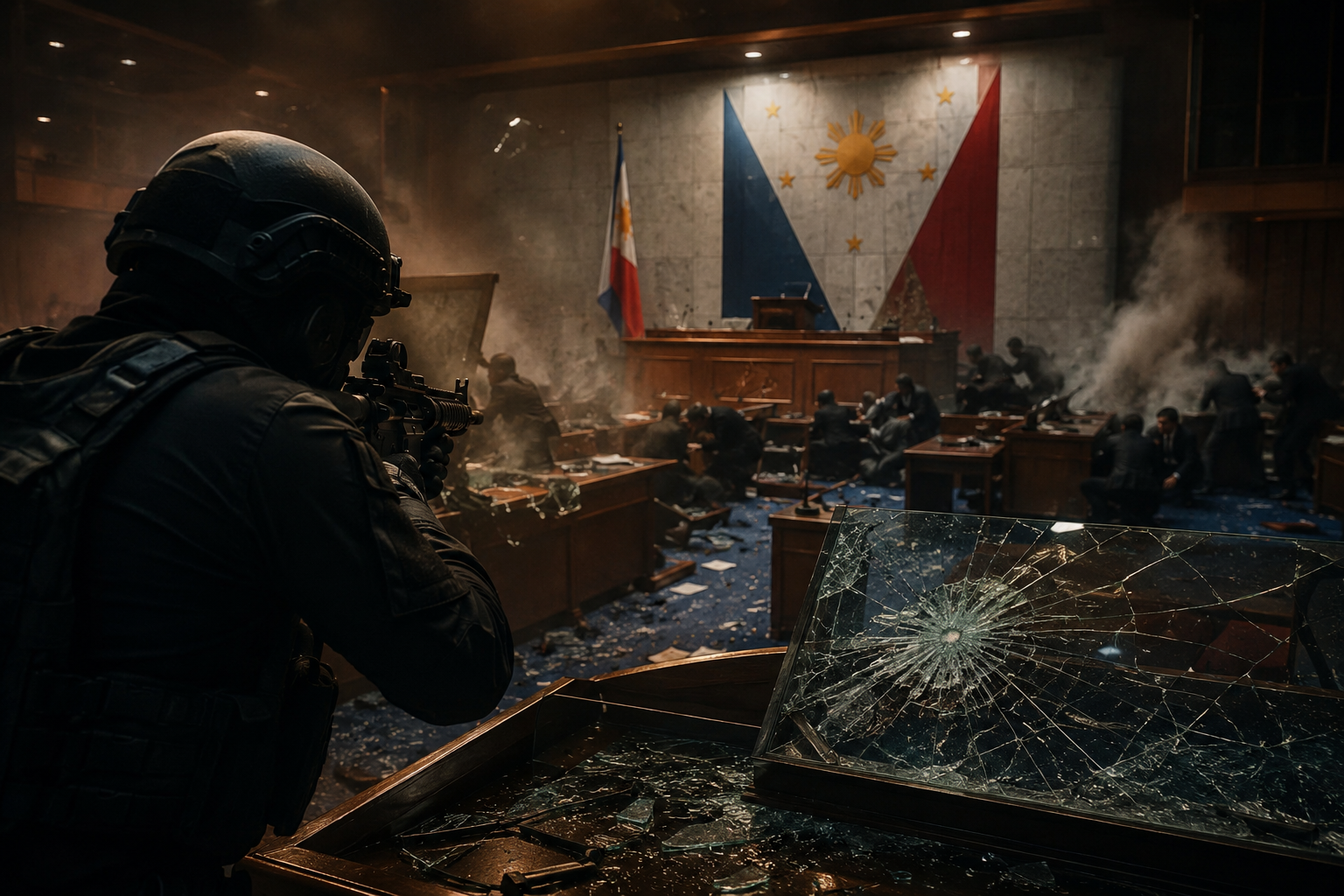
Chaos In Manila: The Philippine Senate Gunfire Incident Nobody Can Fully Explain
The Gunshots Heard Inside The Philippine Senate May Signal A Much Bigger Political Crisis
The sound of gunfire inside the Philippine Senate instantly transformed a political standoff into something darker, more unpredictable, and potentially far more dangerous.
What should have been a tense legal and constitutional confrontation suddenly became a scene of panic, armed movement, confusion, and unanswered questions. Witnesses described people taking cover. Security forces moved through the Senate complex carrying rifles. Officials publicly admitted they did not fully know who fired the shots.
That detail matters more than many people realize.
Because once gunfire erupts inside one of the country’s core democratic institutions — and even senior officials cannot immediately explain what happened — the story stops being just about one senator. It becomes a test of institutional control, political stability, and public trust.
At the center of the crisis is Philippine Senator Ronald dela Rosa, the former national police chief who played a central role in Rodrigo Duterte’s brutal war on drugs. The International Criminal Court has accused him of crimes against humanity linked to thousands of killings during the anti-drug campaign.
Dela Rosa denies wrongdoing. But the legal danger around him has become impossible to ignore.
The Moment The Story Suddenly Escalated
The standoff had already been building for days.
Dela Rosa had reportedly remained inside the Senate building while fears grew that authorities could move to arrest him. Political tensions were already rising across the Philippines, particularly as divisions deepen between allies of President Ferdinand Marcos Jr. and forces aligned with the Duterte political dynasty.
Then came the gunshots.
Witnesses reported hearing more than a dozen shots inside the Senate complex. People were told to run for cover. Armed personnel were seen entering the building.
Yet almost immediately, the facts became murky.
Officials acknowledged the gunfire but struggled to explain who fired the shots or why. Interior Secretary Jonvic Remulla publicly stated that investigators did not yet know who was responsible.
That uncertainty is now driving global attention.
Because confusion during a crisis is one thing. Confusion inside the national legislature during a politically explosive ICC confrontation is something else entirely.
The Part Of The Story That Should Worry Everyone
The gunfire itself is alarming.
But the deeper pressure point is institutional ambiguity.
The Philippine Senate is not an ordinary location. It is one of the symbolic centers of state authority. When armed individuals move through such a building during a political standoff—and officials appear unsure who controls the situation in real time—it creates an image of instability that travels far beyond Manila.
The optics are devastating.
There are still no confirmed reports of deaths or injuries connected to the shooting. Authorities have also not publicly established whether the shots were warning fire, accidental discharge, hostile action, or something else entirely.
That distinction matters enormously.
But politically, the damage may already be done.
Because millions of people have now watched footage of panic inside a national institution while one of the country’s most controversial political figures called on supporters to resist his possible transfer to The Hague.
Why Ronald Dela Rosa Is Such A Volatile Figure
Ronald dela Rosa is not simply another senator facing legal trouble.
He became one of the defining faces of Duterte’s anti-drug crackdown after being appointed national police chief in 2016. The campaign produced thousands of deaths and intense international criticism. Human rights organizations have long argued the real death toll may be substantially higher than official figures.
For supporters, Dela Rosa represents toughness, loyalty, and defiance against foreign pressure.
For critics, he represents impunity and state violence.
That split helps explain why the current confrontation feels so combustible.
The ICC case is not just legal. It is emotional, ideological, and deeply political.
It also arrives during a period when the Philippines is already experiencing heightened political strain surrounding the Duterte family and broader power struggles inside the country’s leadership structure.
The Dangerous Detail Buried Inside The Confusion
One detail keeps resurfacing across eyewitness accounts and official statements: uncertainty.
Who fired the shots?
Why were armed personnel moving through the Senate?
Was this an organized operation, a panic response, a security breakdown, or something more politically charged?
Right now, there are no fully verified public answers.
And that uncertainty creates space for something extremely dangerous in modern politics: competing realities.
Supporters and critics are already interpreting events through completely different lenses. Some view the standoff as evidence of political persecution. Others see it as proof that powerful figures still believe they can resist legal accountability through institutional pressure and public mobilization.
The absence of immediate clarity only intensifies that divide.
Why This Story Suddenly Feels Bigger Than One Country
The Philippines matters strategically far beyond Southeast Asia.
It sits at the center of major geopolitical tensions involving China, the United States, maritime security, regional military positioning, and democratic stability across Asia.
That means scenes of institutional chaos inside Manila carry wider implications.
Foreign governments, investors, diplomatic observers, and regional security analysts will all be watching what happens next — not simply because of one senator, but because the crisis tests how resilient Philippine institutions really are under pressure.
The key issue now is credibility.
Can the state maintain order?
Can authorities explain what happened?
Can the legal process proceed without the appearance of political breakdown?
Those questions suddenly matter far more than the initial headlines.
The Question Hanging Over Manila Tonight
The Philippine Senate gunfire incident remains clouded by confusion.
No complete public explanation exists yet.
But one fact is already clear: the moment has become symbolic.
The images coming out of Manila are not the images of a calm political dispute being quietly processed through institutions. They are the images of a country confronting unresolved tensions around power, justice, loyalty, and state authority all at once.
That is why this story is spreading so fast.
Not because people fully understand what happened.
But because the uncertainty itself feels dangerous.
And until the Philippines can clearly explain who fired those shots, why armed personnel moved through the Senate, and how close the country came to a far more serious escalation, the political shockwaves are unlikely to fade anytime soon.
